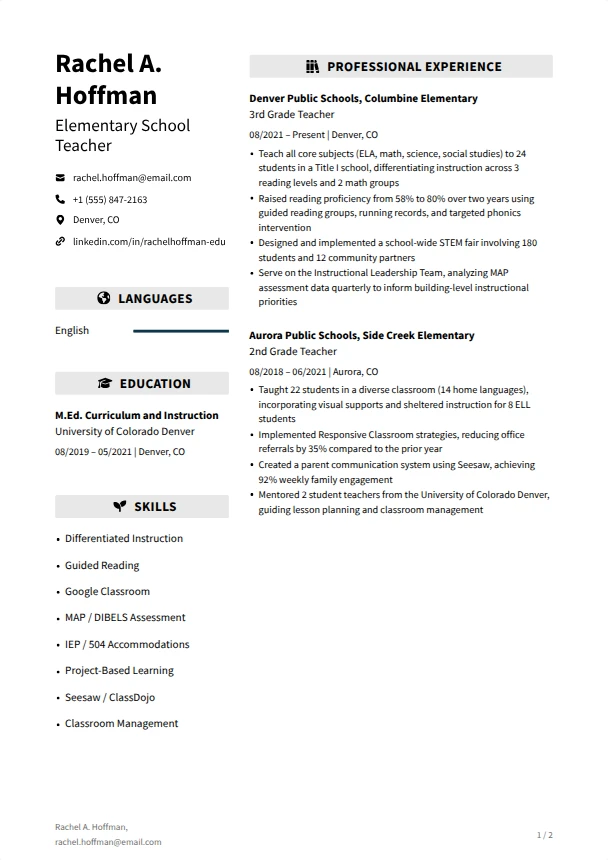
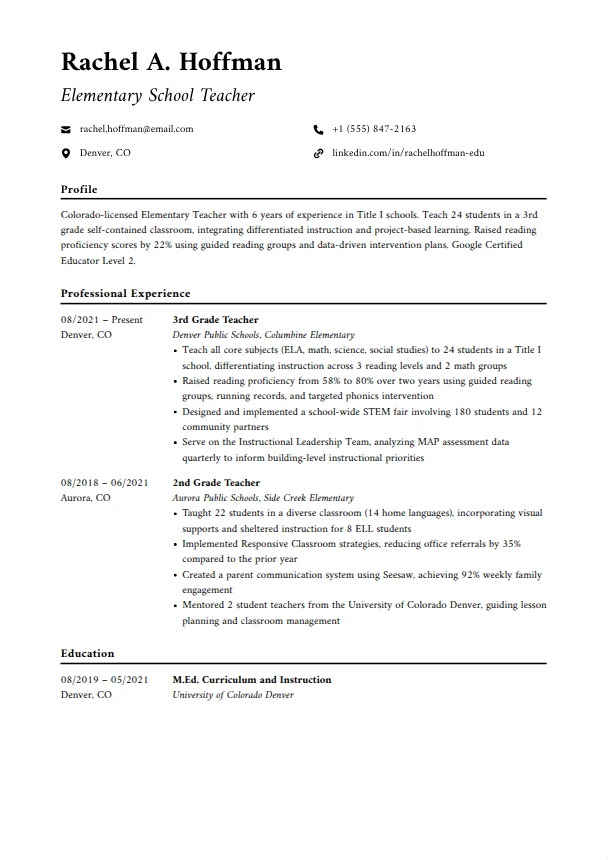
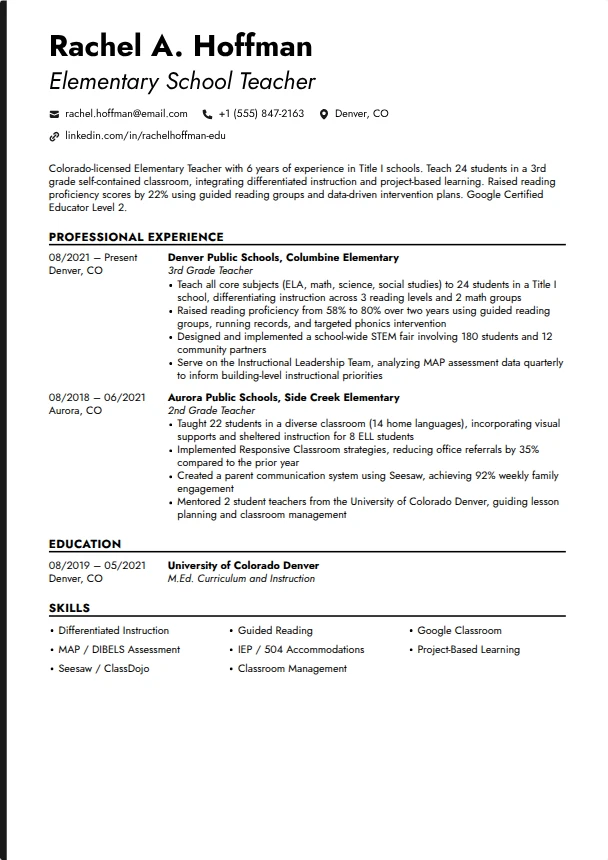
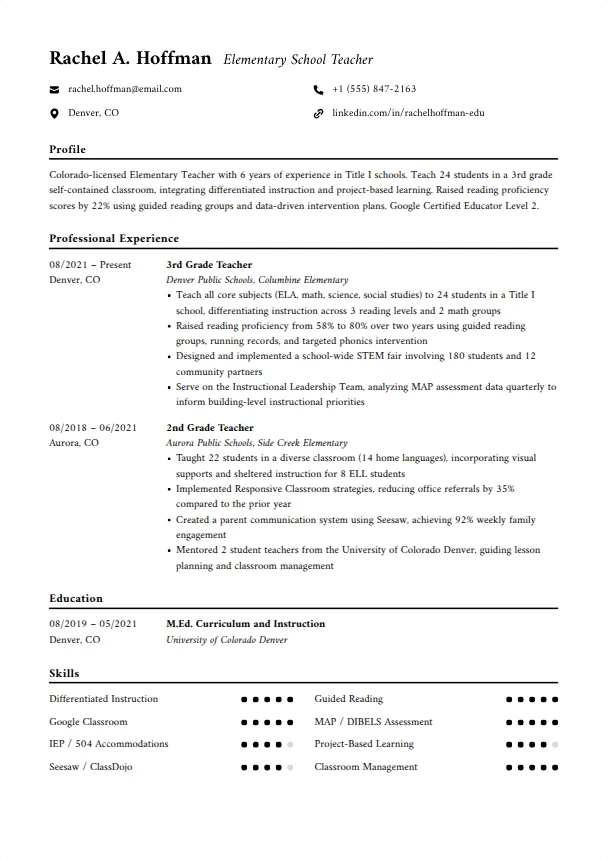
A full K-12 teacher resume example
Here is a complete, illustrative sample for a fictional elementary teacher. The names, schools, and numbers are made up to show the structure.
Maria Delgado
Licensed Elementary Teacher · Columbus, OH · [email protected] · (555) 014-2288
Licensed Elementary Teacher with 6 years in Title I schools. Raised 3rd grade reading proficiency from 58% to 80% using guided reading and data-driven instruction. Google Certified Educator Level 2.
3rd Grade Teacher, Lincoln Elementary (Title I), Columbus, OH
August 2020 to Present · Class size 26
- Raised reading proficiency from 58% to 80% across two cohorts using guided reading groups and DIBELS progress monitoring.
- Designed differentiated instruction blocks that lifted MAP math growth scores above the building average for two consecutive years.
- Implemented PBIS Tier 1 strategies and a class token economy, reducing office referrals by 45% versus the prior year.
- Built a weekly Google Classroom and parent newsletter, reaching 92% family engagement and 100% conference attendance.
- Ohio Resident Educator License, grades K-5, expires 2027
- Google Certified Educator, Level 1 and Level 2
- Passed Praxis Core and Elementary Education content assessments
Differentiated Instruction, Classroom Management, Data-Driven Instruction, IEP / 504 Accommodations, Google Classroom, MAP / DIBELS Assessment, PBIS, Parent Communication, Lesson Planning
This sample is for illustration only. Replace every detail with your own license, schools, and verified student data.
What hiring managers actually look for
Having concrete examples to reference strengthens your teacher resume. These are based on real hiring patterns.
-
1
A valid teaching license for the grade band and subject. Most public K-12 roles require a state license backed by a bachelor's degree and an approved preparation program, so list your certificate, endorsement areas, and state near the top.
-
2
Evidence that your students learned. Principals scan for growth on measures they recognize, such as MAP, DIBELS, or state assessments, expressed as before and after percentages rather than vague descriptions of effort.
-
3
Classroom management and family communication. Reducing behavior referrals through PBIS, running parent conferences, and keeping families informed signal that you can run an orderly, well supported room from day one.
If your resume communicates these things in the first 7-second scan, you'll make it to the detailed read.
For context on the market, the U.S. Bureau of Labor Statistics reports that kindergarten and elementary school teachers earned a median wage of about $62,340 per year in the May 2024 wage data, with the lower range near $46,440 and the top range around $102,010. Pay tends to climb with years of service, advanced degrees, and the specific district. Source: U.S. Bureau of Labor Statistics, Occupational Outlook Handbook, Kindergarten and Elementary School Teachers.
How to structure your resume, section by section
The order matters. Here is what a strong K-12 teacher resume looks like from top to bottom, using the same layout as the example above:
Contact Information
Name, phone, professional email, city and state, and a LinkedIn URL if you keep it current. Skip your full street address and your home district's name if you are job searching quietly.
Professional Summary
Two or three sentences that name your grade band, subject or endorsement, years of experience, and one headline result. Lead with your license status so a screener confirms eligibility in the first line.
Teaching Experience
List each role with school, grade or subject, and dates, then add 3 to 5 bullets. Note the school context (Title I, class size, caseload) so a reader understands the conditions behind your results.
Certifications
State teaching license with certificate type, endorsement areas, and expiration. Add any advanced or technology credentials here, such as National Board Certification or Google Certified Educator, and note the Praxis exams you passed. See the verified list below for the official issuing bodies.
Skills
A focused list of instructional and classroom skills plus the platforms you actually use, such as Google Classroom, Schoology, or Seesaw. Mirror the exact terms in the job posting so screening software registers a match.
Verified licenses and certifications for K-12 teachers
These credentials are real and citable. List the ones you hold, with the issuing body and year.
- State Teaching License or Certification. Required for all public K-12 teachers, with requirements that vary by state. Issued by state boards or departments of education. Source: BLS Occupational Outlook Handbook.
- National Board Certification. An advanced, voluntary credential issued by the National Board for Professional Teaching Standards (NBPTS). Source: NBPTS.
- Praxis tests (Core, Subject Assessments, Content Knowledge for Teaching). Used by many states for licensure, administered by Educational Testing Service (ETS). Source: ETS Praxis.
- Google Certified Educator (Level 1 and Level 2). A technology credential issued by Google for Education. Source: Google for Education.
Key skills to include
Skills that appear most frequently in K-12 teacher job postings:
Tip: Match your skills section to the specific job posting. If they mention PBIS, make sure PBIS is on your resume.
Summary examples you can steal
Use one as a starting point, then swap in your own technologies, numbers, and achievements.
"Licensed Elementary Teacher with 6 years in Title I schools. Raised 3rd grade reading proficiency from 58% to 80% using guided reading and data-driven instruction. Google Certified Educator Level 2."
Why it works: It confirms licensure in the first words, ties a specific reading gain to a named method, and signals Title I experience plus a verifiable technology credential.
"High school Biology teacher with 8 years of experience. AP Biology pass rate of 84%. Department head and STEM fair coordinator for 180+ students."
Why it works: It pairs a hard outcome (AP pass rate) with leadership and scale, showing both subject mastery and the capacity to take on department responsibilities.
"Special Education Teacher with 5 years in inclusive K-5 settings. Manage caseload of 18 students with IEPs. Reduced behavioral referrals by 45% using PBIS and a social skills curriculum."
Why it works: It states caseload size, names the IEP work and PBIS framework that special education hiring teams expect, and quantifies a behavioral improvement.
"Newly licensed Elementary Teacher completing student teaching in a diverse 2nd grade classroom of 22 students. Raised math assessment scores by 15% using small group differentiated instruction."
Why it works: With no full-time history, it leans on the license, the student teaching placement, and one measurable unit result to prove readiness for a first classroom.
Writing strong experience bullets
Every bullet point should answer: "What did you do, and why did it matter?" Use this formula:
Before and after examples:
Taught math to students
Taught 5th grade math to 26 students using Everyday Mathematics, raising MAP proficiency from 62% to 79% in one year
Used classroom management
Implemented PBIS Tier 1 strategies and a class-wide token economy, reducing office referrals by 45% compared to the prior year
Communicated with parents
Created a weekly parent newsletter and Seesaw classroom, achieving 92% family engagement and 100% conference attendance
Strong action verbs for teacher resumes:
Raised, Implemented, Created, Differentiated, Assessed, Collaborated, Designed, Mentored, Facilitated, Integrated
Mistakes that get teacher resumes rejected
Copying without customizing
Submitting a sample verbatim is obvious to a reader and may state grade levels or data that are not yours. Use these examples as scaffolding, then swap in your own schools, subjects, and numbers.
Weak bullet structure
Bullets that start with "Responsible for" or "Helped with" read as a job description. Open with an action verb, name what you taught or built, and close with a result a principal can picture.
Missing school context
A 45% referral drop or a 20 point gain means little without class size, grade band, or population. Add Title I status, caseload, or ELL percentage so readers can weigh the difficulty of your results.
No assessment data
Resumes that only describe activities lose to ones with growth data. If you lack test scores, use proxies such as homework completion, attendance, or conference attendance rates.
Generic skills list
"Hard working" and "team player" tell a screener nothing. Replace them with concrete terms like differentiated instruction, IEP and 504 accommodations, PBIS, and the platforms named in the posting.
What to do with no experience
Adapt these examples for student teaching and entry-level positions:
Use the same bullet format
Action verb plus task plus result works for student teaching too. Replace school names with your placement school, and name the cooperating teacher's grade band.
Scale the metrics appropriately
You may have data for a single unit or quarter rather than a full year. That is fine. Include what you have, such as a 15% gain on a unit assessment.
Lead with your license and Praxis scores
A new teacher's strongest asset is eligibility. Put your state license or pending license, endorsement areas, and passed Praxis exams at the top so a principal knows you can be hired.
Include practicum and tutoring data
Observation hours, tutoring sessions, after-school programs, and field experience all count. List them in a Relevant Experience section with the same bullet format.
Frequently asked questions
Can I use these K-12 teacher resume examples directly?
Use them as templates. Replace all specifics with your actual experience, schools, grade bands, and student data. A reader can tell when an example was copied verbatim, and the grade levels or scores may not be yours.
How many bullets should each teaching job have?
Use 3 to 5 bullets per teaching position. Each should include an action verb, what you taught or built, and a measurable outcome such as a MAP or DIBELS gain.
Where do I list my state teaching license on a resume?
List your state teaching license near the top, in the summary and in a Certifications section. Name the certificate type, your endorsement areas, the issuing state, and the expiration date so a screener can confirm eligibility quickly.
How do I format student outcome data?
Use percentages and before and after comparisons. For example, Raised reading proficiency from 58% to 80% is clear and compelling, especially when you name the assessment and the grade band.
What if I do not have test score data?
Use other metrics such as homework completion rates, attendance improvements, behavior referral reductions through PBIS, or parent engagement and conference attendance rates.
Skip the blank page
Open a complete, filled-in teacher resume in our free builder. Swap in your own details, keep the wording that fits, and download as PDF, free.
Build Your Teacher Resume Now
Use these examples as a starting point in our resume builder. ATS-friendly templates designed for educators.
Start Building, It's FreeRelated resume guides
The full step by step guide to writing a K-12 teacher resume, from summary to skills.
Build a substitute teaching resume that highlights flexibility, classroom management, and reliability.
Write an early childhood resume that highlights developmental milestones, play-based learning, and family communication.
Showcase one on one and small group instruction, subject expertise, and measurable student gains.
More resume examples: