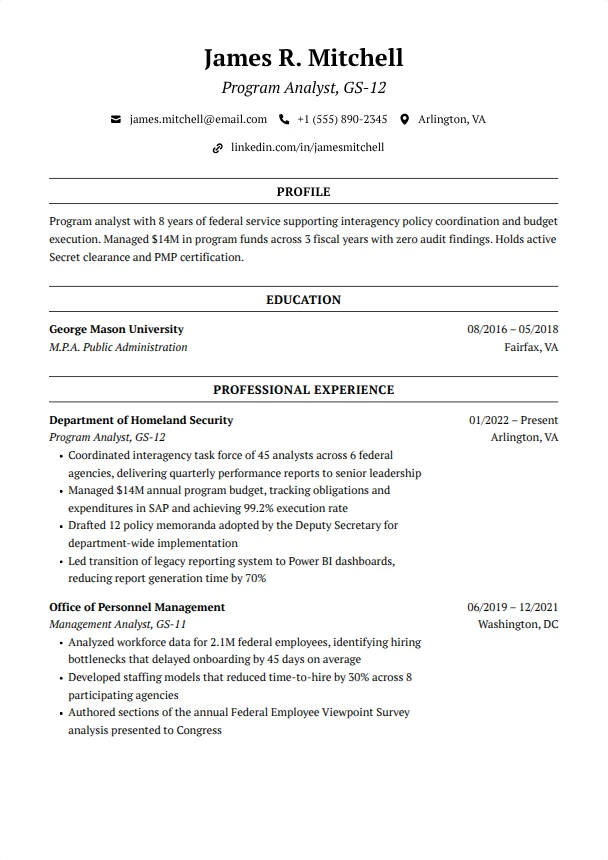
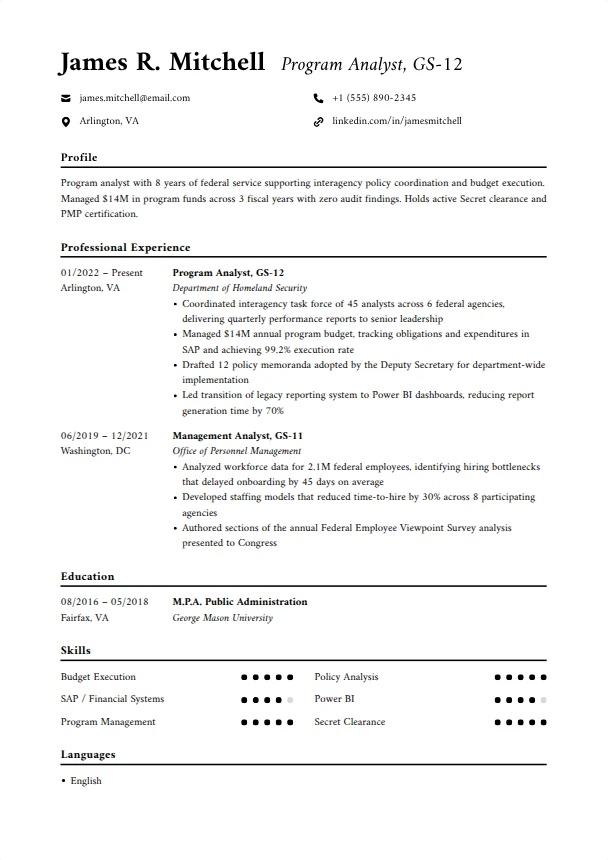
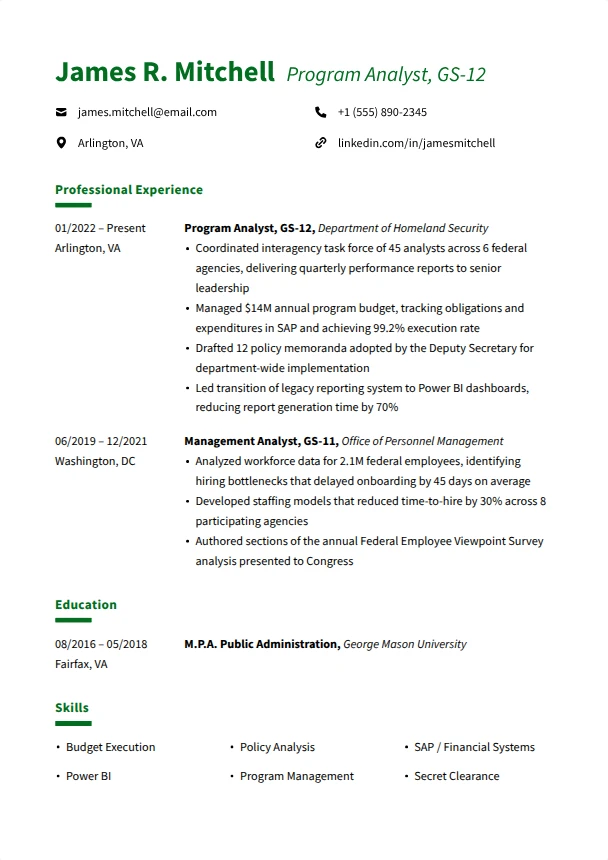
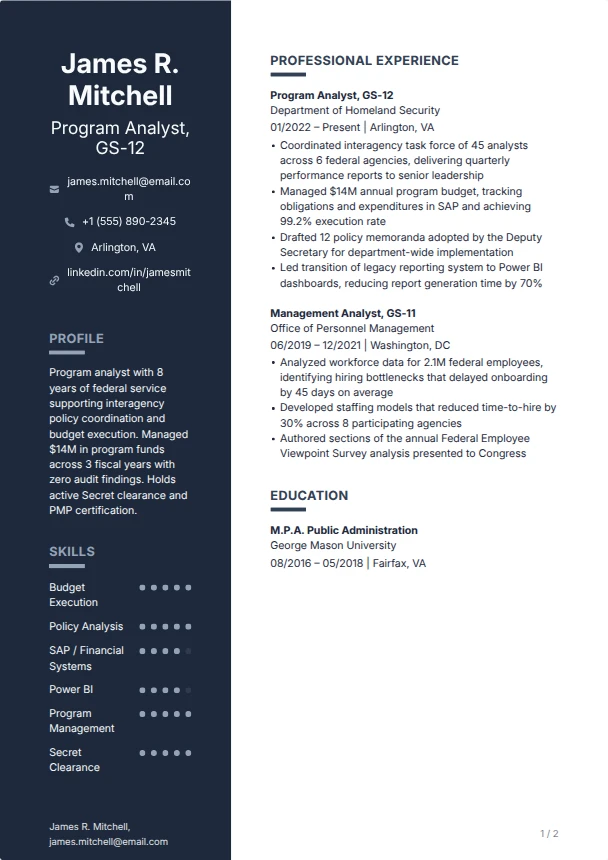
What hiring managers actually look for
Federal hiring panels evaluate resumes against a structured scoring rubric. When reviewing examples to model your own resume after, pay attention to these three elements:
-
1
CCAR format in every experience bullet. Federal panels score each bullet against four criteria: Context (the setting and scope), Challenge (the problem or objective), Action (what you specifically did), and Result (the measurable outcome). Bullets missing any of these elements score lower, even if the underlying experience is strong.
-
2
Keyword density matching the job announcement. HR specialists run your resume through both automated and manual keyword checks against the announcement's qualification requirements. If the posting says 'program evaluation,' your resume needs that exact phrase, not a synonym like 'project assessment.'
-
3
Quantified scope and impact in every role. Federal managers assess whether your experience matches the complexity level of the target grade. Numbers tell the story: budget size, team size, number of stakeholders, geographic scope, and percentage improvements. A GS-12 bullet without these details reads like a GS-7 bullet.
If your resume communicates these things in the first 7-second scan, you'll make it to the detailed read. Everything below is about making that happen.
How to structure your resume, section by section
The order matters. Here's what a strong federal resume examples looks like from top to bottom:
1. Contact information (federal format)
Full legal name, complete mailing address, phone, email, citizenship, veterans' preference, and highest GS grade held (if applicable). Federal resumes require complete addresses, not just city and state.
David Chen
2840 Lakewood Blvd, Apt 12B, Silver Spring, MD 20901
(555) 739-2104 · [email protected]
U.S. Citizen · Veterans' Preference: 5-Point · Highest Grade Held: GS-11, Step 3 (2023-Present)
2. Professional summary example
A federal summary should state your total years of relevant experience, current or most recent GS grade, core competencies, highest-impact achievement, and the target position. Here are two examples at different grade levels.
Strong: "GS-11 Management Analyst with 6 years of progressive federal experience across the Department of Veterans Affairs and Department of Labor. Specializes in program evaluation, policy analysis, and performance measurement. Led a cross-agency working group that redesigned the claims processing workflow for 3 regional offices, reducing average processing time by 22% and clearing a backlog of 4,200 cases. Targeting GS-12 Management Analyst (0343 series) positions."
3. Work experience example (CCAR format)
Every federal work experience entry needs: job title, GS grade and step, agency name, full address, start/end dates (month/year), hours per week, supervisor name and phone, and permission to contact. Then 4-8 CCAR-formatted bullets. Here is a complete entry example.
Management Analyst, GS-11 Step 3
Department of Veterans Affairs, Veterans Benefits Administration
810 Vermont Ave NW, Washington, DC 20420
March 2021 to Present · 40 hours/week
Supervisor: Maria Lopez, (555) 204-7890, may contact
• Led a 5-person working group to evaluate and redesign the disability claims processing workflow across 3 regional offices (Baltimore, Philadelphia, Newark), reducing average processing time from 145 days to 113 days (22% improvement).
• Developed performance dashboards in Tableau tracking 15 KPIs for claims processing, quality assurance, and customer satisfaction, used by 3 division directors for monthly reporting to VBA leadership.
• Drafted 12 policy memoranda and 4 program evaluation reports used by senior leadership for testimony preparation and congressional budget justification materials.
4. Skills section example
Group skills by competency area, using exact language from typical federal job announcements. Include software, methodologies, clearance status, and relevant training.
Analysis & Evaluation: Program evaluation, performance measurement, statistical analysis, cost-benefit analysis, GAO audit standards
Software: Tableau, Power BI, Advanced Excel (pivot tables, VLOOKUP, macros), SharePoint, Microsoft Teams, VA VBMS
Communication: Policy memoranda, congressional testimony support, briefing documents, stakeholder presentations
Clearance: Secret (active, granted 2021)
5. Education and certifications example
List degrees with institution, location, graduation date, and GPA. Include relevant certifications and federal-specific training programs such as FAC-COR, PMP, or Leadership Development Programs.
M.P.A. Public Administration, American University, Washington, DC
Graduated May 2020 · GPA: 3.7/4.0
B.A. Economics, University of Virginia, Charlottesville, VA
Graduated May 2018 · GPA: 3.4/4.0
Certifications: Project Management Professional (PMP, 2023) · FAC-COR Level II (2022) · Lean Six Sigma Green Belt (2021)
Key skills to include
These competencies appear most frequently across federal job announcements from GS-5 through GS-13. Select the ones that match your experience and use the exact phrasing from the target announcement wherever possible.
Tip: Copy competency names directly from the 'Qualifications' and 'How You Will Be Evaluated' sections of the USAJOBS announcement. Federal HR specialists match keywords literally, so 'program evaluation' and 'program analysis' may be scored as different competencies even though the work is similar.
Resume summary examples you can steal
Use one as a starting point, then swap in your own technologies, numbers, and achievements.
"Recent B.A. graduate in Public Administration with a 3.5 GPA and 10 months of internship experience at the Social Security Administration. Processed 80+ benefit verification requests weekly, drafted correspondence for field office supervisors, and maintained filing systems for 2,000+ case records. Eligible for the Pathways Recent Graduates Program, targeting GS-5 Program Support Assistant (0303 series) positions."
Why it works: Quantifies internship volume, specifies the target series and grade, names the hiring authority.
"Program Analyst with 3 years of federal experience at the Department of Education, managing grant monitoring portfolios totaling $45M across 28 grantee organizations. Conducted 12 on-site compliance reviews, identified $1.2M in questioned costs, and developed a risk-assessment scoring model adopted across the division. M.P.A. from Georgetown University, PMP certified."
Why it works: Dollar amounts establish scope, compliance findings demonstrate analytical depth, risk model shows initiative beyond routine duties.
"GS-12 Management Analyst with 8 years of progressive federal experience across the Department of Labor and Office of Personnel Management. Led the redesign of a performance reporting system serving 14 regional offices and 2,300 employees, reducing quarterly report preparation time by 40%. Supervised a team of 4 analysts and managed a $1.8M operating budget. Active Secret clearance, PMP and Lean Six Sigma Green Belt certified."
Why it works: Shows grade progression across agencies, quantifies team and budget responsibility, demonstrates enterprise-level process improvement.
"U.S. Marine Corps veteran (Sergeant, E-5, Honorable Discharge) with 5 years of logistics and operations management experience. Coordinated supply chain operations for a 200-person infantry battalion, managing $12M in equipment inventory with 99.2% accountability rate. Active Secret clearance, eligible for veterans' preference (5-point). Targeting GS-7 Logistics Management Specialist (2003 series) positions."
Why it works: Translates military rank and experience into federal civilian terms, includes clearance and veterans' preference, specifies target series.
Writing strong experience bullets
Every bullet point should answer: "What did you do, and why did it matter?" Use this formula:
Before and after examples:
Reviewed grant applications and made recommendations.
Evaluated 35 competitive grant applications totaling $18M for the Department of Education's Title IV program, applying a 12-criterion scoring rubric and producing written justifications for each funding recommendation presented to the division director.
Managed a team and oversaw daily operations.
Supervised a 4-person analytical team responsible for quarterly performance reporting across 14 regional offices (2,300 employees), implementing standardized templates that reduced report preparation time from 3 weeks to 9 business days.
Helped improve processes and created reports for management.
Designed and implemented a risk-assessment scoring model for grant monitoring that prioritized 28 grantee organizations by compliance risk level, enabling the division to focus 80% of audit resources on the 7 highest-risk grantees and identify $1.2M in questioned costs within the first review cycle.
Strong action verbs for federal resume examples resumes:
Administered · Analyzed · Assessed · Compiled · Coordinated · Developed · Directed · Drafted · Evaluated · Facilitated · Formulated · Implemented · Led · Managed · Monitored · Prepared · Recommended · Reviewed · Supervised · Validated
5 mistakes that get federal resume examples resumes rejected
Using a private sector resume format on USAJOBS
One-page resumes, creative formatting, and graphics will not work for federal applications. Federal resumes require 3-5 pages with month/year dates, hours per week, supervisor contacts, and detailed CCAR bullets. Submit the wrong format and your application is dead on arrival.
Copying examples without adjusting the grade level language
A GS-12 example bullet describes enterprise-level scope: multiple offices, millions in budget, cross-agency coordination. If you paste that language into a GS-7 application, the discrepancy between your claimed experience and your actual background will be obvious during the interview.
Failing to mirror the exact keywords from the announcement
If the announcement says 'program evaluation,' do not write 'project assessment.' Federal HR specialists check for specific competency language. Use the announcement's vocabulary throughout your resume, even if you would naturally phrase it differently.
Omitting the result from experience bullets
Federal scoring rubrics evaluate the outcome of your work. 'Analyzed budget data and prepared reports' describes an activity but not a result. Add what changed: who used the report, what decision it informed, or what metric improved.
Not including all required information for each work entry
Federal resumes require the organization's full address, your exact start and end dates (month/year), hours per week, salary or GS grade, supervisor name and phone number, and permission to contact. Omitting any field can result in an incomplete determination.
What to do if you have no professional experience
Even with limited experience, you can build a strong federal resume using the right examples as your foundation:
Model your bullets after GS-5 examples
GS-5 experience bullets focus on assisting, processing, and supporting rather than leading or managing. Use the examples above as templates: describe what you did in an internship, volunteer role, or academic project with the same CCAR structure and level of detail.
Expand your education section with coursework and projects
At the entry level, relevant coursework and capstone projects count as qualifying experience. Describe each project with the same detail you would use for a work entry: the objective, your role, what tools you used, and the deliverable.
Use the Pathways summary example as your template
The GS-5 summary example above follows the exact pattern federal HR wants to see from entry-level candidates: degree, GPA, internship or volunteer experience with numbers, and the target position and series. Copy that structure and replace the details with your own.
Stack multiple short experiences to demonstrate depth
A 3-month internship, a 6-month volunteer stint, and a part-time campus job can collectively demonstrate the 12 months of experience required for GS-7 if the work was relevant and you describe each entry with enough detail and hours per week.
Frequently asked questions
How long should a federal resume be?
3-5 pages is standard for most federal applications. Unlike private sector resumes, federal resumes require detailed descriptions of each position, including addresses, supervisor contact information, hours per week, and comprehensive CCAR-formatted bullets. Entry-level candidates typically produce 2-3 pages, while experienced GS-12 and above candidates often need 4-5.
Can I use the same federal resume for every USAJOBS application?
No. Every federal application should be tailored to the specific announcement. The qualifications, competencies, and keywords differ between announcements even for similar positions. At minimum, reorder your skills section and adjust your bullet points to match the language in each posting.
What is the CCAR format and why does it matter?
CCAR stands for Context, Challenge, Action, Result. Federal hiring panels use structured scoring rubrics that evaluate each element. Context describes the setting and scope, Challenge identifies the problem, Action explains what you specifically did, and Result quantifies the outcome. Bullets missing any element score lower on the evaluation.
Should I include my GS grade and step on my resume?
Yes, include your grade, step, and series number for every federal position. For private sector positions, include your salary if comfortable. This information helps HR specialists evaluate your experience level and determine whether you qualify for the target grade.
How do I format a federal resume differently from a regular resume?
Federal resumes require: full mailing addresses for each employer, exact start and end dates in month/year format, hours worked per week, supervisor name and phone number, permission to contact each supervisor, your citizenship status, veterans' preference, and highest federal grade held. No creative formatting, no graphics, no columns. Plain text with clear section headers.
Skip the blank page
Open a complete, filled-in veteran-to-civilian resume in our free builder. Swap in your own details, keep the wording that fits, and download as PDF, free.
Build your federal resume examples in minutes
Pick a template, fill in your details, and download a polished federal resume examples ready to submit.
Start Building, It's FreeRelated resume guides
Complete guide to writing a federal resume for USAJOBS with structure, formatting, and CCAR bullet examples.
Entry-level federal resume guide covering Pathways, education-based qualifications, and first-time USAJOBS applicants.
Broader government resume examples including state, local, and federal positions across multiple job families.
More resume examples: