What hiring managers actually look for
Engineering managers and technical recruiters don't read resumes top-to-bottom. They scan for three things in the first pass:
-
1
Relevant tech stack. Do your skills match what they use? If the posting says React, TypeScript, and AWS and your resume leads with jQuery and PHP, you're filtered out before a human sees it.
-
2
Measurable impact. "Reduced p99 API latency by 40%" tells a story. "Worked on backend services" tells nothing. Latency, throughput, uptime, deploy frequency, and test coverage are the numbers that make engineers stand out.
-
3
Evidence of collaboration. Software isn't built alone. Code reviews, cross-functional projects, on-call rotations, mentoring, and leading initiatives all signal you'll work well on a team.
If your resume communicates these three things in the first 7-second scan, you'll make it to the detailed read. Everything below is about making that happen.
What software engineers earn
According to the U.S. Bureau of Labor Statistics Occupational Outlook Handbook (Software Developers, QA Analysts, and Testers, SOC 15-1252), software developers earn a median of $133,080 per year. The lowest 10% earn around $79,850 and the highest 10% earn more than $211,450.
How to structure your resume, section by section
The order matters. Here's what a strong software engineer resume looks like from top to bottom:
1. Contact header
Name, email, phone, location (city + state is enough), LinkedIn, and GitHub. That's it. No photo, no full address, no "references available upon request." For engineers, a working GitHub link does more than any objective statement.
Sarah Chen · [email protected] · (555) 123-4567 · San Francisco, CA
linkedin.com/in/sarahchen · github.com/sarahchen
2. Professional summary (2-3 sentences)
This replaces the old "objective" statement. A summary tells the manager what you bring: years of experience, core stack, and your most impressive achievement. Tailor it to every application.
Strong: "Software engineer with 4 years building scalable web services. Migrated a monolithic Java API to Spring Boot microservices on AWS, improving throughput 3x. Proficient in Python, TypeScript, React, and PostgreSQL."
3. Technical skills
Group by category: Languages, Frameworks, Infrastructure, Tools. Limit to 8-12 skills that match the job posting. Don't list things you'd be uncomfortable whiteboarding.
Frameworks: React, Spring Framework, Node.js
Infrastructure: AWS, Docker, Kubernetes, Terraform, Apache Kafka
Tools: Git, Jenkins, CI/CD pipelines, PostgreSQL
4. Work experience
Reverse chronological. For each role: company, title, dates, and 3-5 bullet points. Every bullet should follow the formula: Action verb + what you did + measurable result.
Strong: "Built a real-time notification service using Apache Kafka and a Node.js consumer, reducing notification delays from 30s to under 2s across 50K daily active users."
5. Projects (especially important early-career)
If you have fewer than 3 years of experience, a Projects section can be as valuable as Work Experience. Include personal apps, open-source contributions, and hackathon projects. Describe each one like a job: what you built, which tech you used (for example a React front end backed by a REST API), and what the outcome was. Link to live demos or repos.
6. Education and certifications
Degree, school, graduation year. Include GPA only if it's 3.5+ and you graduated in the last 2 years. For bootcamp grads, list the program name and relevant projects. If you have 5+ years of experience, education goes last and takes one line. Add certifications here only when they match the posting:
- AWS Certified Solutions Architect - Associate (Amazon Web Services)
- Certified Kubernetes Application Developer (CKAD) (Cloud Native Computing Foundation / The Linux Foundation)
- Microsoft Certified: Azure Developer Associate (AZ-204) (Microsoft)
Certifications are optional for engineers, but a cloud or container credential can tip a close call when the role lists it.
Key skills to include
The technologies below line up with the languages, frameworks, and infrastructure that appear most often in software engineer job postings. Don't copy this entire list: pick the ones that match your experience and the specific role, then use the employer's exact wording.
Tip: If the job posting mentions a specific technology (for example "experience with Kafka" or "Terraform for infrastructure as code"), add it to your skills section using their exact wording. ATS systems match keywords literally.
Example software engineer resume
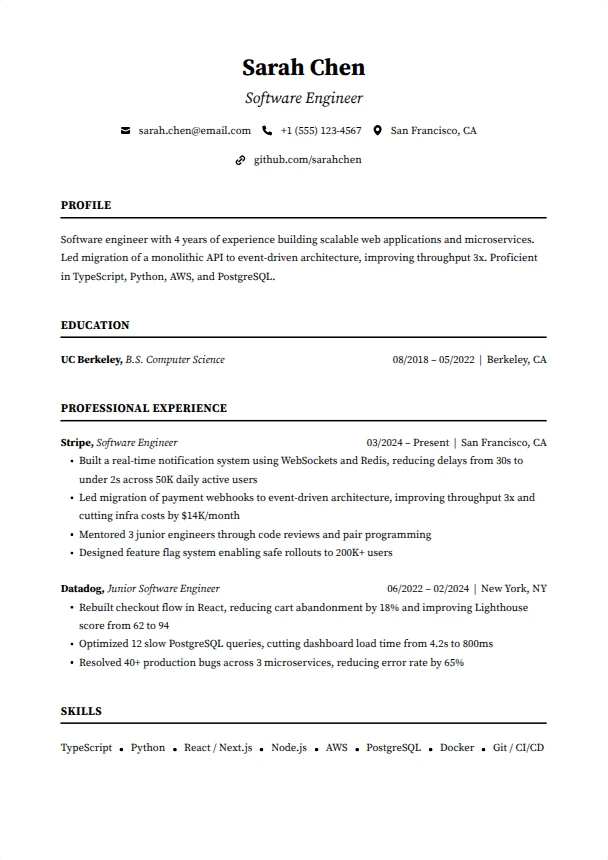
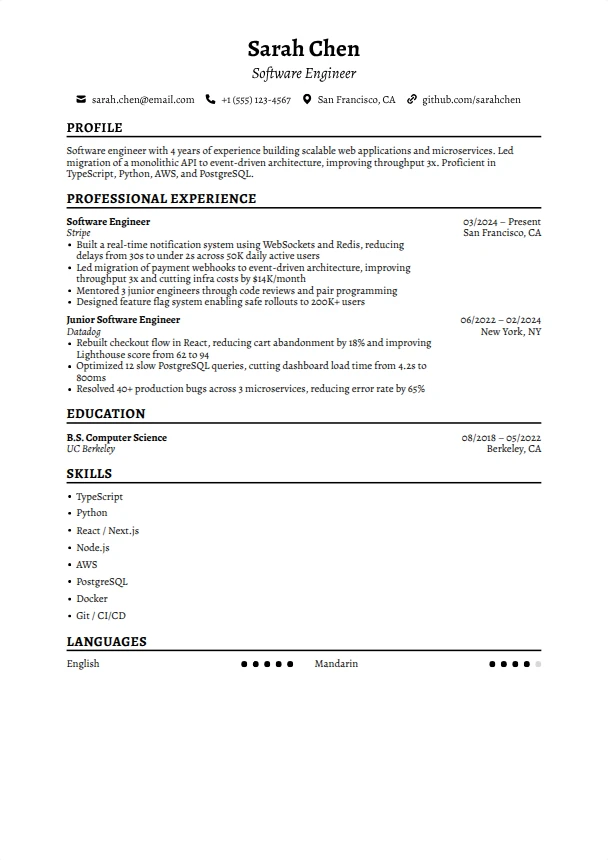
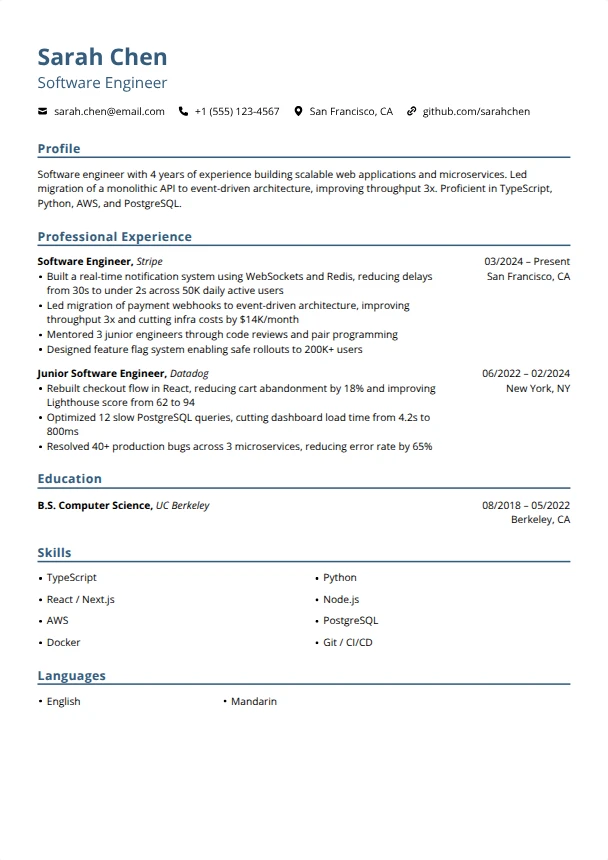
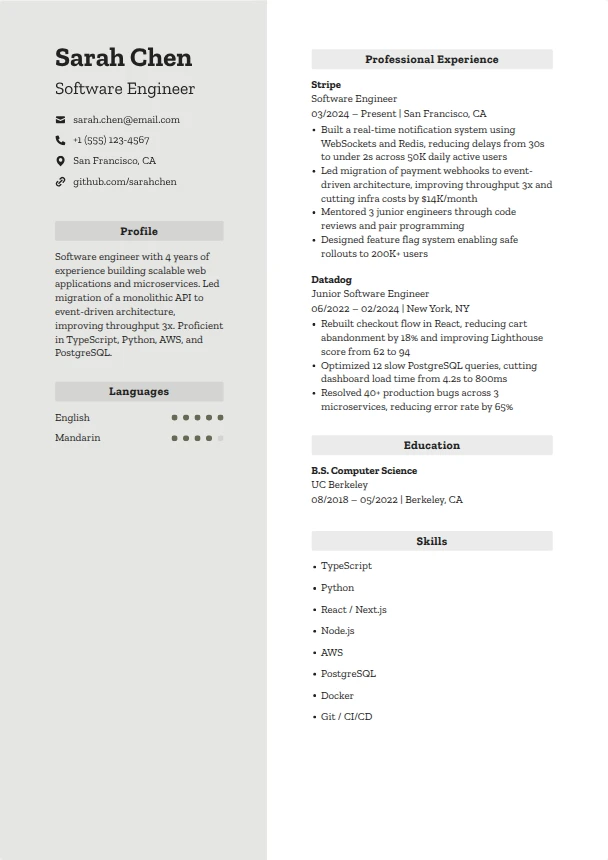
Here's a short, illustrative example that pulls together everything above. The name and employers are fictional; the structure, stack, and quantified bullets are what you should aim for.
Marcus Alvarez
Software Engineer · Austin, TX · [email protected] · (555) 482-1190 · github.com/malvarez-dev
Summary. Software engineer with 5 years building distributed backend services in Java and Python. Led the move from a monolith to Spring Boot microservices on AWS, cutting p99 latency 42%. Comfortable across the stack with React, PostgreSQL, and Kafka-based event pipelines.
Technical Skills.
Languages: Python, Java, TypeScript, SQL · Frameworks: Spring Framework, React, Node.js · Infrastructure: AWS, Docker, Kubernetes, Terraform, Apache Kafka · Tools: Git, Jenkins, CI/CD, PostgreSQL
Senior Software Engineer, Northwind Logistics · 2023 to Present
- Decomposed a 200K-line Java monolith into 9 Spring Boot microservices, reducing p99 API latency from 480ms to 280ms.
- Built an Apache Kafka event pipeline processing 12M messages a day, replacing nightly batch jobs with near-real-time updates.
- Introduced Terraform and Jenkins CI/CD, cutting deploy time from 45 minutes to 6 and raising deploy frequency to 20+ per week.
Software Engineer, Brightpath SaaS · 2021 to 2023
- Rebuilt the customer dashboard in React and TypeScript against a GraphQL API, raising the Lighthouse performance score from 61 to 93.
- Optimized 14 PostgreSQL queries behind the reporting module, dropping average load time from 3.8s to 700ms for 18K daily users.
- Containerized 6 services with Docker and Kubernetes, improving p95 uptime to 99.95% across two regions.
Education and Certifications.
B.S. Computer Science, University of Texas at Austin, 2021 · AWS Certified Solutions Architect - Associate · Certified Kubernetes Application Developer (CKAD)
Illustrative example only. Marcus Alvarez is a fictional candidate created to demonstrate formatting.
Resume summary examples you can steal
Use one as a starting point, then swap in your own technologies, numbers, and achievements.
"Recent CS graduate with hands-on experience building full-stack apps in React and Python. Shipped 3 production-quality projects during internships, including a real-time dashboard backed by a REST API that cut manual reporting by 60%. Eager to contribute to a collaborative engineering team."
Why it works: Specific stack, quantified impact, shows initiative despite limited experience.
"Software engineer with 4 years building scalable web services and microservices. Led migration of a monolithic Java API to event-driven Spring Boot services on AWS, improving throughput 3x. Proficient in Python, TypeScript, PostgreSQL, and Kafka. Mentors junior developers and ships on tight deadlines."
Why it works: Clear level, architectural achievement, leadership signal, specific stack.
"Senior software engineer with 8+ years designing distributed systems at scale. Architected a Kafka-backed payment pipeline handling millions of daily transactions with 99.99% uptime on Kubernetes. Led a platform team of 5 engineers. Strong in system design, performance optimization, and CI/CD with Jenkins and Terraform."
Why it works: Scale signals, reliability metric, team leadership, specific technical depth.
"Full-stack developer with a background in financial analysis and 6 months of intensive training at [Bootcamp]. Built 4 production-ready apps using React, Node.js, and PostgreSQL, all deployed with Docker. Brings analytical rigor, stakeholder communication, and a track record of learning complex systems quickly."
Why it works: Frames the career change as a strength, quantifies projects, highlights transferable skills.
Writing strong experience bullets
Every bullet point should answer: "What did you do, and why did it matter?" Use this formula:
Before and after examples:
Worked on the frontend of the company's main product.
Rebuilt the checkout flow in React and TypeScript, reducing cart abandonment by 18% and improving the Lighthouse performance score from 62 to 94.
Helped with backend development and bug fixes.
Resolved 40+ production bugs across 3 Spring Boot microservices, cutting the error rate by 65% over 2 months.
Responsible for database management and optimization.
Optimized 12 slow PostgreSQL queries powering the analytics dashboard, cutting average page load from 4.2s to 800ms for 15K daily users.
Strong action verbs for engineering resumes:
Built · Designed · Architected · Implemented · Optimized · Migrated · Automated · Deployed · Refactored · Reduced · Scaled · Integrated · Led · Mentored · Shipped · Debugged · Configured · Tested
7 mistakes that get software engineer resumes rejected
Listing every technology you've ever touched
A 30-item skills section doesn't impress: it signals you're padding. Stick to 8-12 skills that match the posting. If you list it, be prepared to talk about it in the interview.
Using a two-column or graphic-heavy template
Multi-column layouts, skill bars, and icons break ATS parsing. Many large companies (Google, Amazon, Meta) use ATS that can't read these. Use a clean single-column layout.
Writing job descriptions instead of achievements
"Responsible for developing features" describes the job. "Built a feature flag system that enabled safe rollouts for 200K users" describes what you did. Every bullet should be an achievement, not a duty.
Sending the same resume to every job
A "senior full-stack engineer" posting and a "backend platform engineer" posting need different resumes. Adjust your summary, skills order, and bullet point emphasis for each application.
Going over one page without 8+ years experience
Recruiters spend 6-10 seconds on an initial scan. If you have under 8 years of experience, one page is the standard. If you need two pages, every line on page two should be as strong as page one.
Listing skills with no proof in your bullets
If your skills section says Kubernetes and Terraform but no bullet shows you using them, back every headline skill with a bullet that quantifies how you used it.
Forgetting to proofread
A typo in your resume signals carelessness: a bad trait for someone writing production code. Read it aloud, run spell check, and have someone else review it before submitting.
What to do if you have no professional experience
No job experience doesn't mean no resume. You just need to lead with different sections:
Lead with Projects, not Experience
Create a "Projects" section and treat each project like a job. Name the project, list the tech stack (for example React, Python, and PostgreSQL), describe what it does, and link to the repo or live demo. Three solid projects are worth more than a generic internship.
Contribute to open source
Even small PRs to established repos (documentation fixes, bug patches, test coverage) show you can work with real codebases, follow contribution guidelines via Git, and collaborate with other developers.
Include freelance and volunteer work
Built a website for a local business? Automated a spreadsheet workflow for a nonprofit with a Python script? These are real engineering work. Describe the problem, your solution, and the impact.
Expand your Education section
List relevant coursework, capstone projects, and academic achievements. If you attended a bootcamp, describe the most impressive project you built during the program and the stack behind it.
Frequently asked questions
How long should a software engineer resume be?
One page for less than 8 years of experience. Two pages maximum for senior and staff-level engineers. Recruiters spend 6-10 seconds on an initial scan, so every line needs to earn its place. If you are struggling to fit on one page, cut the weakest bullets first.
Should I include a summary or objective on my software engineer resume?
Use a summary, not an objective. A summary highlights what you bring: languages, frameworks, impact, and experience level. An objective states what you want, which does not help the hiring manager evaluate you. Two to three sentences naming your core stack (for example Python, React, and AWS) is the sweet spot.
What if I don't have professional software engineering experience?
Lead with a Projects section. Include personal apps, open-source contributions, hackathon projects, and freelance work. Describe each project like a job: what you built, which technologies you used (such as Java, React, or PostgreSQL), and what the outcome was. Link to live demos or GitHub repos. Three strong projects outweigh a generic internship.
Should I list every programming language I know?
No. Tailor your skills to the job posting. List the 8 to 12 technologies that match what the company uses, grouped by category such as languages, frameworks, and infrastructure. A focused stack like Python, TypeScript, Spring Framework, Docker, and Kubernetes signals expertise. A long laundry list signals that you padded your resume. Only list skills you would be comfortable discussing in an interview.
Which certifications help a software engineer resume?
Certifications are optional for software engineers and matter less than shipped projects, but cloud and container credentials can help when a role lists them. The AWS Certified Solutions Architect - Associate, the Certified Kubernetes Application Developer (CKAD), and the Microsoft Certified: Azure Developer Associate (AZ-204) all map to common job requirements. List them only if they match the stack in the posting.
Do I need a cover letter with my software engineer resume?
Only if the posting asks for one. Most engineering hiring managers skip cover letters and go straight to the resume and your GitHub. If you do write one, keep it to 3-4 paragraphs: why this company, what you bring, and one specific technical achievement such as cutting API latency or scaling a service that did not fit on your resume.
Skip the blank page
Open a complete, filled-in software engineer resume in our free builder. Swap in your own details, keep the wording that fits, and download as PDF, free.
Build your software engineer resume now
Pick an ATS-friendly template, add your experience, and download a polished PDF in minutes. Free, no account required.
Start Building: It's FreeRelated resume guides
General IT resume for support, sysadmin, and infrastructure roles.
SQL, Python, dashboards, and stakeholder communication.
CI/CD, infrastructure as code, cloud platforms, and SRE skills.
Security certifications, threat analysis, and compliance experience.
More resume examples: