What hiring managers actually look for
DevOps hiring managers usually engineering leads or platform team managersscan resumes for three things before reading further:
-
1
CI/CD pipeline ownership. Did you build the pipeline or just use it? Managers want to see that you've designed, implemented, and maintained CI/CD pipelines from scratchnot just triggered builds. Include the tools (GitHub Actions, Jenkins, Git Lab CI, Argo CD) and the scale (deployments per day, environments managed).
-
2
Infrastructure as code in production. Terraform, Pulumi, CloudFormation, Ansiblelisting Ia C tools isn't enough. Managers want to see what you managed: ' Managed 300+ AWS resources across 4 environments using Terraform modules'beats ' experience with Terraform'every time.
-
3
Incident response and reliability metrics. DevOps is fundamentally about reliability. Uptime percentages, MTTR improvements, deployment frequency, change failure ratethese DORA metrics tell managers you understand the operational side, not just the automation side.
If your resume communicates these things in the first 7-second scan, you'll make it to the detailed read. Everything below is about making that happen.
How to structure your resume, section by section
The order matters. Here's what a strong devops engineer resume looks like from top to bottom:
1. Contact header
Name, email, phone, location (city + state), LinkedIn, and GitHub. For DevOps roles, a GitHub profile with Ia C repos, pipeline configurations, or open-source contributions is a strong signal.
Marcus Johnson · [email protected] · (555) 890-1234 · Portland, OR
linkedin.com/in/marcusjohnson-devops · github.com/mjohnson-infra
2. Professional summary (2-3 sentences)
Lead with years of DevOps experience, your core toolchain (CI/CD, Ia C, containers), the scale of environments you've managed, and a reliability or deployment metric. DevOps managers want to see numbers immediately.
Strong: "DevOps engineer with 5 years of experience building and maintaining CI/CD pipelines and cloud infrastructure for a Saa S platform serving 500K daily active users. Increased deployment frequency from weekly to 15+ daily deploys using GitHub Actions, Argo CD, and Kubernetes. Reduced MTTR from 45 minutes to 8 minutes through automated rollbacks and Prometheus alerting."
3. Certifications
AWS, Azure, GCP, Kubernetes (CKA/CKAD), and Terraform certifications are highly valued for DevOps roles. List them prominently if you have them.
AWS DevOps Engineer Professional (2025) · CKA (Certified Kubernetes Administrator) (2024) · Hashi Corp Terraform Associate (2024)
4. Technical skills
Group by category: CI/CD, Containers & Orchestration, Ia C, Cloud, Monitoring, Scripting. DevOps skills sections should be specific tool names, not generic categories.
CI/CD: GitHub Actions, Jenkins, Git Lab CI, Argo CD
Containers: Docker, Kubernetes, Helm, ECS/Fargate
Ia C: Terraform, CloudFormation, Ansible, Pulumi
Cloud: AWS (EC2, EKS, S3, RDS, Lambda), GCP
Monitoring: Prometheus, Grafana, Datadog, Pager Duty, ELK Stack
Languages: Python, Bash, Go, YAML
5. Work experience
Reverse chronological. Every bullet should reference the tool, the scale, and the outcome. DevOps managers care about deployment frequency, reliability improvements, infrastructure cost, and incident metrics.
Strong: "Designed and maintained CI/CD pipeline using GitHub Actions and Argo CD, enabling 15+ production deployments daily across 3 Kubernetes clusters with zero-downtime rolling updates. Reduced build time from 18 minutes to 4 minutes through Docker layer caching and parallel test execution."
6. Education
Degree, school, graduation year. For DevOps, certifications and demonstrable project experience often outweigh formal education. Include relevant CS or systems administration coursework if you're a recent graduate.
Key skills to include
These are the most in-demand skills across DevOps job postings in 2026. Don't list everything choose the tools that match the specific role and that you can discuss confidently in an interview.
Tip: DevOps postings are notoriously specific about tooling. If they say ' Argo CD'and you list ' GitOps,' the ATS might not match. Mirror the exact tool names from the job description.
Resume summary examples you can steal
Use one as a starting point, then swap in your own technologies, numbers, and achievements.
"Junior DevOps engineer with 1 year of experience building CI/CD pipelines and managing Docker containers in a startup environment. Built GitHub Actions workflows that automated testing and deployment for 3 microservices. AWS Solutions Architect Associate and Terraform Associate certified. Active open-source contributor with 200+ GitHub contributions."
Why it works: Real production experience despite being junior, specific tools, certifications, open-source contributions.
"DevOps engineer with 4 years of experience building and operating cloud infrastructure for a B2B Saa S platform serving 200K users. Managed 15 Kubernetes clusters across AWS using Terraform and Helm. Increased deployment frequency from bi-weekly to daily while reducing change failure rate from 15% to 3%. CKA and AWS DevOps Pro certified."
Why it works: Platform scale, Kubernetes cluster count, DORA metrics improvement, strong certifications.
"Senior DevOps engineer with 8 years of experience leading platform engineering for a fintech company processing $2B in annual transactions. Built internal developer platform serving 60 engineers, reducing time-to-deploy from 2 hours to 8 minutes. Maintained 99.99% uptime across 40 microservices on Kubernetes. Led team of 4 platform engineers."
Why it works: Business-critical context, internal platform ownership, dramatic deployment improvement, team leadership.
"Linux systems administrator transitioning to DevOps with 5 years of infrastructure experience and hands-on Terraform, Docker, and GitHub Actions skills. Automated server provisioning with Ansible, reducing setup time from 4 hours to 15 minutes. Built a personal Kubernetes homelab cluster with Prometheus monitoring. Terraform Associate certified."
Why it works: Sysadmin background directly relevant, automation achievement quantified, homelab proves commitment, certification.
Writing strong experience bullets
Every bullet point should answer: "What did you do, and why did it matter?" Use this formula:
Before and after examples:
Built CI/CD pipelines for the development team.
Designed CI/CD pipeline using GitHub Actions and Argo CD that increased deployment frequency from weekly to 15+ daily deploys, with automated rollbacks reducing change failure rate from 12% to 2%.
Managed Kubernetes clusters and Docker containers.
Operated 12 Kubernetes clusters (AWS EKS) running 80+ microservices with Helm-managed deployments, maintaining 99.95% uptime while handling 50K requests per second at peak.
Worked on infrastructure automation using Terraform.
Managed 400+ AWS resources across dev, staging, and production using Terraform modules with remote state in S3. Implemented drift detection and automated compliance checks, catching 30+ unauthorized changes per month.
Strong action verbs for devops engineer resumes:
Automated · Deployed · Orchestrated · Containerized · Provisioned · Scaled · Monitored · Optimized · Migrated · Pipelined · Templated · Configured · Integrated · Hardened · Benchmarked · Resolved · Designed · Operated
7 mistakes that get devops engineer resumes rejected
Listing tools without showing what you built with them
' Experience with Kubernetes, Docker, and Terraform'appears on every DevOps resume. What sets you apart is specifics: how many clusters, what scale, what you automated, and what improved. Lead with outcomes, not tool lists.
Not including DORA or reliability metrics
Deployment frequency, lead time for changes, change failure rate, and MTTRthese are the metrics DevOps is measured by. If you improved any of them, it deserves a bullet with numbers.
Confusing DevOps with sysadmin work
If your bullets describe ' patching servers'and ' managing backups'without mentioning automation, pipelines, or infrastructure as code, you're presenting sysadmin experience. Reframe it: ' Automated patch deployment across 200 servers using Ansible, reducing manual effort by 90%.'
Omitting the scale of your infrastructure
Running 3 Docker containers locally is different from orchestrating 100 microservices on Kubernetes. Include numbers: clusters managed, pods running, deployments per day, requests per second, environments maintained.
Forgetting monitoring and observability experience
Prometheus, Grafana, Datadog, Pager Duty, ELKmonitoring is half the DevOps job. If you've built dashboards, set up alerting, or reduced alert noise, feature it on your resume.
Using ' DevOps'as a synonym for ' knows Linux'
Linux skills are necessary but not sufficient. DevOps is about CI/CD, Ia C, containers, monitoring, and reliability engineering. Make sure your resume reflects the full scope, not just the OS layer.
Not showing collaboration with development teams
DevOps bridges development and operations. If you've worked with developers on deployment workflows, built internal platforms, or reduced developer friction, highlight those achievements.
What to do if you have no professional experience
Breaking into DevOps without a formal DevOps title is commonmost DevOps engineers started as developers or sysadmins. Here's how to build a competitive resume:
Build a real CI/CD pipeline project
Create a multi-stage GitHub Actions or Git Lab CI pipeline that builds, tests, and deploys a simple application to AWS or GCP. Document the pipeline in a GitHub repo with a clear README and architecture diagram. This is the #1 thing DevOps hiring managers want to see from entry-level candidates.
Get certified in Terraform and a cloud provider
Hashi Corp Terraform Associate and AWS Solutions Architect Associate are the two most impactful certifications for breaking into DevOps. They prove you understand Ia C and cloud fundamentals the two pillars of the role.
Build a Kubernetes homelab
Set up a local Kubernetes cluster using kind, k3s, or minikube. Deploy multiple services with Helm charts, set up Prometheus and Grafana monitoring, and configure Ingress. Document the entire setup. This demonstrates real container orchestration skills.
Reframe developer or sysadmin experience
If you've written deployment scripts, automated server setup, managed Jenkins builds, or configured Docker for development that's DevOps work. Reframe it: ' Automated deployment pipeline for 3 services using Jenkins and Docker, reducing release time from 4 hours to 20 minutes.'
Frequently asked questions
What's the difference between DevOps Engineer and SRE on a resume?
DevOps engineers focus on CI/CD pipelines, infrastructure automation, and deployment workflows. SREs focus on reliability, incident management, SLOs/SLIs, and error budgets. In practice, there's significant overlap. If you're applying for either role, emphasize the relevant sidebut both value automation, monitoring, and production experience.
How long should a DevOps resume be?
One page for under 7 years of experience. Two pages for senior DevOps or platform engineering roles with extensive infrastructure, multiple certifications, and team leadership. Every line should describe something you built, automated, or improved.
Do I need to know coding for DevOps?
Yes. Python and Bash are the minimumyou'll use them for automation scripts, CI/CD pipeline logic, and custom tooling. Go is increasingly common for platform engineering and building internal tools. You don't need to be a software engineer, but you need to write production-quality scripts.
Should I include my GitHub on a DevOps resume?
Absolutely. A GitHub profile with Terraform modules, CI/CD configurations, Dockerfiles, Kubernetes manifests, or monitoring dashboards is one of the strongest signals you can send. Pin your best repos and make sure they have clear READMEs.
Which cloud certification is best for DevOps?
AWS DevOps Engineer Professional is the most recognized DevOps-specific cert. If you don't have AWS experience yet, start with AWS Solutions Architect Associate as a foundation. For Kubernetes, the CKA (Certified Kubernetes Administrator) is highly valued. Hashi Corp Terraform Associate rounds out the trifecta.
Skip the blank page
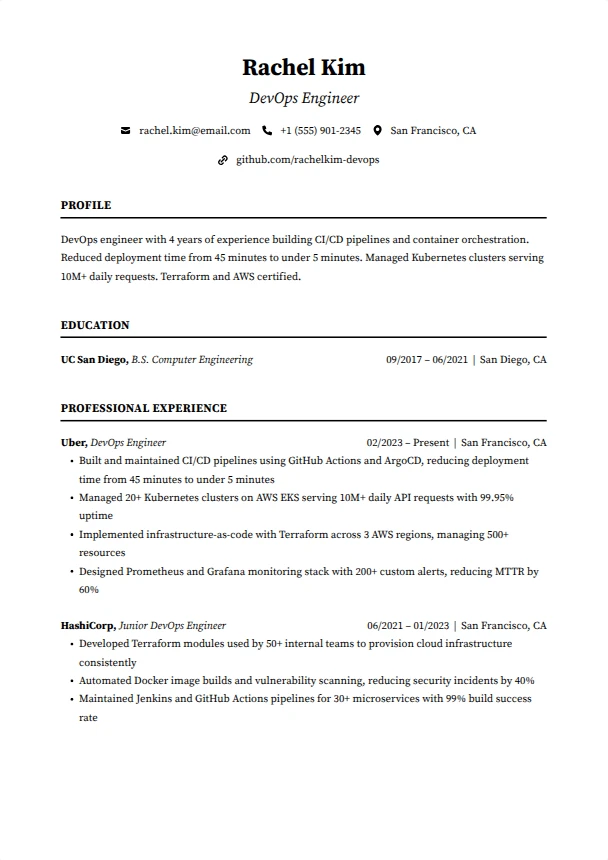
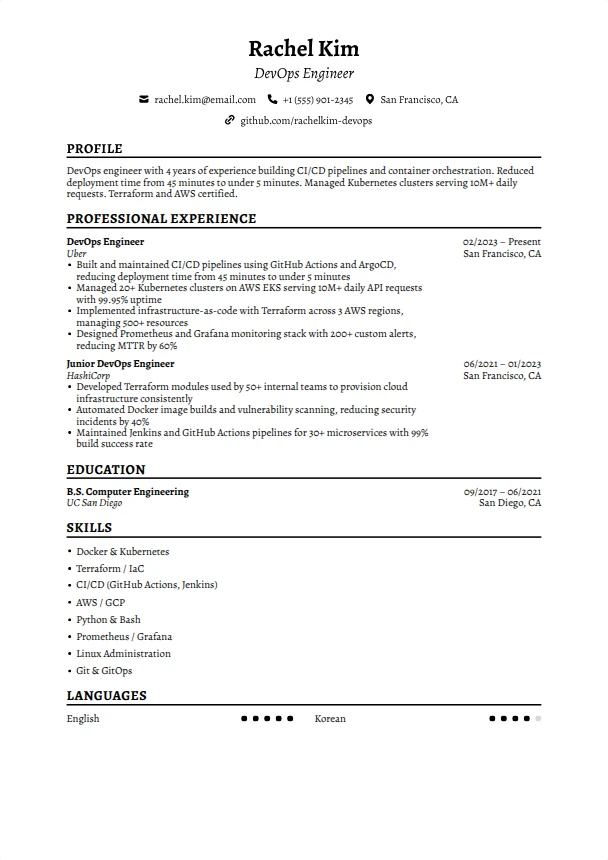
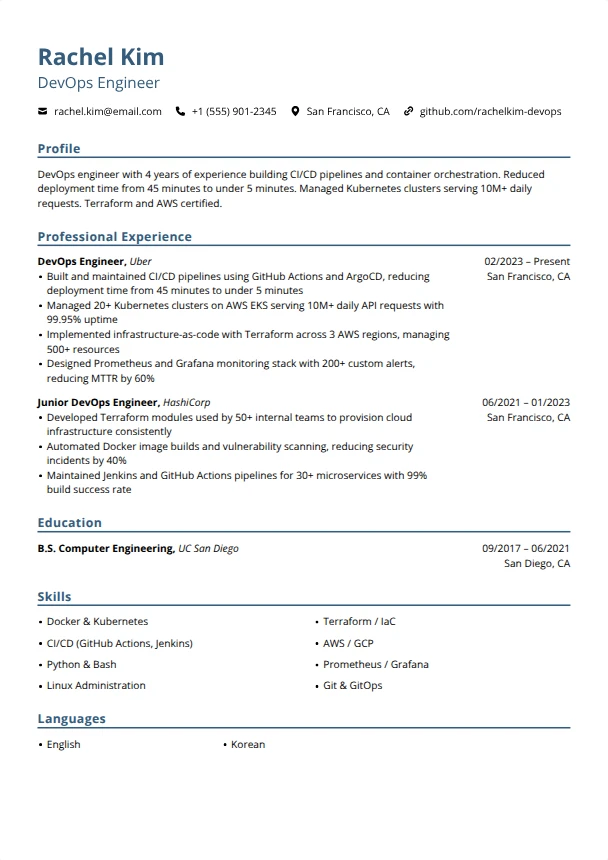
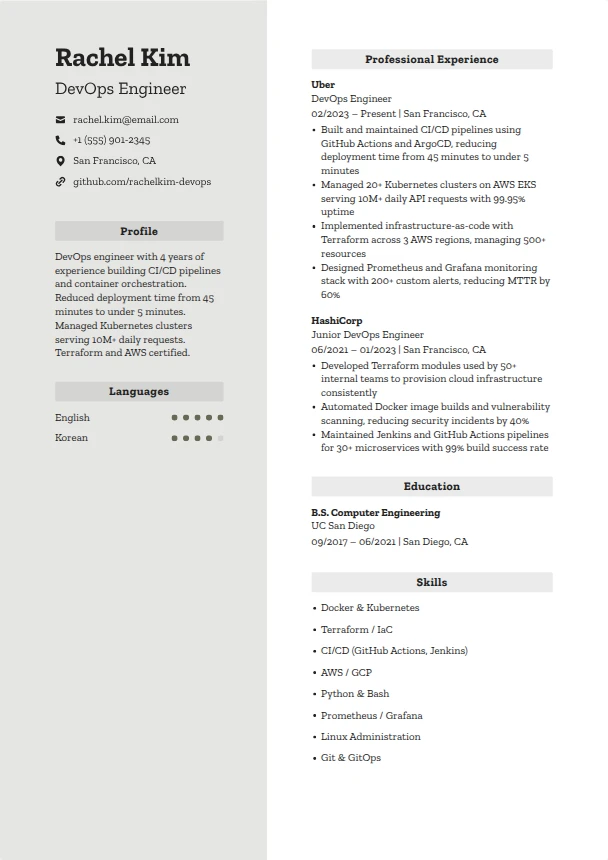
Open a complete, filled-in DevOps / cloud engineer resume in our free builder. Swap in your own details, keep the wording that fits, and download as PDF, free.
Build your DevOps engineer resume now
Pick an ATS-friendly template, add your pipeline and infrastructure experience, and download a polished PDF in minutes. Free, no account required.
Start Building, It's FreeRelated resume guides
Multi-cloud architecture, Ia C, migration, and cost management across AWS, Azure, and GCP.
AWS certifications, services, cost optimization, and migration project examples.
Security certifications, threat analysis, incident response, and compliance.
General IT resume for sysadmin, infrastructure, and networking roles.
More resume examples: