What hiring managers actually look for
AWS hiring managers and cloud recruiters scan resumes for three things before deciding to keep reading:
-
1
AWS certifications that match the role level. Solutions Architect Associate (SAA-C03) is the baseline. For senior roles, they want Solutions Architect Professional (SAP-C02) or DevOps Engineer Professional. If the posting lists a specific cert and you don't have it, your resume often gets filtered before a human sees it.
-
2
Specific AWS services, not just ' cloud experience.' Saying ' experienced with AWS'is meaningless. Managers want to see EC2, S3, Lambda, RDS, CloudFormation, ECS, IAMthe actual services you've used in production. The more specific, the better.
-
3
Cost optimization and migration results. Cloud is expensive, and every AWS hire is expected to manage costs. If you've reduced monthly spend by 30%, right-sized instances, or migrated workloads from on-prem, those numbers belong on your resume.
If your resume communicates these things in the first 7-second scan, you'll make it to the detailed read. Everything below is about making that happen.
How to structure your resume, section by section
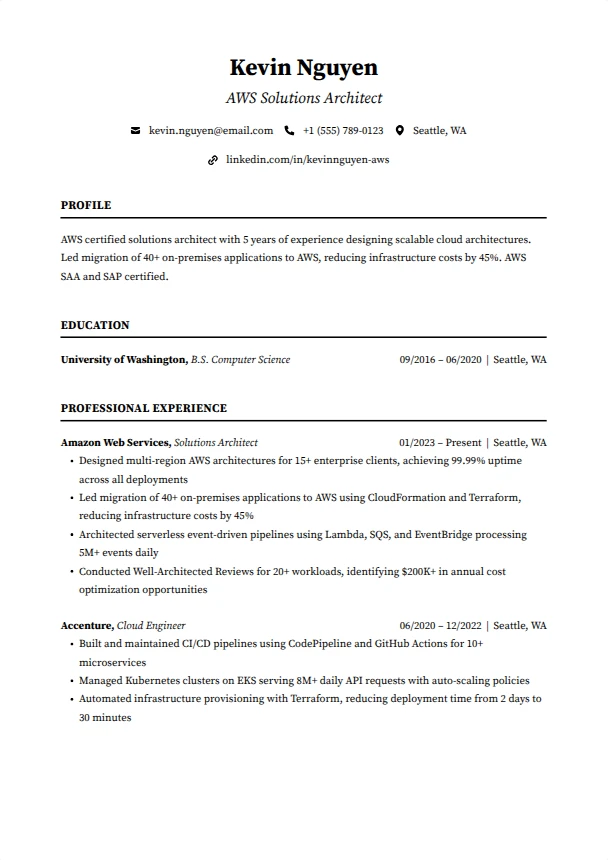
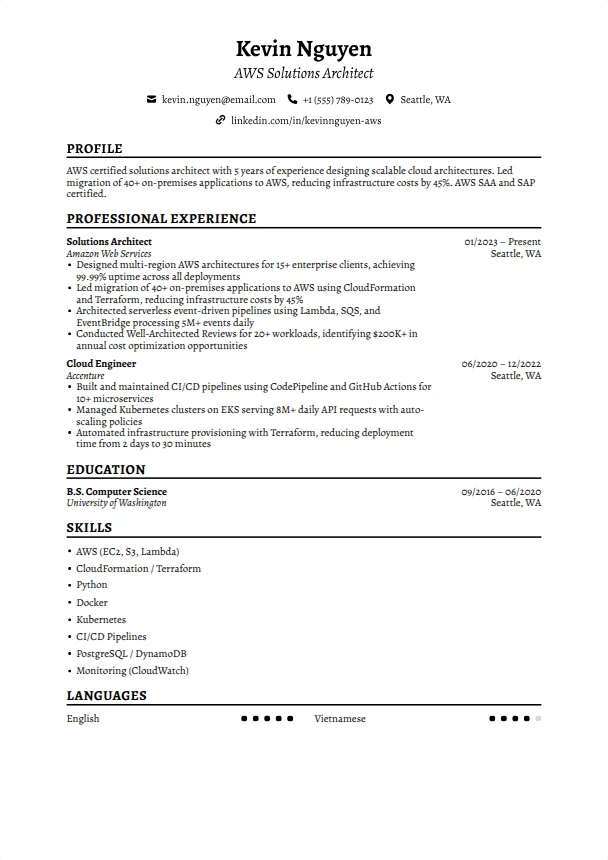
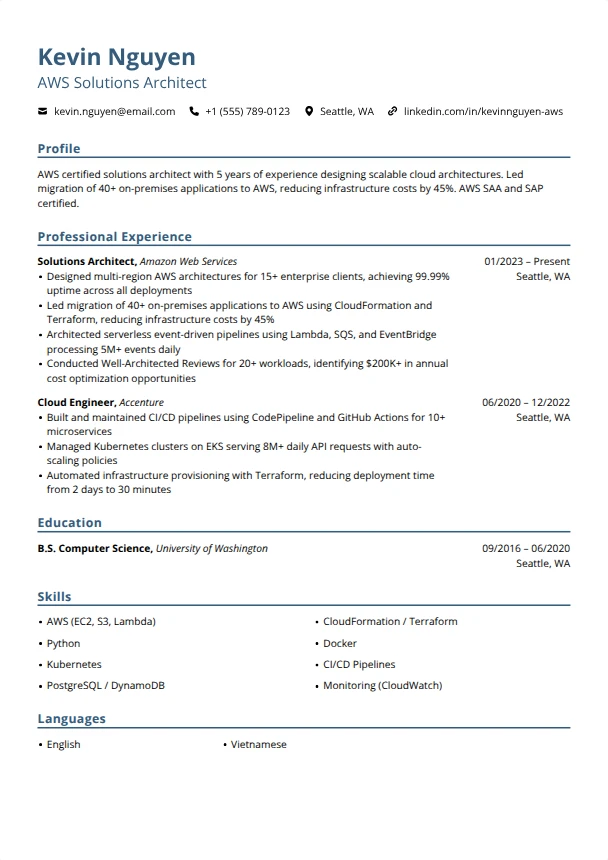
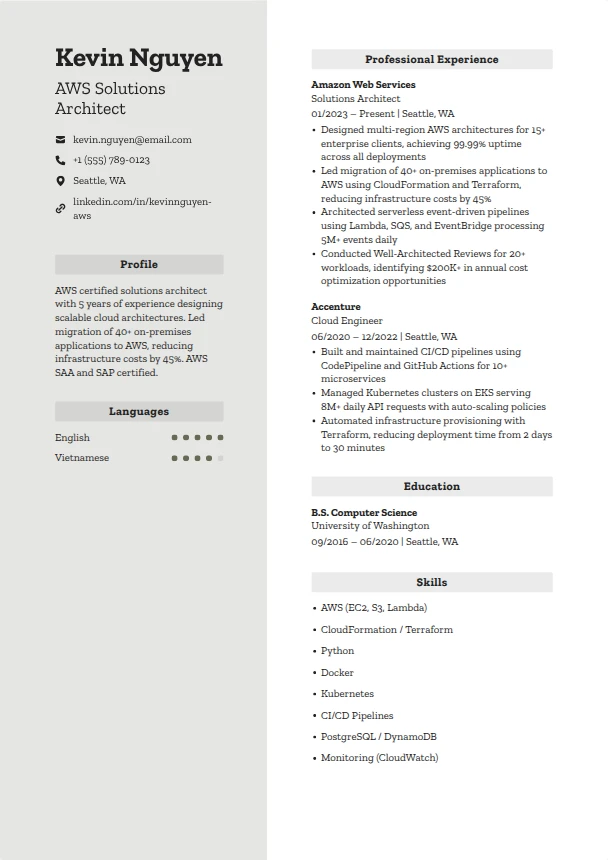
The order matters. Here's what a strong aws resume looks like from top to bottom:
1. Contact header
Name, email, phone, location (city + state), and LinkedIn. If you have an AWS community profile, a tech blog, or GitHub with Ia C repos, include those links.
David Chen · [email protected] · (555) 678-1234 · Seattle, WA
linkedin.com/in/davidchen-aws · github.com/dchen-cloud
2. Professional summary (2-3 sentences)
Lead with your AWS experience level, top certification, the scale of environments you've managed, and your biggest cost or performance achievement. Cloud managers want to see numbers immediately.
Strong: "AWS Solutions Architect with 5 years of experience designing and deploying scalable cloud infrastructure for a Saa S platform serving 2M+ users. Led migration of 40 on-prem workloads to AWS, reducing infrastructure costs by 35% ($420K annually). AWS SAA and SAP certified."
3. Certifications
AWS certifications are the single most important section for cloud roles. List them prominently, ordered by relevance. Include the certification code for ATS matching.
AWS Solutions Architect Professional (SAP-C02, 2025) · AWS Solutions Architect Associate (SAA-C03, 2024) · AWS DevOps Engineer Professional (in progress)
4. Technical skills
Group by category: AWS Services, Ia C & Automation, CI/CD, Monitoring, Languages. Be specific about which AWS services you've useddon't just write ' AWS.'
Compute: EC2, Lambda, ECS, Fargate, Auto Scaling
Storage & DB: S3, RDS (PostgreSQL, My SQL), DynamoDB, Elasti Cache
Networking: VPC, Route 53, CloudFront, ALB/NLB, Transit Gateway
Ia C: CloudFormation, Terraform, CDK
CI/CD: Code Pipeline, Code Build, GitHub Actions
5. Work experience
Reverse chronological. Every bullet should reference specific AWS services, the scale of the workload, and a measurable outcomecost savings, latency reduction, uptime improvement, or migration scope.
Strong: "Architected multi-AZ deployment on AWS for a fintech platform handling 50,000 daily transactions, achieving 99.99% uptime using EC2 Auto Scaling, RDS Multi-AZ, and CloudFront CDN. Reduced monthly AWS spend by $18K through Reserved Instance planning and S3 lifecycle policies."
6. Education
Degree, school, graduation year. For AWS roles, certifications carry more weight than degrees in most cases. Include relevant coursework in cloud computing or distributed systems if you're a recent graduate.
Key skills to include
These are the most in-demand AWS skills across cloud job postings in 2026. Focus on the services and tools you've used in productiondon't list every AWS service that exists.
Tip: If the posting mentions a specific AWS service by name (e.g., ' experience with Step Functions'or ' Kinesis required'), add it to your skills section using their exact wording. ATS systems match keywords literally.
Resume summary examples you can steal
Use one as a starting point, then swap in your own technologies, numbers, and achievements.
"AWS Solutions Architect Associate certified cloud professional with hands-on experience from a 6-month internship managing EC2 instances, S3 buckets, and IAM policies for a 500-user Saa S platform. Completed 3 personal AWS projects including a serverless API using Lambda and API Gateway. Eager to grow into a cloud engineering role."
Why it works: Certification up front, internship with real services, personal projects show initiative, clear career direction.
"AWS cloud engineer with 4 years of experience building and maintaining infrastructure for e-commerce platforms handling $50M+ in annual revenue. Migrated 25 on-prem servers to EC2 and RDS, cutting hosting costs by 40%. Automated infrastructure provisioning with Terraform and CloudFormation, reducing deployment time from 3 days to 2 hours. SAA and DevOps Pro certified."
Why it works: Revenue context, migration scope, cost savings, automation impact, relevant certifications.
"Senior AWS solutions architect with 9 years of cloud experience designing multi-account, multi-region architectures for Fortune 500 clients at Accenture and Deloitte. Led $8M cloud migration program for a healthcare company, achieving HIPAA compliance across 120 workloads. Reduced annual cloud spend by $1.2M through right-sizing, Reserved Instances, and Savings Plans. AWS SAP and DevOps Pro certified."
Why it works: Enterprise consulting context, compliance, massive cost savings, multi-cert credibility.
"Windows systems administrator transitioning to AWS cloud engineering with Solutions Architect Associate certification and 3 personal cloud projects (serverless API, static website on S3/CloudFront, VPC with multi-tier architecture). Brings 6 years of infrastructure experience server management, Active Directory, networking, and disaster recovery directly applicable to cloud operations."
Why it works: Certification proves cloud commitment, projects demonstrate hands-on AWS skills, sysadmin background reframed as cloud-relevant.
Writing strong experience bullets
Every bullet point should answer: "What did you do, and why did it matter?" Use this formula:
Before and after examples:
Managed AWS infrastructure for the company's applications.
Managed AWS infrastructure spanning 120 EC2 instances, 15 RDS databases, and 40 Lambda functions serving 2M monthly active users, maintaining 99.95% uptime across 3 availability zones.
Helped migrate servers to the cloud.
Led migration of 40 on-premises workloads to AWS over 6 months using Cloud Endure and AWS DMS, reducing data center costs by $420K annually while improving application response time by 25%.
Worked on cost optimization for AWS accounts.
Implemented AWS cost optimization strategy using Reserved Instances, Savings Plans, and S3 Intelligent-Tiering, reducing monthly spend from $85K to $52K (39% reduction) without performance impact.
Strong action verbs for aws resumes:
Architected · Deployed · Migrated · Provisioned · Automated · Optimized · Configured · Scaled · Monitored · Secured · Designed · Implemented · Orchestrated · Containerized · Refactored · Integrated · Templated · Benchmarked
6 mistakes that get aws resumes rejected
Writing ' AWS'without listing specific services
' Experience with AWS'tells a hiring manager nothing. List the exact services: EC2, S3, Lambda, RDS, CloudFormation. Specificity is what separates a strong AWS resume from a generic one.
Not including certification codes
ATS systems often search for ' SAA-C03'or ' SAP-C02,' not just ' Solutions Architect.' Include both the full certification name and the exam code to maximize keyword matches.
Omitting cost and scale metrics
Cloud roles are judged on efficiency. If you don't mention monthly spend managed, cost savings achieved, or environment scale (instances, users, requests), managers assume the numbers weren't impressive.
Listing services you've only used in tutorials
If you list Sage Maker but have only run the AWS tutorial notebook, it will show in the interview. Only list services you can discuss confidently what you built, why, and what went wrong.
Ignoring security and compliance experience
Every AWS role involves IAM, security groups, encryption, and compliance. If you've implemented least-privilege IAM policies, configured WAF rules, or achieved SOC 2 / HIPAA compliance on AWS, feature it prominently.
Burying infrastructure-as-code experience
Terraform, CloudFormation, and CDK are expected skills in 2026. If you've written Ia C templates, put it in your bullets with specifics: ' Managed 200+ resources across 3 environments using Terraform modules.'
What to do if you have no professional experience
No professional AWS experience doesn't mean no resume. Cloud is one of the most accessible fields to break into with self-study:
Get AWS Solutions Architect Associate certified
SAA-C03 is the gold standard entry cert for cloud careers. It proves you understand core services, networking, security, and cost optimization. Study with Adrian Cantrill, Stephane Maarek, or the official AWS trainingthen pass the exam.
Build real projects on the AWS Free Tier
Deploy a web application on EC2 with an RDS backend, build a serverless API with Lambda and API Gateway, host a static site on S3 with CloudFront. Document everything in GitHub with architecture diagrams. These are real portfolio pieces.
Learn infrastructure as code from day one
Don't just click through the AWS console. Write Terraform or CloudFormation templates for every project. Ia C experience is a major differentiator for entry-level candidatesit shows you think like an engineer, not just a console user.
Leverage sysadmin or IT experience
If you've managed servers, networks, or Active Directory on-premises, you already understand the fundamentals. Frame your experience in cloud terms: on-prem servers → EC2, local storage → S3, physical networking → VPC. The concepts transfer directly.
Frequently asked questions
Which AWS certification should I get first?
Start with AWS Solutions Architect Associate (SAA-C03). It's the most recognized cloud certification in the industry and covers the foundational services every AWS role requires. From there, choose based on your path: DevOps Engineer Professional for automation-focused roles, or Solutions Architect Professional for design and architecture roles.
How long should an AWS resume be?
One page for under 7 years of experience. Two pages for senior architects or consultants with multiple certifications, migration programs, and multi-cloud experience. Every line on page two should be as strong as page one.
Should I list every AWS service I've used?
No. List the 10-15 services most relevant to the target role. A 30-service list signals padding. Focus on services you've used in production and can discuss in depth during an interview.
Do I need a degree for AWS cloud roles?
Not typically. AWS certifications plus hands-on project experience often outweigh a degree for cloud roles. Companies like Amazon, Capital One, and Accenture actively hire certified professionals without traditional CS degrees. That said, a degree helps for competitive positions at top-tier firms.
Should I include personal AWS projects on my resume?
Absolutely, especially if you're early-career. A well-documented project on GitHubwith architecture diagrams, Terraform code, and a README explaining your design decisionsis stronger evidence than listing services in a skills section. Label them as ' Projects'to distinguish from professional work.
Skip the blank page
Open a complete, filled-in DevOps / cloud engineer resume in our free builder. Swap in your own details, keep the wording that fits, and download as PDF, free.
Build your AWS resume now
Pick an ATS-friendly template, add your certifications and cloud experience, and download a polished PDF in minutes. Free, no account required.
Start Building, It's FreeRelated resume guides
Multi-cloud architecture, Ia C, migration, and cost management across AWS, Azure, and GCP.
CI/CD pipelines, containers, Kubernetes, Terraform, and deployment automation.
General IT resume for sysadmin, infrastructure, and networking roles.
Security certifications, threat analysis, incident response, and compliance.
More resume examples: