What hiring managers actually look for
Cloud engineering managers and infrastructure leads evaluate resumes for three things before deciding to continue reading:
-
1
Multi-cloud or deep single-cloud expertise. Some roles demand deep AWS expertise; others want someone who can work across AWS, Azure, and GCP. Read the posting carefully. Either way, managers want to see specific services, not just platform names' AWS EC2, Azure VMs, GCP Compute Engine'beats ' experience with cloud platforms.'
-
2
Infrastructure as code as a default, not a bonus. Terraform, Pulumi, CloudFormation, ARM templates, Bicep Ia C is the baseline expectation for cloud engineers in 2026. If you're still clicking through consoles for production workloads, your resume will be skipped. Show the scale: resources managed, environments maintained, drift detection.
-
3
Migration and cost optimization track record. Cloud engineers are expensive hires. Managers justify your salary by the migrations you complete and the costs you reduce. If you've migrated 50 servers to the cloud, saved $500K annually, or right-sized infrastructure, those numbers are your most powerful resume bullets.
If your resume communicates these things in the first 7-second scan, you'll make it to the detailed read. Everything below is about making that happen.
How to structure your resume, section by section
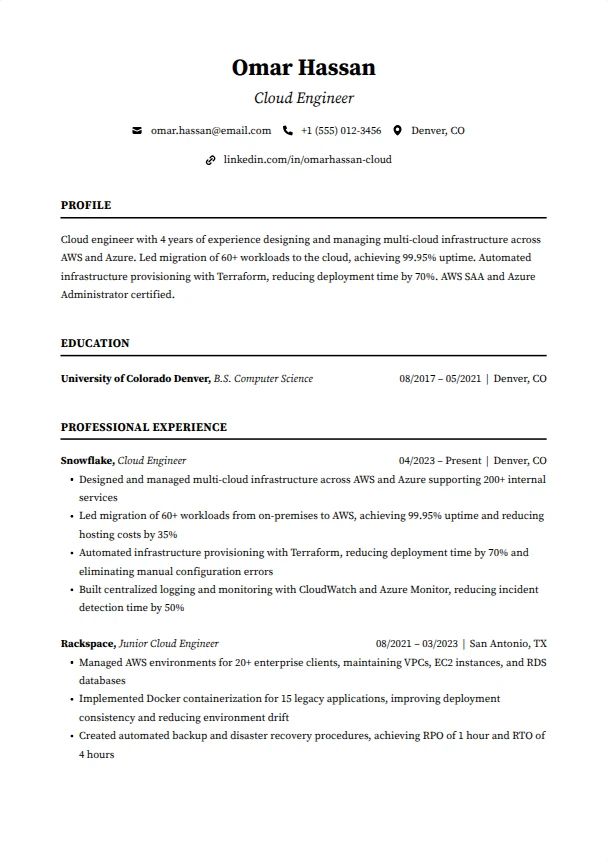
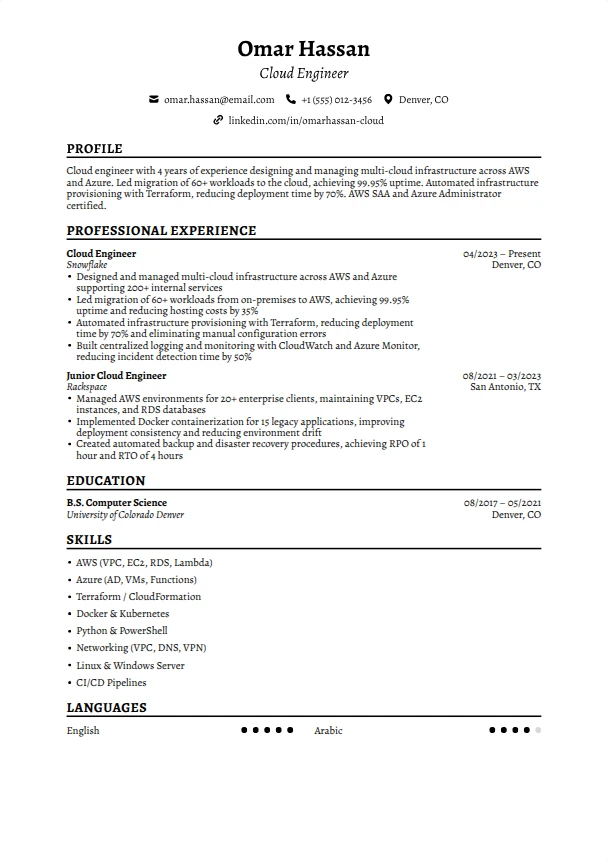
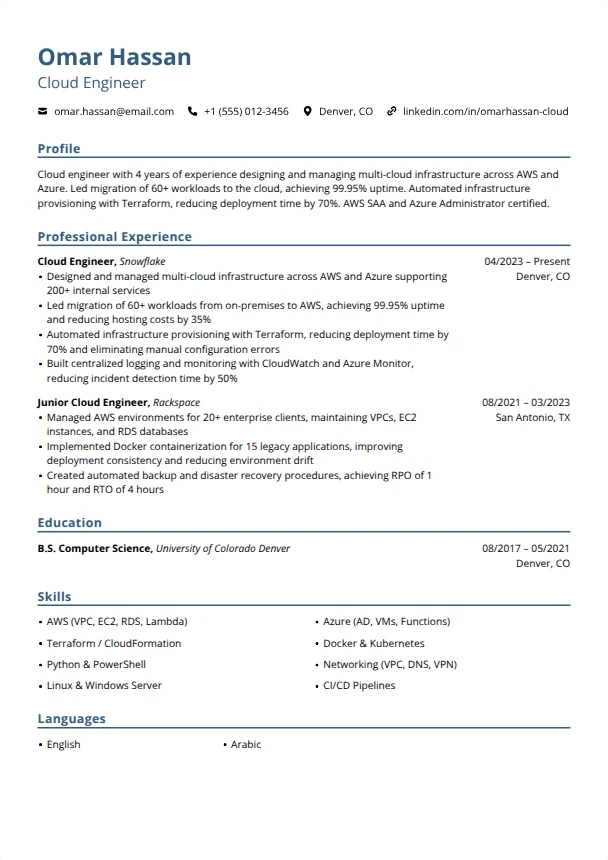
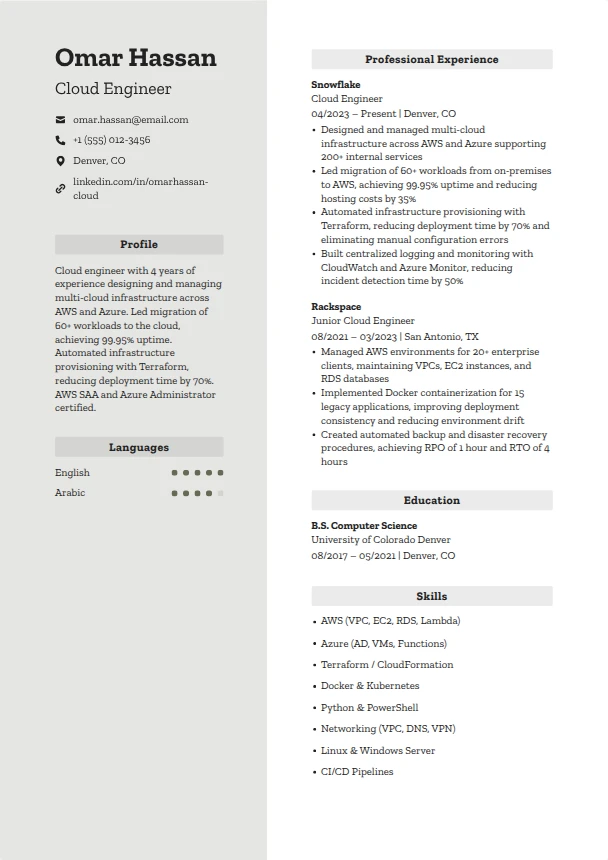
The order matters. Here's what a strong cloud engineer resume looks like from top to bottom:
1. Contact header
Name, email, phone, location (city + state), LinkedIn, and GitHub. Cloud engineer roles value GitHub profiles with Ia C repos, architecture diagrams, and documented infrastructure projects.
Sarah Okafor · [email protected] · (555) 901-2345 · Atlanta, GA
linkedin.com/in/sarahokafor-cloud · github.com/sokafor-infra
2. Professional summary (2-3 sentences)
Lead with years of cloud experience, platform expertise (AWS, Azure, GCPor multi-cloud), the scale of infrastructure you've managed, and your most impressive cost or migration achievement.
Strong: "Cloud engineer with 6 years of experience designing and managing multi-cloud infrastructure across AWS and Azure for a healthcare company serving 3M patients. Led migration of 80 on-prem workloads to AWS and Azure, achieving HIPAA compliance across all environments. Reduced annual cloud spend by $600K through right-sizing and reserved capacity planning. AWS SAP and Azure Administrator certified."
3. Certifications
Cloud certifications are critical differentiators. For multi-cloud roles, having certs across providers (AWS SA + Azure Admin + GCP Associate) is a strong signal. List them prominently with year earned.
AWS Solutions Architect Professional (SAP-C02, 2025) · Microsoft Azure Administrator (AZ-104, 2024) · GCP Associate Cloud Engineer (2024) · Hashi Corp Terraform Associate (2025)
4. Technical skills
Group by cloud platform and technology category. Cloud engineers should show breadth across platforms while demonstrating deep expertise in their primary provider.
AWS: EC2, S3, RDS, Lambda, EKS, CloudFormation, VPC
Azure: VMs, Blob Storage, Azure SQL, AKS, ARM Templates
GCP: Compute Engine, Cloud Storage, BigQuery, GKE
Ia C: Terraform, Pulumi, Ansible, CloudFormation
Containers: Docker, Kubernetes, Helm
Monitoring: Prometheus, Grafana, CloudWatch, Azure Monitor
5. Work experience
Reverse chronological. Every bullet should reference specific cloud services, the architecture decisions you made, and measurable business outcomes. Focus on migrations, cost optimization, security, and reliability.
Strong: "Designed multi-region AWS architecture (us-east-1, eu-west-1) for a global Saa S platform serving 1M users, using Route 53 geolocation routing, CloudFront CDN, and RDS read replicas. Achieved 99.99% availability and reduced European latency by 65%."
6. Education
Degree, school, graduation year. Cloud certifications from AWS, Azure, GCP, and Hashi Corp generally carry more weight than degrees for cloud engineering roles. Include relevant distributed systems or networking coursework for recent graduates.
Key skills to include
These are the most in-demand cloud engineering skills across job postings in 2026. Tailor your list to the specific rolesome want deep single-cloud, others want multi-cloud breadth.
Tip: If the posting says ' Azure'and you only list ' cloud platforms,' the ATS may not match. List each platform and service by name. Multi-cloud roles especially need to see all providers listed explicitly.
Resume summary examples you can steal
Use one as a starting point, then swap in your own technologies, numbers, and achievements.
"AWS Solutions Architect Associate and Azure Administrator certified cloud engineer with hands-on experience from a 6-month cloud internship managing EC2, S3, and Azure VMs for a 300-user company. Built 4 personal cloud projects including a multi-tier VPC architecture and serverless API. Strong foundation in Terraform and Linux systems administration."
Why it works: Dual-platform certifications, real internship, personal projects, Ia C mentioned early.
"Cloud engineer with 5 years of experience designing and managing AWS and Azure infrastructure for a fintech company processing $100M in monthly transactions. Migrated 60 on-prem workloads to a hybrid cloud architecture, reducing infrastructure costs by 45% ($380K annually). Managed 500+ Terraform resources across 5 environments. AWS SAA, Azure Admin, and Terraform Associate certified."
Why it works: Business-critical context, migration scope, cost savings, Ia C scale, triple-certified.
"Senior cloud architect with 10 years of infrastructure experience, including 7 years designing multi-cloud solutions for enterprise clients at AWS and Capgemini. Architected $15M cloud migration for a Fortune 500 retailer spanning AWS and GCP, consolidating 8 data centers into 3 cloud regions. Reduced annual infrastructure spend by $2.3M. AWS SAP, GCP Professional Cloud Architect, and CKA certified."
Why it works: Consulting pedigree, massive migration scale, multi-cloud, enterprise cost savings, top-tier certifications.
"Network administrator transitioning to cloud engineering with 6 years of on-premises infrastructure experience and AWS Solutions Architect Associate certification. Built a multi-cloud homelab with AWS VPC peering and Azure Virtual Networks. Automated server provisioning with Terraform and Ansible, reducing deployment time from 6 hours to 30 minutes. Deep understanding of networking, firewalls, and DNS that translates directly to cloud architecture."
Why it works: Network background is ideal for cloud, certification proves platform knowledge, automation achievement quantified, homelab shows initiative.
Writing strong experience bullets
Every bullet point should answer: "What did you do, and why did it matter?" Use this formula:
Before and after examples:
Managed cloud infrastructure for the company.
Managed multi-cloud infrastructure spanning 200+ AWS and 80+ Azure resources serving 1.5M users, maintaining 99.97% uptime through automated health checks and multi-region failover.
Helped migrate systems to the cloud.
Led phased migration of 80 on-prem workloads to AWS and Azure over 12 months using AWS Migration Hub and Azure Migrate, reducing annual hosting costs from $1.2M to $650K while achieving HIPAA and SOC 2 compliance.
Worked on reducing cloud costs for the team.
Implemented Fin Ops program using AWS Cost Explorer, Azure Cost Management, and custom Terraform tagging policies, identifying $45K in monthly waste and reducing total cloud spend by 32% without performance degradation.
Strong action verbs for cloud engineer resumes:
Architected · Migrated · Provisioned · Designed · Scaled · Optimized · Automated · Configured · Deployed · Secured · Monitored · Integrated · Consolidated · Templated · Orchestrated · Modernized · Benchmarked · Peered
6 mistakes that get cloud engineer resumes rejected
Writing ' cloud experience'without naming platforms and services
' Experience with cloud platforms'is meaningless. Name the providers (AWS, Azure, GCP) and the specific services (EC2, Azure VMs, GKE). Cloud managers need to know exactly what you've worked with.
Not demonstrating multi-cloud when the role requires it
If the posting says ' multi-cloud,' your resume needs to show experience with at least two providers. A resume that's all AWS when they want AWS + Azure will be filtered out, even if you could learn Azure quickly.
Omitting cost management and Fin Ops experience
Cloud costs are a board-level concern. If you've reduced spend, implemented tagging strategies, right-sized instances, or managed reserved capacitythose bullets are often more impressive than architecture achievements.
Listing Ia C tools without showing scale
' Experience with Terraform'appears on every cloud resume. ' Managed 500+ resources across 5 environments with Terraform, using remote state and automated drift detection'tells a story. Always quantify your Ia C experience.
Ignoring security and compliance
Every cloud environment has security requirements IAM policies, encryption, network segmentation, compliance frameworks (SOC 2, HIPAA, PCI-DSS). If you've implemented cloud security controls, feature them prominently. Security-aware cloud engineers are in high demand.
Forgetting to mention migration experience
Cloud migration is one of the highest-value activities for cloud engineers. If you've moved workloads from on-prem to cloud, cloud-to-cloud, or monolith-to-microservices, include the scope (number of workloads, timeline) and results (cost savings, performance gains).
What to do if you have no professional experience
No professional cloud engineering experience doesn't disqualify youcloud is one of the most accessible technical fields to break into through self-study and certifications:
Earn multi-cloud certifications
Start with AWS Solutions Architect Associate, then add Azure Administrator (AZ-104) or GCP Associate Cloud Engineer. Multi-cloud certifications immediately set you apart from candidates with only one platform cert. Hashi Corp Terraform Associate rounds out the toolkit.
Build documented cloud projects
Deploy a multi-tier web application on AWS with VPC, EC2, RDS, and CloudFront. Then build a similar setup on Azure or GCP. Document everything in GitHub with architecture diagrams and Terraform code. These projects are your portfolio.
Practice cloud migrations in your homelab
Set up an on-prem environment with VirtualBox or VMware, then migrate it to AWS using the free tier. Document the planning, execution, and results. Real migration experience even self-directedis what hiring managers want to see.
Leverage infrastructure or networking background
If you've worked in IT infrastructure, networking, or systems administration, your skills transfer directly. Servers become VMs, physical networks become VPCs, local storage becomes cloud storage. Frame your on-prem experience as cloud-ready and show how you're bridging the gap with certifications and projects.
Frequently asked questions
Which cloud certification should I get first?
AWS Solutions Architect Associate (SAA-C03) is the most recognized starting point. AWS has the largest market share, and the SAA cert covers foundational services every cloud role requires. For multi-cloud ambitions, add Azure Administrator (AZ-104) or GCP Associate Cloud Engineer next.
How long should a cloud engineer resume be?
One page for under 7 years of experience. Two pages for senior cloud architects with multiple certifications, large-scale migrations, and multi-cloud expertise. Make sure every line on page two adds valuemigration scope, cost savings, or architecture decisions.
Is multi-cloud experience really necessary?
It depends on the role. Startups typically standardize on one cloud (usually AWS). Enterprise companies increasingly want multi-cloud engineers who can work across AWS and Azure, or implement cloud-agnostic infrastructure with Terraform. Check the job postingit will tell you exactly what they need.
Do I need to know Kubernetes for cloud engineering?
Increasingly, yes. Container orchestration is a core cloud engineering skill in 2026. You don't need to be a Kubernetes expert, but you should be comfortable with EKS, AKS, or GKEdeploying workloads, managing Helm charts, and understanding pod networking. CKA certification is a strong differentiator.
Should I include Fin Ops experience on my resume?
Absolutely. Cloud cost management is a top concern for every company. If you've used AWS Cost Explorer, Azure Cost Management, or third-party tools like Kubecost or Cloud Health, include it. Bullets like ' Reduced monthly cloud spend by 30% through right-sizing and reserved capacity'are among the most impactful things you can put on a cloud resume.
Skip the blank page
Open a complete, filled-in DevOps / cloud engineer resume in our free builder. Swap in your own details, keep the wording that fits, and download as PDF, free.
Build your cloud engineer resume now
Pick an ATS-friendly template, add your cloud certifications and architecture experience, and download a polished PDF in minutes. Free, no account required.
Start Building, It's FreeRelated resume guides
AWS certifications, services, cost optimization, and migration project examples.
CI/CD pipelines, containers, Kubernetes, Terraform, and deployment automation.
Team leadership, budget management, vendor negotiations, and strategic IT planning.
Security certifications, threat analysis, incident response, and compliance.
More resume examples: