What hiring managers actually look for
IT director and VP-level hiring managers evaluate IT manager candidates on three things before reading past the first page:
-
1
Team size and organizational impact. How many people did you manage? Direct reports, contractors, MSP staffall count. Managers want to see that you've led teams, not just participated on them. Include reporting structure: ' Managed 12 engineers reporting to the CTO.'
-
2
Budget ownership and cost management. IT managers own budgets. If you've managed a $500K, $2M, or $10M annual technology budget, say so. Include vendor negotiations, cost reductions, and ROI metrics. Budget experience separates managers from senior engineers.
-
3
Strategic projects, not just operations. Cloud migrations, ERP implementations, security overhauls, office buildouts hiring managers want to see that you've led transformative projects, not just kept servers running. Quantify the scope, timeline, and outcome.
If your resume communicates these things in the first 7-second scan, you'll make it to the detailed read. Everything below is about making that happen.
How to structure your resume, section by section
The order matters. Here's what a strong it manager resume looks like from top to bottom:
1. Contact header
Name, email, phone, location (city + state), and LinkedIn. At the management level, a polished LinkedIn profile is expected. No need for GitHub or tech blogs unless you're particularly active.
Karen Mitchell · [email protected] · (555) 789-0123 · Denver, CO
linkedin.com/in/karenmitchell-itmanager
2. Professional summary (2-3 sentences)
Lead with years of leadership experience, team size, budget scope, and your most impressive strategic achievement. IT manager summaries should read like an executive profile, not a technical skills list.
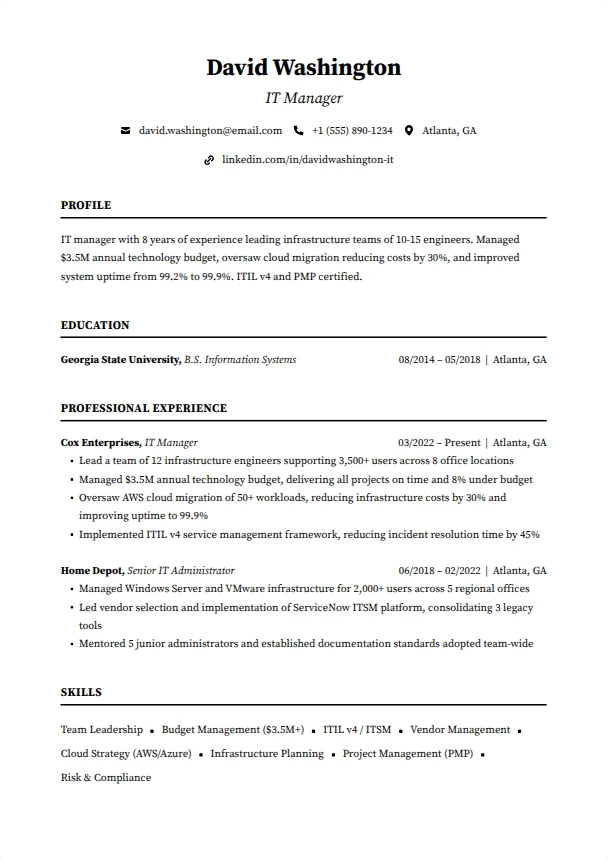
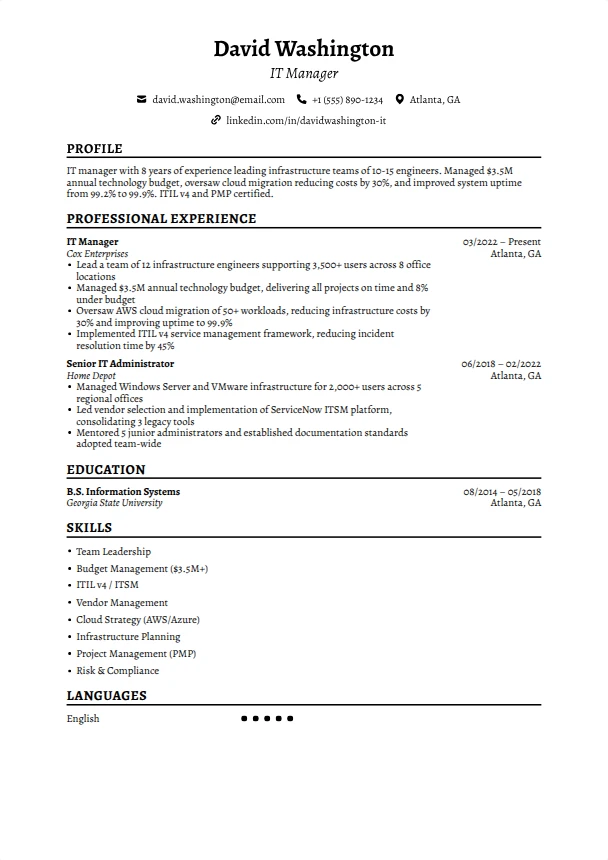
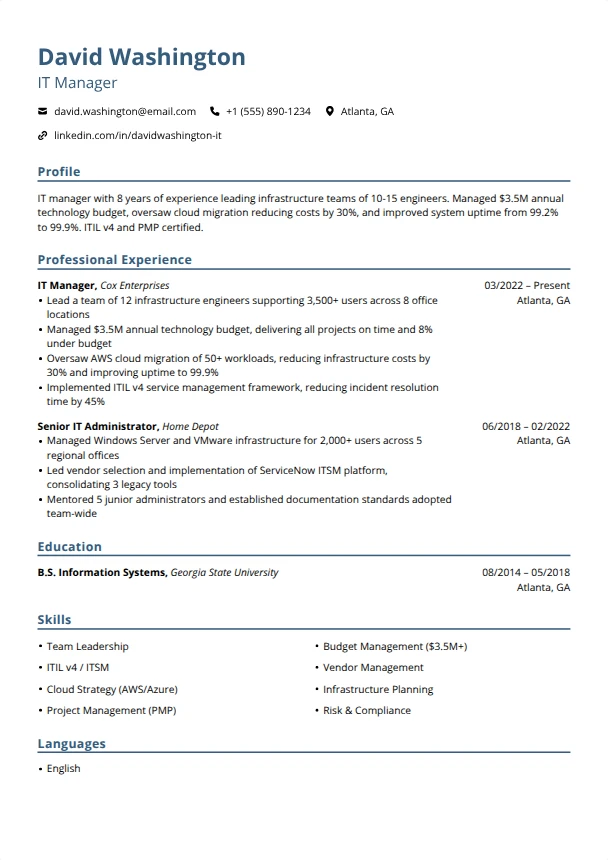
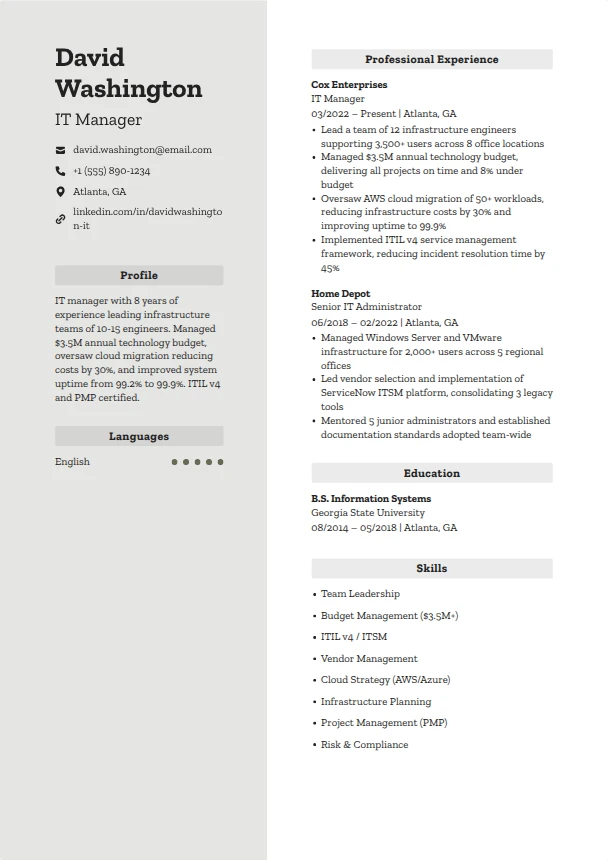
Strong: "IT manager with 8 years of experience leading infrastructure teams of 10-15 engineers across 3 locations. Managed $3.2M annual technology budget and led cloud migration from on-prem Exchange and file servers to Microsoft 365 and Azure, reducing infrastructure costs by 40%. ITIL v4 and PMP certified."
3. Certifications & credentials
For IT managers, certifications signal both technical depth and leadership capability. ITIL, PMP, and cloud certifications (AWS SAA, Azure Administrator) are the most valued combination.
PMP (2024) · ITIL v4 Foundation (2023) · AWS Solutions Architect Associate (2025) · CompTIA Security+ (2022)
4. Technical skills
Group by category but emphasize management-relevant skills: ITSM tools, project management, cloud platforms, and security frameworks. IT managers need to show technical fluency without looking like they belong in a hands-on engineering role.
Leadership: Team Management, Vendor Negotiations, Budget Planning, Strategic Roadmapping
ITSM: ServiceNow, Jira, ITIL v4, SLA Management
Infrastructure: AWS, Azure, VMware, Active Directory, Microsoft 365
Security: ISO 27001, SOC 2, Disaster Recovery, Business Continuity
5. Work experience
Reverse chronological. Every bullet should demonstrate leadership: team outcomes, budget decisions, vendor negotiations, strategic projects, and KPI improvements. Quantify everythingteam size, budget managed, SLA improvements, cost savings.
Strong: "Led 12-person IT team supporting 1,800 employees across 4 offices. Renegotiated $1.5M in vendor contracts (Cisco, Dell, Microsoft EA), saving $280K annually. Improved SLA compliance from 82% to 97% by restructuring the support tier system and implementing ServiceNow automation."
6. Education
Degree, school, graduation year. At the management level, an MBA or MS in IT Management is a differentiator but not required. PMP and ITIL certifications often carry more weight for IT manager roles specifically.
Key skills to include
These are the most in-demand skills for IT manager roles in 2026. Balance technical fluency with leadership and strategic skillsthis is what distinguishes a manager resume from a senior engineer resume.
Tip: IT manager postings vary widely. Some want a hands-on technical lead, others want a strategic business partner. Read the posting carefully and adjust whether you lead with technical skills or leadership skills accordingly.
Resume summary examples you can steal
Use one as a starting point, then swap in your own technologies, numbers, and achievements.
"IT team lead with 5 years of systems administration experience and 2 years leading a 4-person support team. Implemented ITIL-based incident management process that reduced average resolution time by 30%. Managed $400K annual hardware and software budget. PMP certified and ready to scale into a full IT manager role."
Why it works: Shows progression from technical to leadership, quantified process improvement, budget experience, relevant certification.
"IT manager with 7 years of experience leading infrastructure and support teams of 8-12 engineers. Managed $2.5M annual technology budget across hardware, software, and managed services. Led successful migration from on-prem Exchange to Microsoft 365 for 2,000 users with zero business-day downtime. ITIL v4 and PMP certified."
Why it works: Team scale, budget ownership, strategic migration project, zero-downtime metric, dual certifications.
"IT director with 12+ years of progressive leadership experience managing 30+ technical staff across infrastructure, security, and application support. Oversaw $8M annual technology budget and led 3-year digital transformation program that consolidated 5 legacy systems into a unified cloud platform, saving $1.5M annually. MBA and ITIL v4 Expert certified."
Why it works: Director-level scale, massive budget, multi-year transformation, clear cost impact, executive credentials.
"Senior systems engineer transitioning to IT management with 8 years of technical experience and 2 years informally leading a 5-person infrastructure team. Led $600K server refresh project on time and under budget. Mentored 3 junior engineers through promotion cycles. PMP certified and passionate about building high-performing technical teams."
Why it works: Technical credibility, informal leadership quantified, project management, mentorship track record.
Writing strong experience bullets
Every bullet point should answer: "What did you do, and why did it matter?" Use this formula:
Before and after examples:
Managed the IT team and handled day-to-day operations.
Led 12-person IT team supporting 1,800 employees across 4 offices, achieving 99.8% infrastructure uptime and improving SLA compliance from 82% to 97% within the first year.
Worked on the budget and negotiated with vendors.
Managed $3.2M annual technology budget, renegotiating enterprise agreements with Microsoft, Cisco, and Dell that reduced annual spend by $340K while upgrading service tiers.
Led the cloud migration project for the company.
Directed cloud migration of 60 on-prem workloads to AWS and Microsoft 365 over 9 months, eliminating 2 physical data centers and reducing hosting costs by $500K annually. Zero critical incidents during transition.
Strong action verbs for it manager resumes:
Led · Managed · Directed · Oversaw · Negotiated · Restructured · Implemented · Modernized · Consolidated · Mentored · Budgeted · Standardized · Streamlined · Migrated · Delivered · Partnered · Evaluated · Championed
6 mistakes that get it manager resumes rejected
Writing a resume that reads like a senior engineer's
If every bullet describes technical tasks (configured servers, wrote scripts, patched systems), you're positioning yourself as an IC, not a manager. Lead with team outcomes, budget impact, and strategic initiatives.
Not quantifying team size and budget
Managing a 3-person team with a $200K budget is a different job than managing 20 people with $5M. Always include: direct reports, total team size, budget amount, number of users supported, and locations covered.
Omitting vendor management experience
Vendor negotiations are a core IT manager skill. If you've negotiated contracts with Microsoft, Cisco, AWS, Dell, or MSPs, include the dollar amounts and savings achieved. This is leadership experience.
Burying strategic projects below operational duties
Cloud migrations, infrastructure modernization, security overhaulsthese are the bullets that get you interviews. Put transformative projects first in each role, with operational achievements second.
Forgetting to mention KPI improvements
SLA compliance, uptime percentage, ticket resolution time, employee satisfaction scores IT managers are measured by KPIs. If you improved any metric, it deserves a bullet with before/after numbers.
Using a one-page resume when two pages are warranted
Unlike entry-level roles, IT manager positions often expect a two-page resume. If you have 8+ years of experience with leadership, certifications, and strategic projects, using two pages shows substance, not padding.
What to do if you have no professional experience
No formal management title doesn't mean no leadership experience. Here's how to position yourself for your first IT manager role:
Highlight informal leadership
If you've mentored junior engineers, led project teams, or coordinated across departments, that's leadership experience. Frame it: ' Led 4-person project team for network refresh across 3 offices'sounds like management because it is.
Get PMP or ITIL certified
PMP and ITIL v4 Foundation are the two most recognized credentials for IT management. They signal you understand project management methodology and IT service deliveryboth critical for the role.
Quantify any budget or vendor responsibility
Even if you weren't the budget owner, if you researched vendors, recommended purchases, or managed a project budget, include it. ' Evaluated and recommended $150K storage solution, managing vendor selection process'demonstrates business judgment.
Demonstrate process improvement
Managers fix processes. If you've implemented a new ticketing workflow, created documentation standards, or improved SLA compliance even without a manager titlelead with those achievements.
Frequently asked questions
How long should an IT manager resume be?
Two pages is standard for IT manager roles with 7+ years of experience. You need space for leadership scope, budget details, strategic projects, and certifications. If you're under 7 years, one strong page is fine. Never go past two pages.
Should I include technical skills on an IT manager resume?
Yes, but frame them as management-level fluency rather than hands-on expertise. List platforms you oversee (AWS, Azure, VMware), ITSM tools you manage (ServiceNow, Jira), and frameworks you implement (ITIL, ISO 27001). Skip granular CLI commands and scripting details.
Do I need a PMP certification for IT management?
Not always required, but it's the most recognized project management credential for IT leaders. If you're competing for roles at mid-to-large companies, PMP significantly strengthens your candidacy. ITIL v4 is equally valued for service-delivery-focused roles.
How do I show leadership on a resume without a management title?
Focus on outcomes, not titles. ' Led cross-functional team of 6 for infrastructure migration'and ' Mentored 3 junior engineers through promotion to mid-level'are leadership achievements regardless of your official title. Use verbs like led, directed, mentored, coordinated, and managed.
Should I include salary expectations on my IT manager resume?
Never include salary on your resume. Discuss compensation during the interview process after you've demonstrated your value. If the application requires a salary range, research market rates on Glassdoor, Levels.fyi, or Blind first.
Skip the blank page
Open a complete, filled-in IT manager resume in our free builder. Swap in your own details, keep the wording that fits, and download as PDF, free.
Build your IT manager resume now
Pick an ATS-friendly template, add your leadership experience and strategic achievements, and download a polished PDF in minutes. Free, no account required.
Start Building, It's FreeRelated resume guides
General IT resume for sysadmin, infrastructure, and networking roles.
Multi-cloud architecture, Ia C, migration, and cost management across AWS, Azure, and GCP.
CI/CD pipelines, containers, Kubernetes, Terraform, and deployment automation.
Security certifications, threat analysis, incident response, and compliance.
More resume examples: