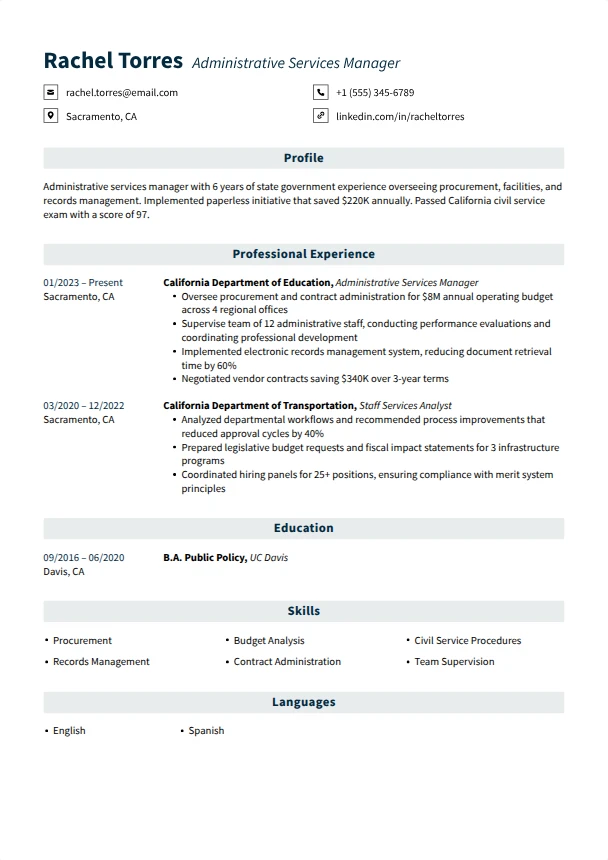
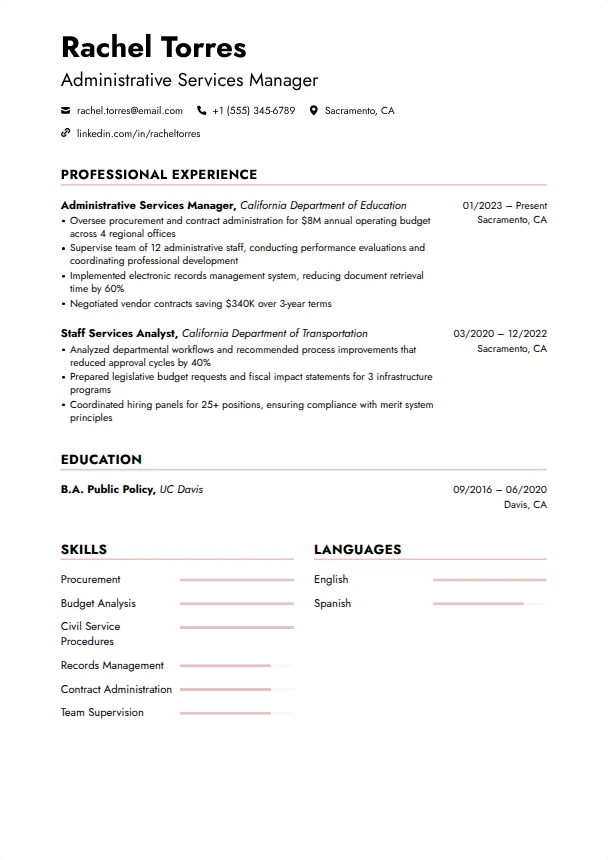
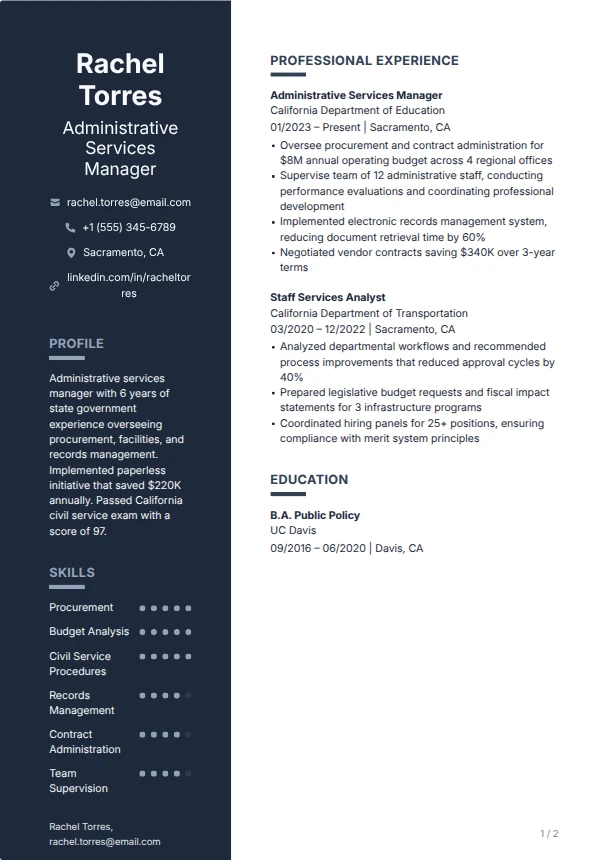
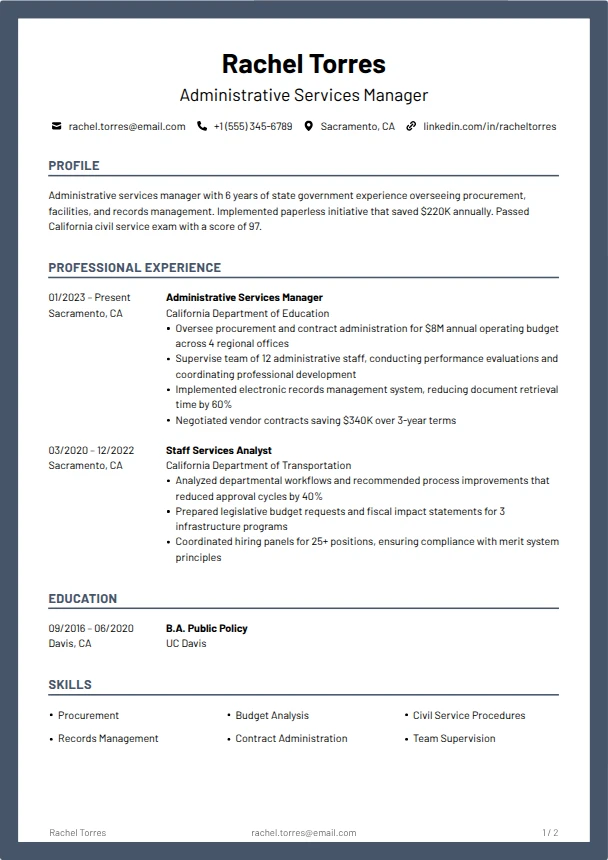
What hiring managers actually look for
Government hiring managers across federal, state, and local agencies share a common screening approach. They look for three things before evaluating your qualifications:
-
1
Direct alignment with the job posting requirements. Government HR departments use structured evaluation criteria. At the federal level, this means specialized experience requirements. At the state and local level, it often means minimum qualifications tied to civil service classification codes. Your resume must clearly demonstrate that you meet every listed requirement, or you will not advance past the first screen.
-
2
Proper formatting and complete information. Government applications are processed by HR specialists following strict checklists, not by hiring managers skimming for interesting candidates. Missing a required field (dates, hours per week, supervisor info at the federal level, or exam scores and license numbers at the state level) is enough to disqualify an otherwise strong application.
-
3
Public-sector awareness and mission orientation. Government hiring panels value candidates who understand the public service context. This means demonstrating experience with accountability, regulatory compliance, constituent services, and taxpayer-funded program management. Even if your background is in the private sector, framing your experience around public outcomes makes a meaningful difference.
If your resume communicates these things in the first 7-second scan, you'll make it to the detailed read. Everything below is about making that happen.
How to structure your resume, section by section
The order matters. Here's what a strong government resume looks like from top to bottom:
1. Contact header
Full name, complete mailing address, email, phone number, and citizenship status. For federal applications, also include veteran's preference status, highest GS grade held, and security clearance level. For state and local positions, include any civil service exam scores, list numbers, or employee ID numbers if you are a current government employee.
David R. Nakamura
456 Oak Street, Sacramento, CA 95814
[email protected] · (555) 678-9012
U.S. Citizen · CA State Civil Service Exam Score: 95.2 (List #4821)
Current State Employee: Department of Finance, Employee ID: ST-88421
2. Professional summary
A 2-4 sentence overview tailored to the specific level of government you are targeting. For federal roles, mirror the specialized experience language. For state and local roles, reference the job classification and emphasize relevant program experience. Always include years of public-sector experience, areas of specialization, and a key accomplishment.
Strong: "Public administration professional with 9 years of combined state and local government experience in budget analysis, program evaluation, and intergovernmental affairs. Currently serving as Senior Budget Analyst for the California Department of Finance, managing a $340M portfolio across 4 program areas. Developed a zero-based budgeting pilot that saved $4.2M in the first fiscal year."
3. Work experience
Reverse chronological order with comprehensive detail. For federal positions, include GS grade/series, hours per week, supervisor info, and agency address. For state positions, include your classification title, bargaining unit (if applicable), and department. For local government, include the municipality, department, and any civil service title. Use 4-8 detailed bullets per role that emphasize compliance, accountability, and measurable outcomes.
Senior Budget Analyst, Range C
California Department of Finance, Budget Division
915 L Street, Sacramento, CA 95814
January 2020 to Present · 40 hours/week
Supervisor: Maria Santos, (555) 321-7654, may contact
- Developed and monitored annual budget proposals for 4 program areas totaling $340M, coordinating with 12 department liaisons to reconcile expenditure projections with legislative priorities
- Created automated variance reports using Power BI and SAP, reducing manual reporting effort by 65% and improving forecast accuracy by 18%
4. Education
Degree, institution, graduation date, and GPA if above 3.0. For federal positions with positive education requirements, this section determines basic eligibility. For state and local positions, check whether the job announcement specifies degree requirements or allows experience substitution. Include relevant coursework if it directly supports the target position's classification requirements.
Master of Public Administration
University of Southern California, Los Angeles, CA
Graduated May 2016 · GPA: 3.6/4.0
Concentration: Public Financial Management
5. Skills / Certifications
List government-relevant certifications, software proficiencies, and specialized training. Include state-specific certifications (e.g., Certified Public Manager), federal certifications (FAC-C, PMP), and technical skills relevant to your target role. Language skills with proficiency levels are especially valuable for constituent-facing roles.
Key skills to include
Government positions span a wide range of functions. Tailor your skills list to the specific role, but these competencies are valued across most public-sector positions:
Tip: State and local government job postings often use classification-specific language. Search your state's civil service website for the job classification standard (e.g., California's 'CalHR Class Specs') and use that exact terminology in your skills section.
Resume summary examples you can steal
Use one as a starting point, then swap in your own technologies, numbers, and achievements.
"Public-sector executive with 18 years of progressive government experience spanning federal (GS-14) and state (Deputy Director level) service. Expert in multi-agency program oversight, legislative affairs, and organizational transformation. Directed a 45-person division that modernized the state's permitting system, reducing processing times by 52% and generating $8M in additional annual revenue through improved fee collection."
Why it works: Shows career progression across government levels, quantifies team size and impact, and demonstrates both operational and strategic expertise.
"Program Manager with 8 years of state government experience at the Department of Social Services, specializing in benefits administration and compliance oversight. Managed a caseload portfolio of 12,000 clients across 3 county offices, implementing quality assurance protocols that increased eligibility determination accuracy from 87% to 96%. Certified Public Manager (CPM) with advanced proficiency in SACWIS and CalSAWS systems."
Why it works: Names the specific department and program area, quantifies scale with caseload numbers, shows measurable improvement, and lists government-specific credentials.
"Recent MPA graduate with practicum experience at the City of Portland Bureau of Planning and Sustainability. Conducted community engagement analysis for the city's comprehensive land use plan update, collecting and synthesizing input from 1,200 residents across 8 neighborhood associations. Proficient in GIS mapping, survey design, and public meeting facilitation. Passed the State of Oregon civil service examination with a score of 97."
Why it works: Highlights government-specific practicum experience, quantifies outreach scope, lists relevant tools, and includes the civil service exam score that demonstrates eligibility.
"Private-sector financial analyst transitioning to government budget analysis with 12 years of experience in financial modeling, variance analysis, and compliance reporting for Fortune 500 companies. Managed annual budgets exceeding $75M and led SOX compliance initiatives across 3 business units. Completed the Government Finance Officers Association (GFOA) training certificate and hold an active CPA license."
Why it works: Translates corporate finance experience into government-relevant terms, quantifies budget scope, and shows proactive steps toward public-sector readiness through GFOA certification.
Writing strong experience bullets
Every bullet point should answer: "What did you do, and why did it matter?" Use this formula:
Before and after examples:
Handled budget requests and tracked spending for the department.
Prepared, justified, and monitored the department's $24M annual operating budget, conducting monthly variance analyses and presenting quarterly expenditure reports to the agency director and legislative budget committee. Identified $1.6M in projected overruns and implemented corrective spending plans that brought all 7 cost centers within 2% of allocation by fiscal year end.
Helped with hiring and onboarding new employees.
Administered the full recruitment lifecycle for 35 merit-system positions annually, including job analysis, exam development, eligible list certification, and appointment processing in compliance with civil service Rule 2.0. Reduced average time-to-fill from 94 days to 61 days by streamlining panel interview scheduling and reference verification workflows.
Responded to public inquiries and complaints.
Managed constituent services for a district of 180,000 residents, responding to an average of 120 inquiries per week across phone, email, and in-person channels. Implemented a case tracking system that improved resolution time by 40% and increased constituent satisfaction scores from 72% to 89% in annual surveys.
Strong action verbs for government resumes:
Administered, Allocated, Analyzed, Audited, Certified, Coordinated, Developed, Enforced, Evaluated, Facilitated, Formulated, Implemented, Investigated, Managed, Monitored, Negotiated, Oversaw, Recommended, Regulated, Reviewed, Streamlined
5 mistakes that get government resumes rejected
Using a private-sector resume format without modification
A polished one-page resume with creative formatting may work in the private sector, but government HR systems require specific information fields and detailed experience descriptions. Fancy designs can also break applicant tracking system parsing. Use a clean, text-based format with all required data points for the level of government you are targeting.
Failing to address the specific minimum qualifications
Government job postings list exact minimum qualifications tied to civil service classifications. If the posting requires 'two years of professional analytical experience in a governmental setting,' your resume must clearly show that experience with dates, hours, and descriptions that match. Reviewers cannot infer or assume your qualifications.
Omitting civil service exam scores or list numbers
Many state and local government positions require you to pass a civil service examination before you can be considered. If you have an active exam score or list number, include it in your resume header. Without it, the hiring department may not be able to pull your application from the eligible list, even if you applied through the portal.
Writing vague bullets without measurable outcomes
Government hiring panels score candidates on demonstrated competency. Bullets like 'responsible for program management' give the panel nothing to score. Instead, state the program name, budget, number of staff or clients, regulatory framework, and the specific result of your work.
Not tailoring the resume for each application
Government job classifications vary significantly even within the same agency. A Budget Analyst position at the state level may emphasize legislative fiscal analysis, while the same title at the county level may focus on departmental cost accounting. Read each announcement thoroughly and adjust your summary, skills, and bullet emphasis to match the specific requirements.
What to do if you have no professional experience
Government agencies at every level have pathways for candidates without prior public-sector experience. The key is understanding which entry points match your background and how to present your qualifications in government-compatible language.
Start with entry-level civil service exams
Most state and local governments use competitive examinations to establish eligible lists. These exams are often open to the public regardless of experience. Start by visiting your state's civil service website (e.g., CalCareers for California, StateJobsNY for New York) and taking exams in your areas of interest. A high score can place you on a hiring list even without direct government experience.
Apply to federal Pathways or student programs
The federal Pathways Program offers three tracks: Internship (current students), Recent Graduates (within 2 years of graduation), and Presidential Management Fellows (advanced degree holders). These programs have lower experience requirements and provide structured development paths. Many state governments run similar intern-to-hire programs.
Reframe private-sector experience using government language
If you managed a budget, you have 'budget formulation and execution experience.' If you ensured your company followed regulations, you have 'compliance oversight experience.' Review the OPM qualification standards for your target federal series or your state's classification specifications, then rewrite your bullets using that exact vocabulary.
Gain experience through boards, commissions, and volunteer service
Many local governments appoint volunteer members to planning commissions, budget advisory committees, and citizen review boards. This experience counts as legitimate government experience on your resume. It also builds your network within the agency and demonstrates your commitment to public service, which hiring panels genuinely value.
Frequently asked questions
What is the difference between a federal resume and a state government resume?
Federal resumes follow USAJOBS formatting requirements and must include specific fields like GS grade, series number, hours per week, and supervisor contact information for every position. They are typically 2-5 pages. State government resumes follow the requirements of that state's civil service system, which varies significantly. Some states use their own online portals with structured fields, while others accept uploaded resumes. State resumes are generally 1-3 pages and may require exam scores or list numbers instead of the detailed federal employment data.
Do I need to pass an exam to get a government job?
It depends on the level of government. Federal positions generally do not require written exams (they use self-assessment questionnaires and resume-based evaluation). However, most state and many local government positions require competitive civil service examinations. These can be written tests, structured interviews, performance assessments, or a combination. Check the specific job announcement for exam requirements and registration deadlines.
How does the merit system affect my application?
The merit system requires that government employees be hired and promoted based on qualifications, not political connections. In practice, this means hiring follows a structured process: job announcement, qualification screening, scoring/ranking, eligible list certification, interview, and selection. Your resume must score well at the screening and ranking stages. You cannot skip steps, and hiring managers typically must select from the top tier of ranked candidates.
Can I apply to government jobs in other states?
Yes, most state government positions are open to all U.S. citizens, though some may give preference to state residents or require you to establish residency within a certain timeframe after hiring. You will need to take that state's civil service exam if required. Federal positions are open to all citizens regardless of state. Check each posting for any residency or relocation requirements.
How long does the government hiring process take?
Federal hiring typically takes 80-120 days from the announcement closing date to a tentative job offer, though it can take longer for positions requiring security clearances. State government hiring timelines vary, with most taking 30-90 days after the application deadline. Local government can be faster, sometimes 2-4 weeks for urgent hires. Factor these timelines into your job search and do not wait to apply to multiple positions simultaneously.
Skip the blank page
Open a complete, filled-in veteran-to-civilian resume in our free builder. Swap in your own details, keep the wording that fits, and download as PDF, free.
Build your government resume in minutes
Pick a template, fill in your details, and download a polished government resume ready to submit.
Start Building, It's FreeRelated resume guides
Detailed guide focused specifically on USAJOBS applications and federal hiring requirements.
How to translate military service into a compelling government resume.
Targeted advice for Army veterans transitioning to government civilian roles.
More resume examples: