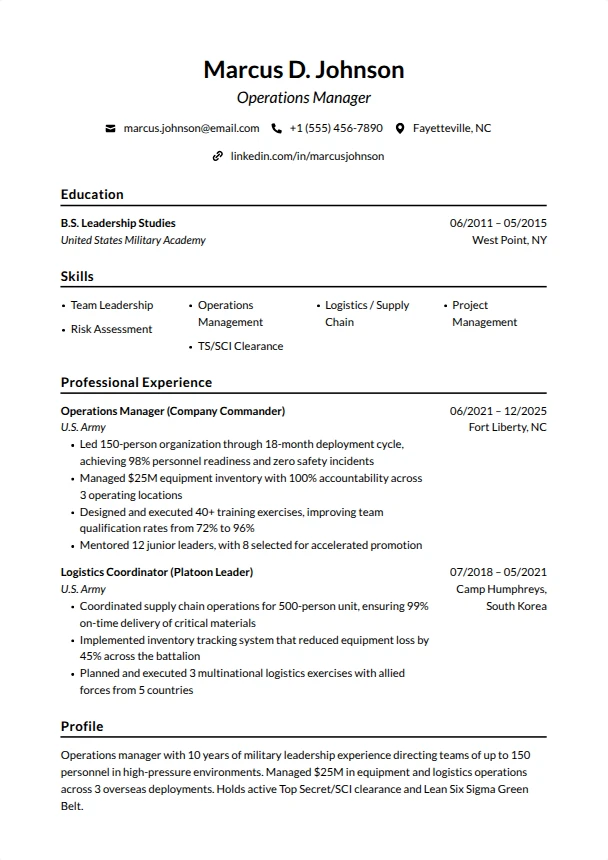
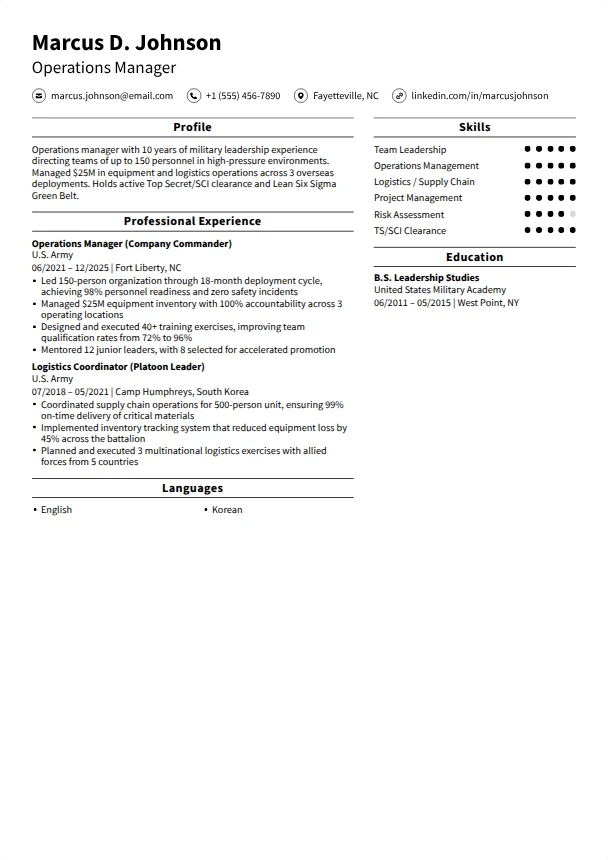
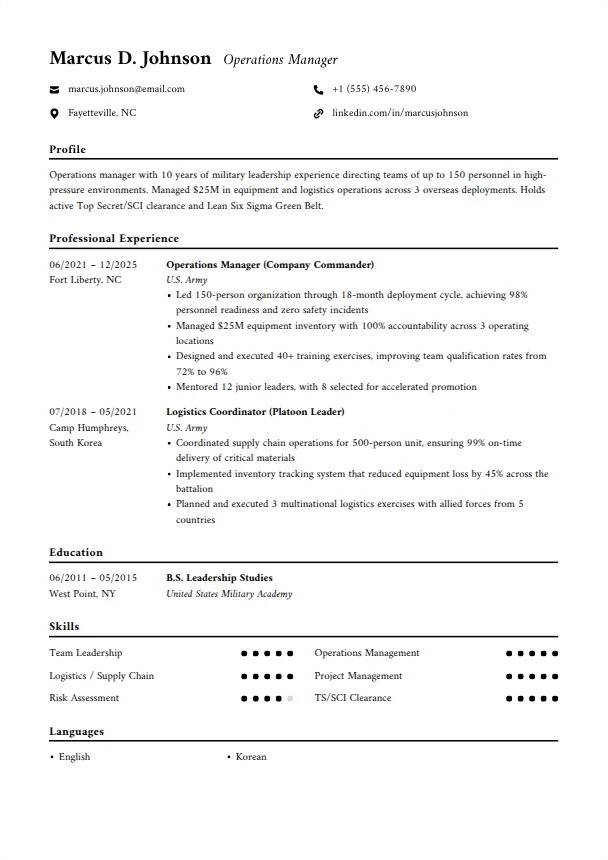
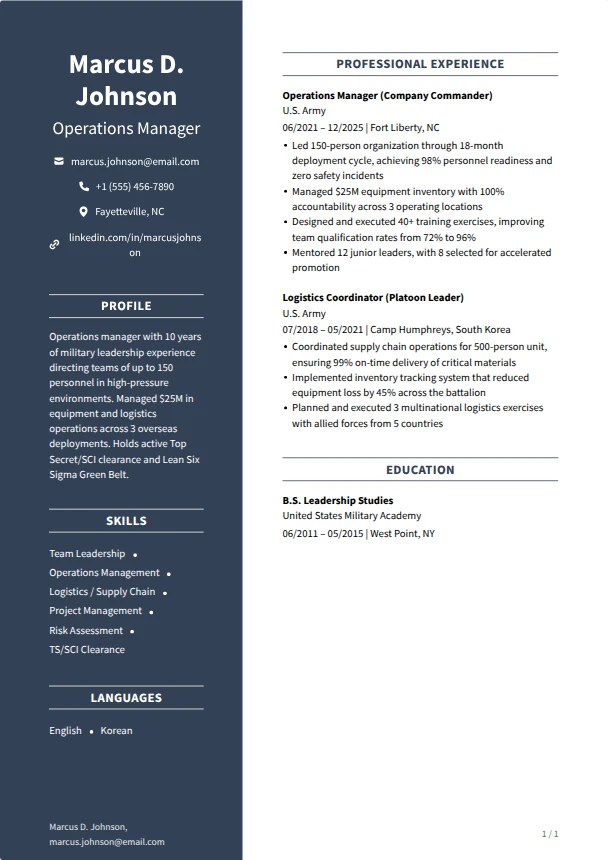
What hiring managers actually look for
Civilian hiring managers want to hire veterans. They respect the discipline and leadership. But they won't decode your resume for you. Here's what they scan for:
-
1
Civilian-readable job titles and responsibilities. A recruiter doesn't know what an E-7 or an 11B does. They need to see titles like 'Operations Manager' or 'Logistics Coordinator' and responsibilities described in plain business language. If your resume reads like a military evaluation, it gets skipped.
-
2
Quantified leadership and operational scope. Military experience is full of metrics that impress civilian employers: team sizes, budget values, equipment worth, completion rates, training hours delivered. Pull those numbers from your evaluations and put them front and center.
-
3
Security clearances and compliance experience. An active Secret or Top Secret/SCI clearance is worth tens of thousands of dollars to defense contractors and government agencies. List it prominently. Also highlight any experience with compliance frameworks, inspections, or regulatory standards.
If your resume communicates these things in the first 7-second scan, you'll make it to the detailed read. Everything below is about making that happen.
How to structure your resume, section by section
The order matters. Here's what a strong military resume looks like from top to bottom:
1. Contact header
Full name, email, phone, city and state, LinkedIn URL. Do not include your rank in your name line. Skip your military email address and use a professional civilian one.
James Carter · [email protected] · (555) 412-7890 · San Antonio, TX
linkedin.com/in/jamescarter-ops
2. Professional summary (2-3 sentences)
Translate your military identity into a civilian value proposition. Lead with years of experience, your core expertise in civilian terms, team sizes you managed, and your strongest measurable achievement. Mention your clearance level here if relevant to the target role.
Strong: "Operations manager with 8 years of leadership experience overseeing teams of 30+ personnel and $12M in equipment across high-pressure environments. Secret clearance (active). Directed logistics for 3 large-scale deployments, consistently completing missions ahead of schedule and under budget."
3. Security clearance and certifications
If you hold an active clearance, this section should appear near the top. List the clearance level, investigation date, and status. Below that, add any certifications you earned during or after service: PMP, CAPM, CompTIA Security+, CDL, OSHA, or any MOS-related credentials that have civilian equivalents.
Secret Clearance (Active, SSBI 2024) · PMP (2025) · CompTIA Security+ (2024) · OSHA 30-Hour (2023)
4. Skills section
Group your skills into categories that make sense for civilian roles: Leadership, Operations, Technical, and Compliance. Translate every military skill into its civilian equivalent. 'Convoy operations' becomes 'fleet logistics coordination.' 'Battle damage assessment' becomes 'incident assessment and reporting.'
Leadership: Team management (30+ direct reports), cross-functional coordination, performance evaluation, training program design
Operations: Logistics planning, supply chain management, inventory control ($12M+ assets), resource allocation
Technical: Microsoft Office Suite, SAP, fleet management systems, radio communications, GPS/mapping tools
Compliance: Safety inspections, regulatory audits, hazardous materials handling, OSHA standards
5. Work experience
Use civilian job titles with your military title in parentheses if needed. For each role, list the branch, unit type (not the unit number), dates, and 3-5 achievement bullets. Use the formula: Action verb + what you did in civilian terms + measurable result. Pull metrics from your NCOERs, OERs, or award citations.
Strong: "Operations Supervisor (Staff Sergeant), U.S. Army, Logistics Unit, 2019-2024<br>Managed daily operations for a 35-person logistics team, coordinating supply distribution across 4 locations. Reduced equipment downtime by 28% through a preventive maintenance tracking system. Trained 12 new team members, achieving a 100% qualification rate within 60 days."
Key skills to include
These are the most transferable military skills mapped to civilian job postings. Choose the ones that match your MOS and the roles you're targeting.
Tip: Use a military skills translator tool (like the one on Military.com or O*NET) to find the exact civilian keywords for your MOS. Then match those keywords to the language in the job posting. ATS systems match keywords literally, so 'supply chain management' and 'logistics' are treated as different terms.
Resume summary examples you can steal
Use one as a starting point, then swap in your own technologies, numbers, and achievements.
"Operations supervisor with 10 years of military leadership experience managing 40+ personnel across logistics, maintenance, and security functions. Directed $8M in equipment readiness and achieved a 98% operational availability rate. PMP certified. Secret clearance (active). Seeking to apply operational planning and team leadership skills in a civilian operations management role."
Why it works: Translates rank into a civilian title, quantifies scope, highlights clearance and certification.
"IT support specialist with 4 years of experience maintaining communications and network systems in military environments. CompTIA Security+ and Network+ certified. Managed 200+ endpoints and provided Tier 2 troubleshooting for classified and unclassified networks. Active Secret clearance."
Why it works: Leads with the civilian role, quantifies the environment, and puts the clearance where defense contractors will see it.
"Program manager with 12 years of experience leading cross-functional teams of 50-120 personnel through complex, time-sensitive operations. Managed annual operating budgets exceeding $15M and delivered 6 major organizational initiatives on schedule. MBA and PMP certified. Top Secret/SCI clearance (active)."
Why it works: Reads like a senior civilian resume, not a military bio. Budget figures and team sizes speak a language every hiring manager understands.
"Logistics coordinator with 6 years of military supply chain experience and 2 years of civilian warehouse operations. Managed inbound and outbound shipping for 500+ line items daily, reducing order processing time by 22%. Forklift certified, OSHA 30-Hour trained, CDL Class A holder."
Why it works: Bridges military and civilian experience, includes hands-on certifications, and quantifies daily throughput.
Writing strong experience bullets
Every bullet point should answer: "What did you do, and why did it matter?" Use this formula:
Before and after examples:
Served as NCOIC for motor pool operations and maintained vehicle fleet readiness.
Managed a 45-vehicle fleet valued at $6.2M, implementing a preventive maintenance schedule that increased operational readiness from 85% to 97% over 12 months.
Conducted training for soldiers on weapons systems and tactical procedures.
Designed and delivered a 120-hour training program for 60 personnel on equipment operation and safety procedures, achieving a 100% certification pass rate across all participants.
Responsible for supply and logistics for the battalion.
Coordinated supply chain logistics for a 600-person organization across 3 locations, processing 200+ requisitions monthly and reducing fulfillment delays by 35% through an improved tracking system.
Strong action verbs for military resumes:
Managed · Coordinated · Directed · Supervised · Trained · Implemented · Planned · Executed · Delivered · Maintained · Oversaw · Streamlined · Reduced · Achieved · Led · Developed · Analyzed · Secured
5 mistakes that get military resumes rejected
Using military jargon without translation
Terms like 'NCOIC,' 'BDE,' 'S-4,' and 'METL' mean nothing to a civilian recruiter. Every piece of military terminology on your resume needs a civilian equivalent. If you wouldn't say it in a job interview at a private company, don't write it on your resume.
Leading with rank instead of job function
Your rank tells a military person your pay grade and authority level. A civilian hiring manager needs to see 'Operations Manager' or 'Training Coordinator,' not 'E-7' or 'O-3.' Use civilian titles and put the military equivalent in parentheses if needed.
Writing your resume like a military evaluation
NCOERs and OERs use a specific style that doesn't translate well to resumes. Phrases like 'performed duties in a manner consistent with the highest standards' are filler in the civilian world. Replace them with specific, measurable achievements.
Forgetting to list your security clearance
An active Secret or TS/SCI clearance is one of the most valuable assets a veteran has. It costs employers $5,000 to $50,000 to sponsor a new clearance investigation. List yours prominently near the top of your resume, including the type, status, and investigation date.
Not using Veterans' Preference for federal applications
If you're applying for federal jobs, you may be eligible for 5-point or 10-point Veterans' Preference. This is a concrete hiring advantage, but you need to include it in your federal resume and attach your DD-214. Don't leave points on the table.
What to do if you have no professional experience
Just separated and have zero civilian work history? That's actually normal. Here's how to position yourself:
Translate your MOS into a civilian job title
Use tools like O*NET, Military.com's MOS translator, or the VA's Military Skills Translator to find the civilian equivalent of your military occupation. An 88M (Motor Transport Operator) becomes 'Commercial Driver / Logistics Specialist.' A 25B (Information Technology Specialist) becomes 'IT Support Technician.' Use the civilian title on your resume.
Leverage TAP and military transition resources
The Transition Assistance Program (TAP) offers resume workshops, career counseling, and job placement help. Organizations like Hire Heroes USA, American Corporate Partners, and your branch's transition office can review your resume and connect you with employers who actively recruit veterans.
Get civilian certifications that match your MOS
Many military skills have direct civilian certification equivalents. Use your GI Bill or credentialing assistance funds to earn them: CompTIA Security+ for cyber roles, CDL for transportation, PMP for project management, EMT for medical. These certifications bridge the gap between your military training and civilian job requirements.
Lead with transferable skills and training
Even without a civilian job title on your resume, you have leadership experience, problem-solving ability, and technical training that most entry-level candidates lack. Frame your military service using the same achievement bullet format as any other job: action verb, what you did in plain language, and the measurable result.
Frequently asked questions
Should I use a military resume or a federal resume format?
It depends on where you're applying. Private sector jobs need a standard one-page resume in civilian language. Federal jobs through USAJobs require a detailed federal resume format that's typically 3-5 pages and includes specific information like GS grade, hours per week, and supervisor contact details. They're fundamentally different documents.
How do I list my military experience on a civilian resume?
Use a civilian job title as the primary heading, with your military rank and branch in parentheses. For example: 'Operations Manager (Staff Sergeant, U.S. Army).' Then describe your responsibilities and achievements in plain business language with measurable results.
Should I include my DD-214 information on my resume?
Not directly on the resume itself. Your DD-214 is a supporting document. However, you should note your discharge status (Honorable Discharge) and service dates. For federal applications, you'll attach the DD-214 separately. For private sector, mention it only if the employer specifically requests proof of veteran status.
How valuable is a security clearance on a civilian resume?
Extremely valuable. An active TS/SCI clearance can make you eligible for roles that pay $20,000-$40,000 more than equivalent uncleared positions, especially with defense contractors and federal agencies. List it near the top of your resume with the clearance type, status, and most recent investigation date.
Can I qualify for Veterans' Preference in federal hiring?
Most veterans with an honorable or general discharge qualify for 5-point preference. Veterans with a service-connected disability may qualify for 10-point preference. This means your application score gets boosted during the federal hiring process. You'll need your DD-214 and, for 10-point preference, an SF-15 form and VA letter.
Skip the blank page
Open a complete, filled-in veteran-to-civilian resume in our free builder. Swap in your own details, keep the wording that fits, and download as PDF, free.
Build your military resume in minutes
Pick a template, fill in your details, and download a polished military resume ready to submit.
Start Building, It's FreeRelated resume guides
How to write a USAJobs-format federal resume with KSAs, series numbers, and proper formatting.
Army-specific MOS translation, NCOER achievements, and civilian career transition tips.
Post-service resume writing for veterans entering the civilian workforce.
More resume examples: