What hiring managers actually look for
Civilian hiring managers appreciate Army veterans, but they won't spend time decoding your resume. Here's what they look for in the first 10 seconds:
-
1
A clear civilian job title that matches the posting. If the posting says 'Warehouse Manager,' your resume should say 'Warehouse Manager,' not '92A Automated Logistical Specialist.' Use the civilian title as your primary heading and put your MOS in parentheses only if it adds value for defense contractors.
-
2
Numbers that prove the scale of your responsibility. The Army gives you access to incredible metrics: personnel managed, equipment values, completion rates, training hours. Civilian hiring managers want to see these numbers. 'Led a team' is weak. 'Led a 42-person platoon responsible for $18M in tactical vehicles' is concrete.
-
3
Active security clearance listed prominently. Defense contractors, government agencies, and cleared facilities need employees who already hold clearances. If you have an active Secret or Top Secret clearance, put it near the top of your resume. It can be the single biggest differentiator between you and a civilian candidate.
If your resume communicates these things in the first 7-second scan, you'll make it to the detailed read. Everything below is about making that happen.
How to structure your resume, section by section
The order matters. Here's what a strong army resume looks like from top to bottom:
1. Contact header
Full name (no rank), professional email, phone, city and state, and LinkedIn URL. Drop the military email. If you have a portfolio or professional website, include it.
Marcus Williams · [email protected] · (555) 398-4521 · Fayetteville, NC
linkedin.com/in/marcuswilliams-logistics
2. Professional summary (2-3 sentences)
Write this as if your reader has never heard of the Army. Lead with your civilian-equivalent title, years of experience, the scale of your responsibility, and your top achievement. Mention your clearance if relevant. Save the Army specifics for the experience section.
Strong: "Logistics and operations manager with 8 years of experience leading teams of 25-50 personnel in high-tempo environments. Managed supply chains supporting 600+ personnel across multiple locations, maintaining 99% inventory accuracy on $22M in assets. Secret clearance (active). PMP certification in progress."
3. Security clearance and certifications
Place this high on the resume, especially if you're targeting defense, government, or cleared private sector roles. Include clearance type, status, and investigation date. List Army training that has civilian equivalents: Lean Six Sigma, hazmat handling, first aid instructor, equal opportunity training.
Secret Clearance (Active, T3 investigation 2023) · Army Lean Six Sigma Green Belt (2024) · CompTIA Security+ (2025) · CDL Class A (2022)
4. Skills section
Group skills by category and translate every Army term. 'PMCS' becomes 'preventive maintenance inspections.' 'LOGPAC' becomes 'logistics supply coordination.' Match your skills to the language in the job posting so the ATS can find them.
Leadership: Team management (25-50 reports), performance evaluation, mentorship, conflict resolution
Logistics: Supply chain management, inventory control, distribution planning, fleet operations
Operations: Project planning, risk assessment, process improvement, after-action analysis
Technical: GCSS-Army (SAP-based ERP), Microsoft Office, GPS/mapping systems, radio communications
5. Work experience
List each assignment as a separate role with a civilian title, your rank and branch in parentheses, unit type (not unit number), location, and dates. Write 3-5 bullets per role using the achievement format. Pull numbers from your NCOERs, award citations, and counseling records.
Strong: "Operations Supervisor (Sergeant First Class, U.S. Army), Logistics Battalion, Fort Liberty, NC, 2021-2025<br>Supervised 42 logistics personnel across supply, transportation, and maintenance sections, supporting a 1,200-person brigade. Reduced equipment downtime by 31% through a restructured maintenance scheduling system. Selected over 6 peers for the Army's Senior Leaders Course."
Key skills to include
These are the highest-value Army skills translated into civilian terms. Select the ones that match your MOS and target job posting.
Tip: Look up your MOS on O*NET or Military.com's skills translator to find exact civilian keyword matches. A 91B (Wheeled Vehicle Mechanic) maps to 'Automotive Service Technician.' A 35F (Intelligence Analyst) maps to 'Intelligence Analyst' or 'Research Analyst.' Use the civilian titles that appear in actual job postings.
Resume summary examples you can steal
Use one as a starting point, then swap in your own technologies, numbers, and achievements.
"Operations supervisor with 10 years of Army leadership experience managing teams of 30-50 across logistics, maintenance, and security functions. Directed daily operations for a 1,000-person organization, maintaining 97% equipment readiness on $25M in assets. Secret clearance (active). Lean Six Sigma Green Belt certified."
Why it works: Reads like a civilian operations resume. Quantifies team size, asset value, and readiness rate without any Army jargon.
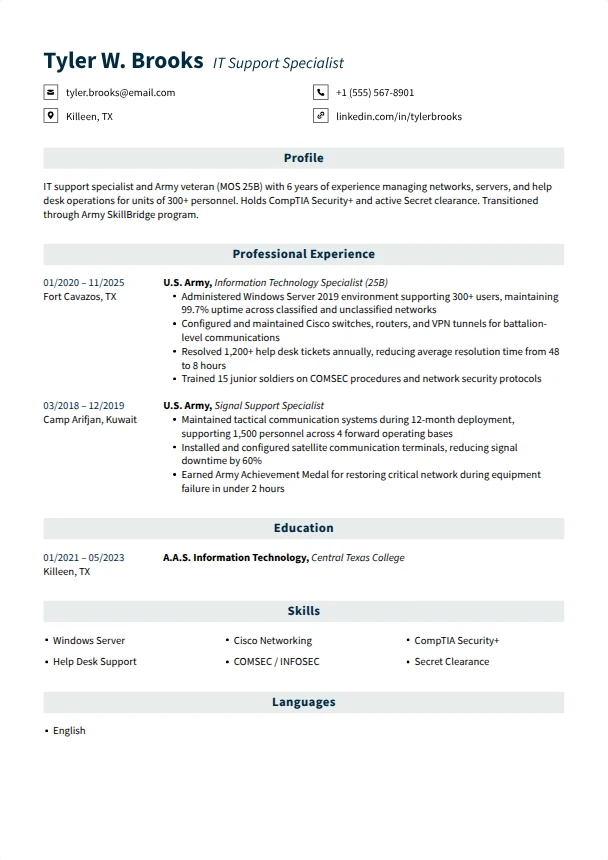
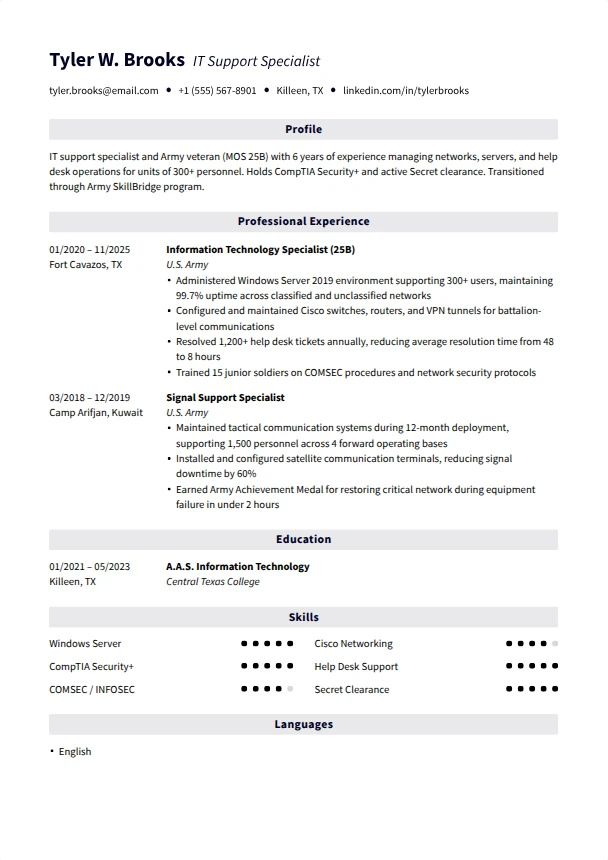
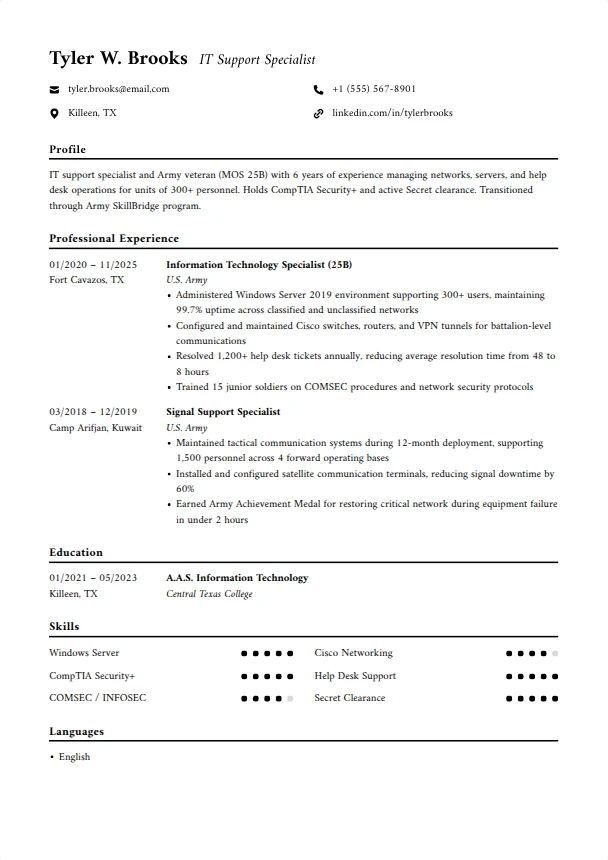
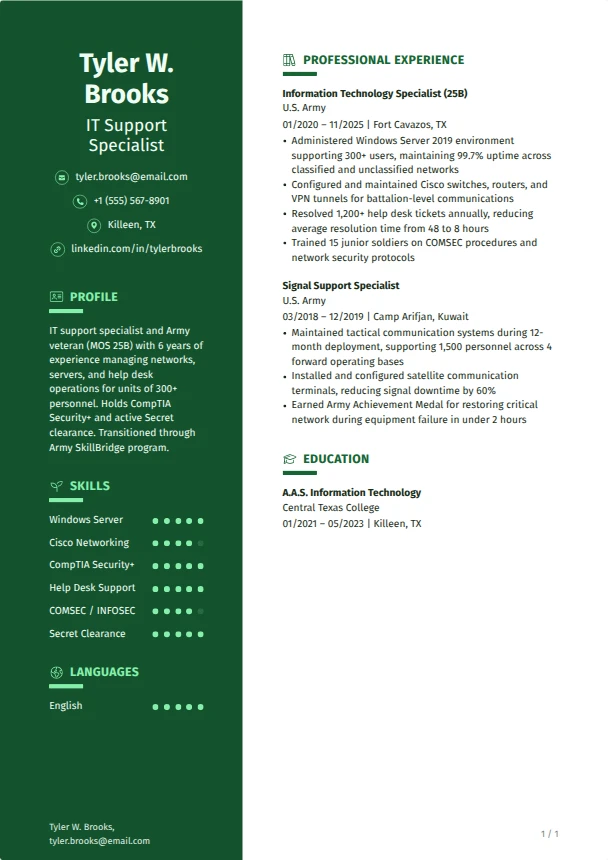
"IT systems administrator with 6 years of experience maintaining network infrastructure and communications systems in the U.S. Army. Managed 300+ endpoints across classified and unclassified networks. CompTIA Security+ and Network+ certified. Active Top Secret clearance with SCI eligibility."
Why it works: Uses civilian IT language, quantifies the environment, and highlights the clearance that defense contractors actively seek.
"Senior project manager with 15 years of experience leading multi-million dollar initiatives and cross-functional teams of 60-150 personnel. Delivered 8 organizational transformation projects on time and within budget. PMP and Lean Six Sigma Black Belt certified. Top Secret/SCI clearance (active)."
Why it works: Positions officer experience as executive project management. The certifications and clearance make this candidate competitive for senior roles immediately.
"Logistics coordinator with 4 years of Army supply chain experience managing inventory, shipments, and distribution for a 400-person unit. Maintained 100% accountability on $4.5M in equipment across 2 overseas deployments. Forklift certified, CDL Class A holder, OSHA 10-Hour trained."
Why it works: Translates junior enlisted experience into warehouse and logistics terms. Includes hands-on certifications that are immediately relevant to civilian employers.
Writing strong experience bullets
Every bullet point should answer: "What did you do, and why did it matter?" Use this formula:
Before and after examples:
Served as supply sergeant for a forward-deployed company. Maintained property book and conducted inventories IAW AR 710-2.
Managed a $9.4M equipment inventory for a 180-person organization across 2 locations, conducting quarterly audits and maintaining 100% accountability over a 24-month deployment cycle.
Trained soldiers on warrior tasks, battle drills, and individual weapon qualification.
Developed and delivered a 200-hour safety and operations training program for 45 personnel, achieving a 98% first-time qualification rate and zero workplace safety incidents over 18 months.
Performed PMCS on assigned vehicles and equipment. Ensured mission readiness of the motor pool.
Supervised preventive maintenance for a 30-vehicle fleet valued at $7.8M, implementing a digital tracking system that increased operational readiness from 88% to 96% and reduced unscheduled repairs by 40%.
Strong action verbs for army resumes:
Managed · Led · Coordinated · Supervised · Directed · Trained · Planned · Executed · Maintained · Implemented · Delivered · Streamlined · Reduced · Improved · Oversaw · Analyzed · Developed · Achieved
5 mistakes that get army resumes rejected
Using Army acronyms without explanation
NCOIC, BDE, BN, PMCS, GCSS-Army, AR 710-2. None of these mean anything to a civilian recruiter. Every acronym on your resume needs to be replaced with plain language or spelled out. If you have to use an Army term, define it in parentheses.
Listing your MOS code as your job title
Writing '11B Infantryman' or '92Y Unit Supply Specialist' as your job title forces the reader to guess what you do. Use the civilian equivalent: 'Security Operations Specialist' or 'Inventory and Supply Chain Manager.' Put the MOS in parentheses only if applying to defense sector roles.
Copying NCOER bullet language directly
NCOER bullets follow a specific Army writing style that sounds unnatural on a civilian resume. Phrases like 'demonstrated exceptional proficiency' and 'contributed to the overall mission success' are vague filler. Rewrite every bullet with a specific action, scope, and measurable outcome.
Including unit designations and deployment names
'1st Platoon, B Company, 2-503rd IN, 173rd ABCT' is meaningless to a civilian. Replace unit designations with descriptive terms: 'Airborne Infantry Battalion' or 'Logistics Support Company.' Skip operation names like OIR or OEF unless applying to defense roles.
Submitting a one-page resume for federal jobs
Private sector resumes should be one page for most candidates. But federal resumes submitted through USAJobs are a completely different format. They require 3-5 pages with specific details like hours worked per week, supervisor contact information, and detailed duty descriptions. Using the wrong format for the wrong application will get you rejected.
What to do if you have no professional experience
Leaving the Army with no civilian work history is the norm, not the exception. Here's how to build a strong resume from your service alone:
Translate your MOS into a civilian career path
Every Army MOS maps to one or more civilian occupations. A 68W (Combat Medic) maps to EMT or Paramedic. A 25B (IT Specialist) maps to Help Desk Technician or Systems Administrator. A 92A (Automated Logistical Specialist) maps to Inventory Manager or Supply Chain Analyst. Use O*NET or your Transition Assistance Program counselor to identify your best matches.
Use your Army training as certification equivalents
Many Army schools have civilian equivalents or can be converted to college credits through the American Council on Education (ACE). Your Army transcript (available through the Joint Services Transcript portal) lists all your training with recommended civilian credit equivalents. Some employers accept Army training directly in place of civilian certifications.
Connect with veteran hiring programs
Companies like Amazon, Microsoft, JPMorgan, and dozens of others run dedicated veteran hiring programs. Organizations like Hire Heroes USA and American Corporate Partners provide free resume reviews and job placement. The VA's Veteran Readiness and Employment (VR&E) program offers career counseling and training. Use every resource available.
Apply for federal jobs with Veterans' Preference
As a veteran with an honorable discharge, you qualify for 5-point Veterans' Preference on federal job applications. If you have a service-connected disability, you may qualify for 10-point preference. This is a real, measurable advantage in federal hiring. Attach your DD-214 to every USAJobs application and make sure you check the Veterans' Preference box.
Frequently asked questions
How do I translate my Army MOS into a civilian job title?
Use the Military.com MOS translator, O*NET OnLine, or the VA's Military Skills Translator. Enter your MOS code and it will return matching civilian occupations with their typical job titles, salary ranges, and required qualifications. Use the civilian title that most closely matches your actual duties as your resume heading.
Should I include my rank on a civilian resume?
Not as your primary identifier. Use a civilian job title as the main heading for each role, then include your rank and branch in parentheses: 'Operations Manager (Sergeant First Class, U.S. Army).' This tells the reader what you did in terms they understand while preserving the context for anyone who knows military structure.
How long should my Army resume be for civilian jobs?
One page for most candidates with under 10 years of combined military and civilian experience. Two pages maximum for senior NCOs or officers transitioning to management roles. The exception is federal resumes through USAJobs, which are typically 3-5 pages and follow a completely different format.
Do employers care about my Army awards and decorations?
Most civilian employers won't recognize specific awards like an ARCOM or AAM. Instead of listing award names, translate the achievement that earned the award into a resume bullet. 'Received Army Commendation Medal' means nothing. 'Recognized for reducing equipment loss by 45% across a 200-person organization' tells a compelling story.
Should I mention combat deployments on my resume?
Only if they add relevant context to your achievements. Instead of 'Deployed to Afghanistan in support of OEF,' write 'Managed logistics operations for a 400-person organization in an austere environment, coordinating $3M in supply shipments monthly.' Focus on what you accomplished and the conditions that made it challenging, without relying on military operation names.
Skip the blank page
Open a complete, filled-in veteran-to-civilian resume in our free builder. Swap in your own details, keep the wording that fits, and download as PDF, free.
Build your army resume in minutes
Pick a template, fill in your details, and download a polished army resume ready to submit.
Start Building, It's FreeRelated resume guides
General military-to-civilian resume translation for all branches of service.
How to write a USAJobs federal resume with proper formatting, KSAs, and series numbers.
Navy-specific rate and rating translation, shipboard experience, and civilian career paths.
More resume examples: