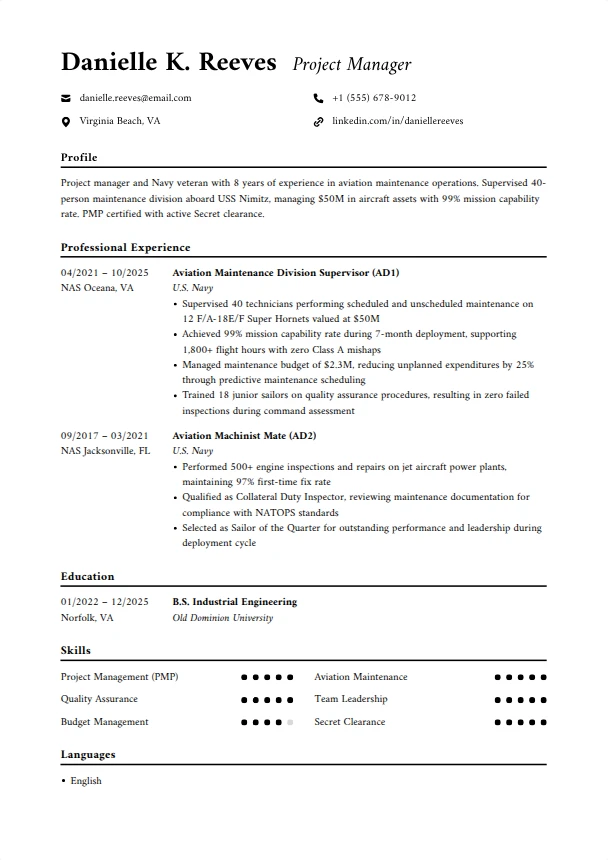
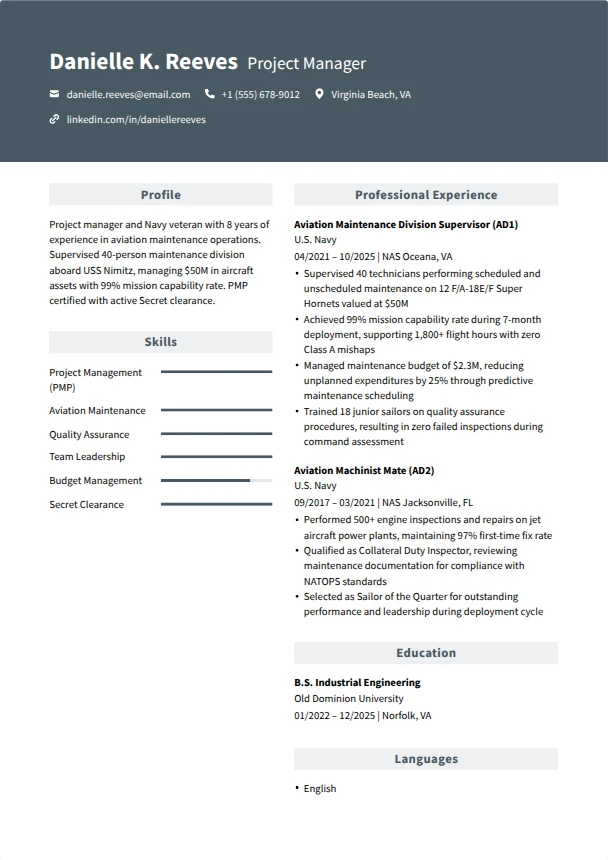
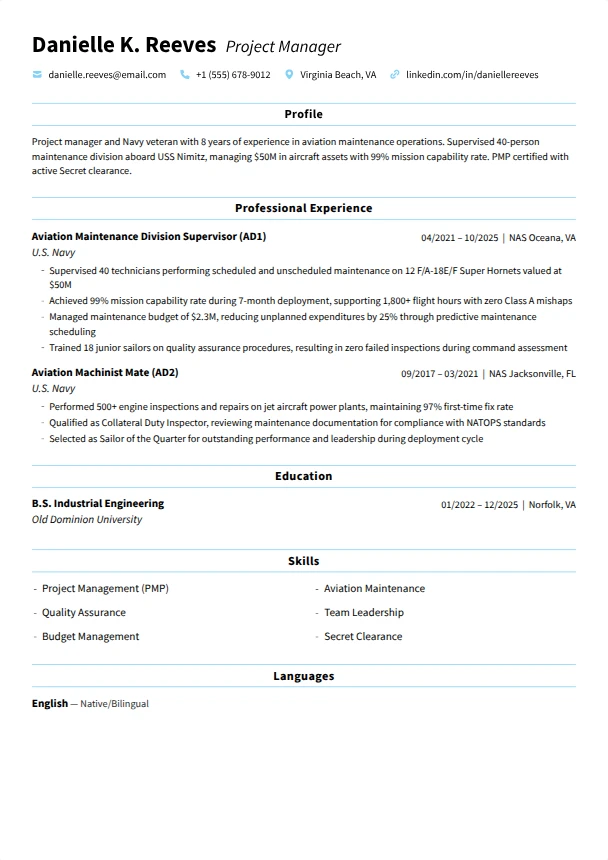
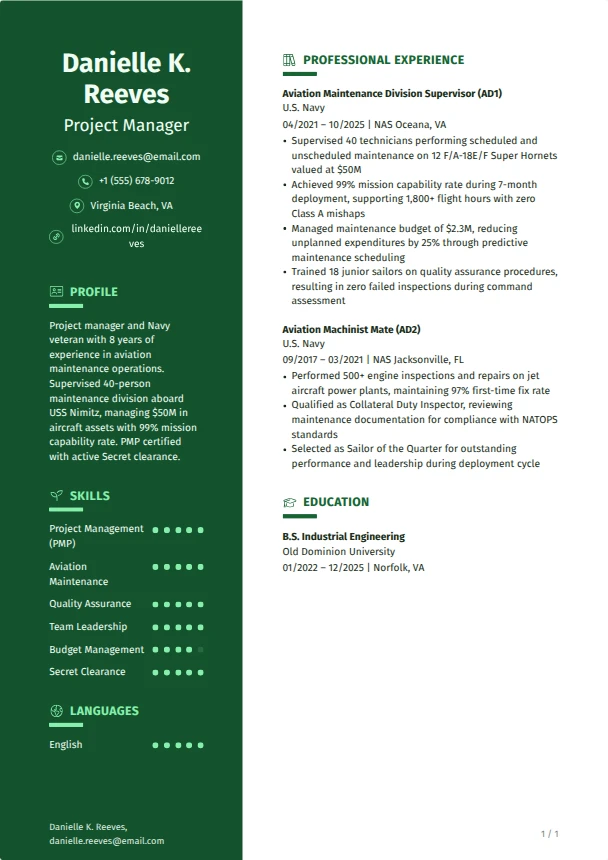
What hiring managers actually look for
Hiring managers reviewing Navy resumes want to see mission impact, leadership scope, and technical proficiency translated into civilian terms.
-
1
Translate Your Rate and Rating Civilian recruiters do not know what an IT2 or an ABH1 does. Always include a plain-language equivalent alongside your rate. For example, write 'Information Systems Technician (Network Administrator)' so the reader immediately understands your role.
-
2
Quantify Operational Scale Navy assignments involve large crews, multi-million dollar equipment, and high-stakes timelines. Hiring managers respond well to numbers like crew size managed, equipment value maintained, and uptime percentages achieved during deployments.
-
3
Highlight Security Clearances Early Many defense contractors and federal agencies require active clearances. If you hold a Secret, Top Secret, or TS/SCI clearance, list it near the top of your resume so recruiters can spot it immediately.
If your resume communicates these things in the first 7-second scan, you'll make it to the detailed read. Everything below is about making that happen.
How to structure your resume, section by section
The order matters. Here's what a strong navy resume guide looks like from top to bottom:
Contact Information and Clearance
Place your name, phone, email, city/state, and LinkedIn URL at the top. If you hold an active security clearance, include it directly below your name. This is especially important for defense and federal roles.
John Martinez | San Diego, CA | (619) 555-0192 | [email protected] Security Clearance: Top Secret/SCI (Active)
Professional Summary
Write a 3-4 sentence summary that includes your total years of Navy service, your rate translated into civilian language, one or two standout accomplishments, and the type of role you are targeting. Avoid acronyms that a civilian reader would not recognize.
Strong: "Network Administrator with 8 years of Navy experience managing classified and unclassified networks aboard an aircraft carrier supporting 5,000+ personnel. Maintained 99.7% network uptime across two combat deployments. Seeking a Network Engineer role in the defense sector."
Military Experience
List each assignment as a separate entry. Include the command name, your rate with civilian equivalent, location, and dates. Under each entry, write 4-6 bullets that describe responsibilities and accomplishments with measurable outcomes. Mention ship or squadron designations for context but always explain what they mean.
USS Abraham Lincoln (CVN-72), San Diego, CA Information Systems Technician Second Class (Network Administrator) Jun 2019 - May 2023
Education and Training
List your formal education first, then relevant Navy schools. Many Navy training programs carry American Council on Education (ACE) credit recommendations. Include the school name, course title, and completion date. If you have college credits through tuition assistance or a completed degree, list that prominently.
A.S. in Information Technology, American Military University, 2022 Navy Information Systems Technician 'A' School, Pensacola, FL, 2015 CompTIA Security+ Certification, 2021
Skills and Certifications
Create a dedicated section for technical skills, certifications, and NEC-related competencies. Translate NEC codes into civilian skill descriptions. Group skills by category when you have more than eight to keep the section scannable.
Key skills to include
Navy veterans develop a wide range of technical and leadership skills. Choose the ones most relevant to your target role and translate them into civilian terminology.
Tip: Match your skills to the job posting. If the posting says 'project management,' do not write 'mission planning.' Use the employer's exact terminology and then provide Navy context in your bullet points.
Resume summary examples you can steal
Use one as a starting point, then swap in your own technologies, numbers, and achievements.
"Nuclear-trained Machinist's Mate with 6 years operating and maintaining reactor plant systems aboard a fast-attack submarine. Supervised a 12-person watch team responsible for propulsion systems valued at over $2 billion. Achieved zero safety violations across three deployment cycles. Pursuing a Reactor Operator position in the commercial nuclear energy sector."
Why it works: This summary translates the nuclear rate into civilian language, quantifies the team size and equipment value, and names the target role clearly.
"Aircraft Maintenance Supervisor with 10 years of Navy experience leading 30-person teams in the inspection, repair, and overhaul of F/A-18 airframes. Maintained a 94% mission-capable rate for a squadron of 12 aircraft during a 9-month combat deployment. Holds FAA Airframe and Powerplant certification."
Why it works: The summary uses civilian job titles, provides fleet readiness metrics, and highlights an industry-recognized FAA certification.
"Intelligence Analyst with 8 years producing all-source intelligence products for carrier strike group commanders. Briefed flag officers on threat assessments covering 15 countries across two theaters of operation. Holds an active TS/SCI clearance and a B.A. in International Relations."
Why it works: This positions the candidate for defense or government analyst roles by emphasizing clearance, briefing experience, and geographic expertise.
"Emergency Medical Technician and former Navy Hospital Corpsman with 5 years providing trauma care in field and shipboard environments. Treated over 2,000 patients across two deployments and trained 40 Marines in tactical combat casualty care. Certified EMT-B seeking a Paramedic or Emergency Room Technician position."
Why it works: It bridges military medical experience to civilian healthcare by using recognized medical titles, patient volume, and a civilian certification.
Writing strong experience bullets
Every bullet point should answer: "What did you do, and why did it matter?" Use this formula:
Before and after examples:
Stood EOOW watches and supervised reactor plant operations.
Supervised a 12-person engineering watch team operating a nuclear reactor plant valued at $2.1 billion, maintaining zero unplanned shutdowns over 18 months.
Performed maintenance on aircraft and kept them mission ready.
Led scheduled and unscheduled maintenance on 12 F/A-18E Super Hornets, achieving a 94% mission-capable rate and reducing maintenance turnaround time by 15%.
Managed supplies for the ship and ordered parts.
Administered a $3.2 million inventory of repair parts and consumables for a guided-missile destroyer, reducing stockout incidents by 22% through improved demand forecasting.
Strong action verbs for navy resume guide resumes:
Supervised, Maintained, Administered, Coordinated, Trained, Inspected, Analyzed, Operated, Calibrated, Directed, Briefed, Implemented
5 mistakes that get navy resume guide resumes rejected
Using Navy Acronyms Without Explanation
Terms like EOOW, PMS, CASREP, and NEC mean nothing to most civilian hiring managers. Always write out the full term with a civilian equivalent. For example, write 'Engineering Officer of the Watch (Shift Supervisor)' instead of just 'EOOW.'
Listing Every Duty Station Without Focus
If you served for 20 years, you may have had 6 or more assignments. Focus on the most recent and most relevant positions. Older or less relevant assignments can be condensed into a single line or omitted entirely.
Omitting Your Security Clearance
An active security clearance is one of the most valuable assets a Navy veteran can offer. Leaving it off your resume means recruiters at defense firms and federal agencies may pass over your application entirely.
Writing a Resume That Reads Like an Eval
Navy evaluations use a specific writing style with phrases like 'handpicked to lead' and 'unmatched devotion to duty.' Civilian resumes should be direct and results-focused. Replace eval language with clear accomplishment statements.
Ignoring Civilian Certifications and Education
Many Navy training courses carry ACE credit recommendations, and service members often earn degrees through tuition assistance. If you have civilian-recognized credentials, make sure they are visible on your resume rather than buried under military training.
What to do if you have no professional experience
If you are transitioning out of the Navy with no prior civilian work experience, your military service provides substantial material for a strong resume.
Lead With Your Military Role in Civilian Terms
Your rate is your job title. Translate it clearly: 'Hospital Corpsman' becomes 'Emergency Medical Technician,' 'Yeoman' becomes 'Administrative Specialist,' and 'Operations Specialist' becomes 'Radar/Sensor Operator.' Use the civilian title as your resume headline.
Highlight Training and Certifications
Navy schools are intensive and well-regarded. List your A School, C School, and any NECs earned along with civilian equivalents. If you completed the Nuclear Power Training Pipeline, that is equivalent to college-level engineering coursework.
Use Deployment Experience as Project Experience
A deployment is a sustained, high-pressure project with clear timelines, goals, and outcomes. Describe your deployment contributions the way a civilian would describe a major project: scope, your role, actions taken, and measurable results.
Leverage Navy Transition Resources
Programs like the Transition Assistance Program (TAP), Skillbridge internships, and the Navy COOL (Credentialing Opportunities Online) program can help you earn civilian certifications before you separate. List any Skillbridge experience on your resume as a civilian internship.
Frequently asked questions
Should I list my NEC codes on a civilian resume?
Not as raw codes. Instead, translate each NEC into a civilian skill description. For example, NEC 9502 (Nuclear Trained Machinist's Mate) should appear as 'Nuclear Propulsion Plant Operator' with a note about the NEC for federal applications where it may be recognized.
How do I list my Navy rank on a resume?
Use your rate (job title) as the primary identifier and include your paygrade for context. For example, write 'Information Systems Technician Second Class (E-5)' or, for a civilian-focused resume, simply 'Network Administrator' with the military context in the description.
Should I include all my sea duty assignments?
Include the assignments most relevant to your target job. If you had four sea duty tours, choose the two or three that best demonstrate the skills the employer is looking for. You can mention earlier assignments in a brief 'Additional Service' section.
How do I explain a deployment gap in civilian terms?
Deployments are not gaps. They are work experience. Frame each deployment as a period of sustained operations in a challenging environment. Include the duration, your role, and specific accomplishments achieved during the deployment.
Is a one-page resume enough for a Navy veteran?
For civilian roles, one to two pages is standard. If you have fewer than 10 years of service, aim for one page. For senior enlisted or officers with 10+ years, two pages is appropriate. Federal resumes follow different rules and are typically three to five pages.
Skip the blank page
Open a complete, filled-in veteran-to-civilian resume in our free builder. Swap in your own details, keep the wording that fits, and download as PDF, free.
Build your navy resume guide in minutes
Pick a template, fill in your details, and download a polished navy resume guide ready to submit.
Start Building, It's FreeRelated resume guides
General guidance for translating any branch of military service into a civilian or federal resume.
Tips for converting Army MOS codes, ranks, and assignments into strong civilian resume content.
A comprehensive guide for all veterans transitioning to civilian careers, covering Veterans' Preference and transferable skills.
More resume examples: