What hiring managers actually look for
Civilian and federal hiring managers value veterans for their discipline, leadership, and ability to perform under pressure. The challenge is presenting these qualities in operations terms they recognize, such as budget administration, personnel management, and process improvement.
Many transitioning veterans target general and operations management roles, which is one of the closest civilian matches for unit leadership. The U.S. Bureau of Labor Statistics Occupational Outlook Handbook reports a median wage of $102,950 per year for top executives and general and operations managers, with the lowest 10 percent earning about $47,420 and the highest 10 percent earning $239,200 or more. Use that range as a benchmark when you frame the scope of the budgets, headcount, and logistics operations you ran in uniform.
-
1
Veterans' Preference Gives You an Edge in Federal Hiring Eligible veterans receive 5 or 10 preference points on federal job applications. A 5-point preference applies to veterans with honorable or general discharge. A 10-point preference applies to disabled veterans, Purple Heart recipients, and others with qualifying service-connected conditions. Always note your Veterans' Preference eligibility on federal applications.
-
2
Operations KPIs Matter More Than Job Titles Civilian employers may not understand your MOS, rate, or AFSC, but they understand operations management, logistics and supply chain, budget administration, and personnel management. Lead with the headcount you scheduled, the equipment budget you controlled, the readiness or on-time delivery rate you held, and the process improvements you drove rather than your military title alone.
-
3
Security Clearances Are High-Value Assets An active Secret, Top Secret, or TS/SCI clearance can take a civilian employer 6 to 18 months and thousands of dollars to sponsor. If you hold one, list it prominently. It is especially valuable for defense contractors, intelligence community roles, and federal agencies.
If your resume communicates these things in the first 7-second scan, you'll make it to the detailed read. Everything below is about making that happen.
How to structure your resume, section by section
The order matters. Here's what a strong veteran resume guide looks like from top to bottom:
Header With Clearance and Veteran Status
Include your name, city/state, phone, email, and LinkedIn URL. If you hold an active security clearance, place it directly below your name. For federal resumes, add your Veterans' Preference status, disability rating if applicable, and citizenship.
Sarah Thompson | Austin, TX | (512) 555-0147 | [email protected] Security Clearance: Secret (Active) | Veterans' Preference: 5-Point
Professional Summary
Write 3-4 sentences covering your total years of military service, your branch, the civilian equivalent of your primary role, one or two headline KPIs, and the type of position you are targeting. This section should read like a civilian operations summary, not a military biography.
Strong: "Operations Manager with 12 years of Army leadership directing logistics and supply chain operations for units of up to 500 personnel. Owned a $15 million equipment budget across three deployments with zero loss, and improved staff scheduling to hold 96% readiness. Seeking a General and Operations Manager role in the manufacturing sector."
Professional Experience
List your military assignments as professional experience entries. Use a civilian-equivalent job title as the primary heading, with your military title in parentheses if helpful. Include the unit or command, location, and dates. Write 4-6 accomplishment bullets per entry with quantified results.
Operations Manager (Captain, U.S. Army) 3rd Brigade Combat Team, Fort Hood, TX Jun 2018 - Aug 2023
Education, Training, and Certifications
List degrees first, then military schools with civilian equivalents, and finally professional certifications. If you used the GI Bill or tuition assistance to complete a degree, list it like any other degree. Include ACE credit recommendations from military training when relevant to your target field.
B.S. in Business Administration, University of Texas, 2022 Army Logistics Management College, Fort Lee, VA, 2019 Project Management Professional (PMP) Certification, 2023
Skills Section
Organize skills into categories such as Leadership, Technical, and Administrative. Use civilian terminology throughout. If you are applying to federal positions, you can include military-specific terms alongside their civilian equivalents since federal HR specialists are more familiar with military language.
Key skills to include
For a veteran moving into civilian operations and management work, these are the ATS keywords hiring managers and screening software look for. Mirror the exact phrasing from the job posting and back each one with a quantified military example.
Certifications and licenses that signal civilian-standard skills carry real weight for transitioning veterans. Three worth pursuing through Army, Navy, or Air Force COOL funding before you separate:
- Project Management Professional (PMP), issued by the Project Management Institute (PMI), validates project management experience for operations and program roles.
- CompTIA Security+ (SY0-701), issued by CompTIA, supports security, compliance, and IT-adjacent operations positions.
- Commercial Driver's License (CDL), available to qualifying veterans through the FMCSA Military Skills Test Waiver Program, opens logistics and transportation work.
Tip: Study the job posting carefully and mirror its language in your skills section. If the posting says 'stakeholder engagement,' do not write 'command briefings.' Use the civilian term and demonstrate it with military examples in your bullets.
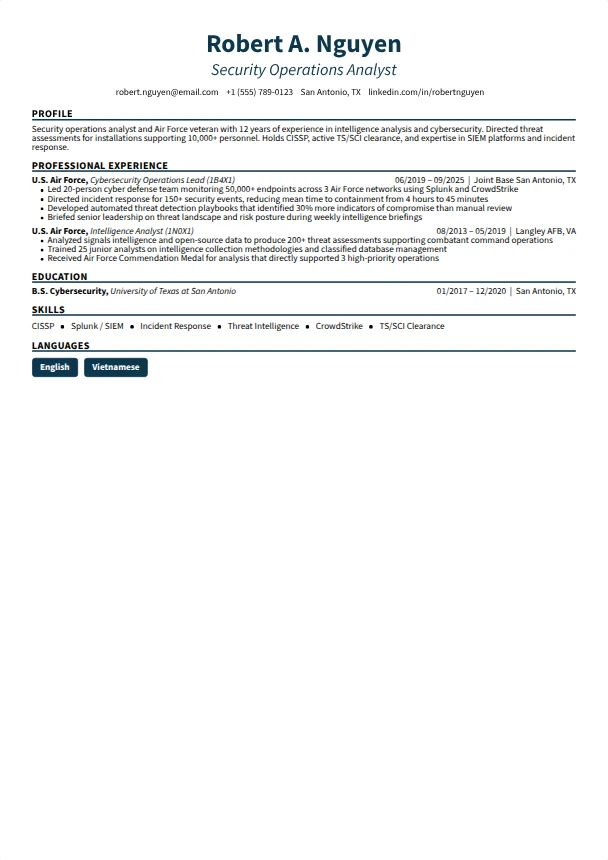
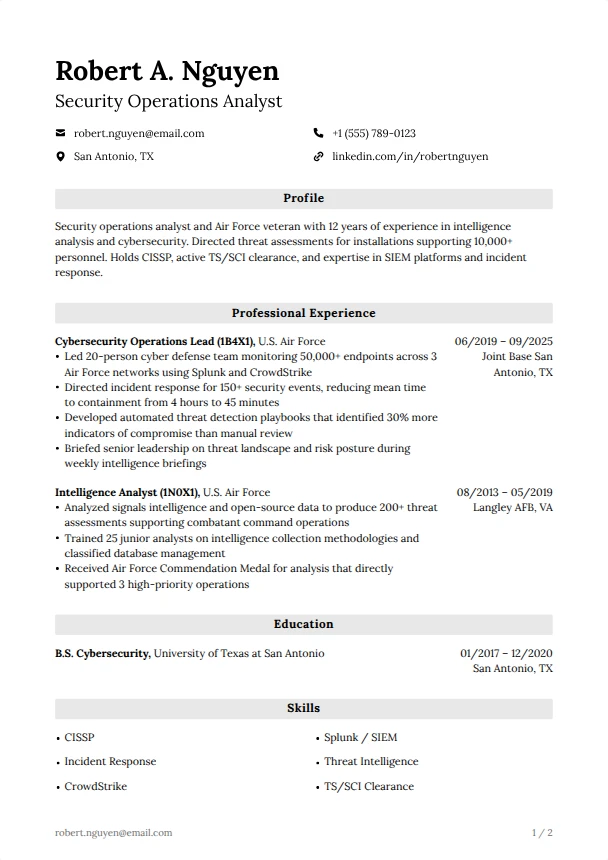
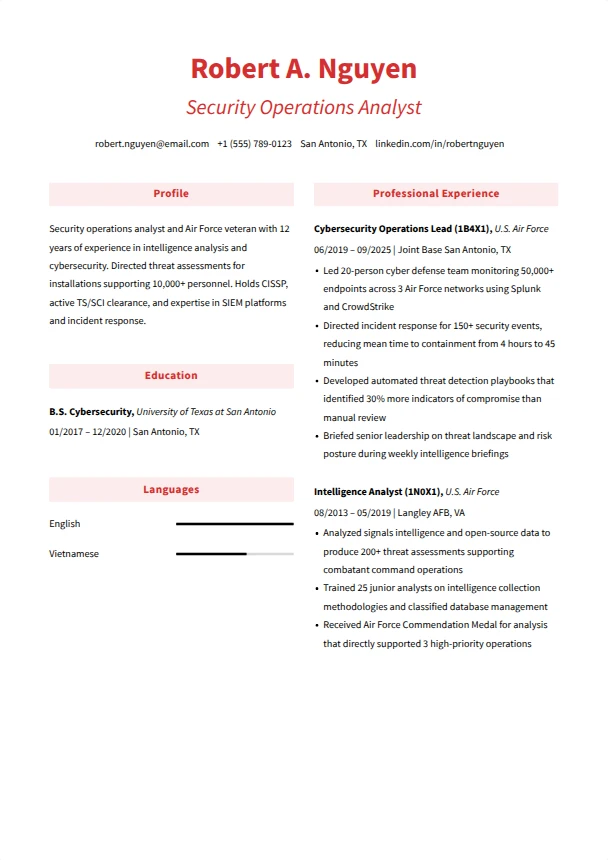
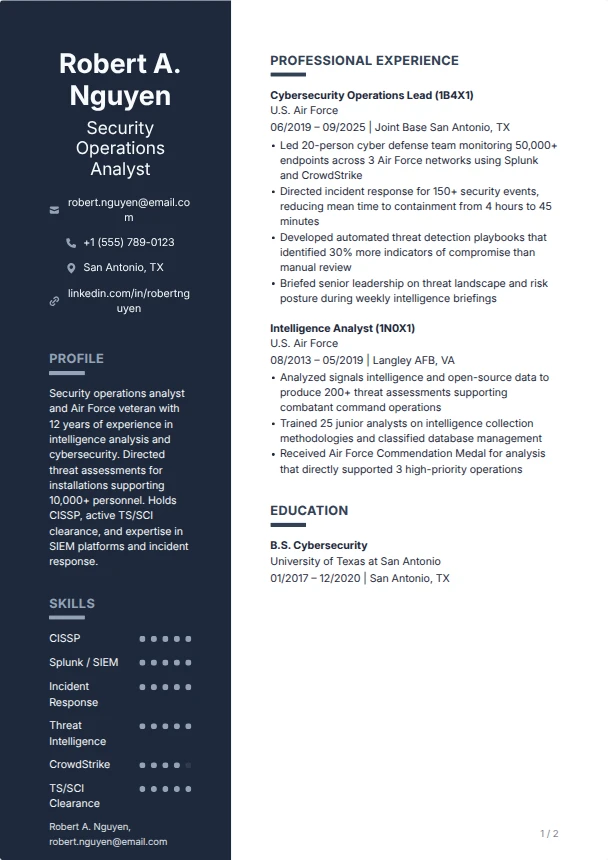
Example Veteran transitioning to civilian work resume
Here is a short illustrative example for a veteran targeting a general and operations manager role. The name and numbers are fictional and meant only to show how to frame military service in civilian operations language.
Marcus Delgado
Columbus, OH | (614) 555-0162 | [email protected] | linkedin.com/in/marcusdelgado
Security Clearance: Secret (Active) | Veterans' Preference: 5-Point
Professional Summary
Operations Manager and U.S. Army veteran with 10 years leading logistics and supply chain operations for units of up to 250 personnel. Administered a $9 million equipment budget, ran staff scheduling and workforce planning across three shifts, and used performance reporting and KPIs to lift on-time delivery. Holds an active Secret clearance and a Project Management Professional (PMP) certification.
Professional Experience
Operations Manager (Sergeant First Class, U.S. Army), 4th Sustainment Brigade, Fort Liberty, NC | 2019 to 2024
- Directed logistics and supply chain operations for 250 personnel, holding equipment readiness at 96% across an 18-month period.
- Administered a $9 million equipment budget and cut excess inventory 22% through a process improvement review.
- Built staff scheduling and workforce planning for 3 rotating shifts, reducing unfilled shifts from 14% to under 4%.
- Produced weekly performance reporting and KPIs for senior leadership and led risk assessment and mitigation for high-value shipments.
Education, Certifications, and Skills
B.S. in Business Administration, GI Bill funded, 2023. Project Management Professional (PMP), PMI. CompTIA Security+ (SY0-701). Skills: Operations Management, Budget Administration, Personnel Management, Microsoft Excel, Regulatory Compliance, Cross-Functional Team Leadership.
Resume summary examples you can steal
Use one as a starting point, then swap in your own tools, KPIs, and achievements.
"Operations Manager with 20 years of military service leading teams of up to 200 personnel across logistics, maintenance, and training functions. Administered a $28 million annual operating budget, ran staff scheduling and workforce planning across multiple sites, and held readiness KPIs above 95%. Holds a B.S. in Organizational Leadership and PMP certification. Seeking a General and Operations Manager role in manufacturing or logistics."
Why it works: It uses the civilian operations title, quantifies budget and headcount, and names credentials civilian employers value.
"Operations and Project Manager with 8 years planning and executing logistics operations in high-pressure environments involving 50+ team members and a $10 million equipment budget. Led a supply chain reorganization that cut delivery times 30% and owned risk assessment and mitigation for every movement. Pursuing a General and Operations Manager position in the distribution sector."
Why it works: It frames deployment work as operations and project management, leads with KPIs, and targets a specific sector.
"Operations professional with 6 years managing classified network operations and regulatory compliance for 3,000+ users. Built performance reporting and KPI dashboards in Microsoft Excel, ran process improvement on access controls, and reduced audit findings by 40%. Holds CompTIA Security+ (SY0-701) and an active Top Secret clearance."
Why it works: It pairs technical operations with compliance language and lets a current certification and clearance validate the military training.
"Operations Coordinator with 4 years managing equipment maintenance schedules, personnel management, and training and development for a 60-person unit. Completed a Skillbridge internship with a Fortune 500 logistics company and earned a Commercial Driver's License through the FMCSA Military Skills Test Waiver. Pursuing a B.S. in Supply Chain Management."
Why it works: It works for junior veterans by emphasizing the Skillbridge internship, a usable license, and a clear operations title.
Writing strong experience bullets
Every bullet point should answer: "What did you do, and why did it matter?" Use this formula:
Before and after examples:
Led a platoon of 40 soldiers during multiple combat deployments.
Directed personnel management and staff scheduling for a 40-person team across three 12-month operations, maintaining 100% accountability and meeting every readiness KPI ahead of schedule.
Managed the motor pool and made sure vehicles were maintained.
Ran logistics and supply chain operations for a 75-vehicle fleet under a $12 million budget, using a process improvement plan to raise operational readiness from 82% to 96% over 18 months.
Responsible for training new soldiers.
Designed and delivered a 6-week training and development program for 120 new personnel annually, cutting time-to-productivity 25% and earning recognition as the top program in the brigade.
Strong action verbs for veteran resume guide resumes:
Directed, Managed, Coordinated, Implemented, Supervised, Trained, Analyzed, Executed, Developed, Oversaw, Streamlined, Delivered
5 mistakes that get veteran resume guide resumes rejected
Using Military Jargon Without Translation
Acronyms like MOS, NCOER, TDY, and PCS mean nothing to most civilian hiring managers. Write everything in plain operations language. If you need to reference a military term for a federal application, include the civilian equivalent alongside it.
Failing to Claim Veterans' Preference
Veterans' Preference can add 5 or 10 points to your federal application score. Many veterans either forget to claim it or do not realize they qualify. Check your eligibility based on discharge status and service dates, and always include it on federal applications.
Leaving Out KPIs and Budget Numbers
Operations hiring managers read for numbers. Headcount managed, budget administered, readiness or on-time delivery rate, and process improvement percentages turn a vague duty list into proof. A bullet without a KPI is an opinion; a bullet with one is evidence.
Underselling Leadership Experience
Even junior enlisted veterans often handled personnel management, budget administration, and high-stakes decisions. Do not downplay your responsibilities. An E-5 managing a 10-person team and a $2 million equipment account is a supervisor and budget administrator in civilian terms.
Ignoring Veteran-Specific Hiring Programs
Programs like VRA (Veterans Recruitment Appointment), Schedule A hiring authority, and the VOW to Hire Heroes Act create special pathways for veteran employment. Research these programs and mention your eligibility where appropriate on federal applications.
What to do if you have no professional experience
If you are leaving the military with no civilian work history, your service itself is professional experience. The key is translating it into operations language civilian employers recognize.
Use Civilian Operations Titles as Resume Headlines
Do not lead with your rank. Instead, use the civilian equivalent of your military role. An Infantry Squad Leader becomes a 'Team Leader and Operations Supervisor.' A logistics NCO becomes an 'Operations and Supply Chain Coordinator.' The civilian title helps recruiters understand your value immediately.
Complete a Skillbridge Internship Before Separation
The DoD Skillbridge program allows service members to intern with civilian companies during their last 180 days of service. This gives you genuine civilian work experience to list on your resume. Even a 3-month Skillbridge internship significantly strengthens your application.
Leverage Veteran Employment Resources
Organizations like Hire Heroes USA, American Corporate Partners, and VA employment services provide free resume reviews, mentorship, and job placement assistance specifically for veterans. Take advantage of these programs during your transition.
Earn Civilian Certifications Before You Separate
Use programs like Army COOL, Navy COOL, or Air Force COOL to earn industry-recognized certifications while still on active duty. A Project Management Professional (PMP), CompTIA Security+, or a Commercial Driver's License earned through the FMCSA Military Skills Test Waiver on your resume shows your skills meet civilian standards.
Frequently asked questions
What is Veterans' Preference and how do I claim it?
Veterans' Preference adds 5 or 10 points to your score on federal job applications. A 5-point preference is for veterans with honorable or general discharge. A 10-point preference applies to disabled veterans, Purple Heart recipients, and certain other categories. You claim it by selecting the appropriate option on your USAJOBS application and uploading your DD-214 and, if applicable, your VA disability letter.
Should I use a civilian resume or a federal resume format?
It depends on the employer. Private-sector operations and management jobs want a one-to-two-page civilian resume that leads with KPIs like budget size, headcount managed, and process improvement results. Federal jobs posted on USAJOBS require a detailed federal resume that is typically three to five pages and includes specifics like series and grade, hours worked per week, and supervisor contact details for each assignment.
How do I translate my military role into an operations or management title?
Start by identifying the core function of your role, then map it to a civilian operations title. A logistics NCO is an Operations or Supply Chain Manager. A first sergeant is a Personnel and Workforce Planning Manager. Use O*NET and the Military Crosswalk Search to confirm the equivalent, then rewrite your bullets around operations management, budget administration, and staff scheduling using the civilian posting's language.
Which certifications help a veteran move into operations management?
Credentials that signal civilian-standard project and operations skills carry the most weight. A Project Management Professional (PMP) from PMI validates project management experience, CompTIA Security+ supports security and compliance roles, and a Commercial Driver's License earned through the FMCSA Military Skills Test Waiver opens logistics and transportation work. Use Army, Navy, or Air Force COOL funding to earn these before you separate.
How do I show combat or deployment experience in operations terms?
Frame deployments as high-stakes operations management assignments. Quantify the headcount you led, the equipment budget you controlled, the staff scheduling and workforce planning you ran, and the readiness or on-time delivery KPIs you hit. Pair that with risk assessment and mitigation language rather than purely combat narratives so hiring managers see a transferable operations leader.
Skip the blank page
Open a complete, filled-in veteran-to-civilian resume in our free builder. Swap in your own details, keep the wording that fits, and download as PDF, free.
Build your veteran resume guide in minutes
Pick a template, fill in your details, and download a polished veteran resume guide ready to submit.
Start Building, It's FreeRelated resume guides
Learn the specific format, length, and content requirements for federal resumes submitted through USAJOBS.
General guidance for translating any branch of military service into a compelling civilian or federal resume.
Specific tips for converting Army MOS codes, ranks, and duty assignments into civilian resume content.
More resume examples: