What hiring managers actually look for
Data analytics hiring managers look for a specific combination of technical and business skills. They scan for three things first:
-
1
SQL proficiency as baseline. SQL is non-negotiable for data analyst roles. If it is not prominent on your resume, many managers will stop reading. They want to see complex queries, not just SELECT statements, so call out joins, window functions, CTEs, and query optimization against PostgreSQL or Snowflake.
-
2
Business impact, not just technical output. "Built a dashboard" is not impressive. "Built a Tableau dashboard that flagged $200K in quarterly revenue leakage" is. Managers want analysts who connect data cleaning, modeling, and visualization to business outcomes.
-
3
Visualization and communication skills. The best analysis is useless if you cannot present it. Tableau or Power BI experience matters, and so does evidence that you presented findings to stakeholders, defended an A/B test result, and influenced a decision.
If your resume communicates these things in the first 7-second scan, you will make it to the detailed read.
On pay, the U.S. Bureau of Labor Statistics groups data analysts with data scientists (SOC 15-2051) and reports a median annual wage of $112,590 per year, with the lowest 10 percent earning less than $63,650 and the highest 10 percent earning more than $194,410, according to the U.S. Bureau of Labor Statistics, Occupational Outlook Handbook, Data Scientists (SOC 15-2051). General-purpose data analyst titles often sit below that median, so frame your resume around the SQL, Python, and BI tools that push you toward the top of the band.
How to structure your resume, section by section
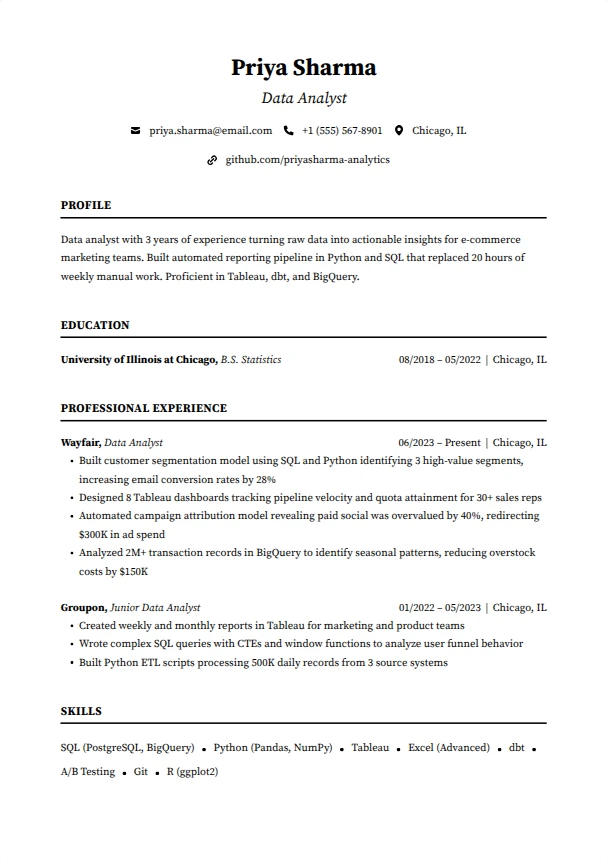
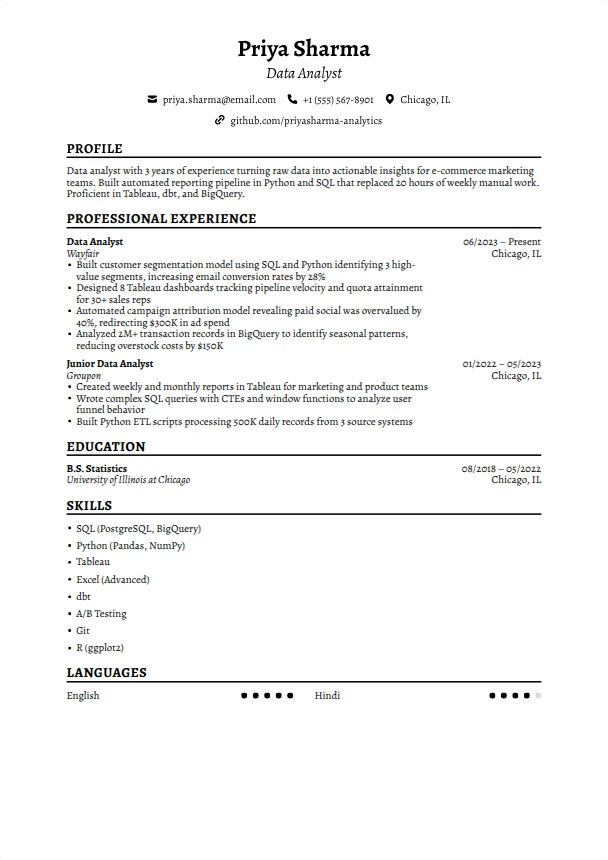
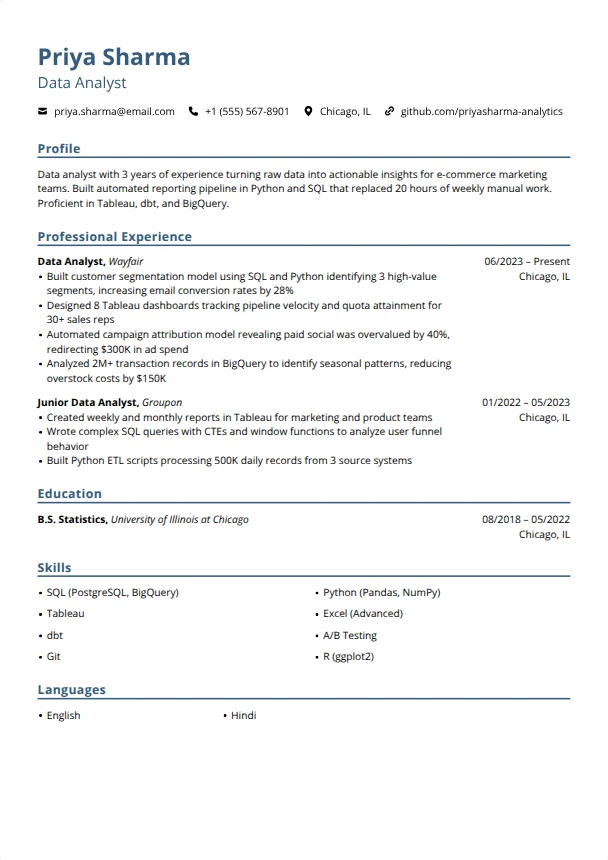
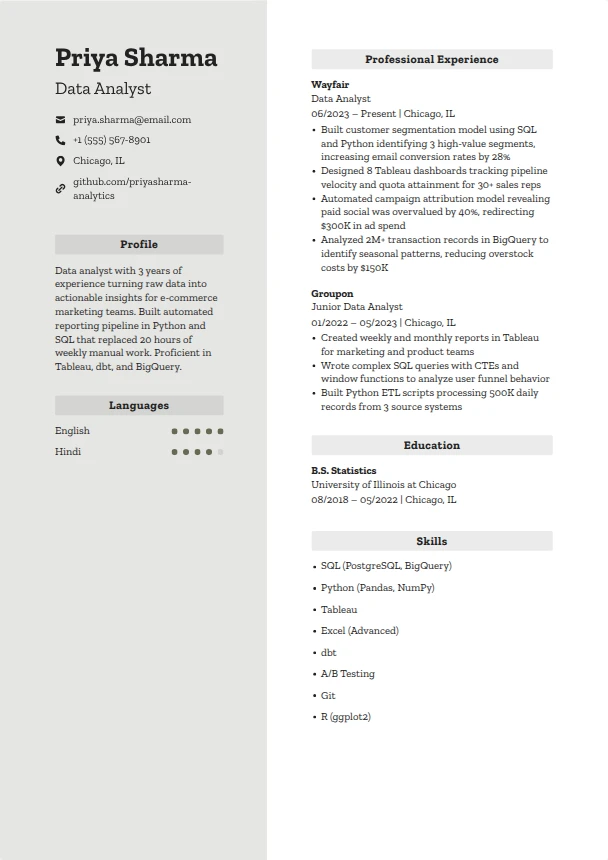
The order matters. Here is a strong data analyst resume from top to bottom:
1. Contact header
Name, email, phone, location (city and state), LinkedIn. If you have a portfolio site or GitHub with analysis projects, include those links.
Priya Sharma · [email protected] · (555) 567-8901 · Chicago, IL
linkedin.com/in/priyasharma-data · github.com/priyasharma-analytics
2. Professional summary (2-3 sentences)
Lead with years of experience, core tools (SQL, Python, Tableau), industry context, and a business-impact achievement that shows you understand both the tools and the business.
Strong: "Data analyst with 3 years of experience turning raw data into actionable insights for e-commerce marketing teams. Built an automated ETL and reporting pipeline in Python and SQL that replaced 20 hours of weekly manual work and cut report errors to near zero. Proficient in Tableau, PostgreSQL, and Snowflake."
3. Technical skills
Group by category: Languages and Query, Visualization, Databases, Tools. Data analyst skill sections should be specific, so list the BI tools, databases, and languages you actually use daily.
Query and Analysis: SQL, Python (Pandas, NumPy), R, Statistical analysis
Visualization: Tableau, Power BI, Data visualization
Databases and Warehouses: PostgreSQL, Snowflake
Tools and Methods: Excel (advanced), ETL, Data cleaning, Data modeling, A/B testing
4. Work experience
For each role, focus on business questions you answered, not just queries you wrote. Every bullet should connect your analysis to a decision or outcome: revenue gained, costs reduced, processes improved.
Strong: "Built a customer segmentation model in SQL and Python that split a single audience into 3 high-value segments. The marketing team used the segments to personalize campaigns, lifting email conversion by 28 percent."
5. Projects (especially for early-career)
If you have fewer than 3 years of experience, include a Projects section with portfolio-worthy analyses. Use public datasets, document the data cleaning and modeling steps, and link to GitHub repos.
NYC Taxi Demand Forecasting: Cleaned and modeled 4M trip records in Python, then built a time-series forecast of hourly demand by zone and published the results in a Tableau dashboard. github.com/priya/nyc-taxi
6. Education and certifications
Degree, school, graduation year. Include relevant coursework (statistics, econometrics, data science). List analytics certifications here with the issuer and the year you earned them.
Key skills to include
These are the ATS keywords that recruiters and screening software match against for data analyst roles. Use the exact terms below where they are true for you, and mirror the wording from the specific job description.
Tip: If the posting says "Tableau" and you only list "data visualization," the ATS may not match them. Use the exact tool names from the job description.
Resume summary examples you can steal
Use one as a starting point, then swap in your own technologies, numbers, and achievements.
"Recent statistics graduate with hands-on experience in SQL, Python, and statistical analysis across 3 portfolio projects and a marketing analytics internship. Built a customer churn model with A/B tested outreach that flagged at-risk accounts and informed the retention team's Q4 plan, and earned the Google Data Analytics Professional Certificate."
Why it works: Specific degree, quantified portfolio, internship impact, named credential, business connection.
"Data analyst with 4 years of experience supporting product and marketing teams at a B2B SaaS company. Built and maintained 15+ Tableau dashboards used by the C-suite for quarterly business reviews. Designed a SQL attribution model on Snowflake that reattributed $1.2M in revenue previously marked as organic."
Why it works: Industry context, stakeholder level, revenue impact, specific tools.
"Senior data analyst with 7 years of experience leading analytics for a 200-person e-commerce company and managing a team of 3. Built the company's first cleaned and modeled data layer on Snowflake, cutting ad-hoc query time by 80 percent. Partnered with product on an A/B testing framework that drove a 15 percent increase in checkout conversion."
Why it works: Leadership, infrastructure ownership, tooling specifics, measurable business outcomes.
"Former financial analyst moving into data analytics with the Google Data Analytics Professional Certificate and 4 portfolio projects in SQL, Python, and Tableau. Brings 5 years of experience analyzing financial data, building forecasting models in Excel, and presenting insights to executives, skills that translate directly to a data analyst role."
Why it works: Certification plus portfolio prove commitment, financial background reframed as analytics-relevant.
Example Data analyst resume
Here is a short, illustrative example with a fictional name, meant only to show format, tone, and the kind of role-specific KPIs that work well.
Marcus Delgado
Data Analyst · Denver, CO · [email protected] · (555) 214-7790 · linkedin.com/in/marcusdelgado-data · github.com/mdelgado-analytics
Summary
Data analyst with 5 years of experience in retail and SaaS. Strong in SQL, Python, and Tableau, with a track record of turning raw transaction data into decisions that move revenue and cost. Microsoft Certified: Power BI Data Analyst Associate (Exam PL-300).
Technical Skills
Query and Analysis: SQL, Python (Pandas, NumPy), R, Statistical analysis, A/B testing
Visualization: Tableau, Power BI, Data visualization
Databases and Pipelines: PostgreSQL, Snowflake, ETL, Data cleaning, Data modeling, Excel (advanced)
Experience
Senior Data Analyst, NorthPeak Retail (2023 to present)
- Rebuilt the weekly sales pipeline as a modeled ETL job in Python and SQL on Snowflake, cutting refresh time from 6 hours to 25 minutes and removing 3 manual handoffs.
- Designed an A/B test on checkout copy and analyzed results in Python, confirming a 9 percent lift in completed orders before a full rollout.
- Built 6 Tableau dashboards tracking margin, basket size, and return rate, used by 4 category managers in weekly planning.
Data Analyst, BrightLayer SaaS (2021 to 2023)
- Cleaned and reconciled 2M+ event records in PostgreSQL, raising data quality scores and cutting reporting disputes by half.
- Created a Power BI churn dashboard backed by a logistic model in Python that flagged at-risk accounts 30 days earlier than the prior process.
Education and Certifications
B.S. in Statistics, University of Colorado. Microsoft Certified: Power BI Data Analyst Associate (Exam PL-300), 2024. Google Data Analytics Professional Certificate, 2022.
This sample is illustrative only. Replace every name, number, and result with your own verified achievements.
Writing strong experience bullets
Every bullet point should answer: "What did you do, and why did it matter?" Use this formula:
Before and after examples:
Created dashboards for the sales team to track performance.
Designed 8 Tableau dashboards tracking pipeline velocity, win rates, and quota attainment, used by 30+ sales reps and 5 managers for weekly forecasting.
Analyzed customer data and wrote reports.
Cleaned and modeled 2M+ customer transaction records in Snowflake to surface seasonal purchasing patterns, informing an inventory strategy that reduced overstock costs by $150K annually.
Helped the marketing team with campaign analysis.
Built an automated attribution model in SQL and Python across 12 marketing channels and ran an A/B test that showed paid social was overvalued by 40 percent, redirecting $300K in ad spend to higher-performing channels.
Strong action verbs for data analyst resumes:
Analyzed · Modeled · Queried · Visualized · Automated · Forecasted · Segmented · Identified · Designed · Built · Optimized · Presented · Partnered · Reported · Validated · Cleaned · Transformed · Measured
6 mistakes that get data analyst resumes rejected
Listing "Excel" as your top skill
Excel is expected. If it is the first thing on your skills list, it signals you are behind the curve. Lead with SQL, Python, and BI tools. Keep Excel as an advanced skill if you use pivot tables, lookups, or macros.
Describing outputs instead of outcomes
"Created 10 dashboards" says nothing about value. "Created Tableau dashboards that flagged $200K in revenue leakage" connects your work to business results. Always answer: so what?
Not including SQL prominently
SQL is the most requested skill in data analyst job postings. If it is buried in a long skills list, the ATS might miss it. Put it first in your technical skills section.
Ignoring the business context of your analyses
Hiring managers do not care that you wrote a complex CTE, they care that it solved a business problem. Every technical bullet should include who used the output and what decision it informed.
Including coursework projects without labeling them
Academic projects are valuable, but present them under "Projects" or "Academic Projects," not under "Work Experience." Misrepresenting coursework as professional work damages trust if discovered.
Using jargon without context
"Performed ETL processes" means little to a non-technical recruiter on the first screen. Add context: "Built an ETL pipeline that cleaned 2M daily records from 5 source systems into a unified Snowflake warehouse."
What to do if you have no professional experience
No professional data analyst experience does not mean no resume. Here is how to build a competitive profile.
Build a portfolio with public datasets
Use Kaggle, government data (data.gov), or sports statistics to create 3 to 5 analysis projects. Each should have a clear question, data cleaning and modeling steps in SQL or Python, and a Tableau or Power BI visualization. Host them on GitHub with clean README files.
Earn a recognized certificate
The Google Data Analytics Professional Certificate, the Microsoft Certified: Power BI Data Analyst Associate (Exam PL-300), and the Salesforce Certified Tableau Data Analyst give you structured learning, guided projects, and a credential to put on your resume.
Contribute to analytics communities
Enter Kaggle competitions, answer questions on Stack Overflow, or write analysis blog posts. These demonstrate genuine engagement with the field beyond just applying for jobs.
Reframe existing experience
If you have worked in any role that involved reporting, spreadsheets, or data entry, you have transferable skills. "Cleaned and tracked 500+ SKUs in monthly Excel reports" is data analyst work, so frame it that way.
Frequently asked questions
Do I need to know Python for a data analyst role?
SQL remains the core requirement, but Python (especially Pandas and NumPy) now appears in a large share of data analyst postings alongside it. If you only know SQL and Excel, you can still be competitive for junior roles, but adding Python for data cleaning, data modeling, and automation opens up significantly more opportunities and pairs naturally with R for statistical analysis.
Which certifications help a data analyst resume?
The Google Data Analytics Professional Certificate is a strong entry credential, the Microsoft Certified: Power BI Data Analyst Associate (Exam PL-300) signals Power BI depth, and the Salesforce Certified Tableau Data Analyst validates Tableau and data visualization skills. List the credential, the issuer, and the year earned in an education or certifications section, and pick the one that matches the BI tool in the job posting.
How long should a data analyst resume be?
One page for under 7 years of experience. Use two pages only if you have significant project portfolios, publications, or leadership experience. Quality beats quantity, so a focused one-page resume that highlights SQL, Python, and dashboard impact outperforms a padded two-pager.
Should I learn Tableau or Power BI first?
Check the BI tool named in postings in your target market. Tableau is common in tech and consulting, while Power BI is common in enterprises on Microsoft stacks. If you are unsure, learn one well, mirror the exact tool name from the job description on your resume, and note that core data visualization skills transfer between the two.
Should I include a portfolio link on my resume?
Yes. A portfolio with clean, well documented analysis projects is one of the strongest signals a data analyst can send. Include 3 to 5 projects that each show a clear business question, the SQL or Python you used, the data cleaning steps, and a Tableau or Power BI visualization of the result, then link it in your contact header.
How much do data analysts earn?
The U.S. Bureau of Labor Statistics groups data analysts with data scientists (SOC 15-2051) and reported a median annual wage of $112,590, with the lowest 10 percent earning less than $63,650 and the highest 10 percent earning more than $194,410. General-purpose data analyst titles on job boards often pay less than the data scientist median, so location, industry, and your tooling (SQL, Python, Snowflake, Tableau) all matter.
Skip the blank page
Open a complete, filled-in data analyst resume in our free builder. Swap in your own details, keep the wording that fits, and download as PDF, free.
Build your data analyst resume now
Pick an ATS-friendly template, add your SQL and visualization skills, and download a polished PDF in minutes. Free, no account required.
Start Building, It's FreeRelated resume guides
Full-stack, backend, and frontend engineering roles with code-focused bullets.
General IT resume for sysadmin, infrastructure, and networking roles.
Security certifications, threat analysis, incident response, and compliance.
HTML, CSS, JavaScript, responsive design, and portfolio presentation.
More resume examples: