What hiring managers actually look for
Web development hiring managers and tech leads evaluate resumes differently than generic recruiters. They scan for three things:
-
1
A portfolio or live projects. A GitHub profile or portfolio link tells a manager more than any bullet point. If your resume doesn't include a link to actual work, you're at a significant disadvantage especially for frontend and full-stack roles.
-
2
Modern, relevant tech stack. React, Next.js, TypeScript, and Tailwind CSS are 2026's frontend defaults. Node.js, Express, and PostgreSQL dominate backend. If your resume still leads with j Query or PHP without modern alternatives, managers may assume your skills are outdated.
-
3
Production experience vs.tutorial projects. There's a visible difference between ' built a to-do app following a tutorial'and ' built and deployed a booking system handling 500 daily users.' Managers want evidence of real-world constraints: performance, edge cases, and users.
If your resume communicates these things in the first 7-second scan, you'll make it to the detailed read. Everything below is about making that happen.
How to structure your resume, section by section
The order matters. Here's what a strong web developer resume looks like from top to bottom:
1. Contact header
Name, email, phone, location (city + state), LinkedIn, GitHub, and portfolio URL. For web developers, the portfolio link is arguably the most important item after your name.
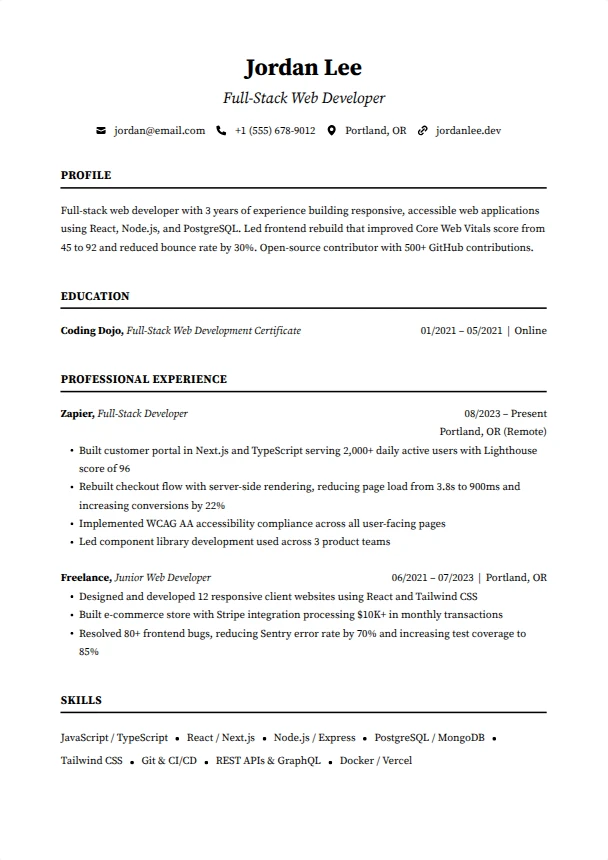
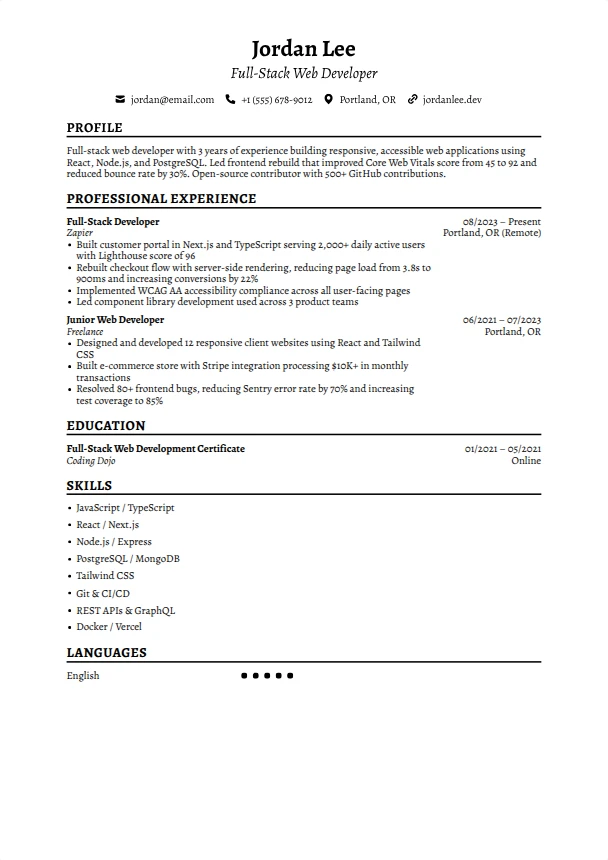
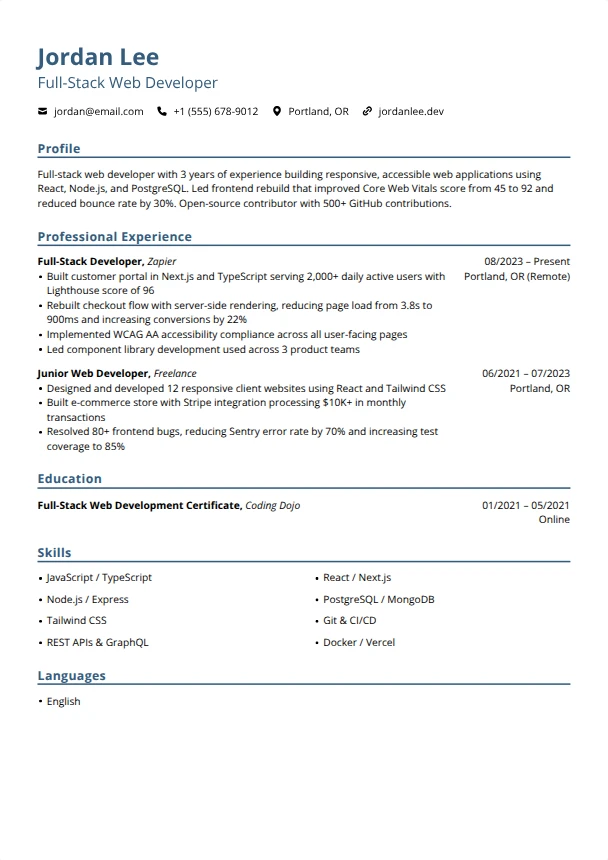
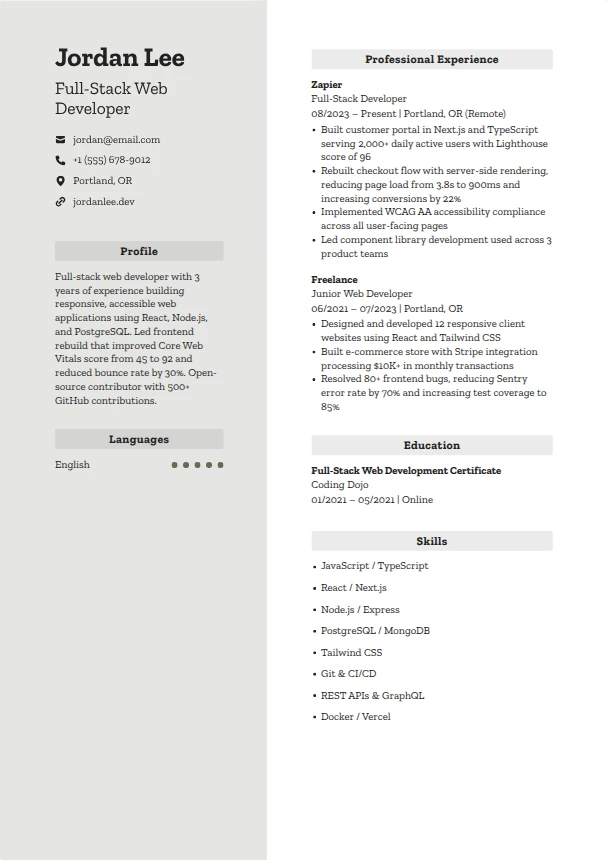
Jordan Lee · [email protected] · (555) 678-9012 · Portland, OR
linkedin.com/in/jordanlee-dev · github.com/jordandev · jordanlee.dev
2. Professional summary (2-3 sentences)
Lead with your specialization (frontend, backend, full-stack), years of experience, primary framework, and a measurable achievement. Web dev managers want to see your stack and your impact.
Strong: "Full-stack web developer with 3 years of experience building responsive, accessible web applications using React, Node.js, and PostgreSQL. Led frontend rebuild that improved Core Web Vitals score from 45 to 92 and reduced bounce rate by 30%. Open-source contributor with 500+ GitHub contributions."
3. Technical skills
Group by layer: Frontend, Backend, Database, DevOps/Tooling. Web developers need to be specific about frameworks and versions' React'alone is fine; ' JavaScript'alone is too broad.
Frontend: React, Next.js, TypeScript, Tailwind CSS, HTML5, CSS3
Backend: Node.js, Express, Python, Django, REST APIs, GraphQL
Database: PostgreSQL, MongoDB, Redis, Prisma ORM
Tools: Git, GitHub Actions, Docker, Vercel, Figma, Lighthouse
4. Work experience
Focus on what you built, the scale it handled, and the measurable outcome. Web development is visual and quantifiable use metrics like load time, Lighthouse score, conversion rate, and user count.
Strong: "Built a customer portal in Next.js and TypeScript serving 2,000+ daily active users, achieving a Lighthouse performance score of 96 and WCAG AA accessibility compliance."
5. Projects (critical for web developers)
Your projects section is your portfolio in text form. For each project, include: what it does, tech stack, scale or impact, and a link. Three well-documented projects are worth more than a long work history.
Recipe Finder AppFull-stack Next.js app with 1,000+ recipes, search with filters, user accounts, and favorites. PostgreSQL + Prisma backend. 200+ monthly users. recipefinder.dev
6. Education
Degree, school, graduation year. For bootcamp grads, list the program name and duration. If you're self-taught, your projects section carries the weight of your education section.
Key skills to include
These are the most in-demand web development skills in 2026 job postings. Frontend leans heavily toward React and TypeScript; full-stack adds Node.js and database experience.
Tip: If the job posting mentions specific frameworks (e.g., ' Vue.js'or ' Angular'), add them to your skills if you have experience. Don't only list React if they're looking for Vuetailor for each application.
Resume summary examples you can steal
Use one as a starting point, then swap in your own technologies, numbers, and achievements.
"Full-stack web developer and recent graduate of [Bootcamp]. Built 5 production-ready applications using React, Node.js, and PostgreSQL during an intensive 14-week program. Portfolio includes a real-time chat application and an e-commerce platform with Stripe integration. Active GitHub contributor with 300+ contributions."
Why it works: Specific bootcamp, quantified projects, production-quality work, active GitHub presence.
"Frontend developer with 4 years of experience building responsive, accessible web applications in React and TypeScript. Led UI component library development used across 3 product teams. Improved Core Web Vitals from ' needs improvement'to ' good'across all pages, reducing bounce rate by 25%."
Why it works: Specialization clarity, cross-team impact, performance metrics, accessibility mention.
"Senior full-stack developer with 7 years of experience building and scaling web applications for Saa S companies. Architected a multi-tenant platform on Next.js and PostgreSQL serving 50,000+ users. Led a team of 4 developers. Reduced page load time by 60% through code splitting, caching, and CDN optimization."
Why it works: Scale signals, architecture ownership, team leadership, specific optimization wins.
"Self-taught web developer with a background in graphic design, bringing 3 years of visual design experience to frontend development. Built 6 client websites using React and Tailwind CSS, including an e-commerce store processing $10K+ in monthly transactions. Strong eye for responsive design, animation, and user experience."
Why it works: Design background framed as strength, real client work, revenue numbers, practical output.
Writing strong experience bullets
Every bullet point should answer: "What did you do, and why did it matter?" Use this formula:
Before and after examples:
Built websites for clients using HTML, CSS, and JavaScript.
Designed and developed 12 responsive client websites using React and Tailwind CSS, delivering all projects on time with an average Lighthouse score of 94 and zero post-launch critical bugs.
Worked on the company's main web application.
Rebuilt the checkout flow in Next.js with server-side rendering, reducing page load from 3.8s to 900ms and increasing checkout completion rate by 22%.
Fixed bugs and added features to the frontend.
Resolved 80+ frontend bugs and implemented 15 new features over 6 months using React and TypeScript, reducing Sentry error rate by 70% and increasing test coverage from 45% to 85%.
Strong action verbs for web developer resumes:
Built · Designed · Developed · Deployed · Implemented · Optimized · Refactored · Styled · Integrated · Automated · Tested · Debugged · Shipped · Migrated · Architected · Maintained · Launched · Configured
7 mistakes that get web developer resumes rejected
Not including a portfolio or GitHub link
For web developers, no portfolio link is a red flag. Managers want to see your code and your live sites. Include GitHub, a personal portfolio, or at minimum, screenshots and descriptions of your projects.
Listing every language and framework you've ever tried
A 25-item skills section signals breadth without depth. List 10-15 technologies you can actually discuss in an interview. If you did one tutorial in Angular, don't list Angular.
Describing tasks instead of achievements
' Developed features for the company website'could describe any web developer on earth. ' Developed a search feature that improved product discovery by 35%' describes what you specifically accomplished.
Including only tutorial projects
To-do apps, weather apps, and calculator clones don't differentiate you. Build something original that solves a real problem, even if it's small. A custom tool you actually use is more impressive than 10 tutorial follow-alongs.
Ignoring performance and accessibility
Web performance and accessibility are increasingly important in 2026 hiring. If you've improved Lighthouse scores, implemented WCAG compliance, or optimized Core Web Vitals, mention itit signals maturity.
Using a visually ' creative'resume format
Ironically, web developers should use the simplest resume format. Multi-column layouts, custom fonts, and embedded images break ATS parsing. Let your portfolio showcase your design skillsyour resume should showcase your content.
Forgetting to mention deployment experience
Building locally is half the job. Deploying to production is the other half. If you've used Vercel, Netlify, AWS, Docker, or CI/CD pipelines, include it. It shows you can ship, not just code.
What to do if you have no professional experience
No professional web development experience is fineyour projects are your resume. Here's how to make them count:
Build 3-5 real projects and deploy them
Not tutorial follow-alongsoriginal projects that solve real problems. A personal finance tracker, a local event finder, or a recipe manager. Deploy them on Vercel or Netlify so managers can see live, working applications.
Contribute to open source
Even small PRs to established reposfixing documentation, adding tests, resolving minor bugsshow you can work with real codebases, read other people's code, and follow contribution guidelines.
Build a portfolio website
Your portfolio is itself a project. Build it from scratch (not a template), make it responsive and fast, and use it to showcase your other work. This is the first thing many hiring managers will click.
Do freelance or volunteer work
Build a website for a local business, nonprofit, or friend's side project. Real client work with real constraints (deadlines, feedback, revisions) is experience treat it like a job on your resume.
Frequently asked questions
Should I include a portfolio link on my web developer resume?
Yesthis is one of the most important elements of a web developer resume. Include your portfolio URL and GitHub in your contact header. For frontend and full-stack roles, hiring managers will visit your portfolio before reading the rest of your resume.
React or Vuewhich should I learn first?
Check job postings in your target market. React dominates in most US markets (70%+ of frontend postings), especially in startups and mid-size companies. Vue is more common in certain enterprise environments and international markets. If unsure, learn Reactthe concepts transfer.
How long should a web developer resume be?
One page for under 7 years of experience. Your portfolio and GitHub do the heavy lifting that a second page would attempt. Keep the resume focused on impact, stack, and metrics.
Do I need a CS degree to be a web developer?
No. Web development is one of the most accessible fields in tech. Bootcamp grads, self-taught developers, and career changers are common and accepted. What matters is your portfolio, your ability to pass technical interviews, and your track record of building things.
Should I include freelance projects on my resume?
Absolutely. List them under ' Freelance Web Development'with the client type (not name, unless permitted), what you built, the tech stack, and the result. '12 client websites with 100% on-time delivery'is a strong signal.
Skip the blank page
Open a complete, filled-in web developer resume in our free builder. Swap in your own details, keep the wording that fits, and download as PDF, free.
Build your web developer resume now
Pick an ATS-friendly template, add your projects and tech stack, and download a polished PDF in minutes. Free, no account required.
Start Building, It's FreeRelated resume guides
Full-stack, backend, and frontend engineering roles with code-focused bullets.
General IT resume for sysadmin, infrastructure, and networking roles.
SQL, Python, dashboards, and data storytelling for business stakeholders.
Security certifications, threat analysis, incident response, and compliance.
More resume examples: