What hiring managers actually look for
A manager scanning your resume asks three questions.
-
1
Can you hold a pace? Rooms per shift and inspection pass rate show whether you turn a floor on time.
-
2
Do you work safely? Chemical handling, sanitation protocols, and bloodborne pathogens awareness protect everyone.
-
3
Will you show up? Reliability and attendance matter as much as pace.
Answer these in the first scan and you reach the detailed read.
How to structure your resume, section by section
A strong resume from top to bottom:
Contact Information
Name, phone, email, city, and shift availability.
Professional Summary
Two or three lines led by your strongest numbers: rooms per shift, inspection pass rate, and years of experience.
Work Experience
Measurable bullets in reverse chronological order: rooms per shift, deep cleaning, linen turnover, inspection duties.
Skills
Cleaning, safety, and tool skills worded to match the posting.
Education and Certifications
A high school diploma is enough for most roles. List credentials like the Certified Guestroom Attendant designation or OSHA Bloodborne Pathogens training.
Key skills to include
The skills screening software and managers look for. Use the ones true for you:
Tip: If you have used a CMMS or inventory software, name it. Tool familiarity sets you apart.
Certifications and training worth listing
Certified Guestroom Attendant (CGA)
Offered by the American Hotel & Lodging Educational Institute (AHLEI). A guestroom-specific credential.
OSHA Bloodborne Pathogens training (29 CFR 1910.1030)
Defined by the U.S. Occupational Safety and Health Administration (OSHA). Expected for staff who may handle contaminated waste.
Resume summary examples you can steal
Use one as a starting point, then swap in your numbers.
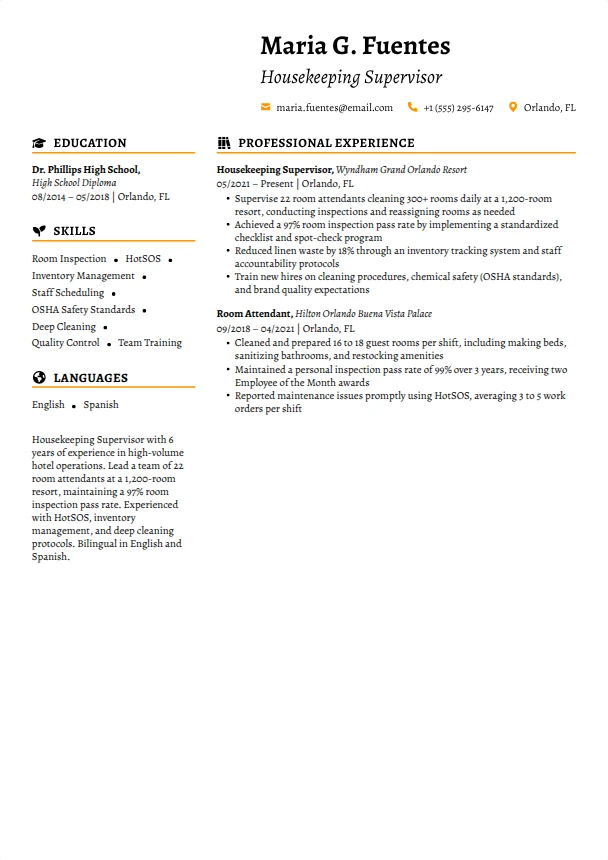
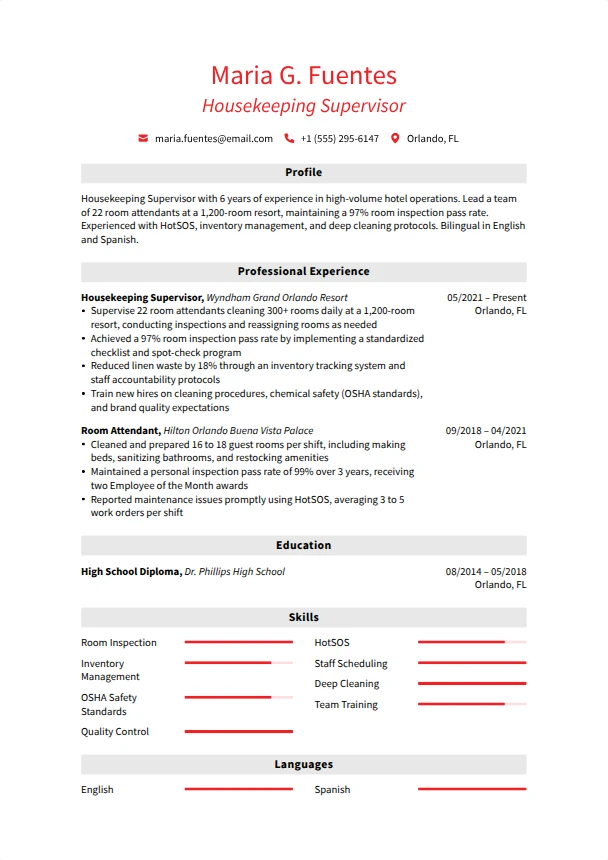
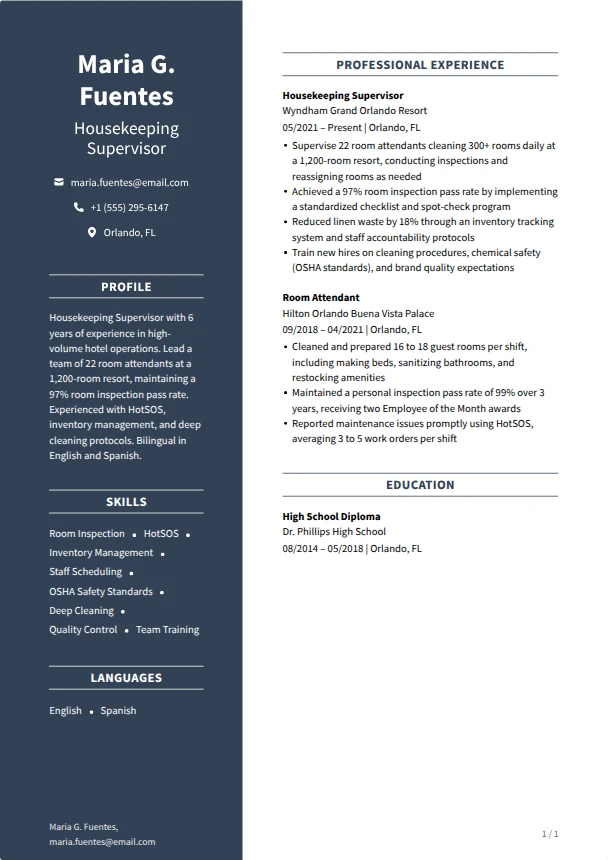
"Housekeeping Supervisor with 6 years of hotel experience. Lead 22 room attendants turning 300+ rooms daily at a 1,200-room resort, running spot inspections to hold a 97% inspection pass rate."
Why it works: team size, daily volume, and a quality metric.
"Detail-oriented Room Attendant with 3 years cleaning 16 to 18 rooms per shift at a luxury hotel. 99% inspection pass rate, fluent in chemical dilution and linen turnover, with two Employee of the Month awards."
Why it works: a concrete pace paired with quality signals.
"Reliable, punctual cleaner seeking a hotel room attendant role. Experience with deep cleaning, sanitation protocols, and supply restocking in residential and commercial settings, with a perfect attendance record."
Why it works: leans on reliability and transferable skills.
Writing strong experience bullets
Every bullet should answer: "What did you do, and why did it matter?"
Before and after examples:
Cleaned hotel rooms
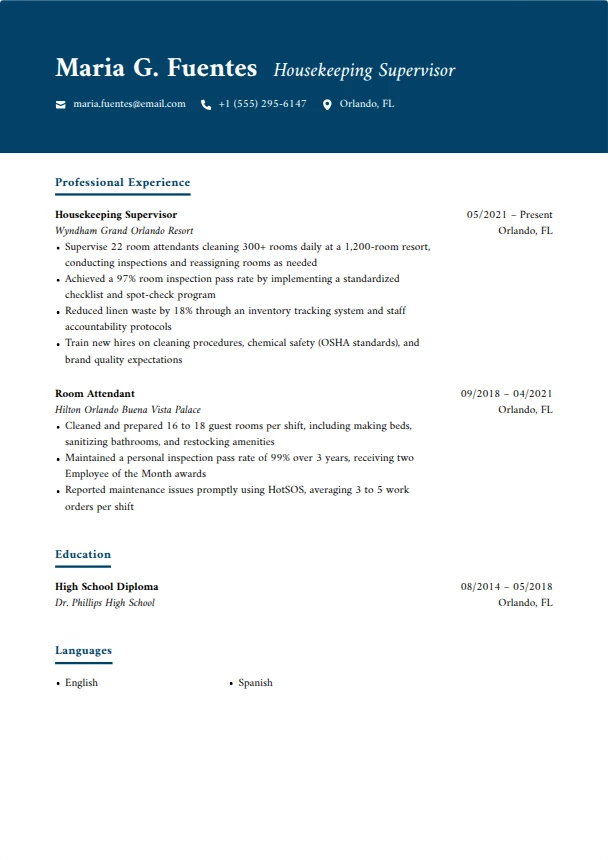
Cleaned and turned 16 to 18 guest rooms per shift, including bathrooms and amenity restocking, holding a 99% inspection pass rate
Supervised the housekeeping team
Supervised 22 room attendants turning 300+ rooms daily, running spot inspections to protect checkout timing
Kept track of supplies
Managed linen, towel, and amenity inventory in inventory software, restocking carts daily to keep turnover moving
Strong action verbs for housekeeping resumes:
Cleaned, Inspected, Sanitized, Disinfected, Turned, Restocked, Supervised, Trained, Maintained, Reported
5 mistakes that get housekeeping resumes rejected
Not including room counts
Rooms per shift is the first number a manager scans for. Leaving it out hides your pace.
Forgetting inspection rates
An inspection pass rate shows you clean fast without sacrificing quality.
Skipping safety training
Chemical handling and bloodborne pathogens awareness reduce a property's risk.
Being too brief
A one-line job entry says nothing. Spell out deep cleaning, linen turnover, and restocking.
Not mentioning bilingual skills
A second language helps with training and coordination on diverse teams.
What to do if you have no professional experience
Housekeeping is one of the most accessible entry points in the hotel industry. How to land a first role:
Emphasize reliability
Managers value attendance and punctuality. Mention your record of showing up on time.
Highlight cleaning experience
Any cleaning counts, from residential to janitorial. Include specific tasks and standards you maintained.
Show physical capability
The work is physically demanding. Noting that you can stand for long periods and lift supplies helps.
Get safety certified
OSHA Bloodborne Pathogens training or the CGA course can set you apart.
Frequently asked questions
What should I put on a housekeeping resume?
Include rooms cleaned per shift, inspection pass rates, deep cleaning and linen turnover duties, supervisory experience, and chemical handling knowledge. List tools such as CMMS, plus OSHA Bloodborne Pathogens training (29 CFR 1910.1030) if you have it.
Do I need experience for a housekeeping job?
Many hotels hire room attendants without experience. Reliability, punctuality, physical stamina, and a willingness to learn sanitation protocols are the main requirements. Prior residential or commercial cleaning work helps.
How do I make a housekeeping resume stand out?
Include specific numbers such as rooms cleaned per shift, inspection pass rates, and team size. Mention awards and certifications like the Certified Guestroom Attendant (CGA) credential.
Should a housekeeping resume be one page?
Yes. One page is standard for room attendant and supervisor roles. Keep it focused on relevant cleaning experience and the rooms-per-shift numbers that show your pace.
What skills are most important for housekeeping?
Room cleaning and turnover, deep cleaning, linen and towel management, chemical handling and dilution, sanitation protocols, room inspection, and time management are the core skills.
Skip the blank page
Open a complete, filled-in housekeeping resume in our free builder. Swap in your own details, keep the wording that fits, and download as PDF, free.
Build Your Housekeeping Resume Now
Create a professional housekeeping resume in minutes. ATS-friendly templates that highlight your efficiency and reliability.
Start Building, It's FreeRelated resume guides
More resume examples: