What hiring managers actually look for
Resort hiring picks up significantly in spring and summer months. Properties in Hawaii, Florida, and mountain destinations are actively recruiting for seasonal and full-time positions.
-
1
Guest-facing service instinct. Resorts hire for warmth and judgment under pressure. Recreation workers spend their days organizing activities and meeting guests, so managers scan for evidence that you can read a room, defuse complaints, and keep visitors coming back.
-
2
Safety and certifications. Pools, beaches, and activity programs carry real liability, so a current CPR/AED card, a Red Cross Lifeguarding certificate, or first aid training signals you can be trusted with guests near water and equipment from day one.
-
3
Reliability through peak season. Seasonal staffing surges mean managers value people who show up, adapt to long weekends and holidays, and can be cross-trained across pool and beach operations, kids club, and front-of-house roles as demand shifts.
If your resume communicates these things in the first 7-second scan, you'll make it to the detailed read. Everything below is about making that happen.
What resort recreation roles pay
Most resort activity and recreation jobs fall under the recreation worker category. Reported annual wages range from about $25,640 at the lower end to $49,460 at the higher end, with a median of roughly $35,380 per year. Seasonal contracts, tips at some properties, and supervisory titles shift where you land in that band. Use these figures to set realistic expectations and to anchor salary conversations once you reach the offer stage. Source: U.S. Bureau of Labor Statistics, Occupational Outlook Handbook, Recreation Workers.
How to structure your resume, section by section
The order matters. Here's what a strong resort resume looks like from top to bottom:
Contact Information
Name, phone, email, and city. Because many resorts are in destination locations, add a short line noting that you are open to relocation or seasonal contracts. List a professional email and skip the full street address.
Professional Summary
Two or three lines naming your role (activities coordinator, pool attendant, guest experience associate), years in hospitality, the property types you have worked at, and one measurable win such as activity participation or guest satisfaction scores. Lead with what makes you safe and dependable around guests.
Work Experience
Reverse chronological. For each role, note the property size (room count, daily guest volume) and lead bullets with numbers: activities run per week, participation rates, team members supervised, vendor savings. If your work was seasonal, label the contract dates so the gap reads as a season, not a lapse.
Skills
Mix guest-service strengths with the concrete tools resorts screen for: activity programming, event planning, vendor management, scheduling, and safety protocols. Recreation roles lean on active listening, speaking, and monitoring, so name those alongside any pool and beach operations or fitness skills you bring.
Education & Certifications
Most recreation roles are open to candidates with a high school diploma, while supervisory and therapeutic roles favor a recreation or hospitality degree. Give certifications their own line and include the issuing body and the year so screeners can confirm they are current. See the certifications section below for issuers and links.
Key skills to include
Resorts look for a blend of programming, safety, and guest relations skills. Mirror the wording in the job posting so the applicant tracking system flags a match. Here are the top skills to include:
Tip: If you hold any water safety or recreation certifications, list them by name in a dedicated certifications section.
Certifications worth listing
None of these are required to get hired everywhere, but each gives a manager a concrete reason to trust you near water, food, and guests. List the issuer and the year you earned it.
American Red Cross Lifeguarding (with CPR/AED for Professional Rescuers and First Aid)
Offered by the American Red Cross. The strongest credential for pool and beach roles, it bundles lifeguarding with CPR/AED and first aid so one card covers most water-facing duties.
ServSafe Food Handler Certificate
Offered by the National Restaurant Association (ServSafe). Useful when your role touches poolside snack service, beach bars, or any food and beverage area.
Certified Therapeutic Recreation Specialist (CTRS)
Offered by the National Council for Therapeutic Recreation Certification (NCTRC). A strong signal for wellness and therapeutic recreation programming at spa and destination resorts.
A sample resort resume
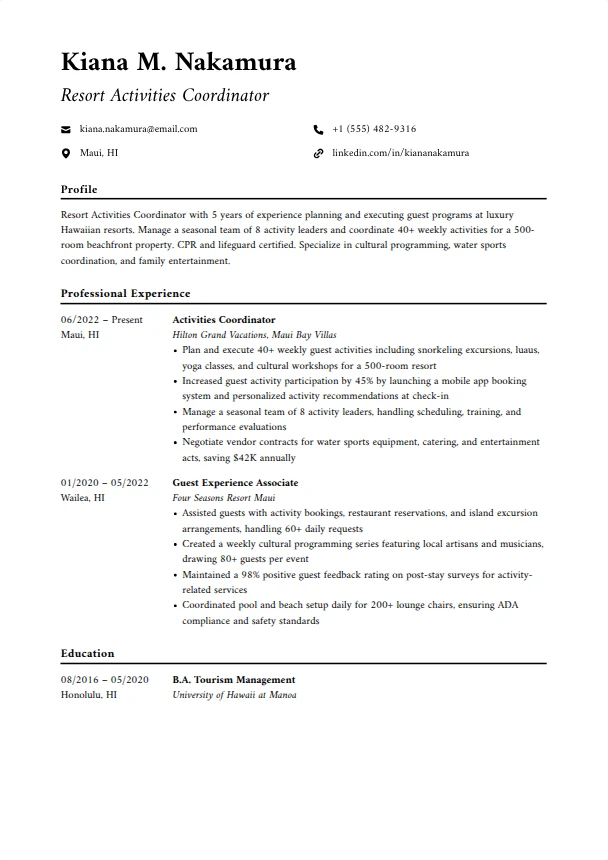
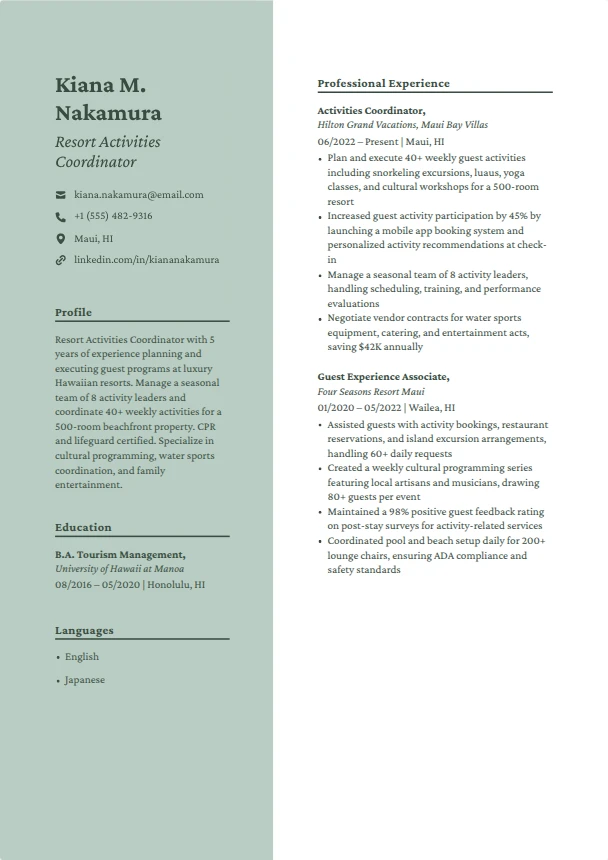
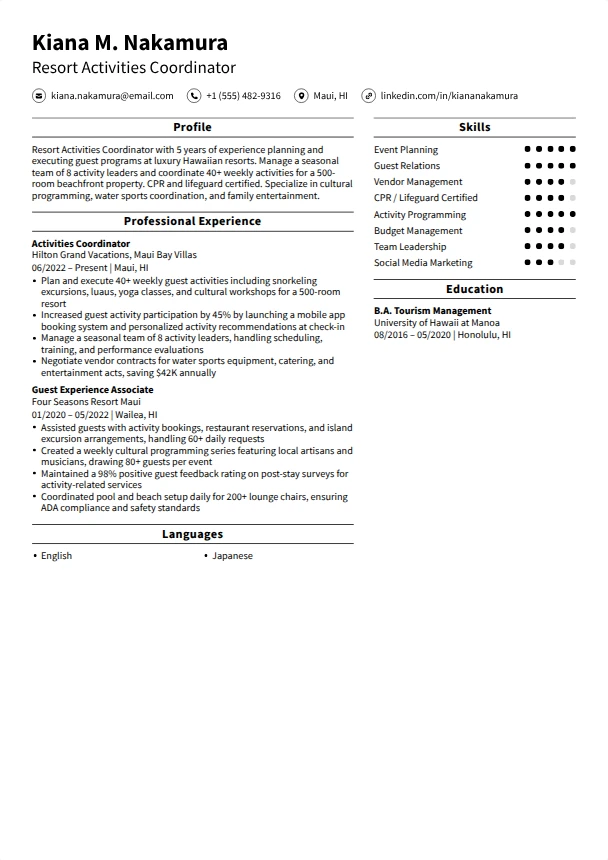
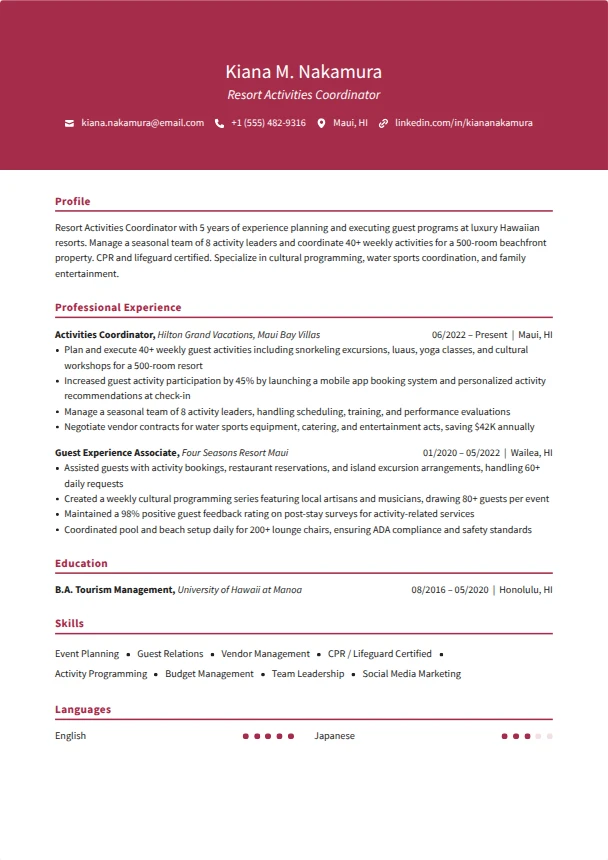
Here is an illustrative resort activities resume. The person and numbers are fictional and meant only to show structure and tone. Swap in your own details.
Resort activities coordinator with 5 years at a 480-room beach property. Builds daily recreation programming for pool and beach operations, leads seasonal staffing, and holds a current Red Cross Lifeguarding certificate with CPR/AED and first aid. Increased activity participation by 40% over two seasons.
- Planned and executed 40 or more weekly guest activities including snorkeling, cultural workshops, and evening entertainment for a 480-room resort.
- Increased activity participation by 40% over two seasons by rebuilding the daily recreation programming schedule.
- Managed a seasonal team of 8 activity leaders, handling scheduling, training, and safety protocols.
- Negotiated vendor contracts for water sports equipment, catering, and entertainment, saving roughly $40K annually.
- Monitored pool and beach operations for up to 200 daily guests, enforcing safety protocols with zero reportable incidents.
- Ran kids club and poolside activities and assisted first aid response as a CPR/AED certified responder.
Activity programming, recreation programming, guest relations, event planning, vendor management, scheduling, seasonal staffing, team leadership, pool and beach operations, safety protocols, customer service, first aid.
American Red Cross Lifeguarding with CPR/AED for Professional Rescuers and First Aid, 2024. ServSafe Food Handler Certificate, 2023.
Summary examples you can steal
Use one as a starting point, then swap in your own programs, numbers, and achievements.
"Resort Activities Coordinator with 5 years of experience at luxury Hawaiian properties. Manage 40+ weekly activities for 500-room resorts, increased participation by 45%, and lead seasonal teams of 8. Red Cross Lifeguarding certified."
Why it works: It pairs property scale (500 rooms) with two hard numbers a hiring manager cares about, participation growth and team size, and front-loads a safety credential.
"Guest Experience Associate with 3 years at beach and spa resorts. Created a cultural programming series drawing 80+ guests per event and maintained 98% positive feedback ratings. CPR/AED certified."
Why it works: It shows initiative (built a new series) and ties it to a guest satisfaction score, the KPI resorts watch most closely.
"Recreation management graduate seeking a resort activities position. Completed a summer internship coordinating pool and beach activities and kids club programming for 200+ guests daily. Lifeguard certified."
Why it works: With no full-time history, it leans on a relevant degree and an internship with real daily guest volume, proving readiness without padding.
"Event planner transitioning to resort operations. 4 years of experience coordinating corporate events for 100 to 500 attendees. CPR/AED certified with strong vendor management and scheduling skills."
Why it works: It reframes outside experience in resort terms (events, attendee counts, vendors) and front-loads a CPR/AED certification to close the safety gap a manager would worry about.
Writing strong experience bullets
Every bullet point should answer: "What did you do, and why did it matter?" Use this formula:
Before and after examples:
Planned activities for guests
Planned and executed 40+ weekly guest activities including snorkeling, cultural workshops, and evening entertainment for a 500-room resort
Managed the activities team
Managed a seasonal team of 8 activity leaders, handling scheduling, training, and performance evaluations
Worked with outside vendors
Negotiated vendor contracts for water sports equipment, catering, and entertainment, saving $42K annually
Strong action verbs for resort resumes:
Coordinated, Planned, Executed, Negotiated, Launched, Managed, Trained, Created, Increased, Maintained
5 mistakes that get resort resumes rejected
Being too general
"Provided great guest service" tells a manager nothing. Name the activity, the property size, and the result: 40+ weekly activities for a 500-room resort, or a 45% jump in participation.
Forgetting certifications
Red Cross Lifeguarding, CPR/AED, first aid, and ServSafe Food Handler are often the deciding factor for pool, beach, and food and beverage roles. Bury them in a paragraph and an ATS or a busy manager will miss them. Give them their own labeled section.
Not showing seasonal management
Resort hiring spikes for peak season, so managers want proof you can handle a surge. Note how you ran activities at full occupancy, covered holiday weekends, or scaled a team up and down across a contract.
Omitting budget details
If you have negotiated vendor contracts or managed an activities budget, say so with a figure. "Saved $42K annually on water sports and entertainment vendors" carries far more weight than "managed vendors."
Using a cluttered template
Heavy graphics, columns, and icons confuse applicant tracking systems and bury your numbers. Use a clean, single-column, reverse chronological layout that stays readable after the software parses it.
What to do if you have no professional experience
Many resort positions are designed for people starting their hospitality career. Here is how to get your foot in the door:
Start with seasonal positions
Summer and holiday seasons bring huge hiring surges at resorts. Apply early for activities staff, pool attendant, or kids club roles.
Get your certifications first
A Red Cross Lifeguarding certificate with CPR/AED and first aid makes you immediately more hireable for pool and beach operations. It is often the line that moves an entry-level resume to the top of the pile.
Leverage any event experience
Planned events for school, church, camp, or volunteer organizations? That counts. Frame it in resort terms: attendee counts, activity programming, and scheduling.
Show willingness to relocate
Many resorts are in destination locations. Stating you are open to relocation removes a common hiring concern.
Frequently asked questions
What qualifications do I need for a resort job?
Most entry-level resort positions require strong communication skills and a positive attitude. For pool, beach, and recreation roles, a current CPR/AED card and an American Red Cross Lifeguarding certificate are often the deciding factor. Supervisory and activities-director roles typically want 2 to 5 years of hospitality experience.
Is resort work seasonal?
Many resort positions are seasonal, especially in ski and beach destinations where hiring surges in spring and summer. Year-round resorts in Hawaii, Florida, and the Caribbean offer permanent positions. Label seasonal contract dates on your resume so a gap reads as a season, not a lapse.
How do I write a resort resume with no hospitality experience?
Focus on transferable skills from customer service, event planning, camp counseling, or recreation roles. List any safety certifications first, such as Red Cross Lifeguarding or CPR/AED, since those make you immediately hireable for pool and beach positions, and state that you are open to relocation.
Which certifications help most on a resort resume?
American Red Cross Lifeguarding with CPR/AED for Professional Rescuers and First Aid is the strongest credential for pool and beach roles. A ServSafe Food Handler certificate helps for poolside food and beverage work, and a Certified Therapeutic Recreation Specialist (CTRS) credential supports therapeutic and wellness programming roles. List each with its issuer and year.
What is the best format for a resort resume?
Use a clean, single-column, reverse chronological format. Keep it to one page and focus on guest service metrics, activity programming numbers, team size, and certifications so an applicant tracking system can parse them cleanly.
Skip the blank page
Open a complete, filled-in front desk resume in our free builder. Swap in your own details, keep the wording that fits, and download as PDF, free.
Build Your Resort Resume Now
Use our resume builder to create a polished resort resume in minutes. ATS-friendly templates designed for hospitality and recreation careers.
Start Building, It's FreeRelated resume guides
Examples and skills for hotel roles across front of house and operations.
Highlight guest check-in, reservations, and service recovery experience.
Show attention to detail, room turnover speed, and safety standards.
More resume examples: