What hiring managers actually look for
After reviewing hundreds of insurance resumes, hiring managers consistently reward three patterns visible in the strongest examples:
-
1
Production numbers front and center. The best insurance resumes quantify everything: policies written per month, premium volume generated, retention rates, and loss ratios. An agent who writes '$1.2M in annual premium' tells a clearer story than one who says 'consistently met sales goals.' Every example below includes this level of detail.
-
2
License and designation placement above the fold. In the strongest examples, licenses (P&C, Life & Health) and designations (CPCU, CIC, ARM) appear in the top third of the resume. This mirrors how agency owners actually scan: they verify credentials before reading experience.
-
3
Client retention metrics alongside new business numbers. Agencies care about keeping clients as much as finding new ones. The strongest examples show both acquisition and retention: 'Grew book of business to 450 policies while maintaining a 94% retention rate.' This dual focus separates experienced agents from transactional sellers.
If your resume communicates these things in the first 7-second scan, you'll make it to the detailed read. Everything below is about making that happen.
How to structure your resume, section by section
The order matters. Here's what a strong insurance resume examples looks like from top to bottom:
1. Contact header
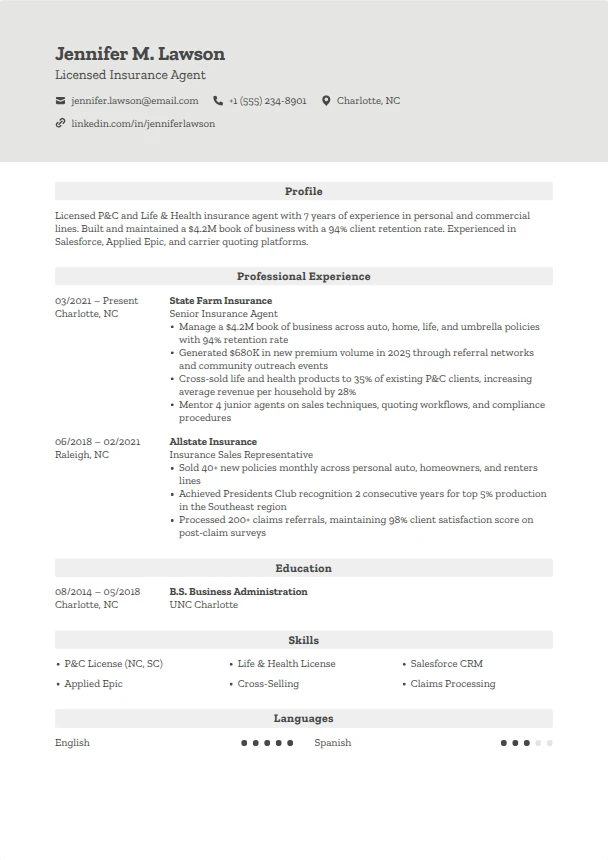
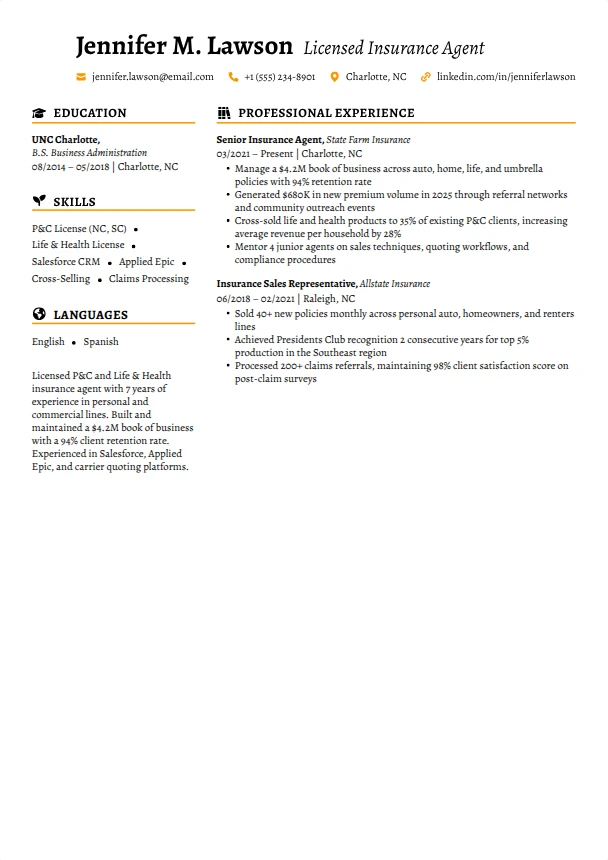
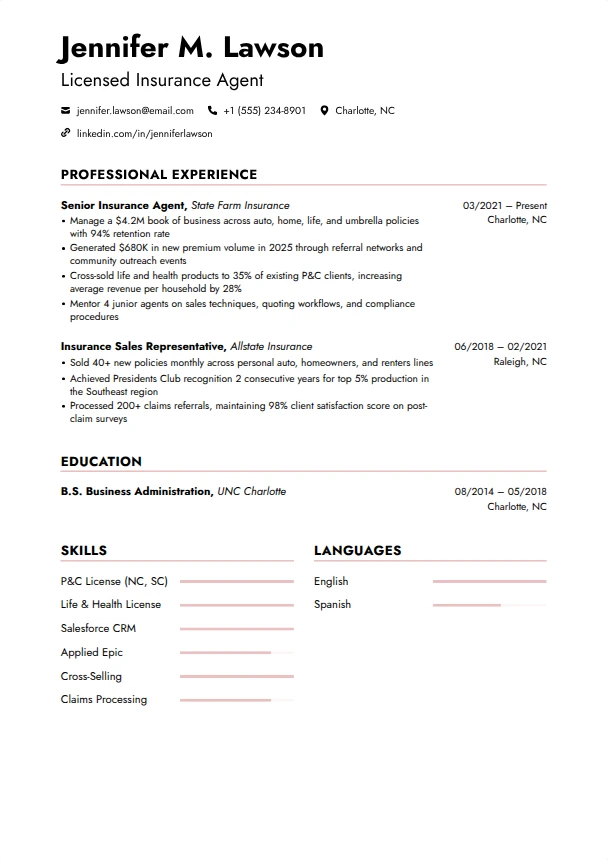
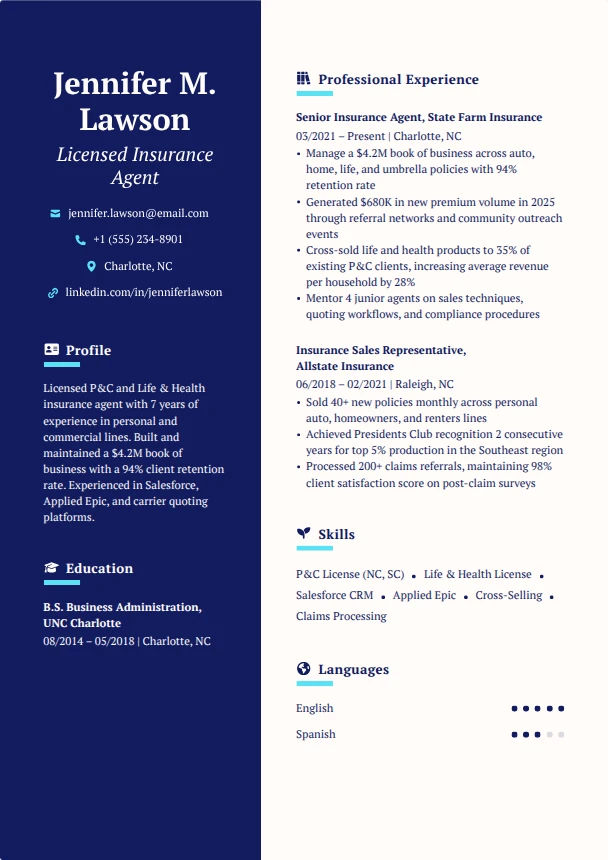
Every strong insurance resume example starts clean: name, email, phone, location, LinkedIn. No photos, no decorative elements, no full mailing address. The examples below show this in action.
Sarah Caldwell · [email protected] · (555) 293-4481 · Charlotte, NC
linkedin.com/in/sarahcaldwell-ins
2. Professional summary
Notice how each example below tailors the summary to a specific role. An agent summary leads with production numbers. An underwriter summary leads with risk assessment scope. An adjuster summary leads with claims volume. Match your summary to the exact role you are targeting.
Strong: "Licensed P&C insurance agent with 6 years of experience managing a $3.2M book of business across personal and commercial lines. Grew new policy volume by 28% year-over-year while maintaining a 93% client retention rate. CPCU designation in progress with 4 of 8 exams completed."
3. Licenses and designations
In every insurance example that gets callbacks, licenses and professional designations sit right below the summary. They act as instant validation for hiring managers who need to verify credentials before reading further.
Property & Casualty License (NC, SC, VA) · Life & Health License (NC) · CPCU (4/8 exams completed) · CIC (2025)
4. Core competencies
The strongest examples group skills by function and keep the list to 12-15 items. Notice how each example below tailors this section to the specific insurance role rather than listing every generic business skill.
Sales: New business development, cross-selling, referral generation, pipeline management
Technical: Policy rating, coverage analysis, risk assessment, claims review
Systems: AMS360, Applied Epic, Salesforce, comparative raters
Service: Client retention, renewal management, policy review, coverage gap analysis
5. Work experience
Study how each example structures bullets: action verb, what was done, measurable impact. The best insurance examples include 3-5 bullets per role, with production numbers and retention metrics leading each position.
Strong: "Managed a $3.2M book of business across 450 personal and commercial lines policies. Generated $840K in new annual premium through referral programs, community networking, and digital lead campaigns. Maintained a 93% client retention rate by conducting annual policy reviews and proactively identifying coverage gaps."
6. Education and continuing education
In insurance resume examples that work, education is brief: degree, school, year. Continuing education credits and industry courses deserve their own line items, especially designations like CPCU, CIC, or ARM that require ongoing study.
Key skills to include
Across the strongest insurance resume examples, these skills appear most frequently. Customize your list based on which example template matches your role.
Tip: Compare your skills section against the job posting before submitting. The strongest resume examples we have seen match 70-80% of the posting's listed requirements word-for-word. If the posting says 'Applied Epic,' do not write 'agency management systems.'
Resume summary examples you can steal
Use one as a starting point, then swap in your own technologies, numbers, and achievements.
"Licensed P&C agent with 4 years of experience growing a personal lines book from $600K to $1.8M in written premium. Specializes in auto, home, and umbrella coverage with a 95% client retention rate. Generates 40% of new business through referral programs and community involvement. Consistently ranked in the top 10% of agents in a 200-agent region."
Why it works: This example leads with book growth trajectory, shows retention alongside acquisition, and provides a competitive ranking for context.
"Commercial lines account manager with 7 years of experience servicing a $5.4M book across manufacturing, construction, and professional services verticals. Manages 180+ commercial accounts, coordinating renewals, endorsements, and certificate issuance. Reduced E&O exposure by implementing a standardized policy review checklist adopted across 3 branch offices."
Why it works: This example quantifies the book, specifies industry verticals, and highlights a process improvement that shows leadership beyond daily servicing.
"Property claims adjuster with 5 years of experience handling 120+ open claims monthly across residential and commercial property damage. Maintained an average cycle time of 18 days (company target: 25 days) while achieving a 4.7/5.0 policyholder satisfaction score. Experienced in Xactimate estimating, field inspections, and subrogation recovery."
Why it works: This example quantifies caseload, beats the company benchmark on cycle time, and names the specific tools an adjuster is expected to know.
"Commercial property underwriter with 6 years of experience evaluating $50M+ in annual submission volume across middle-market accounts. Maintains a combined ratio of 92% on a $28M book of business. Developed a streamlined risk scoring model that reduced quote turnaround from 5 days to 2 days, improving broker satisfaction scores by 20%."
Why it works: This example speaks the underwriter's language: combined ratio, submission volume, and quote turnaround. It also shows process innovation, not just task execution.
"Former financial advisor transitioning to insurance sales with a Life & Health license and Series 65 designation. Brings 5 years of experience managing $4M in client assets, conducting annual reviews, and cross-selling financial products. Averaged 12 new client acquisitions per quarter through referral networks and community seminars."
Why it works: Maps financial advisory skills directly to insurance, quantifies client acquisition, and shows an existing license that validates industry commitment.
"Business administration graduate with Property & Casualty license and internship experience at a regional independent agency. Assisted senior agents with policy renewals, quote preparation, and client communications for a 300-policy book. Completed 40+ hours of carrier product training across 5 personal lines carriers during the internship."
Why it works: This example turns an internship into concrete experience with numbers, names the agency model, and quantifies training hours to show engagement.
Writing strong experience bullets
Every bullet point should answer: "What did you do, and why did it matter?" Use this formula:
Before and after examples:
Sold insurance policies to new clients.
Generated $840K in new annual written premium by developing a referral program, hosting 4 quarterly community events, and converting 35% of online leads into bound policies.
Handled claims and worked with policyholders.
Managed a caseload of 120+ open property claims monthly, completing field inspections within 48 hours of assignment and maintaining an average cycle time of 18 days, 28% faster than the company target.
Reviewed insurance applications and made decisions.
Evaluated 400+ commercial property submissions annually totaling $50M in potential premium, maintaining a 92% combined ratio on bound accounts while meeting a 48-hour quote turnaround SLA for priority brokers.
Helped clients with their policy renewals.
Managed renewal process for 180 commercial accounts ($5.4M book), negotiating carrier terms, presenting coverage options, and achieving a 96% renewal retention rate across all verticals.
Did customer service for an insurance office.
Served as primary point of contact for 300+ personal lines policyholders, processing endorsements, answering coverage questions, and cross-selling umbrella policies to 22% of existing auto/home clients.
Strong action verbs for insurance resume examples resumes:
Acquired · Analyzed · Assessed · Bound · Built · Closed · Consulted · Converted · Cross-sold · Evaluated · Generated · Managed · Negotiated · Processed · Prospected · Renewed · Retained · Reviewed · Underwrote
5 mistakes that get insurance resume examples resumes rejected
Copying example resumes word-for-word
Templates are starting points, not finished products. Hiring managers and agency owners recognize generic phrasing. Use the structure and format from examples, but replace every detail with your actual production numbers, licenses, and client metrics.
Using the same example for every insurance role
An agent resume and an underwriter resume require completely different emphasis. Choose the example closest to your target role, then customize your skills and summary to match each specific job posting.
Including production numbers you cannot verify
If an example says '$3M book of business' and your book was $800K, use your real number. Insurance is a small industry, and production numbers are easily verified through carrier reports and references. Inflated metrics will surface.
Burying licenses and designations at the bottom
In insurance, your licenses are your credentials. Every strong example places them in the top third of the resume. Never bury P&C, Life & Health, CPCU, or CIC designations in a miscellaneous section at the end.
Listing only new business without retention metrics
Agencies value retention as much as acquisition. The best examples show both sides: new premium generated AND client retention rate. If you only show new business numbers, hiring managers may assume you churn clients.
What to do if you have no professional experience
Even the example templates can be adapted for candidates with no insurance work history. Here is how to modify them:
Use the career changer example as your starting point
The career changer and entry-level templates above are specifically designed for people transitioning into insurance. Start with whichever is closer to your situation and customize with your own licensing progress, transferable experience, and skills.
Replace 'Book of Business' with training and coursework metrics
Instead of production numbers, quantify your preparation: hours of pre-licensing study, number of carrier product training modules completed, or mock sales scenarios practiced. These details fill the gap while showing initiative.
Front-load your licensing section
In the examples above, licenses appear after the summary. For no-experience candidates, consider making them even more prominent. Your P&C or Life & Health license (even in progress) is your strongest credential.
Add an internship or volunteer section
If you have done any insurance-adjacent volunteer work (financial literacy workshops, community outreach) or completed an agency internship, format it like a full work experience entry with bullets and metrics.
Frequently asked questions
Can I use these examples as-is?
No. These are templates to study and learn from, not to submit directly. Use the structure, formatting, and bullet patterns, but replace all content with your real production numbers, licenses, and client metrics. Agency owners in the insurance industry talk to each other, and duplicate resumes get noticed.
Which example should I start with?
Pick the one closest to your target role: personal lines agent for agency sales, commercial account manager for servicing roles, claims adjuster for claims positions, underwriter for risk assessment roles, and career changer if you are coming from another industry.
How do I adapt an example for a specific job posting?
Read the posting and identify the top 5 requirements (specific licenses, systems, line of business experience). Adjust your skills section to match their exact wording. Rewrite your summary to address their priorities. Reorder your bullets so the most relevant production metrics come first.
Should I include my production numbers if they are modest?
Yes. Honest numbers are always better than vague statements. A $500K book of business is a real achievement for a newer agent. Context matters more than size: growth rate, retention percentage, and ranking among peers all add meaning to smaller numbers.
How do I handle multiple carrier appointments on my resume?
List your primary carriers in your experience bullets where relevant, but do not create a separate carrier appointment section. Mentioning that you worked with 8+ carriers in a personal lines role or 5 specialty carriers in commercial lines provides context without cluttering the resume.
Build your insurance resume from these examples
Pick the template closest to your experience level, customize it with your own production numbers, and download a polished PDF in minutes. Free, no account required.
Start Building, It's FreeRelated resume guides
The complete guide to writing an insurance resume from scratch.
How to break into insurance with no prior industry experience.
How to land your first health insurance role with transferable skills.
More resume examples: