What hiring managers actually look for
When you have no life insurance experience, hiring managers at agencies and carriers are evaluating three qualities that predict success in the role:
-
1
Comfort with needs-based, consultative selling. Life insurance is not transactional. Agents sit across from families and discuss death, disability, and financial security. Managers want people who can have difficult conversations with empathy and professionalism. Any experience in financial advising, counseling, healthcare, or high-consideration retail sales signals this ability.
-
2
Life & Health licensing progress. Your Life & Health license is the baseline requirement. Candidates who have completed pre-licensing coursework or already passed their state exam move to the top of the pile. Captive agencies like Northwestern Mutual, New York Life, and MassMutual often sponsor licensing, but showing you have started the process on your own demonstrates initiative.
-
3
Self-discipline and prospecting willingness. Life insurance roles are often commission-based, and new agents need to prospect actively. Hiring managers look for evidence of self-motivation: meeting personal sales targets, running a side business, completing a certification on your own time, or any experience where your income depended on your effort.
If your resume communicates these things in the first 7-second scan, you'll make it to the detailed read. Everything below is about making that happen.
How to structure your resume, section by section
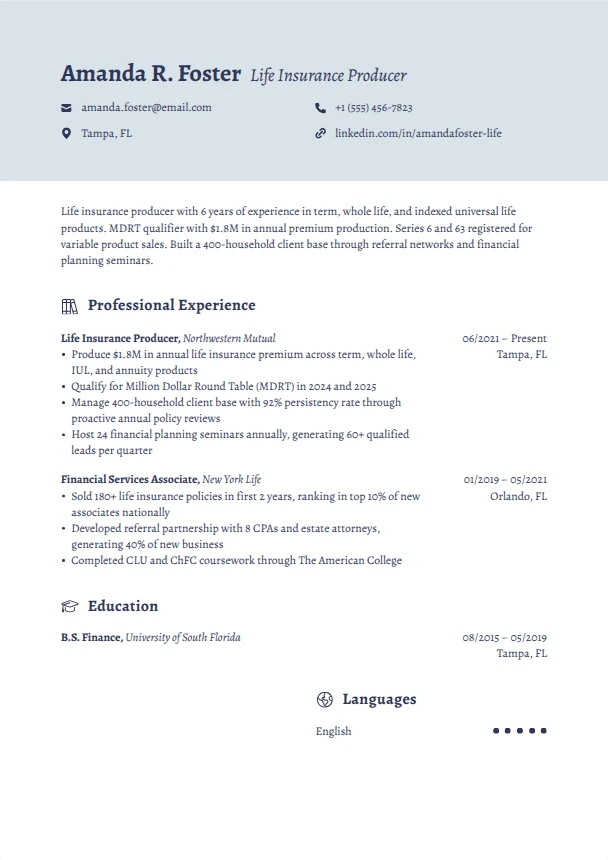
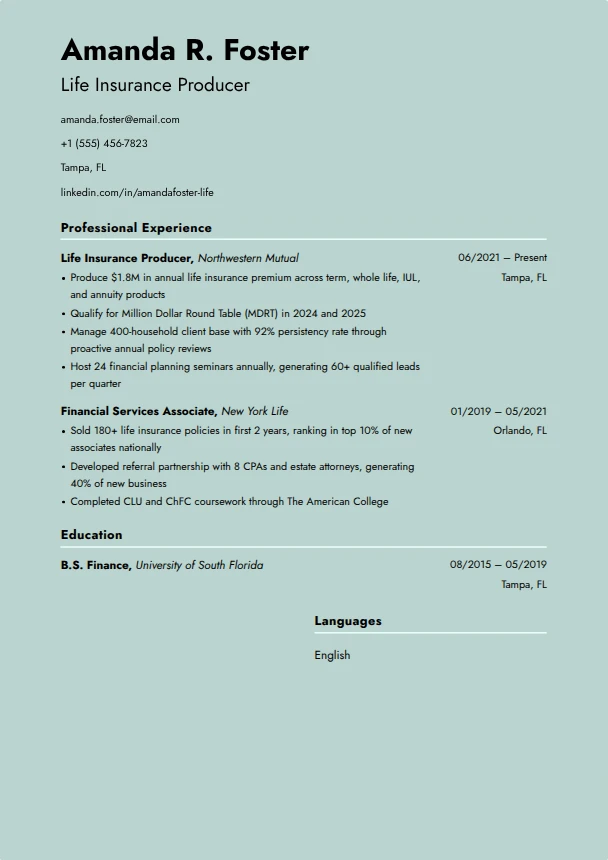
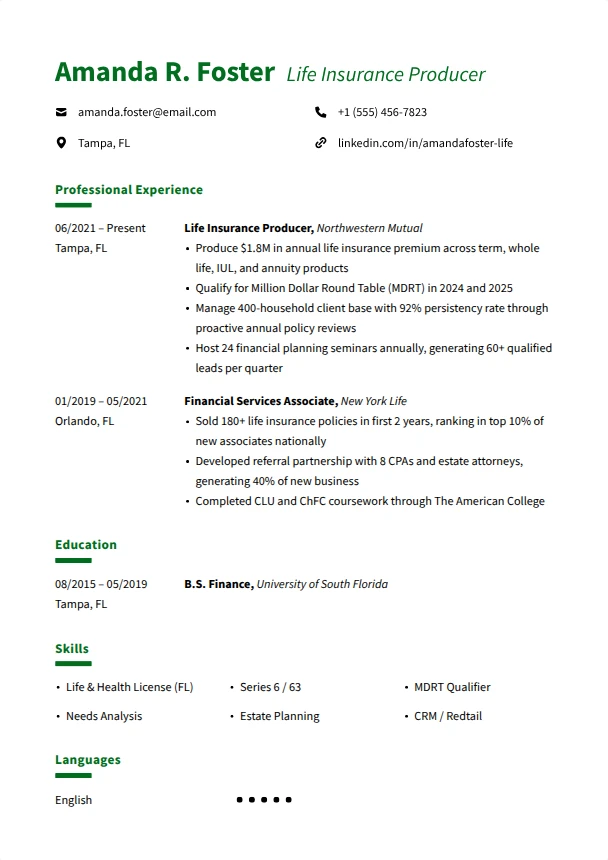
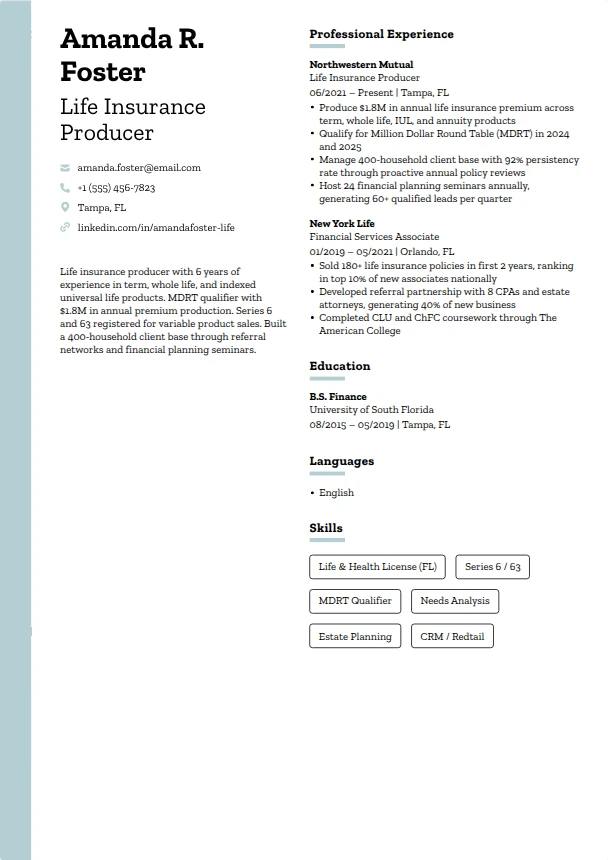
The order matters. Here's what a strong life insurance resume (no experience) looks like from top to bottom:
1. Contact header
Name, email, phone, city and state, LinkedIn. If you have a professional website or financial services profile, include it. Skip the photo and full street address.
2. Professional summary (2-3 sentences)
Lead with your Life & Health licensing status, relevant sales or advisory experience, and the type of life insurance role you are pursuing. Be specific about your consultative selling background and financial literacy.
Strong: "Financial services professional pursuing a Life & Health license with pre-licensing coursework completed through Kaplan. Brings 4 years of consultative sales experience in banking, advising clients on savings products, retirement accounts, and loan options. Consistently exceeded quarterly cross-selling targets by 20% through needs-based conversations and long-term relationship building."
3. Licensing and certifications
Place your Life & Health license or progress directly below your summary. If you hold other financial credentials (Series 6, Series 63, CFP coursework), list them here as well. These demonstrate comfort with regulated industries and exam preparation.
Life & Health Pre-Licensing Course (Kaplan, completed January 2026) · State Exam (passed February 2026) · Series 6 (planned Q3 2026)
4. Transferable skills
Group your skills by category, mapping them to life insurance competencies. Financial advising becomes needs analysis. Retail sales becomes consultative selling. Use the language from life insurance job postings wherever possible.
Sales: Needs-based selling, consultative approach, closing, referral generation
Financial: Retirement planning basics, savings strategies, risk assessment, budgeting
Client Service: Relationship building, active listening, follow-up, trust development
Technical: CRM systems, Microsoft Office, presentation software, quoting tools
5. Work experience (reframed for life insurance)
Reframe your banking, financial services, retail, or customer service experience to highlight consultative selling, client relationships, and financial conversations. Life insurance managers want to see that you can sit across from someone, understand their needs, and recommend a solution.
Strong: "Advised 15+ clients weekly on savings products, retirement accounts, and personal loans as a personal banker at Wells Fargo. Grew personal referral network to 80+ active contacts, generating $1.2M in new deposits over 18 months. Exceeded quarterly cross-selling targets by 20% through needs-based conversations during account reviews."
6. Education
List your degree, relevant coursework (finance, business, economics, psychology), and any financial planning or insurance-specific training. Include GPA only if 3.5+ and recent.
Key skills to include
These are the most common skills listed in entry-level life insurance job postings. Focus on the ones you can genuinely demonstrate through your sales, financial services, or customer-facing experience.
Tip: Life insurance sales depend heavily on soft skills. If you have experience in any role where you built trust with clients, explained complex topics simply, or generated business through relationships rather than transactions, those skills translate directly. Frame them using insurance industry language.
Resume summary examples you can steal
Use one as a starting point, then swap in your own technologies, numbers, and achievements.
"Personal banker pursuing a Life & Health insurance license after 4 years of advising clients on savings, retirement, and lending products. Grew a personal referral network to 80+ active contacts and generated $1.2M in new deposits through needs-based conversations. Exceeded quarterly cross-selling targets by 20% while maintaining a 4.9/5.0 client satisfaction score."
Why it works: Banking experience maps directly to life insurance: advising clients, cross-selling financial products, and building long-term relationships. The referral network shows prospecting ability.
"Retail sales associate transitioning to life insurance after completing Life & Health pre-licensing coursework. Brings 3 years of high-consideration retail sales experience, consistently ranking in the top 5% of a 40-person sales team. Known for building repeat client relationships and explaining complex product features in clear, relatable terms."
Why it works: High-consideration retail (furniture, electronics, automotive) involves the same consultative approach as life insurance. The team ranking provides competitive context.
"Finance graduate with Life & Health license and summer internship at a Northwestern Mutual district office. Completed 30+ practice financial needs analyses during internship and observed 15 client meetings with senior advisors. Developed a prospecting plan that generated 8 qualified appointments from warm market outreach during a 10-week period."
Why it works: The internship provides direct life insurance exposure. Quantifying practice analyses and appointments shows engagement beyond passive observation.
"Former school counselor transitioning to life insurance after earning a Life & Health license. Brings 6 years of experience guiding families through complex decisions, building trust in sensitive conversations, and managing caseloads of 200+ students. Completed a personal finance coaching side project, helping 25 families create savings plans over 12 months."
Why it works: Counseling experience demonstrates the empathy and communication skills critical for life insurance. The personal finance coaching project shows initiative and financial literacy.
Writing strong experience bullets
Every bullet point should answer: "What did you do, and why did it matter?" Use this formula:
Before and after examples:
Helped customers at a bank with their accounts.
Advised 15+ clients weekly on savings, retirement, and lending products as a personal banker, growing a referral network to 80+ active contacts and generating $1.2M in new deposits over 18 months.
Sold electronics at a retail store.
Delivered consultative sales presentations for high-consideration electronics (average ticket: $1,200), achieving 135% of monthly target for 6 consecutive months and earning a top 5% ranking on a 40-person sales team.
Worked as a counselor helping students and families.
Guided 200+ students and their families through academic and financial aid planning, conducting one-on-one advising sessions and managing sensitive conversations about affordability, goals, and long-term outcomes.
Strong action verbs for life insurance resume (no experience) resumes:
Advised · Built · Closed · Coached · Communicated · Consulted · Converted · Counseled · Developed · Educated · Generated · Guided · Managed · Negotiated · Presented · Prospected · Referred · Retained
5 mistakes that get life insurance resume (no experience) resumes rejected
Framing life insurance as 'just sales'
Life insurance is consultative financial planning, not transactional selling. Your resume should emphasize advising, needs analysis, and relationship building. Agencies want advisors, not aggressive closers. Use language that reflects the consultative nature of the work.
Not mentioning your Life & Health license status
Whether you have passed your exam or are still studying, your licensing status belongs in the top third of your resume. Captive agencies like Northwestern Mutual and New York Life expect licensing readiness. Omitting it raises questions about your commitment.
Ignoring the prospecting reality of the role
Most entry-level life insurance positions require active prospecting, especially in the first 1-2 years. If you have experience generating leads, building referral networks, or cold calling, make sure that is on your resume. Agencies want to see that you understand what the daily work looks like.
Applying without researching the agency model
Captive agencies (Northwestern Mutual, New York Life, MassMutual) provide training, mentorship, and often a base salary or stipend. Independent agencies offer higher commissions but less support. Your resume and cover letter should reflect which model you are pursuing and why.
Leaving out financial literacy indicators
Life insurance agents discuss retirement planning, college savings, estate protection, and income replacement. If you have any background in personal finance, budgeting, financial advising, or even personal finance blogging, include it. Agencies want people who are comfortable talking about money.
What to do if you have no professional experience
Life insurance is one of the most accessible financial careers because agencies actively recruit and train people with no industry background. Here is how to position yourself:
Get your Life & Health license before applying
While captive agencies often sponsor licensing, arriving with your license already in hand shows initiative and lets you start selling sooner. Pre-licensing courses through Kaplan, ExamFX, or your state's approved providers typically take 40-60 hours. The state exam itself is straightforward with proper preparation.
Emphasize any consultative or advisory experience
Life insurance is about understanding a client's financial situation and recommending the right coverage. Any role where you advised people on decisions (banking, counseling, teaching, fitness coaching, financial planning) demonstrates this consultative approach. Frame these experiences using insurance language.
Understand the captive agency training model
Companies like Northwestern Mutual, New York Life, MassMutual, and Guardian offer structured training programs that last 6-12 months. They teach product knowledge, prospecting, and sales techniques. Mentioning that you are targeting these programs in your cover letter shows you understand the career path.
Build your warm market list before your first interview
Life insurance managers will ask about your natural market (people you already know who might need coverage). Having a list of 100+ contacts ready shows you understand prospecting and are prepared for the reality of the job. You do not need to share the list, just demonstrate that you have thought about it.
Frequently asked questions
Do I need a Life & Health license before applying to life insurance agencies?
Not always. Major captive agencies (Northwestern Mutual, New York Life, MassMutual) typically sponsor your licensing as part of their onboarding process. However, having your license or pre-licensing coursework completed makes you a stronger candidate and shortens your ramp time. Independent agencies generally expect you to be licensed before starting.
Is life insurance sales commission-only?
It depends on the agency. Many captive agencies offer a training stipend, draw against commission, or base salary for the first 6-12 months. After that, compensation typically shifts to commission-based. Independent agents are usually commission-only from day one. Ask about the compensation structure during interviews so you can plan accordingly.
What transferable skills matter most for life insurance?
Consultative selling, active listening, relationship building, and financial literacy are the most transferable skills. Life insurance is about understanding a family's financial needs and recommending appropriate coverage. Any experience advising people on important decisions (banking, counseling, coaching, teaching) translates directly.
How long does it take to get a Life & Health license?
Most states require 20-40 hours of pre-licensing coursework, which can be completed online in 1-3 weeks of focused study. After completing the course, you schedule and take the state exam. The entire process from enrollment to license typically takes 3-6 weeks depending on exam availability in your state.
What is the difference between captive and independent life insurance agencies?
Captive agencies (Northwestern Mutual, New York Life) represent one carrier exclusively and provide structured training, mentorship, and often a base stipend. Independent agencies represent multiple carriers and offer more product flexibility but less training support. For candidates with no experience, captive agencies are typically the better entry point due to their training infrastructure.
Skip the blank page
Open a complete, filled-in insurance agent resume in our free builder. Swap in your own details, keep the wording that fits, and download as PDF, free.
Build your life insurance resume today
Pick a template, add your Life & Health licensing progress and consultative sales experience, and download a polished PDF in minutes. Free, no account required.
Start Building, It's FreeRelated resume guides
The complete guide to writing an insurance resume from scratch.
How to break into insurance with no prior industry experience.
How to land your first health insurance role with transferable skills.
More resume examples: