What hiring managers actually look for
Communications hiring managers evaluate resumes differently than most other functions. Here is what they prioritize:
-
1
Writing quality is on trial from sentence one. Your resume is a writing sample. Sloppy prose, passive voice, or unclear messaging tells a hiring manager everything they need to know. Every sentence should be tight, active, and purposeful.
-
2
Media results and stakeholder impact matter most. Press placements, media impressions, stakeholder satisfaction scores, and internal engagement metrics are the currency of communications. Vague claims about "improving communications" carry no weight.
-
3
Range across communication types is valued. The best candidates show experience across press releases, executive messaging, internal communications, crisis response, and digital content. Demonstrating versatility makes you more competitive for senior roles.
If your resume communicates these things in the first 7-second scan, you'll make it to the detailed read. Everything below is about making that happen.
How to structure your resume, section by section
The order matters. Here's what a strong communications resume looks like from top to bottom:
1. Contact header
Include your name, phone, email, location, LinkedIn URL, and a link to your portfolio or published clips if applicable.
Sarah Kim · (202) 555-0167 · [email protected] · Washington, DC · linkedin.com/in/sarahkim · sarahkimwrites.com
2. Summary or objective
Lead with your communications specialty (PR, internal comms, corporate communications) and your strongest measurable achievement. Name the types of organizations and stakeholders you have worked with.
Strong: "Corporate communications manager with 6 years of experience leading internal and external messaging for a Fortune 500 healthcare company. Managed crisis communications during a product recall that preserved brand trust, with post-crisis sentiment scores returning to baseline within 45 days."
3. Key media placements or campaigns
If you have notable press coverage or campaign results, list 2 to 3 highlights after your summary. Include publication names, reach, and outcomes.
4. Skills
Group skills into categories like media relations, content, and strategy. Include both traditional PR skills and modern digital communications capabilities.
Media: Press release writing · Media pitching · Press conference coordination · Journalist relationships
Content: Executive speechwriting · Internal newsletters · Crisis messaging · Thought leadership
Tools: Cision · Muck Rack · Meltwater · WordPress · Google Analytics 4
5. Experience
Write 3 to 5 bullets per role focused on the scope and impact of your communications work. Include media placements secured, internal engagement metrics, crisis responses managed, and executive communications delivered.
Strong: "Secured 48 media placements in 2025 across Bloomberg, Forbes, TechCrunch, and industry publications, generating an estimated 12M earned media impressions and contributing to a 28% increase in inbound partnership inquiries."
6. Education and certifications
List your degree, any PR or communications certifications (PRSA APR, for example), and relevant professional development. Graduate degrees in communications, journalism, or public relations carry weight in this field.
Key skills to include
Communications roles require a broad skill set that spans writing, strategy, relationships, and measurement. Here are the most important skills for 2026:
Tip: Communications roles vary significantly. A PR-focused role needs media relations front and center, while an internal comms role should highlight employee engagement and change management. Tailor your skills to the specific function.
Resume summary examples you can steal
Use one as a starting point, then swap in your own technologies, numbers, and achievements.
"PR manager with 8 years of experience securing top-tier media coverage for technology companies, from Series A startups to publicly traded enterprises. Built and maintained relationships with 200+ journalists and secured coverage in the Wall Street Journal, Wired, and the New York Times, generating over 50M earned media impressions."
Why it works: Names specific publications, quantifies the journalist network, and shows experience across company stages.
"Internal communications specialist with 5 years of experience at a 10,000-person manufacturing company. Redesigned the employee newsletter program, increasing open rates from 22% to 58%, and led communications for a company-wide restructuring that maintained 85% employee satisfaction scores."
Why it works: Shows measurable improvement in engagement and demonstrates ability to handle sensitive organizational changes.
"Director of Corporate Communications with 10 years of experience managing messaging for financial services organizations during periods of regulatory change, M&A activity, and market volatility. Led a crisis communications response during a data breach that was cited by PR Week as an industry best practice."
Why it works: Demonstrates high-stakes experience and external recognition, which validates the candidate's expertise.
"Communications coordinator with 2 years of experience supporting media relations, content creation, and event logistics at a mid-size nonprofit. Drafted 30+ press releases, coordinated media outreach for an annual fundraising gala that raised $1.2M, and managed the organization's LinkedIn presence."
Why it works: Quantifies output and ties communications work to a tangible organizational outcome.
Writing strong experience bullets
Every bullet point should answer: "What did you do, and why did it matter?" Use this formula:
Before and after examples:
Managed media relations for the company.
Led media relations strategy that secured 65 press placements in 2025, including features in Reuters, CNBC, and the Wall Street Journal, generating 18M earned impressions.
Wrote internal communications for employees.
Created and distributed weekly internal newsletters to 8,500 employees across 12 offices, achieving a 54% average open rate and 89% employee awareness of key company initiatives.
Helped with crisis communications.
Developed and executed a crisis communications plan during a product safety recall, coordinating messaging across PR, social media, and customer support channels within 4 hours of the incident. Brand sentiment recovered to pre-crisis levels within 6 weeks.
Strong action verbs for communications resumes:
Secured · Drafted · Led · Coordinated · Managed · Developed · Positioned · Crafted · Pitched · Advised · Facilitated · Authored · Distributed · Navigated · Influenced · Elevated
7 mistakes that get communications resumes rejected
Writing a resume that reads poorly
A communications resume is a writing sample. Passive voice, wordy sentences, and unclear messaging undermine your credibility before you even get an interview. Every line should demonstrate your communication skills.
Not quantifying media results
"Secured media coverage" is incomplete. Include the number of placements, the publications, the estimated reach or impressions, and any business impact that resulted from the coverage.
Ignoring internal communications experience
Many candidates focus exclusively on external PR. Internal communications is a growing field, and experience with employee engagement, change management, and executive messaging is increasingly valued.
Listing job duties instead of strategic contributions
"Managed social media" is a task. "Developed a social media strategy for executive thought leadership that grew the CEO's LinkedIn following by 15K and generated 3 speaking invitations" is a contribution.
Omitting crisis communications experience
If you have managed any crisis response, include it. Crisis communications is one of the most valued skills in the field, and real examples demonstrate composure, speed, and strategic thinking.
Using industry jargon without substance
Phrases like "synergized cross-functional stakeholder engagement" obscure meaning rather than clarifying it. Use plain, direct language and let your results demonstrate sophistication.
Forgetting to include media monitoring tools
Proficiency in Cision, Muck Rack, Meltwater, or similar tools is expected for most PR and communications roles. Not listing them suggests you may not have hands-on experience with industry-standard platforms.
What to do if you have no professional experience
Communications is one of the most transferable skill sets in business. Here is how to build a resume without direct professional experience:
Write for any publication or organization
Contribute articles to campus newspapers, industry blogs, Medium, or nonprofit newsletters. Published writing samples, even unpaid ones, demonstrate your ability and initiative.
Volunteer for PR or comms at a nonprofit
Offer to write press releases, manage media lists, or create internal newsletters for a local nonprofit. Many organizations need communications help and will welcome a motivated volunteer.
Build a writing portfolio
Collect 5 to 10 strong writing samples across different formats: press releases, blog posts, social media copy, talking points, and newsletters. A simple portfolio website shows hiring managers your range and quality.
Get a relevant certification
The PRSA offers an introductory certificate program, and HubSpot offers free content marketing and PR-related courses. These add credibility and show commitment to the field.
Frequently asked questions
What is the difference between a communications resume and a marketing resume?
Communications resumes emphasize media relations, messaging strategy, stakeholder management, and written communication. Marketing resumes focus more on campaigns, demand generation, and revenue metrics. There is overlap, but the emphasis is different.
Should I include writing samples with my communications resume?
Yes, either as a portfolio link on your resume or as attachments when the application allows it. Press releases, published articles, and corporate messaging documents are all strong samples.
How important is crisis communications experience?
Very important, especially for mid-level and senior roles. If you have managed any crisis response, include it prominently. Even handling a negative social media situation or customer complaint at scale counts.
Do I need a communications or journalism degree?
It helps but is not required. Many successful communications professionals come from English, political science, business, or other liberal arts backgrounds. Strong writing skills and relevant experience matter more than the specific degree.
How do I show internal communications results on a resume?
Use metrics like newsletter open rates, employee engagement survey scores, intranet usage, event attendance, and awareness of key initiatives. Compare before and after numbers to show your impact.
Skip the blank page
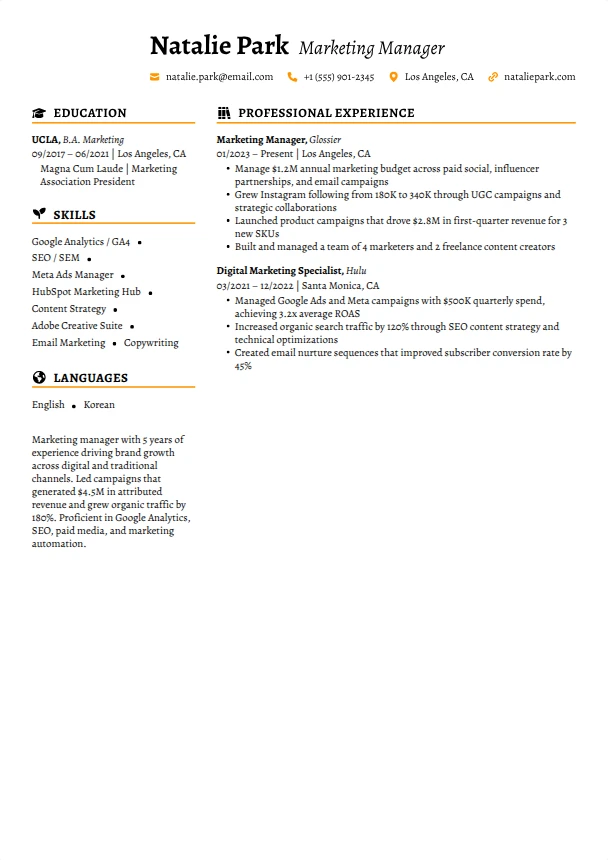
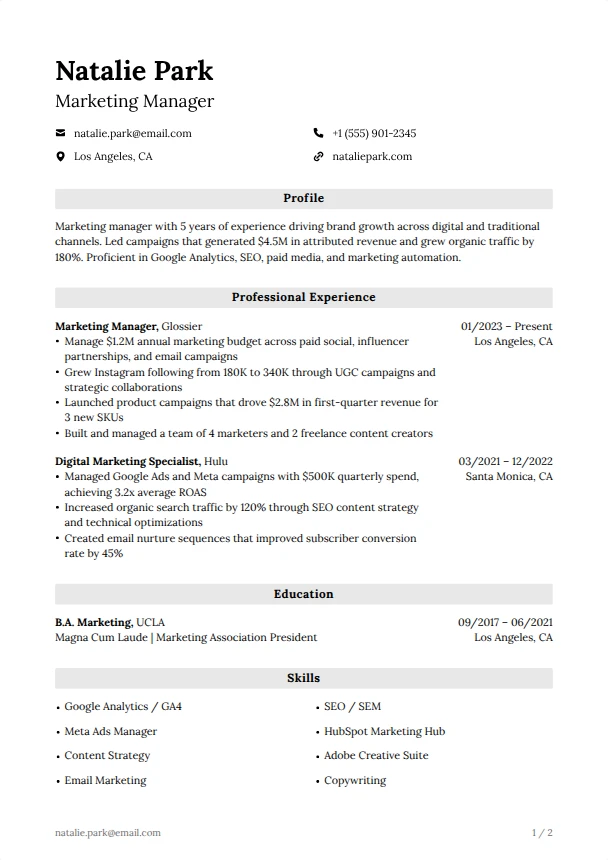
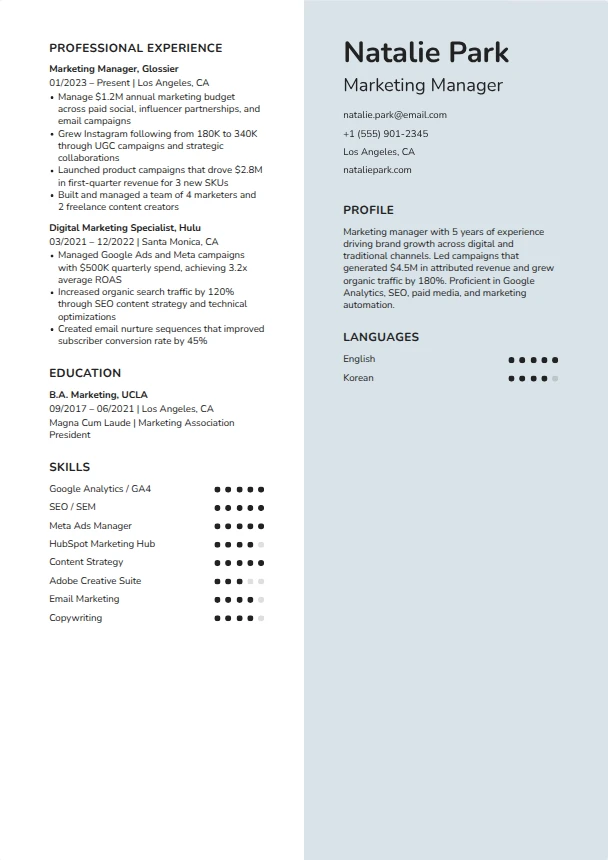
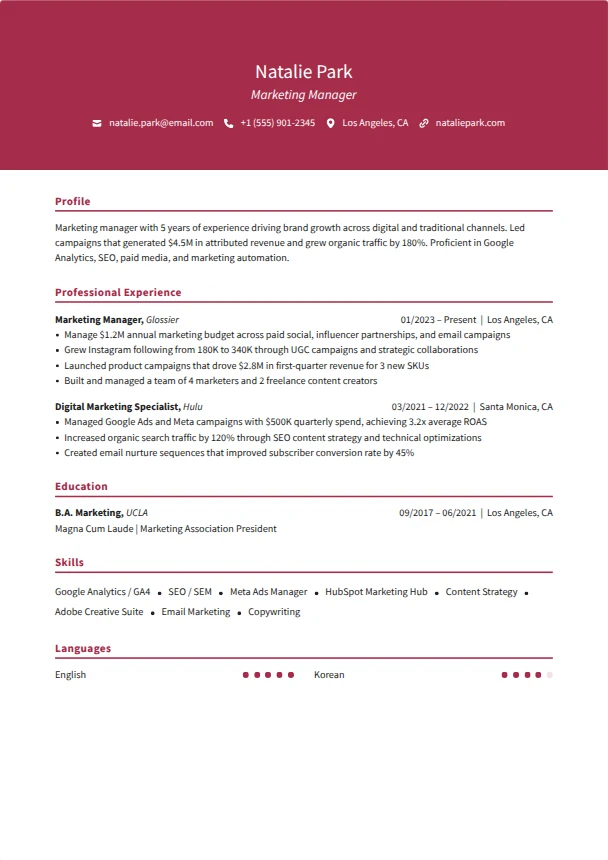
Open a complete, filled-in marketing resume in our free builder. Swap in your own details, keep the wording that fits, and download as PDF, free.
Build your communications resume now
Pick a template, showcase your writing and media skills, and download a polished communications resume in minutes.
Start Building, It's FreeRelated resume guides
Write a marketing resume that highlights campaign strategy and business results.
Showcase platform expertise, content creation, and engagement growth.
Build a sales resume focused on quota achievement and pipeline growth.
Highlight client relationships, retention, and upsell achievements.
More resume examples: