What hiring managers actually look for
Construction firms reviewing candidates without formal PM experience look for three things:
-
1
Field experience that demonstrates project understanding. Have you worked on site long enough to understand sequencing, subcontractor coordination, and safety protocols? Foremen, lead carpenters, and field engineers who know how projects flow are strong PM candidates. Quantify your field time and project types.
-
2
Certifications that signal management readiness. PMP, OSHA 30, and Procore certification tell employers you are serious about the transition. These are not just resume keywords. They demonstrate that you have studied project management methodology and can use industry-standard software.
-
3
Leadership and coordination track record. Even without a PM title, you may have led crews, coordinated deliveries, managed daily schedules, or handled RFIs. Any experience directing people, materials, or timelines counts as management experience. Frame it that way.
If your resume communicates these things in the first 7-second scan, you'll make it to the detailed read. Everything below is about making that happen.
How to structure your resume, section by section
The order matters. Here's what a strong construction manager resume (no experience) looks like from top to bottom:
1. Contact header
Name, email, phone, location (city + state), and LinkedIn. If you have PMP or OSHA 30, add them after your name.
Sarah Mitchell, OSHA 30 · [email protected] · (555) 681-2349 · Nashville, TN
linkedin.com/in/sarahmitchell-cm
2. Professional summary (2-3 sentences)
Lead with your field experience, crew sizes managed, and the types of projects you have worked on. Mention management certifications and software proficiency.
Strong: "OSHA 30-certified construction foreman with 6 years of field experience managing 10-15 person crews on commercial projects from $2M to $12M. Tracked daily progress in Procore, coordinated subcontractor schedules, and maintained a zero-incident safety record. Completing PMP certification (expected June 2026)."
3. Certifications and training
List OSHA 30, PMP (or in progress), Procore certification, and any trade licenses. In-progress certifications are valuable when you include the expected completion date.
OSHA 30-Hour (2024) · Procore Certified (2025) · PMP (in progress, expected June 2026) · First Aid / CPR (2025)
4. Skills
Blend your field skills with management capabilities. Show that you can bridge the gap between the trailer and the job site.
Management: Crew scheduling, subcontractor coordination, daily reports, RFI tracking
Software: Procore, PlanGrid, Microsoft Project, Bluebeam
Field: Blueprint reading, quality inspections, material takeoffs, punch list management
Safety: OSHA 30, toolbox talks, site safety audits, incident reporting
5. Work experience
Reframe your field experience to highlight management responsibilities. Every time you scheduled a crew, coordinated a delivery, or ran a safety meeting, you were doing project management work.
Strong: "Managed daily operations for a 15-person crew on a $8M commercial tenant improvement. Coordinated schedules with 6 subcontractor trades in Procore, conducted weekly toolbox talks, and tracked progress against CPM milestones. Delivered the project 1 week early with zero safety incidents."
Key skills to include
These skills bridge the gap between field work and management roles. Include the ones you can demonstrate from your current experience.
Tip: If a job posting says 'assistant project manager' or 'project engineer,' these roles are designed for people transitioning from the field. Tailor your resume to emphasize documentation, software, and coordination skills.
Resume summary examples you can steal
Use one as a starting point, then swap in your own technologies, numbers, and achievements.
"Construction foreman with 8 years of field experience managing 10-20 person crews on commercial projects up to $15M. Coordinated subcontractor schedules, tracked daily progress in Procore, and maintained a zero-incident safety record across 12 completed projects. Completing PMP certification (expected June 2026)."
Why it works: Proven field leadership, software proficiency, safety record, and active pursuit of PM credential.
"Construction management graduate with OSHA 30 certification and a 6-month internship as a project engineer on a $20M mixed-use development. Managed RFI logs (60+ items), processed submittals in Procore, and tracked daily progress for the superintendent. Proficient in Bluebeam and P6 Primavera."
Why it works: Relevant degree, hands-on internship, named software tools, and quantified documentation.
"Former Army platoon leader transitioning to construction management with PMP certification and OSHA 30. Led 40-person teams through complex logistics operations under strict timelines and safety protocols. Managed $5M+ in equipment and supplies. Proficient in Microsoft Project and Procore."
Why it works: Military leadership at scale, budget responsibility, new industry certifications.
"Journeyman electrician with 10 years of field experience transitioning to construction project management. Led electrical crews of 6-10 on projects from $1M to $8M, coordinating with GCs and other trades. Completed Procore certification and OSHA 30. Currently pursuing PMP."
Why it works: Deep trade knowledge, crew leadership, multi-trade coordination, and active upskilling.
Writing strong experience bullets
Every bullet point should answer: "What did you do, and why did it matter?" Use this formula:
Before and after examples:
Supervised workers on the construction site.
Managed a 15-person crew through rough-in and finish phases on a $8M commercial build, coordinating daily activities with 6 subcontractor trades and maintaining a zero-incident safety record.
Handled paperwork and daily reports.
Generated daily progress reports in Procore for a $12M mixed-use project, tracking 200+ RFIs, 150 submittals, and 40 change orders while keeping the superintendent and owner informed of schedule impacts.
Helped with scheduling and material ordering.
Coordinated material deliveries and crew schedules for 3 concurrent commercial projects ($18M combined), reducing material waste by 12% through improved takeoff processes and just-in-time ordering.
Strong action verbs for construction manager resume (no experience) resumes:
Managed · Coordinated · Scheduled · Tracked · Documented · Led · Reported · Inspected · Processed · Supervised · Communicated · Estimated · Organized · Facilitated · Delivered
5 mistakes that get construction manager resume (no experience) resumes rejected
Not translating field experience into management language
Running a crew is project management. Coordinating subcontractors is stakeholder management. Tracking daily progress is schedule management. Reframe your field work using PM terminology so hiring managers see the overlap.
Skipping the PMP or Procore certification
These certifications cost a few hundred dollars and take weeks, not years. They are the fastest way to signal you are serious about the transition. Even listing 'PMP (in progress, expected Q3 2026)' shows commitment.
Only listing trade skills without management capabilities
Your carpentry or concrete skills got you here, but they will not get you the PM job. Lead with crew coordination, scheduling, documentation, and software proficiency. Keep trade skills as supporting evidence.
Writing a two-page resume for your first management role
Keep it to one page. Focus on the 3-5 most management-relevant accomplishments from your field career. A concise, targeted resume shows better judgment than a long one stuffed with every job you have had.
Not mentioning software proficiency
Procore, PlanGrid, Bluebeam, and P6 Primavera are standard tools in construction management. If you have used them on the field side, list them. If you have not, take Procore's free online training before you apply.
What to do if you have no professional experience
Transitioning into construction management without a formal PM title is entirely possible. Here is how to position yourself:
Get Procore certified (free)
Procore offers free online training and certification at Procore.org. Completing their project manager certification course proves you can navigate the industry's most popular platform.
Start pursuing PMP certification
PMP requires 35 hours of project management education and an exam. Many online programs cost $300 to $500. Even listing 'PMP (in progress)' on your resume signals serious intent to employers.
Apply for assistant PM or project engineer roles
These are designed as stepping stones. You will handle RFIs, submittals, daily logs, and schedule updates while learning the management side from senior PMs and superintendents.
Reframe your field experience as management
If you have ever scheduled a crew, coordinated with other trades, tracked project progress, conducted a safety meeting, or managed material deliveries, you have management experience. Name it, quantify it, and put it on your resume.
Frequently asked questions
Can I become a construction manager without a degree?
Yes. Many superintendents and project managers rose through the trades without a formal degree. A strong field track record combined with PMP or CCM certification can substitute for a CM degree at many firms. Some companies also offer internal promotion paths.
What is the best certification for breaking into construction management?
Start with OSHA 30 (required on most commercial sites) and Procore certification (free online). Then pursue PMP for general project management credibility. CCM (Certified Construction Manager) is valuable but requires 4+ years of CM experience.
How do I explain the transition from field work to management?
Frame it as a natural progression. Field experience gives you deep knowledge of how projects are actually built. Combine that with scheduling, documentation, and budgeting skills and you have a unique advantage over someone with only a degree and no site time.
What is the salary difference between field and management roles?
Assistant PMs and project engineers typically earn $55,000 to $75,000. Experienced project managers earn $85,000 to $130,000. Senior superintendents and directors of construction can exceed $150,000. The jump from field to management often represents a 20% to 40% pay increase.
Should I apply to general contractors or specialty subcontractors?
Both. Large GCs hire assistant PMs and project engineers regularly. Specialty subcontractors (electrical, mechanical, concrete) also need project managers and often prefer candidates with trade-specific field experience.
Skip the blank page
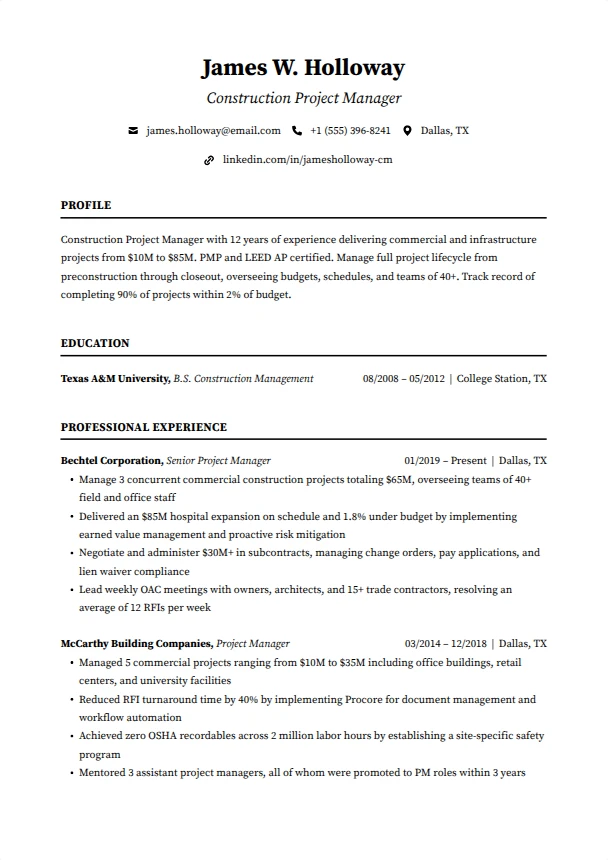
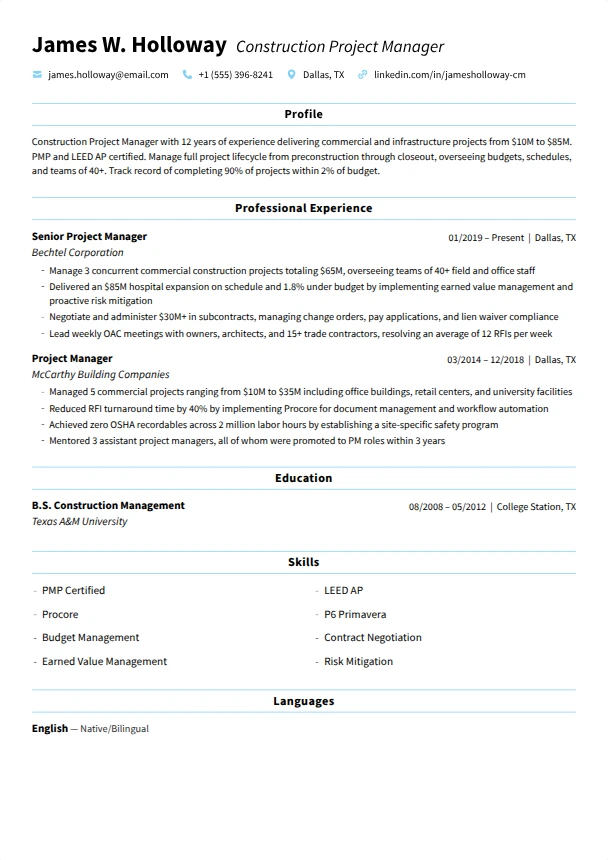
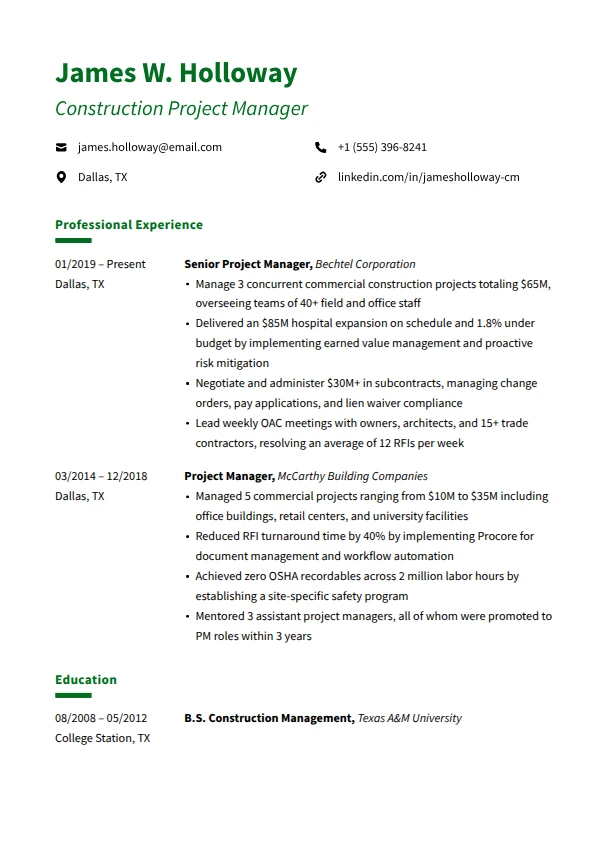
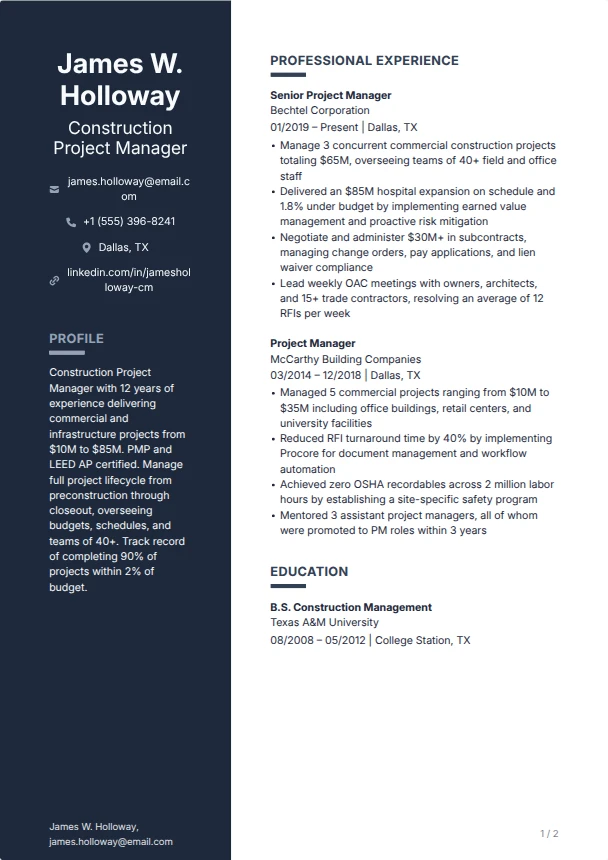
Open a complete, filled-in construction resume in our free builder. Swap in your own details, keep the wording that fits, and download as PDF, free.
Build your construction manager resume now
Pick a clean template, add your field experience and management certifications, and download a polished PDF in minutes. Free, no account required.
Start Building, It's FreeRelated resume guides
Complete guide for experienced construction managers with project portfolios and certifications.
General guide for all construction roles from laborers to skilled tradespeople.
Guide for entering construction with no prior industry experience.
More resume examples: