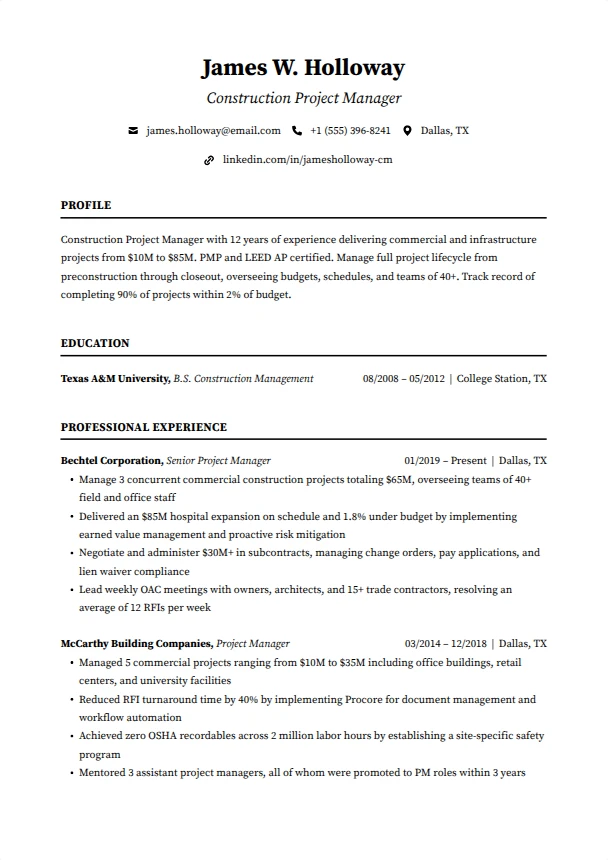
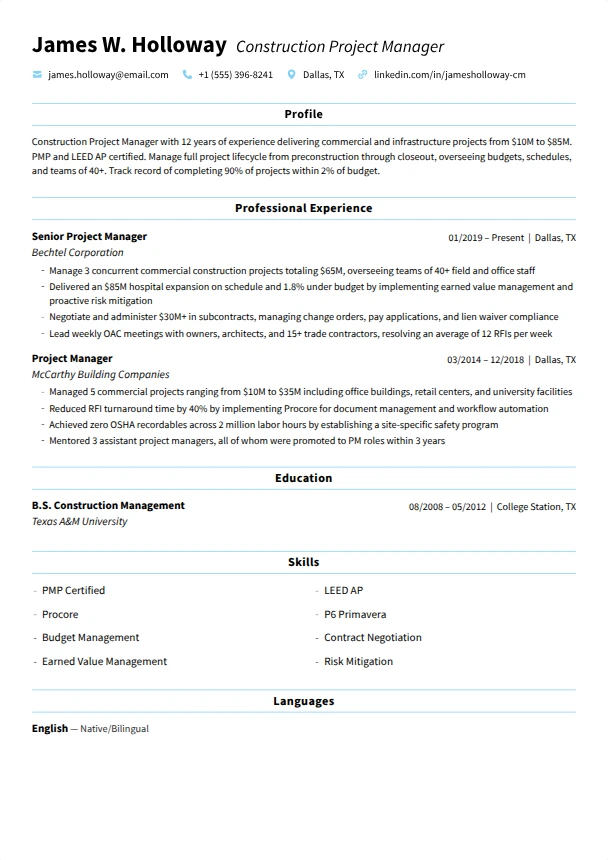
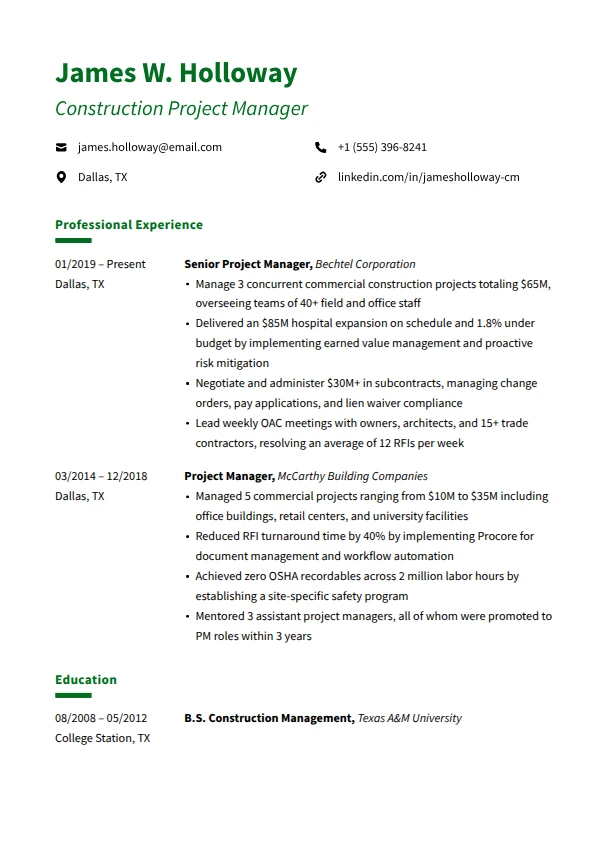
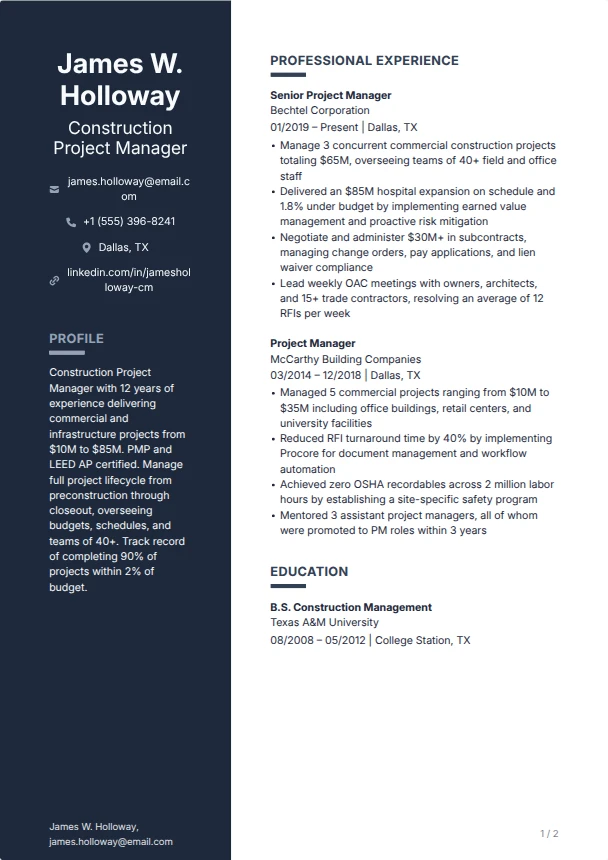
What hiring managers actually look for
Construction firms and general contractors hiring managers look for three things before reading your experience section:
-
1
Budget management and cost control track record. Have you managed project budgets in the millions? Can you show you delivered under budget or controlled change orders? Construction is a margin business and every dollar counts. Include specific budget figures and savings percentages.
-
2
Scheduling proficiency and on-time delivery history. Do you use P6 Primavera, Microsoft Project, or Procore scheduling? Have you consistently hit deadlines? Liquidated damages for late delivery can cost thousands per day. Managers want proof you can keep a project on track.
-
3
Safety leadership and OSHA compliance. Are you OSHA 30 certified? What is your EMR (Experience Modification Rate)? Can you show a track record of zero-incident projects? Insurance costs are directly tied to safety performance, so this is a bottom-line issue for every GC.
If your resume communicates these things in the first 7-second scan, you'll make it to the detailed read. Everything below is about making that happen.
How to structure your resume, section by section
The order matters. Here's what a strong construction manager resume looks like from top to bottom:
1. Contact header
Name, email, phone, location (city + state), and LinkedIn. If you hold PMP, CCM, or LEED credentials, add them after your name.
David Chen, PMP, OSHA 30 · [email protected] · (555) 712-3489 · Denver, CO
linkedin.com/in/davidchen-cm
2. Professional summary (2-3 sentences)
Lead with your years of experience, project types and scale, total value of projects managed, crew sizes, and your strongest achievement. Include certifications and software proficiency.
Strong: "PMP-certified construction manager with 10 years of experience delivering commercial and mixed-use projects from $5M to $75M. Managed crews of 30-80 workers and subcontractor teams of 15+ trades. Delivered 12 consecutive projects on time with a combined $180M portfolio. OSHA 30 certified with zero lost-time incidents over the last 4 years."
3. Certifications and licenses
List PMP, CCM (Certified Construction Manager), OSHA 30, LEED AP, and any trade licenses. These credentials signal leadership capability and industry commitment.
PMP (PMI, 2022) · OSHA 30-Hour (2023) · LEED Green Associate (2024) · First Aid / CPR (2025)
4. Technical skills
Group by category: Project Management, Software, Safety, Estimating. Construction managers are expected to be proficient in both field operations and office software.
PM Software: Procore, P6 Primavera, Microsoft Project, PlanGrid
Estimating: Bluebeam, RSMeans, On-Screen Takeoff
Safety: OSHA 30, fall protection planning, site safety audits
Contracts: AIA documents, RFIs, submittals, change order management
5. Work experience
Reverse chronological. For each role: company, title, dates, and 3-5 bullet points. Every bullet should include the project type, dollar value, and a measurable outcome. Show progression from assistant PM to PM to superintendent or senior manager.
Strong: "Directed all phases of a $42M, 120,000 sq ft Class A office build from preconstruction through substantial completion. Managed 65-person crew and coordinated 18 subcontractor trades. Delivered project 3 weeks early and 2.5% under budget, saving the owner $1.05M."
6. Education
Degree, school, graduation year. Construction management, civil engineering, and architecture degrees carry the most weight. Include relevant coursework only if you graduated within the last 2 years.
Key skills to include
These are the most in-demand skills across construction management job postings in 2026. Pick the ones that match your experience and the specific role you are targeting.
Tip: If the job posting mentions a specific software platform or contract type (e.g., 'Procore experience required' or 'CM-at-risk delivery'), add it to your skills section using their exact wording. ATS systems match keywords literally.
Resume summary examples you can steal
Use one as a starting point, then swap in your own technologies, numbers, and achievements.
"Construction management graduate with OSHA 30 certification and 1 year of field experience as a project engineer on a $15M commercial build. Managed RFI logs, processed 40+ submittals, and tracked daily progress in Procore. Assisted superintendent with crew scheduling and subcontractor coordination."
Why it works: Names the software, quantifies project scale, and shows hands-on field exposure.
"Construction project manager with 6 years of experience managing commercial and multifamily projects from $3M to $25M. Delivered 8 projects with a combined value of $95M, averaging 98% on-time completion. Proficient in Procore, P6 Primavera, and Bluebeam. OSHA 30 and PMP certified."
Why it works: Portfolio value, on-time rate, software stack, and dual certifications.
"Construction superintendent with 15 years of field experience managing ground-up commercial and institutional projects up to $75M. Supervise crews of 40-80 workers and coordinate 20+ subcontractor trades. Delivered $250M+ in total project value with zero OSHA recordable incidents over the last 5 years."
Why it works: Portfolio scale, crew sizes, trade coordination, and exceptional safety record.
"Former Army Corps of Engineers officer transitioning to commercial construction management with PMP certification and OSHA 30. Led infrastructure projects valued at $8M+ in austere environments, managing 30-person teams under strict timelines and safety protocols. Proficient in P6 Primavera and Microsoft Project."
Why it works: Military leadership translates directly, project scale is quantified, and industry certifications are current.
Writing strong experience bullets
Every bullet point should answer: "What did you do, and why did it matter?" Use this formula:
Before and after examples:
Managed construction projects and supervised subcontractors.
Managed a $28M, 85,000 sq ft medical office build from preconstruction through CO, coordinating 14 subcontractor trades and maintaining a zero-incident safety record across 18 months.
Handled budgets and did project scheduling.
Controlled a $42M project budget with Procore cost tracking, processing 120+ change orders and holding final costs to 1.8% under the original GMP, saving the owner $756K.
Made sure projects were completed on time.
Built and maintained CPM schedules in P6 Primavera for 3 concurrent projects ($65M combined), identifying and resolving 15 critical-path delays to deliver all three within contractual deadlines.
Strong action verbs for construction manager resumes:
Directed · Managed · Coordinated · Scheduled · Estimated · Negotiated · Inspected · Delivered · Supervised · Tracked · Reviewed · Resolved · Procured · Budgeted · Expedited · Commissioned
5 mistakes that get construction manager resumes rejected
Not including project dollar values
A $2M tenant improvement and a $50M ground-up build require different capabilities. If you do not include dollar values, hiring managers will assume the lower end. Always list the total project value for your most significant projects.
Leaving out software proficiency
Procore, P6 Primavera, PlanGrid, and Bluebeam are standard tools in construction management. If you have used them, list them by name. Many ATS systems filter on these keywords before a human reviews your application.
Writing duty descriptions instead of project outcomes
Do not write 'responsible for managing construction projects.' Write 'Delivered a $28M medical office build 2 weeks early and 3% under budget.' Every bullet should include what you managed, the scale, and the result.
Omitting your safety track record
Construction companies pay between 5% and 15% of payroll in workers' compensation premiums. A manager with a clean safety record directly reduces those costs. If you have zero-incident projects, highlight them prominently.
Using a generic summary for every application
A commercial GC and a residential custom builder have different priorities. Read the job description, identify whether they emphasize scheduling, safety, estimating, or client relations, and tailor your summary accordingly.
What to do if you have no professional experience
Breaking into construction management without direct experience is challenging but possible. Here is how to position yourself:
Get OSHA 30 and PMP certified
OSHA 30 costs about $180 online and takes a week. PMP requires 35 hours of project management education and passing an exam. Together, these certifications tell employers you are serious about construction management, not just exploring.
Start as a project engineer or assistant PM
These roles are the standard entry point for construction management graduates. You will handle RFIs, submittals, daily logs, and schedule updates while learning the field operations side from the superintendent.
Learn Procore and P6 Primavera
Procore offers free online training and certification courses. P6 Primavera proficiency is a major differentiator for scheduling roles. Having these on your resume before your first day shows initiative.
Leverage internships and co-op experience
Most construction management programs include internships or co-ops with GCs. Even a single summer on a job site gives you real project content for your resume. Describe the project type, value, and your contributions.
Frequently asked questions
Do I need a degree to become a construction manager?
Not always, but it helps. Many superintendents rise through the trades without a degree. However, project manager roles at large GCs typically require a construction management, civil engineering, or related degree. Experience can substitute for education in many firms.
How long should a construction manager resume be?
One page for under 8 years of experience. Two pages for senior PMs and superintendents with extensive project portfolios. Include a project list as an addendum if the employer requests it.
Should I include a separate project list?
For senior roles, yes. A one-page project list showing project name, type, value, your role, and completion status is standard in commercial construction. Keep it separate from your resume and bring it to interviews.
What is the most important certification for construction managers?
OSHA 30 is the baseline. PMP (Project Management Professional) and CCM (Certified Construction Manager) are the most valued leadership certifications. LEED AP is increasingly important for commercial and institutional work.
How do I describe experience on projects that are not yet complete?
List the project as ongoing with the expected completion date. Focus on milestones you have already delivered: 'Currently managing a $35M mixed-use development (expected completion Q4 2026). Completed structural phase 2 weeks ahead of schedule and within budget through Q1 2026.'
Skip the blank page
Open a complete, filled-in construction resume in our free builder. Swap in your own details, keep the wording that fits, and download as PDF, free.
Build your construction manager resume now
Pick a clean, ATS-friendly template, add your project portfolio and certifications, and download a polished PDF in minutes. Free, no account required.
Start Building, It's FreeRelated resume guides
General guide for all construction roles from laborers to skilled tradespeople.
Specialized guide for rough and finish carpenters with trade-specific skills and project examples.
Guide for concrete workers covering formwork, finishing, and pour volume metrics.
More resume examples: