What hiring managers actually look for
Concrete contractors and superintendents hiring finishers and form setters look for three things immediately:
-
1
Pour volume and project scale experience. How many cubic yards have you placed in a single day? Have you worked on elevated decks, foundations, or flatwork? Concrete is a time-critical trade where experience at scale matters. Include your largest single-day pour and total volume across recent projects.
-
2
Flatness and finish quality metrics. Commercial clients specify FF/FL numbers (Floor Flatness and Floor Levelness). If you have consistently hit FF50/FL30 or better, that is a major selling point. Include specific flatness tolerances you have achieved on recent projects.
-
3
Formwork complexity and safety record. Elevated deck formwork, shoring systems, and post-tension work require precision and strict safety compliance. If you have experience with complex formwork or post-tension slabs, list it. Pair it with your OSHA certification and incident history.
If your resume communicates these things in the first 7-second scan, you'll make it to the detailed read. Everything below is about making that happen.
How to structure your resume, section by section
The order matters. Here's what a strong concrete resume looks like from top to bottom:
1. Contact header
Name, email, phone, location (city + state). Include your trade level if applicable (journeyman cement mason, ACI certification).
2. Professional summary (2-3 sentences)
Lead with years of experience, specialization (flatwork, structural, decorative), pour volumes, and safety record. Name the types of projects you have worked on.
Strong: "Concrete finisher with 9 years of experience in commercial flatwork, elevated decks, and structural foundations. Placed 200,000+ cubic yards across projects ranging from $1M to $40M. Consistently achieve FF50/FL35 flatness specifications on polished and sealed floors. OSHA 30 certified with zero recordable incidents."
3. Certifications and licenses
List ACI certifications (Flatwork Finisher, Concrete Field Testing Technician), OSHA 10/30, forklift, and any CDL if you operate concrete trucks or pump equipment.
ACI Flatwork Finisher (2023) · OSHA 30-Hour (2024) · Forklift Certified (2025) · First Aid / CPR (2025)
4. Technical skills
Group by category: Finishing, Formwork, Equipment, Safety. Be specific about the types of concrete work and tools you handle.
Finishing: Power troweling, broom finish, exposed aggregate, polished concrete, stamped patterns
Formwork: Wall forms, elevated deck shoring, grade beams, footings, post-tension layout
Equipment: Laser screed, power trowel, bull float, vibrators, concrete pump
Safety: OSHA 30, silica dust compliance, fall protection, PPE enforcement
5. Work experience
Reverse chronological. For each role: company, title, dates, and 3-5 bullet points. Include pour volumes (cubic yards), square footage finished, flatness specs achieved, and crew sizes.
Strong: "Finished 45,000 sq ft of commercial warehouse flooring to FF55/FL40 specifications using laser screed and ride-on power trowels. Coordinated 8-person crew through 6 consecutive weekend pours (180+ cubic yards each) with zero cold joints and zero safety incidents."
6. Education and training
List trade school, apprenticeship programs, and ACI training. Include hours completed. In concrete trades, hands-on training and certifications outweigh formal education.
Key skills to include
These are the most in-demand concrete skills across job postings in 2026. Pick the ones that match your experience and the specific role you are targeting.
Tip: If the job posting mentions a specific type of concrete work (e.g., 'post-tension experience required' or 'decorative concrete specialist'), tailor your skills and bullets to highlight that exact specialization.
Resume summary examples you can steal
Use one as a starting point, then swap in your own technologies, numbers, and achievements.
"OSHA 10-certified concrete laborer with 1 year of experience assisting finishing crews on commercial flatwork projects. Operated vibrators, bull floats, and hand tools during pours of 100+ cubic yards. Maintained job site safety and material staging for 3 completed projects ($500K to $2M)."
Why it works: Certification listed, tool experience named, pour volumes quantified, and project values included.
"ACI-certified concrete finisher with 6 years of experience in commercial flatwork and structural foundations. Finished 500,000+ sq ft of warehouse and retail flooring to FF50/FL30 or better specifications. Operate laser screed and ride-on power trowels. OSHA 30 certified with zero incidents across 15 completed projects."
Why it works: ACI certification, massive square footage, flatness specs, equipment proficiency, and clean safety record.
"Concrete foreman with 14 years of experience leading crews of 8-20 workers on commercial and industrial projects from $2M to $35M. Coordinated pours of 300+ cubic yards per day on elevated deck and tilt-up wall projects. Managed relationships with 5+ ready-mix suppliers and 3 pump companies. OSHA 30 certified with an EMR of 0.82."
Why it works: Crew scale, pour volume, project values, vendor management, and EMR metric.
"Former landscaping contractor transitioning to commercial concrete with newly completed OSHA 10 and ACI Flatwork Finisher certifications. Brings 5 years of experience with site grading, compaction, drainage installation, and operating skid steers and mini excavators. Poured 200+ residential patios, driveways, and walkways."
Why it works: Related outdoor trade experience, new concrete certifications, and quantified residential concrete work.
Writing strong experience bullets
Every bullet point should answer: "What did you do, and why did it matter?" Use this formula:
Before and after examples:
Poured concrete on job sites.
Placed and finished 12,000 sq ft of commercial warehouse flooring per week using laser screed and ride-on power trowels, achieving FF55/FL40 flatness on every pour.
Built forms for concrete walls.
Constructed 8,500 linear feet of wall formwork for a $22M parking structure, maintaining plumb tolerances within 1/8 inch per 10 feet and supporting pours of 200+ cubic yards per placement.
Worked on a decorative concrete project.
Stamped and stained 6,000 sq ft of decorative concrete for a luxury resort pool deck, matching 4 custom color patterns and completing the project 3 days ahead of the owner's opening deadline.
Strong action verbs for concrete resumes:
Poured · Finished · Formed · Screeded · Troweled · Placed · Vibrated · Leveled · Stamped · Polished · Sealed · Graded · Tied · Coordinated · Supervised · Cured
5 mistakes that get concrete resumes rejected
Not including pour volumes or square footage
Concrete hiring is volume-based. A finisher who has handled 300-yard pours is in a different category than someone who has only done residential sidewalks. Always include the largest pours, total square footage, and project values.
Omitting flatness and levelness specifications
Commercial clients specify FF/FL numbers, and achieving them consistently is a premium skill. If you have hit FF50/FL30 or better on polished floors, state it. It immediately tells a superintendent you can handle high-spec work.
Leaving off ACI certifications
ACI Flatwork Finisher and Concrete Field Testing Technician certifications are recognized across the industry. If you have them, list them prominently. They separate you from uncertified competitors.
Being vague about formwork experience
There is a massive difference between setting forms for a residential patio and building elevated deck shoring for a 6-story building. Specify the type of formwork, the heights involved, and the pour volumes your forms supported.
Ignoring the safety section entirely
Concrete work involves silica dust exposure, heavy lifting, elevated work, and chemical handling. OSHA 30, silica dust compliance, and fall protection certifications show you take these hazards seriously. Missing them can cost you the job.
What to do if you have no professional experience
Concrete is a trade you can enter with zero prior experience. The work is physically demanding but pays well and offers clear advancement. Here is how to start:
Get OSHA 10 and apply as a concrete laborer
Concrete laborer positions involve moving materials, operating vibrators, and assisting finishers during pours. The OSHA 10 course costs about $25 and takes 2 days. Most concrete contractors will hire laborers with just this certification and a strong work ethic.
Learn the basics of finishing tools
Bull floats, hand trowels, edgers, and groovers are the foundation tools. Watch instructional videos, practice on small residential pours, or ask a concrete contractor if you can observe a commercial pour. Familiarity with the tools gives you an edge.
Pursue ACI Flatwork Finisher certification
ACI offers a Flatwork Finisher certification that involves both a written exam and a practical demonstration. It costs about $200 and proves to employers that you understand proper finishing techniques.
Highlight physical fitness and related labor experience
Concrete work requires stamina, strength, and the ability to work in extreme heat. If you have experience in landscaping, warehousing, or any physically demanding job, frame it as preparation for the demands of concrete.
Frequently asked questions
What certifications do concrete workers need?
OSHA 10 or 30 is the baseline. ACI Flatwork Finisher and ACI Concrete Field Testing Technician are the most recognized trade certifications. Forklift and CDL (if operating pump trucks) are also valuable. Most can be earned in under a week.
How long should a concrete resume be?
One page. Concrete hiring decisions happen fast. Include your certifications, top 3-5 projects with volumes and specs, and your safety record. That is all a superintendent needs to decide if you are worth an interview.
Should I include flatness specs on my resume?
Yes, especially for commercial work. FF/FL numbers are the industry standard for floor quality. If you consistently achieve FF50/FL30 or higher, that is a competitive advantage worth highlighting.
What is the career path in concrete?
Laborer to finisher to lead finisher to foreman to superintendent. Some concrete workers also move into estimating or project management. The entire path from laborer to foreman can take 5 to 8 years depending on your skills and the company.
How do I describe residential concrete experience when applying for commercial jobs?
Focus on transferable skills: forming, placing, finishing, and safety. Quantify your work using volumes and square footage rather than project count. 'Poured and finished 2,500+ sq ft of residential flatwork per week' translates well to commercial contractors.
Skip the blank page
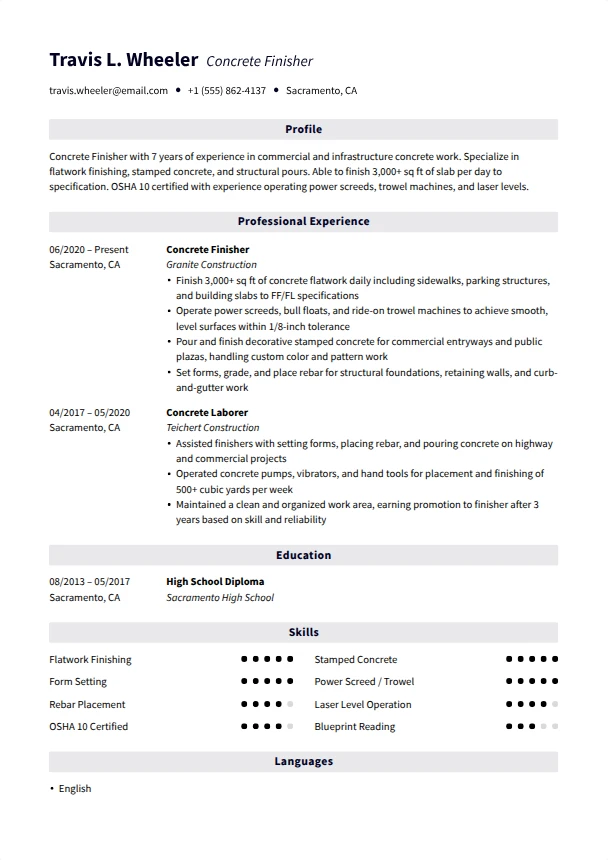
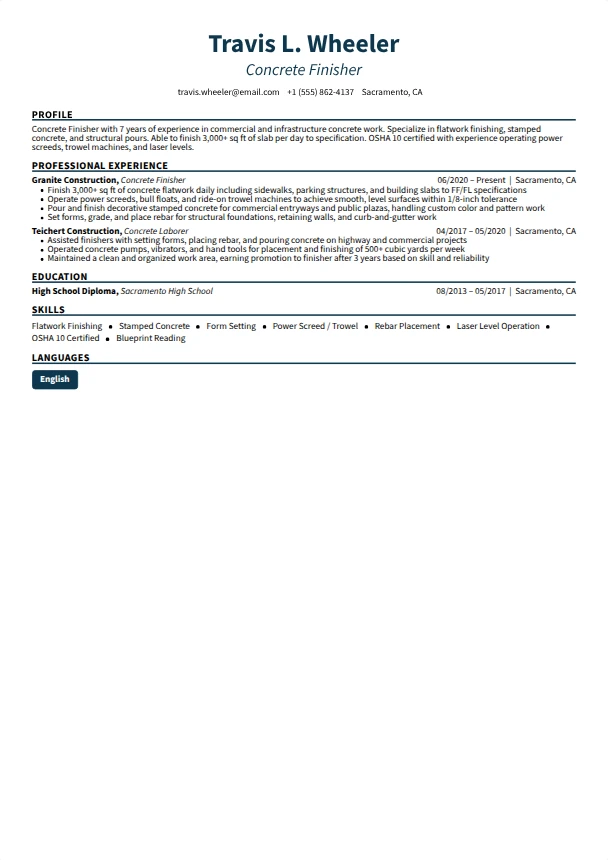
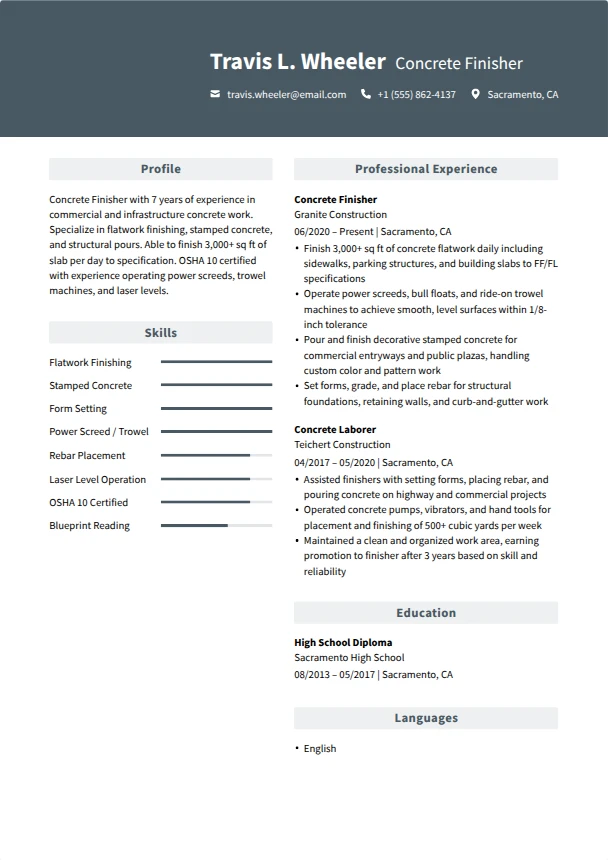
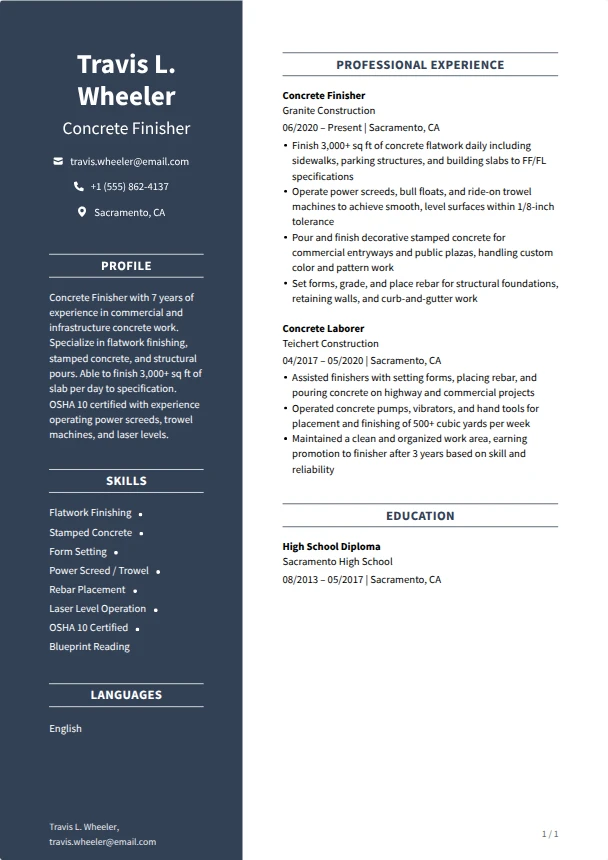
Open a complete, filled-in construction resume in our free builder. Swap in your own details, keep the wording that fits, and download as PDF, free.
Build your concrete resume now
Pick a clean, ATS-friendly template, add your pour volumes and trade certifications, and download a polished PDF in minutes. Free, no account required.
Start Building, It's FreeRelated resume guides
General guide for all construction roles from laborers to skilled tradespeople.
Guide for rough and finish carpenters with trade-specific skills and project examples.
Guide for project managers and superintendents with budgets and scheduling.
More resume examples: