What hiring managers actually look for
Construction foremen and general contractors hiring carpenters scan resumes for three things before they read your full work history:
-
1
Rough framing vs. finish carpentry specialization. These are different skill sets and different pay scales. Rough framers need speed plus structural knowledge of roof truss and rafter systems. Finish carpenters need precision for trim, cabinet making, and built-ins. Make it clear which you specialize in, or demonstrate competence in both.
-
2
Blueprint reading and layout ability. Can you read architectural drawings, run material takeoffs and estimating, and lay out walls from a foundation plan? Carpenters who can self-direct from blueprints are worth significantly more than those who need constant supervision.
-
3
Safety credentials and tool proficiency. OSHA 10 or OSHA 30 cards, scaffolding competence, and fall protection awareness are expected. List the specific tools you run, from framing nailers and table saws to miter saws, routers, and laser levels.
If your resume communicates these things in the first 7-second scan, you will make it to the detailed read. Everything below is about making that happen.
How to structure your resume, section by section
The order matters. Here is what a strong carpenter resume looks like from top to bottom:
1. Contact header
Name, email, phone, location (city and state). If you hold a Journey Worker (journeyman) carpenter certificate, include that designation. LinkedIn is optional for trade roles but helpful.
James Kowalski, Journey Worker Carpenter · [email protected] · (555) 218-4673 · Portland, OR
2. Professional summary (2 to 3 sentences)
Lead with your trade level (apprentice, journeyman, master), years of experience, specialization (rough, finish, or both), and your most impressive project or measurable result.
Strong: "Journey Worker carpenter with 7 years in commercial and residential rough framing and finish carpentry. Framed and trimmed 20 plus structures, from custom homes to mid-rise apartments, and read blueprints to run my own material takeoffs. OSHA 30 card holder with zero recordable safety incidents over the last 4 years."
3. Certifications and licenses
List your Journey Worker (journeyman) carpenter certificate, OSHA 10 and OSHA 30 Construction cards, and any specialty training such as scaffolding or fall protection awareness. Name the issuing body and the year so a foreman can verify each one.
Journey Worker Carpenter (UBC registered apprenticeship, 2021) · OSHA 30-Hour Construction (2023) · OSHA 10-Hour Construction (2020) · Scaffolding awareness (2024)
Verified issuing bodies for the credentials above: the OSHA Outreach Training Program (U.S. Department of Labor / OSHA) issues the OSHA 10-Hour and OSHA 30-Hour Construction course completion cards, and the United Brotherhood of Carpenters and Joiners of America (UBC) sponsors the registered apprenticeship that leads to the Journey Worker (journeyman) carpenter trade certificate. List a credential only if you actually hold it.
4. Technical skills
Group by category: Rough Framing, Finish Carpentry, Tools, Safety. Be specific about the types of work and equipment you handle.
Finish: Finish carpentry and trim, crown molding, cabinet making and built-ins, doors, stair rails, drywall hanging and finishing
Tools: Table saw, miter saw, router, framing nailer, laser level, hand tools
Safety: OSHA 10-30, scaffolding, fall protection awareness, PPE compliance
5. Work experience
Reverse chronological. For each role: company, title, dates, and 3 to 5 bullet points. Include the project type, square footage, and measurable outcomes like cycle time, layout accuracy, or first-pass inspection results.
Strong: "Framed 12 custom homes (1,800 to 4,200 sq ft) from foundation plans, completing each shell within a 3-week target. Installed crown molding, custom built-ins, and hardwood stair systems with miter joints held under 1/16 inch."
6. Education and apprenticeship
List your registered apprenticeship program, trade school, or relevant education. Include hours completed and the sponsoring organization, such as the United Brotherhood of Carpenters. In carpentry, apprenticeship completion is often valued more than a degree.
Key skills to include
These are the carpentry skills that turn up most often in job postings and applicant tracking system filters. Pick the ones that match your experience and the specific role you are targeting, and use the exact wording from the posting where you can.
Tip: If the job posting specifies a type of construction (for example commercial tenant improvement or custom residential), tailor your skills and experience bullets to match that project type. Generic carpentry resumes lose to targeted ones.
Resume summary examples you can steal
Use one as a starting point, then swap in your own tools, numbers, and achievements. The examples below are illustrative.
"First-year carpentry apprentice with an OSHA 10-Hour Construction card and 6 months assisting journeymen on residential rough framing. Ran a framing nailer, table saw, and miter saw daily while keeping a clean, fall-protected work area. Helped frame 4 homes (1,600 to 2,800 sq ft) and learned to read wall layouts off the foundation plan."
Why it works: Trade path is clear, the OSHA card is named, and project scale is quantified.
"Journey Worker carpenter with 5 years in commercial and residential rough framing and finish work. Framed 30 plus structures, from single-family homes to 4-story apartment buildings, working from blueprints and my own material takeoffs. Led crews of 4 to 8 and hold an OSHA 30-Hour Construction card."
Why it works: Trade level, project variety, blueprint reading, crew leadership, and a named safety card.
"Master finish carpenter with 12 years specializing in custom trim, cabinet making and built-ins, and stair systems. Delivered finish packages for 50 plus homes with miter joints held under 1/16 inch and near-zero punch-list callbacks. Train and mentor 3 to 4 apprentices each year on layout and finish technique."
Why it works: Specialization clarity, a strong project count, a precision metric, and mentorship.
"Custom furniture maker moving into commercial carpentry with a freshly earned OSHA 10-Hour Construction card. Brings 4 years of precision woodworking, including hand-tool joinery, cabinet making, and finishing for high-end clients. Comfortable reading shop drawings and holding tolerances under 1/32 inch on built-ins."
Why it works: Related craft experience, a new safety card, and precision metrics that transfer directly.
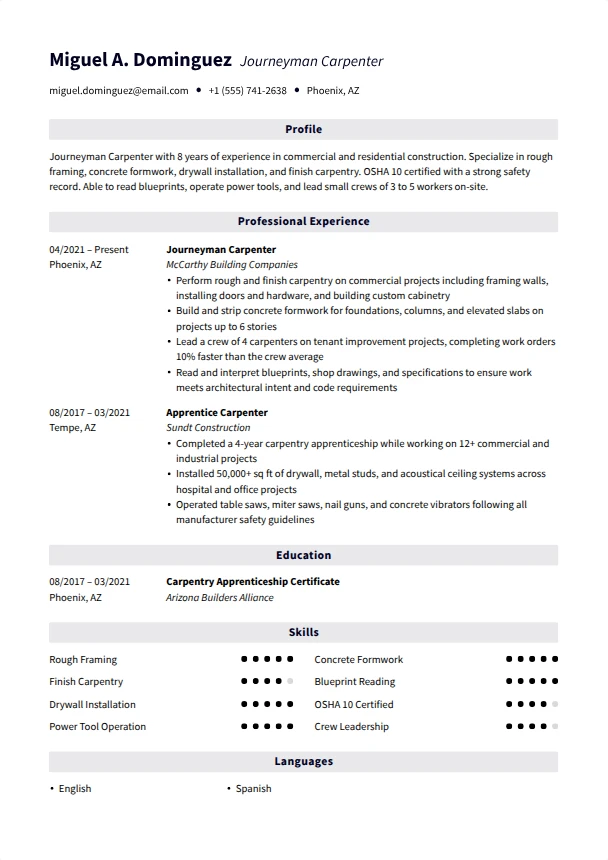
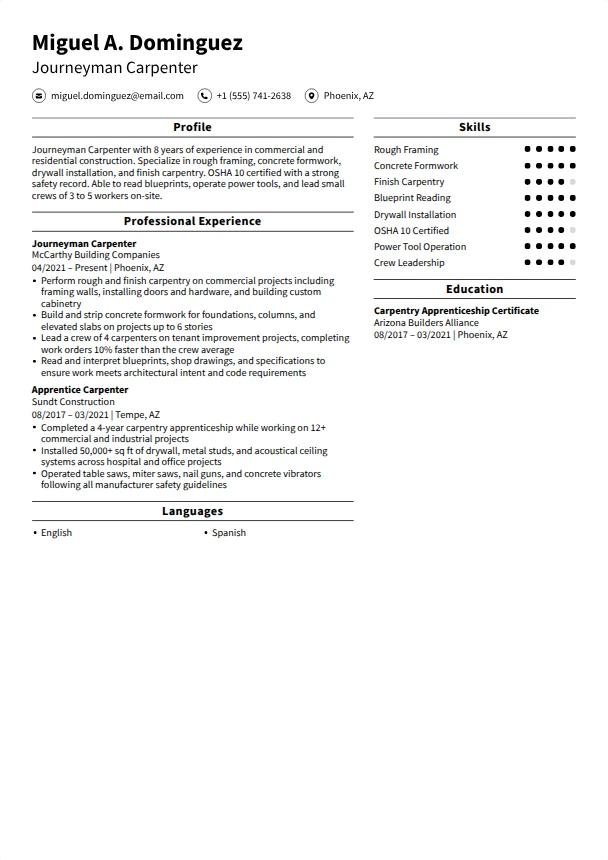
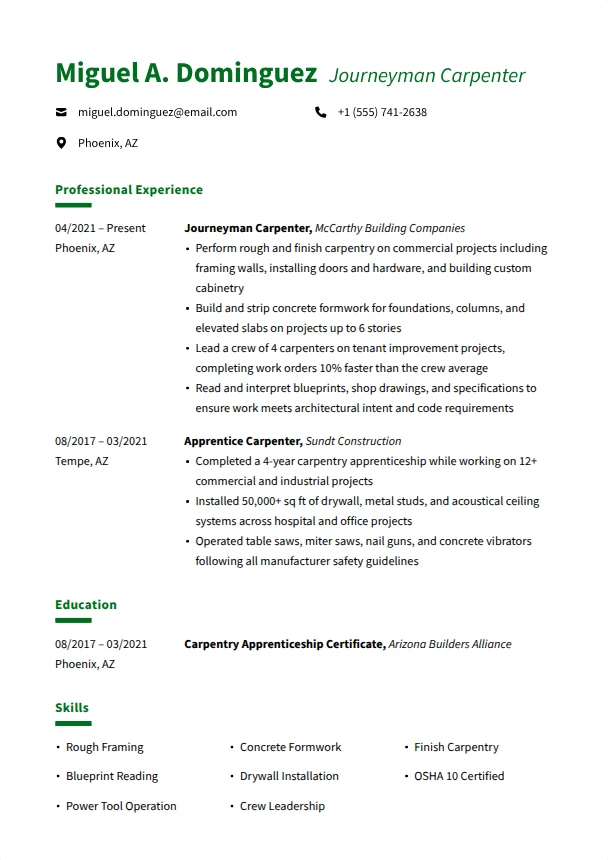
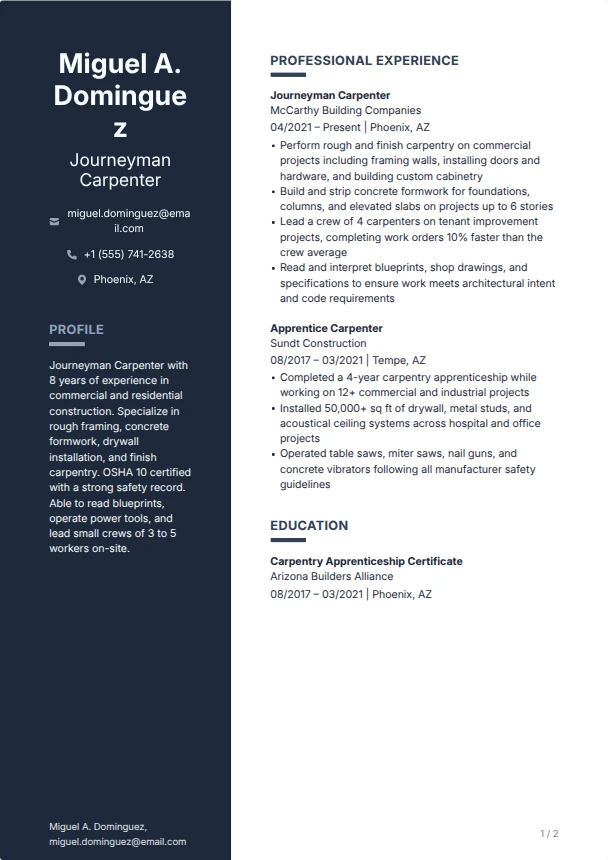
Example Carpenter resume
Here is a short, illustrative example that ties the sections above together. The name and employers are fictional; swap in your own details, tools, and numbers.
Marcus Reyes, Journey Worker Carpenter
Sacramento, CA · [email protected] · (555) 640-2218
Summary. Journey Worker carpenter with 8 years across rough framing and finish carpentry. Reads blueprints, runs material takeoffs, and leads crews of up to 6. OSHA 30-Hour Construction card holder.
Certifications. Journey Worker (journeyman) carpenter, UBC registered apprenticeship (2019) · OSHA 30-Hour Construction (2022) · OSHA 10-Hour Construction (2017).
Skills. Rough framing, roof truss and rafter systems, concrete formwork, finish carpentry and trim, cabinet making and built-ins, drywall hanging and finishing, scaffolding, table saw, miter saw, router, hand tools.
Experience: Lead Carpenter, Sierra Ridge Builders (2021 to present).
- Framed 18 custom homes (1,500 to 4,000 sq ft) from foundation plans, passing first-attempt framing inspections on each.
- Installed crown molding, doors, and built-ins with miter joints held under 1/16 inch and minimal punch-list rework.
- Built concrete formwork for elevated decks and ran material takeoffs that kept lumber waste low.
Experience: Carpenter, Delta Framing Co. (2017 to 2021).
- Set roof truss and rafter systems and sheathed roofs on residential and light commercial jobs.
- Erected and inspected scaffolding and enforced fall protection on multi-story work.
Education. UBC registered carpentry apprenticeship, completed 2019.
Writing strong experience bullets
Every bullet point should answer: "What did you do, and why did it matter?" Use this formula:
Before and after examples:
Did framing work on residential houses.
Framed 15 single-family homes (1,400 to 3,600 sq ft) from blueprints over 14 months, setting roof truss systems and passing every framing inspection on the first attempt.
Installed trim and molding in new construction.
Ran finish carpentry across 8 custom homes, installing crown molding, baseboards, door casings, and built-ins with miter joints held under 1/16 inch and zero finish-quality callbacks.
Built forms for concrete work.
Built concrete formwork for elevated decks on a 4-story apartment job, holding layout within 1/8 inch and supporting large single-day pours without a blowout.
Strong action verbs for carpenter resumes:
Framed · Installed · Constructed · Measured · Cut · Erected · Aligned · Assembled · Fabricated · Finished · Leveled · Plumbed · Sheathed · Trimmed · Braced · Secured
5 mistakes that get carpenter resumes rejected
Not specifying rough vs. finish experience
These are different specializations with different pay rates. A foreman hiring for finish work needs to know you can run precision trim and cabinet making, not just speed-frame. Be clear about which type of carpentry dominates your experience.
Omitting project types and square footage
Framing a 1,200 sq ft ranch and framing a 4,200 sq ft custom home are different levels of complexity. Always include the project type, square footage, and number of units or structures you completed.
Forgetting to list tool proficiency
Hiring managers want to know you can run specific equipment without training. List your tools: table saw, miter saw, router, framing nailer, laser level, and the hand tools you rely on for layout and trim.
Leaving off your apprenticeship or trade school
Your registered apprenticeship completion and Journey Worker (journeyman) carpenter certificate carry significant weight in the trades. List the sponsoring organization, hours completed, and year of completion.
Not mentioning safety credentials
OSHA 10 and OSHA 30 Construction cards plus scaffolding and fall protection awareness are expected on commercial job sites. Missing them can cost you the job even if your carpentry skills are strong.
What to do if you have no professional experience
Carpentry is one of the best trades to enter without formal experience. Here is how to get started:
Apply to a registered apprenticeship
The United Brotherhood of Carpenters and other sponsors offer paid apprenticeship programs that combine on-the-job training with classroom instruction. You earn while you learn, and the program leads to a Journey Worker (journeyman) carpenter certificate.
Get your OSHA 10 card before your first day
The OSHA 10-Hour Construction Outreach course is required on most commercial job sites and shows employers you take safety seriously from day one. Many carpenters add the OSHA 30-Hour card later as they take on lead roles.
Highlight any hands-on building experience
Home renovation projects, furniture and cabinet building, theater set construction, and Habitat for Humanity volunteer work all count. If you have built anything with your hands, describe it with measurements, materials, and the tools you used.
Start as a carpenter's helper
Helper and laborer positions on carpentry crews are the most common entry point. You will carry materials, hold walls, clean up, and learn rough framing by watching. Most helpers move into apprentice roles within 6 to 12 months.
Frequently asked questions
Do I need a license to work as a carpenter?
Most states do not require a license for general carpentry work. Completing a registered apprenticeship and earning a Journey Worker (journeyman) carpenter certificate, often through the United Brotherhood of Carpenters, significantly increases your earning potential and job options. Some specialty work, such as structural modifications, may require permits or a contractor license depending on your state and the scope of the job.
Which certifications should a carpenter put on a resume?
The OSHA 10-Hour and OSHA 30-Hour Construction Outreach course completion cards are the most widely expected, since most commercial sites require them before you set foot on the deck. Add your Journey Worker (journeyman) carpenter trade certificate from a registered apprenticeship if you hold one. List each credential with the issuing body and the year so a foreman can verify it quickly.
Should I include photos of my work?
Not on the resume itself. Having a simple portfolio, a physical binder or a phone gallery, of your best finish carpentry and framing is extremely effective in interviews. Clean miter joints, tight crown molding returns, and complex roof truss or rafter work are the kinds of projects worth showing.
What is the difference between rough and finish carpentry on a resume?
Rough carpentry covers structural work: wall framing, roof truss and rafter systems, subfloors, sheathing, and concrete formwork. Finish carpentry covers visible detail work: trim, crown molding, cabinet making and built-ins, doors, and stairs. Many carpenters do both, but stating which one you specialize in, and backing it with blueprint reading and material takeoff skills, tends to command higher pay.
How do I show progression in my carpentry career?
List your trade progression clearly: helper to apprentice with logged hours, apprentice to Journey Worker (journeyman), then journeyman to lead carpenter or foreman. Include the year of each milestone and the registered apprenticeship that sponsored you. This shows a hiring manager your growth trajectory and your commitment to the trade.
Skip the blank page
Open a complete, filled-in construction resume in our free builder. Swap in your own details, keep the wording that fits, and download as PDF, free.
Build your carpenter resume now
Pick a clean, ATS-friendly template, add your trade skills and project experience, and download a polished PDF in minutes. Free, no account required.
Start Building, It's FreeRelated resume guides
General guide for all construction roles from laborers to skilled tradespeople.
Guide for project managers and superintendents with budgets, scheduling, and crew leadership.
Specialized guide for concrete finishers and formwork specialists.
More resume examples: