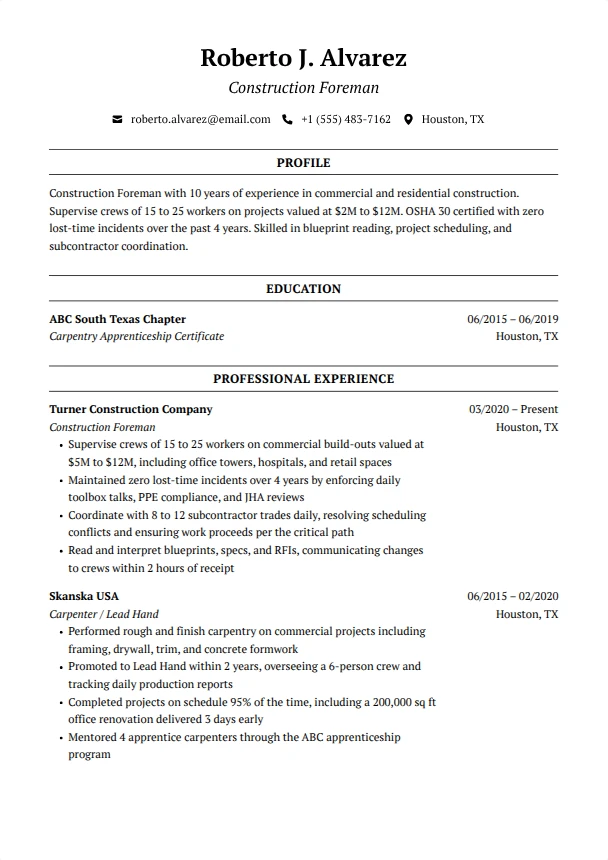
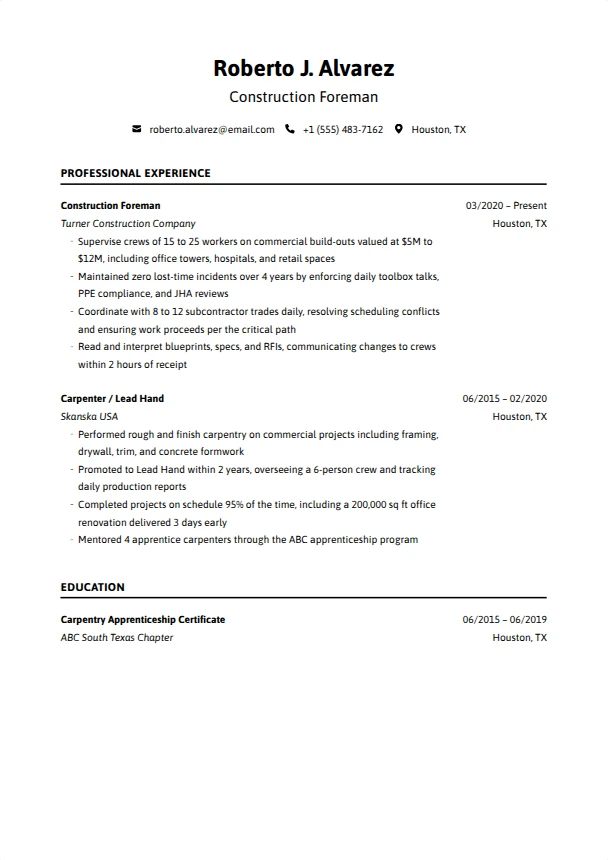
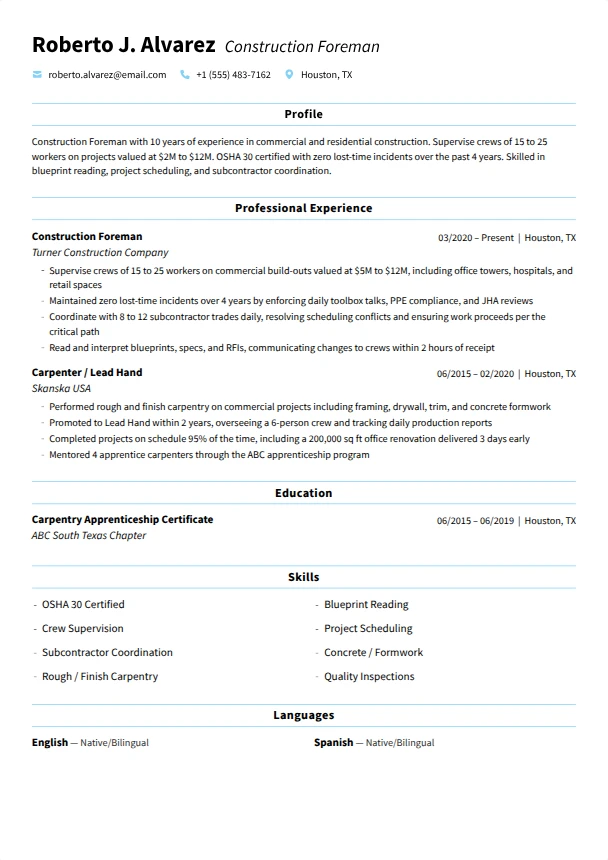
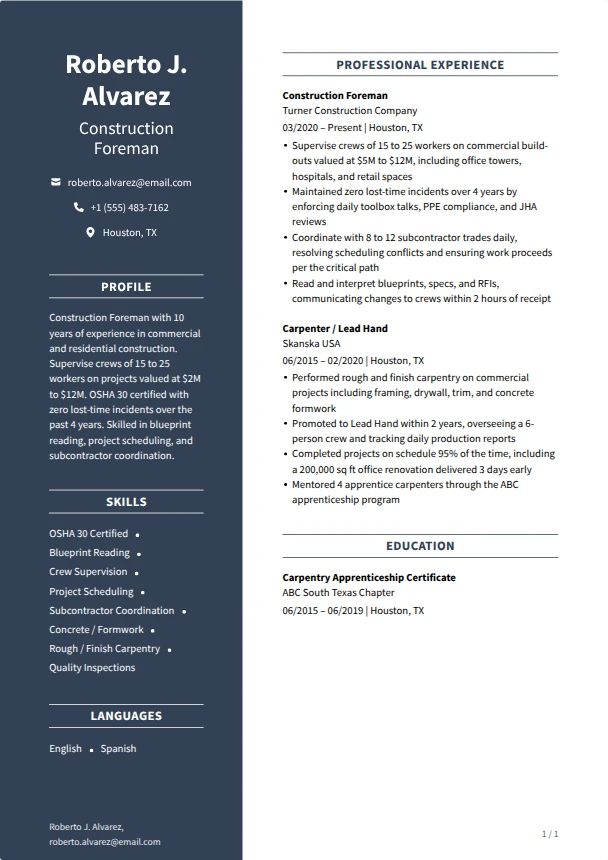
What hiring managers actually look for
Construction recruiters and foremen reviewing resumes consistently prioritize three things across all experience levels:
-
1
Safety certifications listed near the top. OSHA 10/30 is the first thing most construction hiring managers scan for. With 11,000 jobs lost in February 2026, competition is fierce and missing this baseline credential gets your resume discarded before anything else is read.
-
2
Project types and dollar values for context. Construction hiring is project-based. Managers need to know whether you have worked on $200K residential remodels or $50M commercial ground-up builds. Include specific project types, values, and square footage in your experience bullets.
-
3
Quantified achievements instead of duty lists. Every construction resume says 'supervised crews' and 'managed projects.' The ones that get callbacks say 'supervised a 20-person crew on a $15M build and delivered 2 weeks early with zero safety incidents.' Numbers make the difference.
If your resume communicates these things in the first 7-second scan, you'll make it to the detailed read. Everything below is about making that happen.
How to structure your resume, section by section
The order matters. Here's what a strong construction resume examples looks like from top to bottom:
1. Contact header
Name, email, phone, location (city + state). Add relevant credentials after your name (OSHA 30, PMP, Journeyman). Keep it clean and professional.
Anthony Brooks, OSHA 30 · [email protected] · (555) 743-2198 · Charlotte, NC
linkedin.com/in/anthonybrooks-construction
2. Professional summary (2-3 sentences)
This is the most important section for construction resumes. Include your trade or role, years of experience, project types and scale, and your strongest metric (safety record, on-time delivery, cost savings).
Strong: "OSHA 30-certified construction foreman with 7 years of experience leading crews of 10-18 on commercial and institutional projects from $3M to $20M. Completed 9 consecutive projects on schedule with zero OSHA recordable incidents. Proficient in Procore, PlanGrid, and blueprint interpretation."
3. Certifications
Place certifications immediately after your summary. In construction, these are often weighted as heavily as work experience.
OSHA 30-Hour (2024) · Procore Certified PM (2025) · Forklift / Boom Lift (2025) · First Aid / CPR (2025)
4. Skills
Organize by category and keep it scannable. Match the job posting keywords exactly.
Field: Framing, concrete, drywall, roofing, finish carpentry
Equipment: Excavator, skid steer, boom lift, forklift
Software: Procore, PlanGrid, Bluebeam, Microsoft Project
Safety: OSHA 30, fall protection, confined space, lockout/tagout
5. Work experience
Use the Action + Context + Result formula for every bullet. Include project type, dollar value, crew size, and measurable outcomes.
Strong: "Led a 16-person crew through all phases of a $12M, 40,000 sq ft retail build-out, coordinating 8 subcontractor trades and achieving substantial completion 10 days ahead of the owner's deadline with zero punch-list items at turnover."
6. Education
List degrees, trade school, or apprenticeship programs. Include GPA only if 3.5+ and graduated in the last 2 years. For most construction roles, certifications and project experience outweigh education.
Key skills to include
The most effective construction resumes include a mix of field skills, equipment proficiency, software, and safety certifications. Choose the ones that match your target role.
Tip: Look at 3-5 job postings for your target role and identify the skills that appear in every one. Those are your must-have keywords. Add them to your resume using the employer's exact phrasing.
Resume summary examples you can steal
Use one as a starting point, then swap in your own technologies, numbers, and achievements.
"OSHA 10-certified construction laborer with 2 years of experience assisting crews on commercial framing and concrete projects up to $5M. Operated power tools, staged materials, and maintained job site cleanliness and safety. Zero incidents across 6 completed projects. Available for all shifts and overtime."
Why it works: Certification, project scale, safety record, and availability all in three sentences.
"Journeyman carpenter with 6 years of commercial and residential experience. Framed 25+ structures from single-family homes to 3-story apartment buildings. Proficient in rough framing, concrete formwork, and finish trim. OSHA 30 certified with a zero-incident record over the last 3 years."
Why it works: Trade level, project variety, dual specialization (rough and finish), and safety credentials.
"Construction foreman with 9 years of experience leading crews of 12-20 on commercial and institutional projects from $5M to $25M. Coordinated 10+ subcontractor trades, maintained CPM schedules in Procore, and delivered 8 consecutive projects on time. OSHA 30 certified with zero lost-time incidents."
Why it works: Crew size, project scale, software proficiency, on-time record, and safety.
"PMP-certified construction project manager with 12 years of experience managing a $200M+ portfolio of commercial, healthcare, and mixed-use projects. Led cross-functional teams of 50+ across preconstruction, construction, and closeout phases. Averaged 97% on-time delivery and 2.1% under budget across the last 5 years."
Why it works: Portfolio value, team scale, delivery metrics, and budget performance.
Writing strong experience bullets
Every bullet point should answer: "What did you do, and why did it matter?" Use this formula:
Before and after examples:
Helped with framing and general construction work.
Assisted a 12-person framing crew on 4 residential builds ($350K to $1.2M), cutting studs, carrying trusses, and installing sheathing while maintaining OSHA compliance and zero safety incidents.
Ran a crew on a commercial project.
Directed a 18-person crew through structural steel, concrete, and envelope phases on a $16M, 55,000 sq ft medical office building. Coordinated with 12 subcontractor trades and achieved substantial completion 2 weeks early.
Managed budgets and schedules for construction projects.
Controlled budgets and CPM schedules for 3 concurrent commercial projects ($45M combined) in Procore and P6 Primavera. Processed 180+ change orders and held final costs to 1.5% under GMP across all three.
Strong action verbs for construction resume examples resumes:
Directed · Led · Managed · Supervised · Coordinated · Erected · Installed · Poured · Framed · Operated · Tracked · Delivered · Estimated · Inspected · Completed · Scheduled
5 mistakes that get construction resume examples resumes rejected
Using the same resume for every construction role
A laborer resume, a carpentry resume, and a PM resume have different audiences and different priorities. Tailor your summary, skills, and top 3 bullets for each specific job posting.
Leaving out numbers and project context
Construction is a numbers business. Dollar values, square footage, crew sizes, safety incident rates, and schedule performance are what hiring managers evaluate. A resume without metrics reads as a resume without accomplishments.
Burying OSHA and trade certifications
Put certifications near the top of your resume, right after the summary. Many ATS systems and recruiters scan for OSHA, PMP, and trade licenses first. If they do not find them quickly, they move on.
Writing duty descriptions from the job posting
Do not write 'Responsible for supervising construction crews.' Write what you actually accomplished: crew sizes, project values, on-time delivery, and safety records. Duties describe the job. Achievements describe you.
Making the resume longer than necessary
One page for under 10 years of experience. Two pages maximum for senior PMs and superintendents. Construction hiring decisions are made quickly, and a focused one-page resume gets read in full.
What to do if you have no professional experience
If you are new to construction, these examples still apply to you. Here is how to adapt them:
Start with the laborer example above
The general laborer summary template works for anyone with OSHA 10 and some form of physical labor experience. Swap in your own transferable skills from warehouse, landscaping, or manufacturing work.
Get OSHA 10 before you write your resume
It costs $25, takes 2 days, and appears in every example on this page. It is the single fastest way to make an entry-level construction resume credible.
Quantify everything from your current job
How many pounds do you lift? How many hours do you work? How many people do you work with? Construction hiring managers think in numbers. Give them numbers from whatever experience you have.
Apply through construction staffing agencies
Agencies like PeopleReady, Tradesmen International, and Labor Finders specialize in placing entry-level construction workers. They can get you on a site quickly, and that first project becomes real resume content.
Frequently asked questions
Which construction resume example should I use?
Pick the example closest to your current experience level: laborer for entry-level, tradesperson for skilled workers with 3-8 years, foreman for crew leaders, and PM for those managing budgets and schedules. Customize the template with your own projects and metrics.
Can I use these examples as-is?
No. Use them as structural guides and fill in your own experience, certifications, and project details. Hiring managers and ATS systems can detect generic content. Your resume needs to reflect your actual work history.
What if my experience spans multiple trades?
Lead with the trade most relevant to the job you are applying for. List other trade experience in a secondary section or as supporting bullets. Versatility is valued in construction, but your resume should have a clear focus.
How often should I update my construction resume?
After every completed project. Add the project type, value, your role, crew size, and any notable achievements (early completion, clean safety record, under budget). Keeping a running project list makes resume updates painless.
Should I include a project list as a separate page?
For senior PMs and superintendents, yes. A one-page project list showing project name, type, value, your role, and completion status is standard practice for interviews. For foremen and below, keep everything on one page.
Skip the blank page
Open a complete, filled-in construction resume in our free builder. Swap in your own details, keep the wording that fits, and download as PDF, free.
Build your construction resume now
Pick one of the templates above, add your own projects and certifications, and download a polished PDF in minutes. Free, no account required.
Start Building, It's FreeRelated resume guides
Full section-by-section guide for writing a construction resume from scratch.
Specialized guide for project managers and superintendents with portfolio metrics.
Guide for breaking into construction with no prior industry experience.
More resume examples: