What hiring managers actually look for
The academic job market is competitive, but a new PhD with a clear research story and real classroom exposure can still stand out. Search committees read for evidence of independent scholarship and a candidate who can teach from day one, even without a faculty title yet.
-
1
Peer-reviewed publications and a research trajectory. Committees want to see that your dissertation work is moving toward peer-reviewed publications and that you have a plausible plan for tenure-track scholarship, including grant writing aimed at funders such as NSF and NIH.
-
2
Evidence you can teach independently. Teaching assistantships, guest lectures, and any course design count. List course design for online or hybrid delivery, learning management system experience with Blackboard or Canvas, and student evaluation scores so a committee can picture you running a section.
-
3
Fit with the department and its students. Research universities weigh publications and external funding, while teaching colleges weigh curriculum development, academic advising, and student assessment. Tailor the top third of your resume to whichever the department values most.
If your resume communicates these things in the first 7-second scan, you'll make it to the detailed read. Everything below is about making that happen.
What postsecondary teachers earn
According to the U.S. Bureau of Labor Statistics Occupational Outlook Handbook, postsecondary teachers earn a median wage of about $83,980 per year. The lowest 10 percent earn around $48,570 per year, and the highest 10 percent earn more than $199,520 per year. As a first-time applicant, expect to start near the lower end, with pay rising as you move from adjunct or instructor roles into tenure-track positions and accumulate publications, funded research, and seniority.
Source: U.S. Bureau of Labor Statistics, Occupational Outlook Handbook: Postsecondary Teachers.
An illustrative professor resume (no experience)
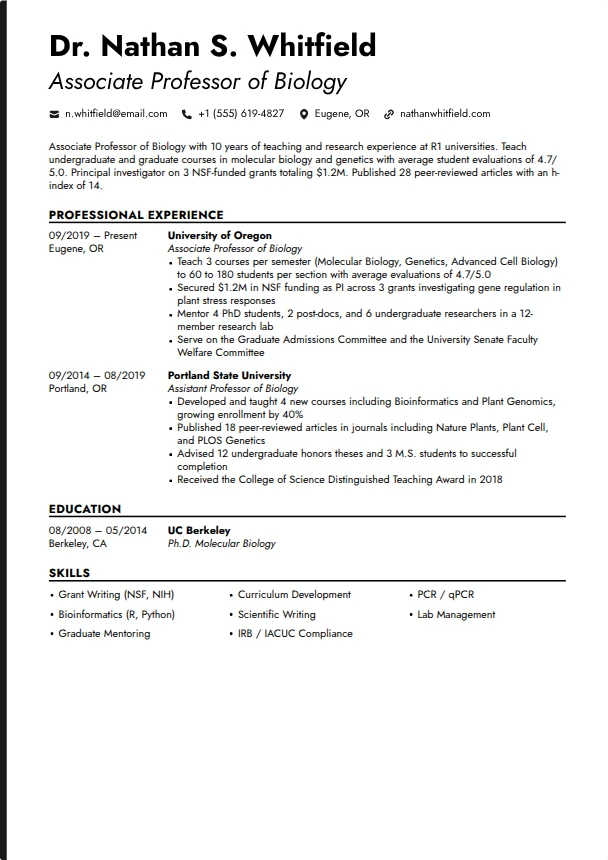
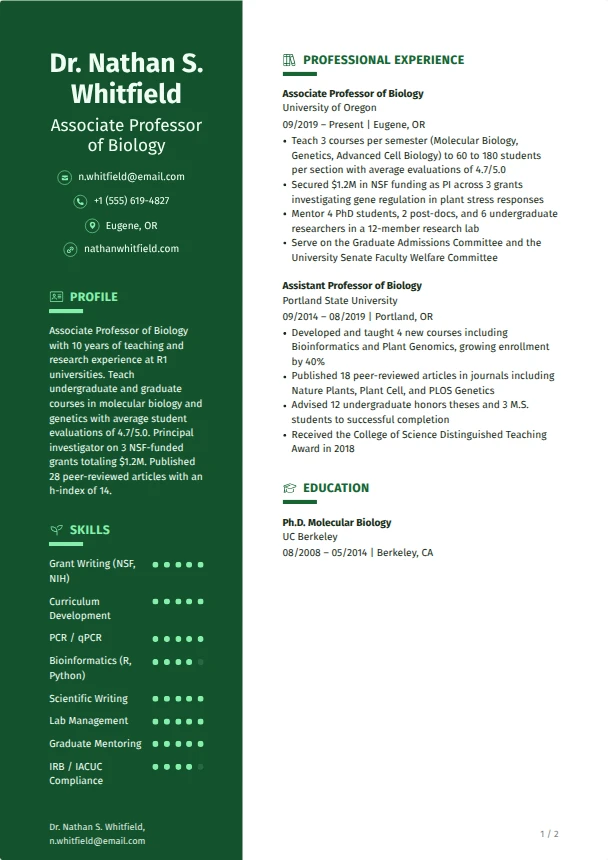
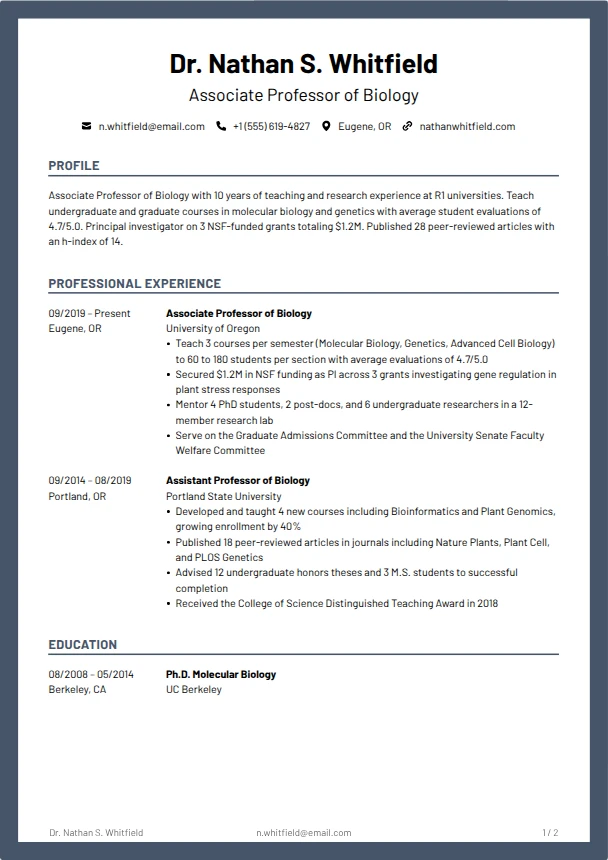
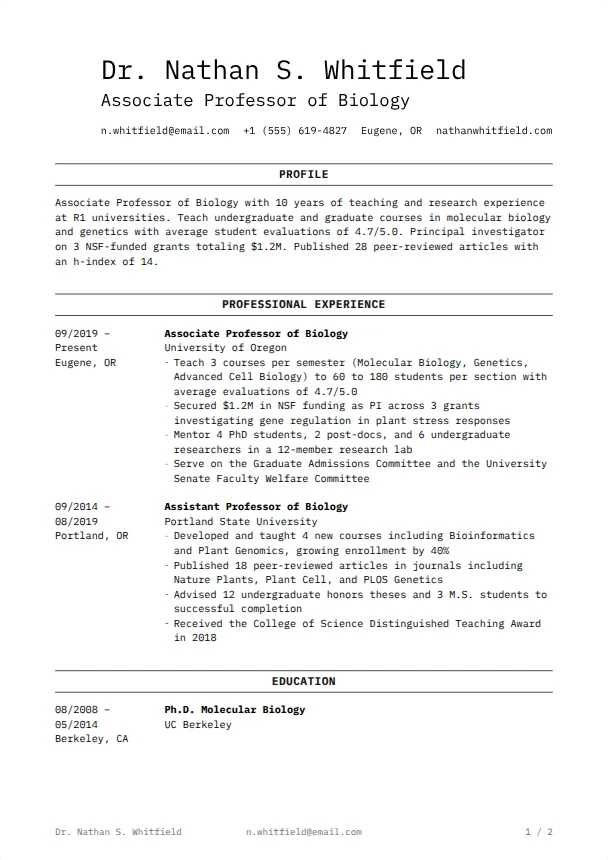
Here is a short fictional sample for a new PhD applying to a first faculty position. The names and numbers are made up to show structure and tone, so replace every line with your own field, courses, and results.
Dr. Maya Okonkwo
Sociology, PhD (defended May 2026) | [email protected] | City, State
Research Summary
Sociologist studying labor migration and community networks, with three peer-reviewed publications and a dissertation grounded in mixed methods and statistical analysis in R. Seeking a tenure-track assistant professor role combining research methods instruction with active scholarship.
Teaching Experience
- Instructor of record, Introduction to Sociology (2 sections, 90 students), with 4.6 of 5.0 student evaluations and a full course redesign for hybrid delivery in Canvas.
- Teaching assistant, Research Methods and Statistics, leading weekly labs in SAS and R and grading with Turnitin for two academic years.
Research and Publications
- Three peer-reviewed publications, including two lead-authored articles in regional sociology journals.
- Co-wrote a graduate research assistant section of an NSF proposal that secured pilot funding.
Skills and Credentials
Curriculum development, research methods, statistical analysis (SAS, R), learning management systems (Blackboard, Canvas), Turnitin, graduate mentoring. ACUE Certification in Effective Teaching (in progress).
How to structure your resume, section by section
The order matters. Here's what a strong professor resume (no experience) looks like from top to bottom:
Contact Information
Name, professional email, phone, city and state, and a link to your academic website or scholarly profile. Keep it to two clean lines so a search committee can find you in seconds. Skip a photo and skip your full mailing address.
Research Summary
Two or three sentences naming your field, your dissertation focus, your research methods, and the kind of position you want. This is where a new PhD frames a trajectory rather than a track record, so lead with the question you study and the methods you use.
Education
List your PhD first, with the institution, expected or actual defense date, dissertation title, and advisor. Add prior degrees underneath. For a first faculty application, education sits near the top because it is your strongest credential.
Publications
Use a consistent citation style and clearly mark peer-reviewed publications, including those under review or in press. Distinguish lead authorship from co-authorship. Even two or three quality entries signal that your scholarship is moving toward tenure-track output.
Teaching
Name each course, your role (instructor of record or teaching assistant), enrollment size, and student evaluation scores. Note any curriculum development, course design for online or hybrid delivery, and the learning management systems you used, such as Blackboard or Canvas.
Key skills to include
These are the skills and keywords academic search committees and resume screening software look for on a new PhD's application. Use the exact phrasing where it is true for you:
Tip: For research universities, lead with peer-reviewed publications and grant writing. For teaching colleges, lead with courses taught, curriculum development, and student evaluation scores.
Certifications that strengthen a teaching-focused application
No license is required to teach at most colleges, but a teaching certificate gives a new PhD with limited classroom time something concrete to show. Two recognized options:
- ACUE Certification in Effective Teaching (endorsed by the American Council on Education), from the Association of College and University Educators (ACUE).
- Quality Matters Teaching Online Certificate (TOC), from Quality Matters, which is useful if you will teach online or hybrid courses.
Resume summary examples you can steal
Use one as a starting point, then swap in your own field, methods, numbers, and achievements.
"PhD candidate in Computer Science defending May 2026. Published 6 peer-reviewed papers at top venues (NeurIPS, ICML). Instructor of record for 3 courses with 4.5 of 5.0 student evaluations and full course design in Canvas."
Why it works: It leads with a concrete defense date and peer-reviewed publications, then proves teaching readiness with instructor-of-record experience and a real evaluation score, which is exactly what a committee scans for in a no-experience applicant.
"Postdoctoral researcher in Neuroscience with 2 years of bench experience. Co-wrote a funded grant proposal and mentored 3 graduate students. 8 peer-reviewed publications and active research methods training."
Why it works: It signals tenure-track scholarship through grant writing and graduate mentoring, the two activities that separate a postdoc from a fresh PhD, without claiming any number that is not earned.
"Industry researcher seeking a first academic position. Five years of applied machine learning work translated into peer-reviewed publications, strong statistical analysis skills in R, and mentoring of junior team members."
Why it works: A career changer with no faculty title reframes industry output as research methods, publications, and mentoring, mapping non-academic work directly onto what a search committee values.
"PhD in English Literature seeking a teaching-focused faculty position. Taught 12 course sections as instructor of record with evaluations averaging 4.6 of 5.0, plus curriculum development and an ACUE Certification in Effective Teaching."
Why it works: For a teaching college, it front-loads classroom volume, evaluation scores, curriculum development, and a recognized teaching certificate instead of leaning on a thin publication record.
Writing strong experience bullets
Every bullet point should answer: "What did you do, and why did it matter?" Use this formula:
Before and after examples:
Published research papers
Published 6 peer-reviewed papers in top-tier venues (NeurIPS, ICML), with lead authorship on 4, accumulating 150+ citations
Taught classes
Served as instructor of record for 3 undergraduate courses (Intro to ML, Data Structures, Statistics) with 60 to 120 students and 4.5 of 5.0 evaluations
Worked in a research lab
Led a 4-person research team investigating neural architecture search, producing 2 publications and mentoring 2 undergraduate thesis students
Strong action verbs for professor resume (no experience) resumes:
Published, Taught, Mentored, Secured, Presented, Developed, Investigated, Designed, Collaborated, Led
5 mistakes that get professor resume (no experience) resumes rejected
CV too long for career stage
A new PhD does not need a ten-page CV. Padding it with every workshop and seminar buries your peer-reviewed publications and teaching. Keep the resume tight and let the strongest research and instruction land in the first page.
Not tailoring to institution type
Sending the same resume to a research university and a teaching college signals you did not read the posting. Reorder sections so research and grant writing lead for one, and curriculum development, student assessment, and evaluations lead for the other.
Burying teaching experience
Teaching assistantships and guest lectures are real teaching, so do not hide them at the bottom. Name the courses, enrollment sizes, student evaluation scores, and any course design for online or hybrid delivery so a committee sees you can run a section.
Listing every conference poster
A wall of minor posters dilutes your record. Highlight invited talks and peer-reviewed presentations, group routine posters briefly, and distinguish invited from submitted work so the committee sees signal, not volume.
Generic research description
"Conducted research" tells a committee nothing. Name your research methods, your statistical analysis tools such as SAS or R, the question you study, and the outcome, so your scholarship reads as specific and tenure-track ready.
What to do if you have no professional experience
Entering academia as a new PhD is the standard path, and most first-time applicants have only teaching assistantships and graduate research to work with. Here is how to turn that into a competitive resume:
Prioritize peer-reviewed publications
Even 2 to 3 quality peer-reviewed publications demonstrate research independence. Focus on getting your dissertation work published, and mark anything under review or in press so the trajectory is visible.
Turn assistantships into teaching credentials
Becoming instructor of record, even for one section, gives you course design and curriculum development experience that committees value far more than a TA line. Add a teaching certificate such as the ACUE Certification in Effective Teaching to back it up.
Apply for postdocs strategically
Postdocs in strong labs with active grant writing and steady publication records are the best stepping stones to tenure-track positions, especially in STEM fields where a postdoc is expected.
Build a simple academic website
A clean page with your CV, peer-reviewed publications, research methods, and a short research statement helps a search committee learn about you before the interview. Link it from your resume header.
Frequently asked questions
When should I start applying for faculty positions?
Most tenure-track searches open in August to October for positions starting the following fall. Start preparing your materials in the summer before you plan to defend.
Do I need publications to land a faculty job with no teaching experience?
For research universities, yes. The expected number varies by field, and peer-reviewed publications carry the most weight. For teaching colleges, strong student evaluations and an ACUE Certification in Effective Teaching can compensate for a shorter publication record.
Should I do a postdoc before a tenure-track job?
In most STEM fields, a postdoc is expected before a tenure-track position. In humanities and social sciences, direct hiring from PhD programs is more common. Either way, frame postdoc work around grant writing, peer-reviewed publications, and graduate mentoring.
How do I show teaching skill when my only experience is a teaching assistantship?
List your teaching assistantships as real teaching: name the courses, note enrollment sizes, and include any student evaluation scores. Add curriculum development, course design for online or hybrid delivery, and learning management system experience with Blackboard or Canvas to show you can run a course independently.
What software and tools should a new PhD list on a professor resume?
List the learning management systems you have used, such as Blackboard and Canvas, plus statistical analysis tools like SAS and R, and Turnitin for assessment integrity. These map directly to the keywords academic search committees and screening software look for.
Skip the blank page
Open a complete, filled-in teacher resume in our free builder. Swap in your own details, keep the wording that fits, and download as PDF, free.
Build Your Academic Resume Now
Create a polished academic resume for your first faculty application. Clean templates for new PhDs and postdocs.
Start Building, It's FreeRelated resume guides
The full professor resume guide for experienced and tenure-track applicants.
How to write a K-12 teacher resume with classroom and certification tips.
Present tutoring and teaching assistantships as real instructional experience.
Sample education resumes you can adapt for an academic application.
More resume examples: