What hiring managers actually look for
Academic hiring remains competitive, but STEM, nursing, and data science positions have strong demand. Adjunct and visiting positions offer entry points.
Per the U.S. Bureau of Labor Statistics, postsecondary teachers earned a median wage of about $83,980 per year, with the lowest 10 percent near $48,570 and the highest 10 percent above $199,520 (BLS Occupational Outlook Handbook, Postsecondary Teachers). Pay varies widely by discipline, rank, institution type, and whether the line is tenure-track or adjunct.
-
1
Fit with the department. Search committees read the first half page to judge whether your teaching fields, research area, and degree match the posted line. Name your discipline, terminal degree, and the courses you can teach right away.
-
2
Evidence of teaching effectiveness. Course load, student headcount, modalities taught (in person, hybrid, online), and evaluation scores show you can carry a real teaching assignment, not just lecture occasionally.
-
3
Scholarship and funding that fit the institution. R1 universities weigh publications, grant dollars, and citation impact heavily. Teaching colleges and community colleges weigh pedagogy, advising, and student success. Lead with the side that matches the job.
If your resume communicates these things in the first 7-second scan, you'll make it to the detailed read. Everything below is about making that happen.
An example professor resume
Here is a short, illustrative one-page resume sample for a tenure-track candidate. It is a fictional example, not a real person, meant to show how teaching, research, and funding sit together on a single page.
Biologist with 9 years of combined teaching and research experience. Principal investigator on federally funded plant-stress research. Strong record of peer-reviewed publications and graduate mentoring, with consistent student evaluation averages of 4.7 out of 5.0.
Assistant Professor, Department of Biology, Riverton University (2020 to present)
- Teach 3 courses per term (Molecular Biology, Genetics, Advanced Cell Biology) to 60 to 180 students across in-person and hybrid sections.
- Redesigned the Genetics course in Canvas, raising student pass rates and aligning assessments to defined student learning outcomes.
- Serve on the curriculum committee and advise roughly 25 undergraduate majors per year.
- Lead a lab of 4 graduate students and 6 undergraduate researchers studying gene regulation in plant stress responses.
- Secured external grant funding as principal investigator across three awards investigating drought tolerance.
- Published peer-reviewed articles in field-leading journals; presented invited talks at national conferences.
PhD, Molecular Biology, Northgate University. Postdoctoral training in plant genomics. Certification in Effective College Instruction (ACUE).
Fictional sample for illustration. Replace every figure with your own verified record before you apply.
How to structure your resume, section by section
The order matters. Here's what a strong professor resume looks like from top to bottom:
Contact Information
Name, email, phone, and city. Add links that committees actually check: an ORCID iD, Google Scholar profile, and a department or personal academic page. Skip your full mailing address.
Research/Teaching Statement Summary
Two or three lines naming your rank or target rank, discipline, years of experience, and one or two headline metrics (grant dollars, publication count, evaluation average). This is the 7-second hook that earns the full read.
Teaching Experience
List courses taught with titles, level (intro vs graduate), modality, enrollment, and evaluation scores. Note whether you were instructor of record or a teaching assistant. Include curriculum you designed and any courses you launched.
Research Experience
Summarize your research agenda, the labs or projects you led, and your role (PI, co-PI, postdoc). Quantify grant funding, datasets, or specimens, and name methods and tools such as SAS, R, or specialized lab techniques.
Publications
On a resume, list your 5 to 8 strongest peer-reviewed works in your field's citation style, reverse chronological, with your name in bold. Save the exhaustive list for the full CV. Note any best-paper awards or high-impact venues.
Education and Credentials
List your PhD or terminal degree first, with institution, field, year (or expected defense date), and dissertation title. Add postdoctoral training and any voluntary teaching credential. Two recognized options are the Certification in Effective College Instruction from the Association of College and University Educators (ACUE), endorsed by the American Council on Education (ACE), and the Quality Matters (QM) Teaching Online Certificate for instructors who teach online or hybrid courses.
Key skills to include
These are the skills and keywords that screening software and search committees look for on a professor resume. Use the ones that match your record:
A teaching credential is not required to become a professor, but a recognized one can strengthen a teaching-focused application. Two verified options:
- Certification in Effective College Instruction, from the Association of College and University Educators (ACUE), endorsed by the American Council on Education (ACE).
- Quality Matters (QM) Teaching Online Certificate, from Quality Matters, for demonstrating competency in online course delivery.
Tip: For tenure-track positions, lead with your strongest area (research or teaching) based on the institution type. R1 schools want research; teaching colleges want pedagogy.
Resume summary examples you can steal
Use one as a starting point, then swap in your own technologies, numbers, and achievements. These are illustrative samples, not real candidates.
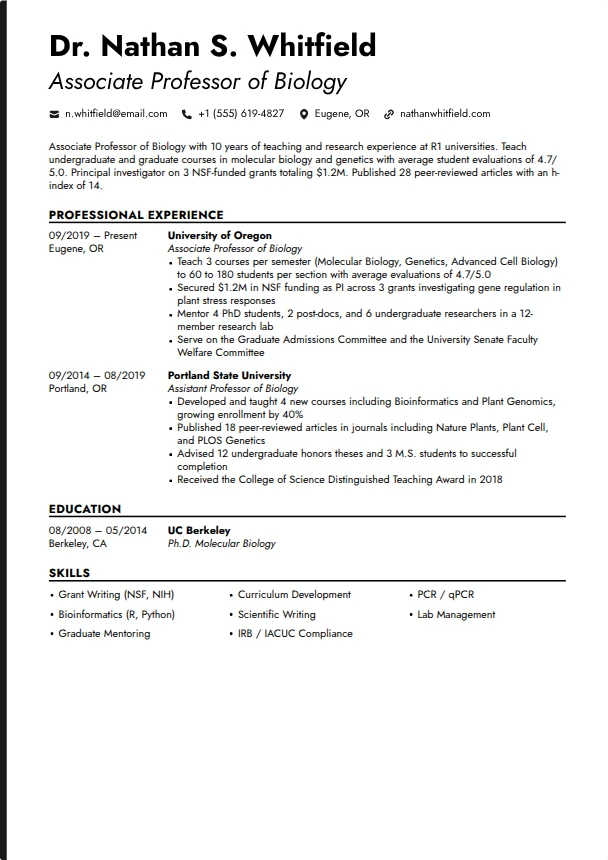
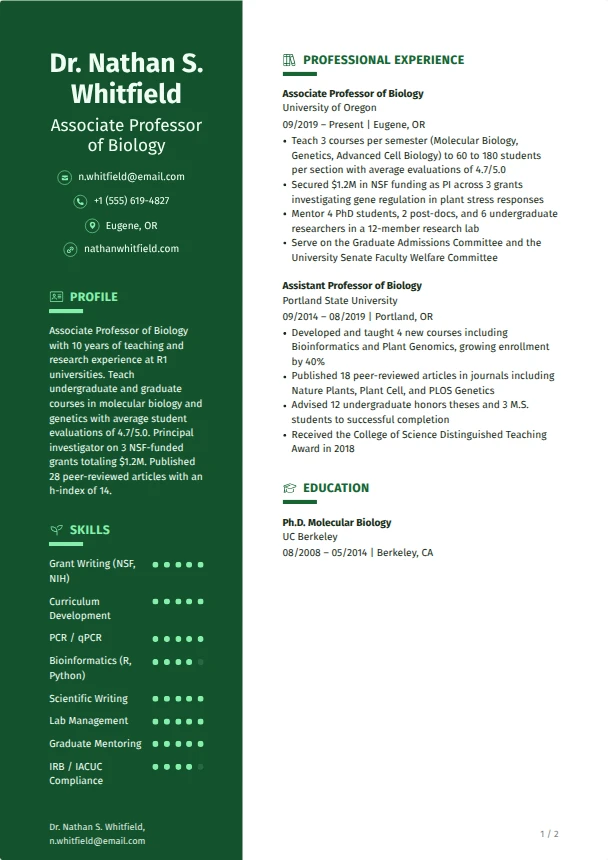
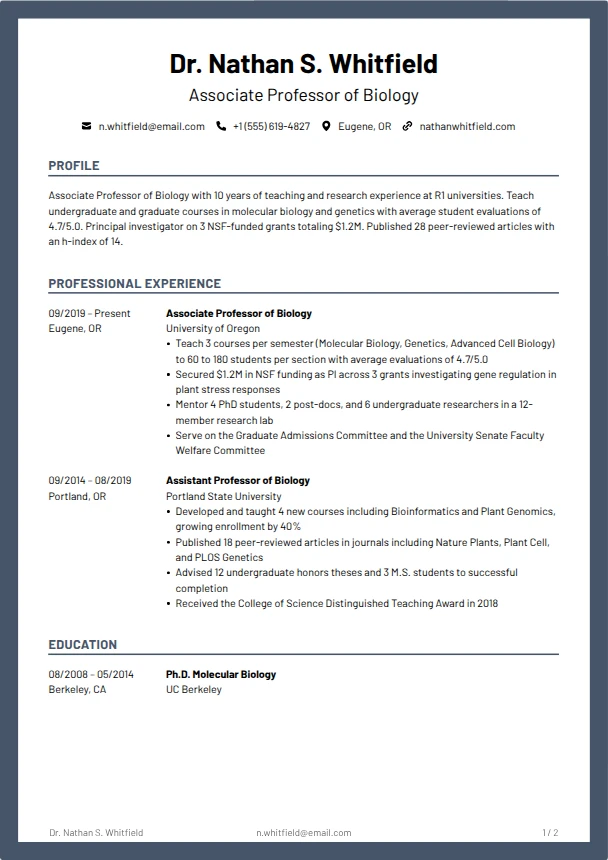
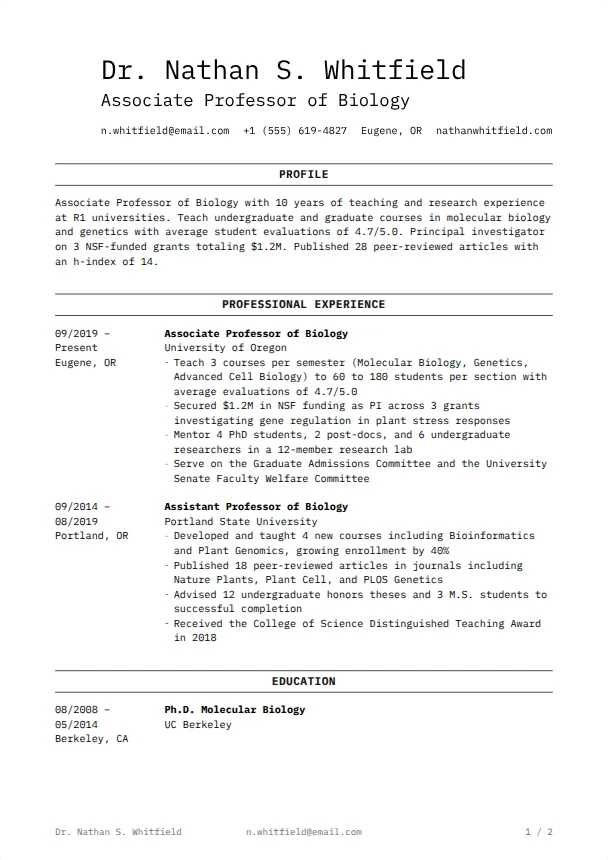
"Associate Professor of Biology with 10 years of teaching and research experience at R1 universities. PI on multiple federal grants. Published 28 peer-reviewed articles (h-index 14). Teaching evaluations average 4.7/5.0."
Why it works: leads with rank and field, then stacks the three metrics an R1 committee scans for (funding, output, teaching scores) in a single line.
"Adjunct Instructor of English with 5 years teaching composition and literature at 3 institutions. Teach 4 to 5 sections per semester to 120+ students. Developed a hybrid writing workshop model adopted department-wide."
Why it works: quantifies the real teaching load (sections, students, institutions) and shows institutional impact, which matters more than research for adjunct and lecturer lines.
"Ph.D. candidate in Computer Science defending May 2026. Published 6 papers in top-tier venues. Taught 3 courses as instructor of record with 4.5/5.0 evaluations."
Why it works: states the defense date up front so committees know your timeline, then proves both research (named venues) and independent teaching despite a short record.
"Senior Data Scientist transitioning to academia. 8 years of industry machine learning experience. 12 patents, 4 publications, and guest lectures at 3 universities."
Why it works: reframes industry experience as scholarly currency (patents, publications, guest lectures) so a committee sees a credible bridge into a faculty role.
Writing strong experience bullets
Every bullet point should answer: "What did you do, and why did it matter?" Use this formula:
Before and after examples:
Taught biology courses
Teach 3 courses per semester (Molecular Biology, Genetics, Advanced Cell Biology) to 60 to 180 students with average evaluations of 4.7/5.0
Got research funding
Secured external grant funding as PI across 3 awards investigating gene regulation in plant stress responses
Mentored students
Mentor 4 PhD students, 2 postdocs, and 6 undergraduate researchers, with 3 students earning competitive national fellowships
Strong action verbs for professor resumes:
Secured, Published, Developed, Mentored, Taught, Designed, Reviewed, Presented, Investigated, Established
5 mistakes that get professor resumes rejected
Mixing CV and resume formats
Sending a 12-page CV when the posting asks for a resume, or a thin resume when a research university expects a full CV. Match the document type to the institution and the words in the job ad.
Not quantifying teaching
"Taught undergraduate courses" tells a committee nothing. Add course count, enrollment, modality, and evaluation scores so your teaching record is measurable.
Burying grant funding
Funding is one of the clearest signals of research independence. Pull total dollars, your role (PI vs co-PI), and the funding agency into a visible line rather than hiding them inside paragraphs.
Listing every conference
A resume is not the full CV. Listing 30 poster sessions buries the work that matters. Keep the most prestigious invited talks and selected presentations, and move the exhaustive list to your CV.
No research statement hint
A list of papers with no through-line leaves the committee guessing about your agenda. Use the summary to name your research focus in one sentence so your publications read as a coherent program.
What to do if you have no professional experience
New PhD graduates and career changers can build a competitive academic profile:
Lead with publications
Even 2 to 3 peer-reviewed publications in good venues demonstrate research capability. Quality matters more than quantity for early career.
Emphasize teaching evaluations
If you taught as a TA or instructor of record, include your evaluation scores. This is concrete evidence of teaching ability. A voluntary credential like the ACUE Certification in Effective College Instruction can reinforce a thin teaching record.
Include conference activity
Presentations, poster sessions, and workshop facilitation show scholarly engagement even without a long publication record.
Highlight mentoring
Mentoring undergraduates, leading study groups, or supervising lab assistants counts as teaching experience.
Frequently asked questions
What is the difference between a CV and a resume for professors?
An academic CV is comprehensive and can be multiple pages, including all publications, presentations, grants, and service. A resume is 1 to 2 pages and focuses on the most relevant experience.
How long should a professor CV be?
There is no page limit for academic CVs. Early career CVs are typically 3 to 5 pages. Senior faculty may have 10 to 20+ pages.
Should I include my h-index?
Include it if it is strong for your field and career stage. For early career researchers, it is better to highlight individual high-impact publications.
How do I list publications on my CV?
Use your field's standard citation format. List in reverse chronological order with full author lists. Bold your name.
Do community colleges want CVs or resumes?
Most community colleges prefer a resume-style document (2 to 3 pages) focused on teaching experience and student success metrics rather than a full academic CV.
Do I need a teaching certificate to be a professor?
A terminal degree such as a PhD is the standard requirement. A teaching credential is not mandatory, but voluntary certificates like the ACUE Certification in Effective College Instruction or the Quality Matters Teaching Online Certificate can strengthen a teaching-focused application, especially at community colleges and teaching universities.
Skip the blank page
Open a complete, filled-in teacher resume in our free builder. Swap in your own details, keep the wording that fits, and download as PDF, free.
Build Your Professor Resume Now
Create a polished academic resume or CV with our builder. Clean templates designed for higher education positions.
Start Building, It's FreeRelated resume guides
Structure a K-12 teaching resume around classroom results and certifications.
Highlight subject expertise and measurable student improvement.
Show flexibility and classroom management across grade levels and subjects.
Browse sample teaching resumes across grade levels and subjects.
More resume examples: