What hiring managers actually look for
Academic hiring committees evaluate CVs differently than corporate recruiters. Here is what they prioritize:
-
1
Publication record is the primary metric for research positions. Search committees count publications, weigh journal impact factors, and note whether you are first author or a contributor. Even one peer-reviewed publication as an early-career researcher signals that you can complete the full research cycle from hypothesis to published finding.
-
2
Teaching experience needs to show pedagogical range. Listing courses you assisted with is a start. But committees want to see independent course design, student evaluation scores, curriculum development, and evidence that you can teach across multiple levels (introductory and advanced courses).
-
3
Grant and fellowship history demonstrates institutional viability. Universities need researchers who can bring in funding. Listing grants you have received, applied for, or contributed to (even small departmental grants) shows that you understand the funding landscape in your field.
If your resume communicates these things in the first 7-second scan, you'll make it to the detailed read. Everything below is about making that happen.
How to structure your resume, section by section
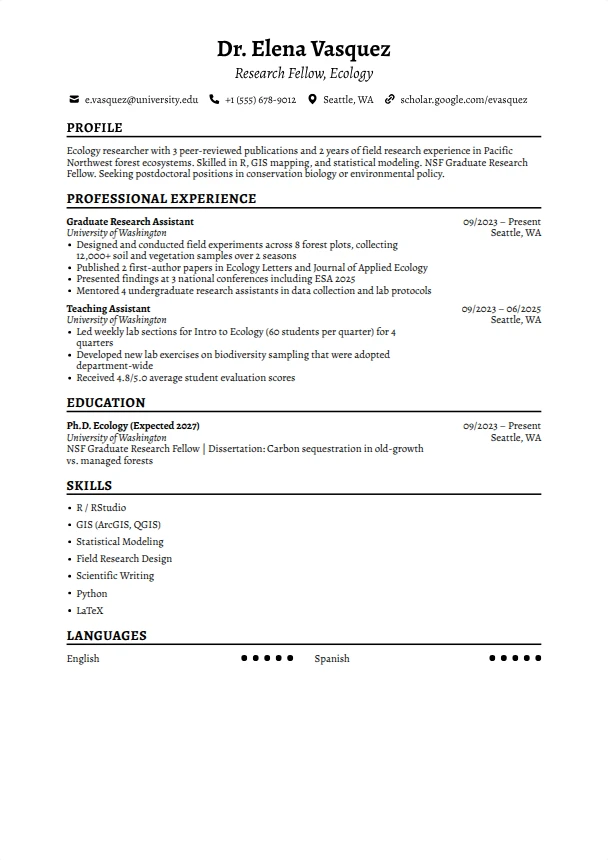
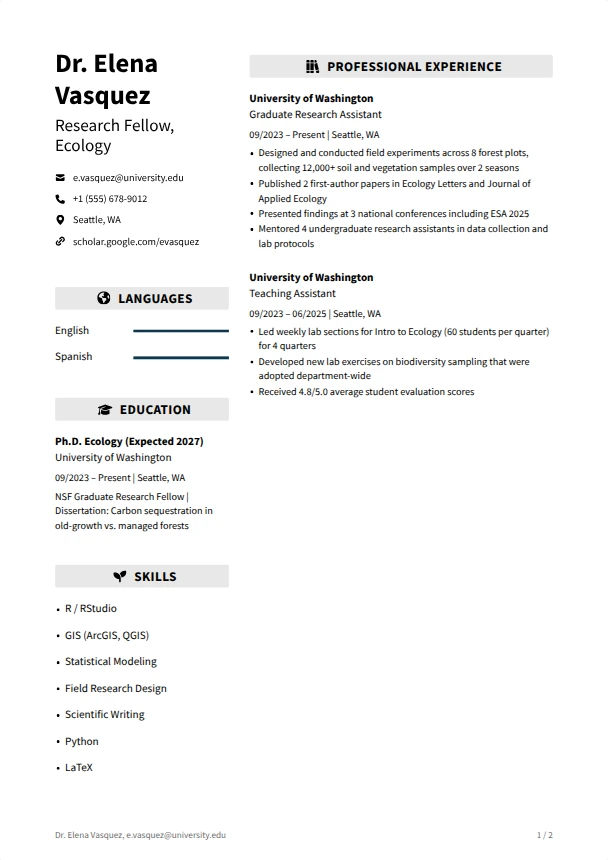
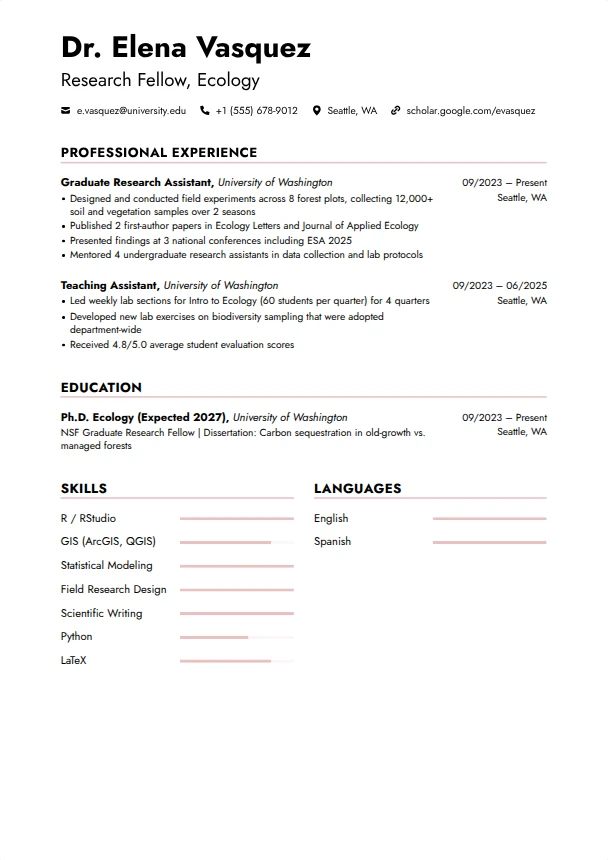
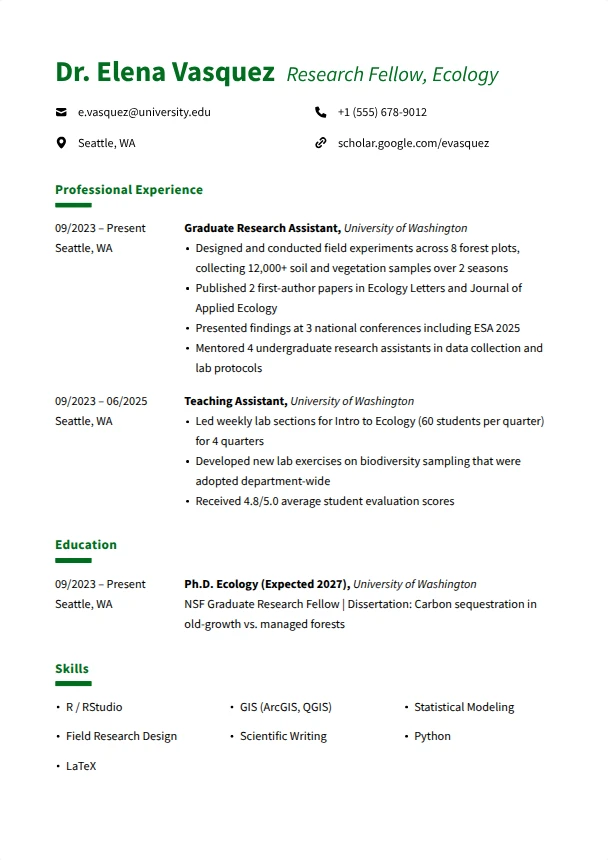
The order matters. Here's what a strong academic resume looks like from top to bottom:
1. Contact header
Include your full name, institutional affiliation, department email, phone number, and links to your Google Scholar profile or personal academic website. ORCID iDs are increasingly expected.
Dr. Priya Sharma · Department of Chemistry, University of Wisconsin-Madison · [email protected] · orcid.org/0000-0002-1234-5678
2. Research statement or profile (2-3 sentences)
Summarize your research focus, methodology, and one key finding or contribution. This section replaces the corporate 'professional summary' and should position you within your subfield.
Strong: "Environmental chemist investigating microplastic degradation pathways in freshwater ecosystems using advanced spectrometric methods. Published three peer-reviewed studies demonstrating that UV exposure accelerates polymer breakdown rates by 40% in controlled laboratory conditions. Seeking a postdoctoral research position in environmental toxicology."
3. Education
List degrees in reverse chronological order. Include institution, degree, field, year, dissertation or thesis title, and advisor name. For PhD candidates, include your expected defense date.
4. Publications
Format publications according to your discipline's citation style (APA, MLA, Chicago, etc.). List peer-reviewed journal articles first, then conference proceedings, book chapters, and working papers. Bold your name in the author list.
Sharma, P., Lee, J., & Torres, M. (2025). UV-accelerated degradation of polyethylene microplastics in simulated freshwater environments. Environmental Science & Technology, 59(3), 1142-1155.
5. Research and teaching experience
Separate these into two sections. For research, list your lab or group, PI name, institution, dates, and bullet points describing your specific contributions, methods, and findings. For teaching, list each course, your role (instructor of record, TA, guest lecturer), enrollment size, and any curriculum you developed.
Strong: "Served as instructor of record for General Chemistry I (CHEM 101), a 120-student lecture course. Designed all exams and assignments, delivered 45 lectures, and maintained a 4.3/5.0 student evaluation average across two semesters."
6. Grants, awards, and professional activities
List grants received (with amounts), fellowships, academic awards, conference presentations, professional society memberships, peer review service, and committee roles. These sections can each be separate on a longer CV.
Key skills to include
Academic positions require a mix of research methods, technical proficiency, and scholarly communication skills. These appear most frequently in academic job postings:
Tip: Match your skills to the specific requirements listed in the job posting or fellowship application. A computational biology position needs to see Python and bioinformatics tools. A humanities position needs to see archival research and digital humanities methods.
Resume summary examples you can steal
Use one as a starting point, then swap in your own technologies, numbers, and achievements.
"PhD candidate in molecular biology at Johns Hopkins University with four first-author publications in peer-reviewed journals and $45,000 in fellowship funding. Dissertation research on CRISPR-based gene therapy for sickle cell disease has been presented at three international conferences. Seeking a postdoctoral position in a translational genomics laboratory."
Why it works: Quantifies publications, funding, and conference presentations. The dissertation topic is specific enough for committee members to immediately assess fit.
"M.A. in sociology from the University of Chicago with a thesis on housing displacement in gentrifying neighborhoods, using mixed-methods analysis of census data and 30 in-depth interviews. Completed two semesters as a teaching assistant for Introduction to Social Research Methods. Seeking admission to a doctoral program in urban sociology."
Why it works: The thesis description names the methodology and data sources, which shows research maturity. Teaching experience adds a second dimension of academic preparation.
"Recent PhD in English literature from Yale University specializing in postcolonial Caribbean fiction. Author of six peer-reviewed articles and a book manuscript under review at Duke University Press. Four years of independent teaching experience across survey and upper-division courses with consistently strong evaluations. Seeking a tenure-track assistant professor position."
Why it works: A book manuscript under review signals readiness for the tenure clock. Six articles and four years of independent teaching exceed typical expectations for a new assistant professor.
"Senior biology major at the University of Michigan with a 3.8 GPA and two semesters of research experience in the Anderson Lab studying plant immune responses. Co-author on a poster presented at the Midwest Plant Biology Conference. Proficient in PCR, Western blot, and confocal microscopy. Applying for the summer REU program in plant genetics."
Why it works: Names the specific lab, research topic, and techniques. The poster co-authorship shows the student contributed meaningfully to a research output, not just washed glassware.
Writing strong experience bullets
Every bullet point should answer: "What did you do, and why did it matter?" Use this formula:
Before and after examples:
Helped with research in the lab.
Conducted 200 spectrometric analyses of water samples from 12 collection sites, generating the primary dataset for a peer-reviewed publication on microplastic contamination in the Great Lakes.
Was a teaching assistant for a class.
Led weekly discussion sections for 60 students in Introduction to Political Science, designed three supplementary workshops on research methodology, and earned a 4.5/5.0 teaching evaluation average.
Applied for grants.
Wrote and submitted four grant proposals totaling $120,000 to NSF, NIH, and two private foundations. Secured $35,000 in funding for a two-year study on antibiotic resistance in agricultural runoff.
Strong action verbs for academic resumes:
Investigated · Published · Presented · Designed · Analyzed · Mentored · Supervised · Lectured · Authored · Collaborated · Secured · Reviewed · Collected · Synthesized · Administered · Developed · Co-authored
7 mistakes that get academic resumes rejected
Using a one-page corporate resume format for academic applications.
Academic CVs are expected to be longer than one page. A comprehensive CV that properly lists publications, teaching, grants, and conference presentations will naturally run two to five pages even for early-career researchers.
Omitting publications that are in progress.
Include manuscripts under review, in revision, or in preparation. Label them clearly as 'under review at [Journal Name]' or 'in preparation.' Committees understand the publication timeline and want to see your pipeline.
Listing teaching without evaluation data.
Student evaluation scores (when strong) add credibility to your teaching section. If your scores are above average, include them. If you do not have formal evaluations yet, mention informal feedback or teaching awards.
Neglecting to list conference presentations.
Every poster, panel, and paper you have presented at a conference belongs on your CV. Include the conference name, location, date, and your presentation title. This section demonstrates engagement with your scholarly community.
Formatting publications inconsistently.
Pick one citation style and use it throughout. Mixing APA and MLA formatting, or forgetting italics for journal names, signals carelessness in a context where precision matters enormously.
Forgetting professional service and committee work.
Peer reviewing for a journal, serving on a department committee, or organizing a conference panel all count. These activities show that you contribute to the academic ecosystem beyond your own research.
Leaving out your advisor's name.
In academia, who trained you matters. Include your dissertation advisor, research supervisor, or lab PI name in your education or research experience sections. Committees will recognize established scholars in your field.
What to do if you have no professional experience
If you are early in your academic career, here is how to build a CV that demonstrates potential:
Seek out undergraduate research opportunities.
Most universities have REU programs, honors thesis tracks, or faculty-led research teams that accept undergraduates. Even one semester of lab or fieldwork gives you meaningful CV content and a faculty reference.
Present at undergraduate or regional conferences.
Many disciplines have student-focused conferences with high acceptance rates. Submitting a poster or short paper gets you a presentation credit on your CV and experience with the academic conference process.
Publish in undergraduate research journals.
Most large universities host undergraduate research journals, and many disciplines have national ones. These publications count on your CV and demonstrate that you can complete the peer review process.
Volunteer as a tutor or supplemental instructor.
If you cannot get a formal TA position yet, tutoring or SI leadership gives you teaching experience. Document the subject, number of students, and any measurable improvement in their performance.
Frequently asked questions
What is the difference between an academic resume and an academic CV?
In academic contexts, the terms are often used interchangeably, but a CV is the more common and accurate term. Unlike a corporate resume (one page), an academic CV is a comprehensive document that grows throughout your career. It includes every publication, presentation, and teaching assignment.
How long should an academic CV be?
There is no page limit. A graduate student's CV might be two to three pages. A mid-career professor's CV could be 15 pages or longer. Include everything relevant and let the length reflect your actual record.
Should I include non-academic work experience?
Only if it is relevant to the position. Industry experience in your research area is valuable. A summer job at a restaurant is not. If you are transitioning from industry to academia, highlight the transferable technical skills.
Do I need a research statement and a teaching statement in addition to my CV?
Most faculty and postdoc applications require separate research and teaching statements. Your CV should complement these documents, not duplicate them. Keep CV descriptions brief and save detailed narratives for the statements.
How should I list publications that have multiple authors?
Follow your discipline's citation convention. In most fields, bold your own name in the author list. If you are not the first author, the bold formatting helps committee members quickly identify your contributions across multiple co-authored works.
Skip the blank page
Open a complete, filled-in entry-level resume in our free builder. Swap in your own details, keep the wording that fits, and download as PDF, free.
Build your academic resume now
Pick a template, add your details, and download a polished PDF in minutes. Free, no account required.
Start Building, It's FreeRelated resume guides
Resume writing guide for recent bachelor's and master's graduates.
Resume tips for current undergraduate students.
General guide for writing your first professional resume.
How to build a strong resume when your work history is thin.
More resume examples: