What hiring managers actually look for
Campus recruiters who hire students with no prior internships say they look for these signals:
-
1
Self-directed learning signals ambition. Completing an online certification, building a side project, or learning a tool outside of class shows recruiters you do not wait to be assigned tasks. This quality predicts strong on-the-job performance.
-
2
Depth of involvement beats breadth. A recruiter would rather see 3 semesters of deep involvement in one organization than token membership in 10 clubs. Depth shows you stick with things and grow your responsibilities over time.
-
3
Communication skills are non-negotiable. Every role requires writing emails, presenting to teams, and explaining your work. Students who can demonstrate these skills through presentations, published writing, or leadership roles have a significant advantage.
If your resume communicates these things in the first 7-second scan, you'll make it to the detailed read. Everything below is about making that happen.
How to structure your resume, section by section
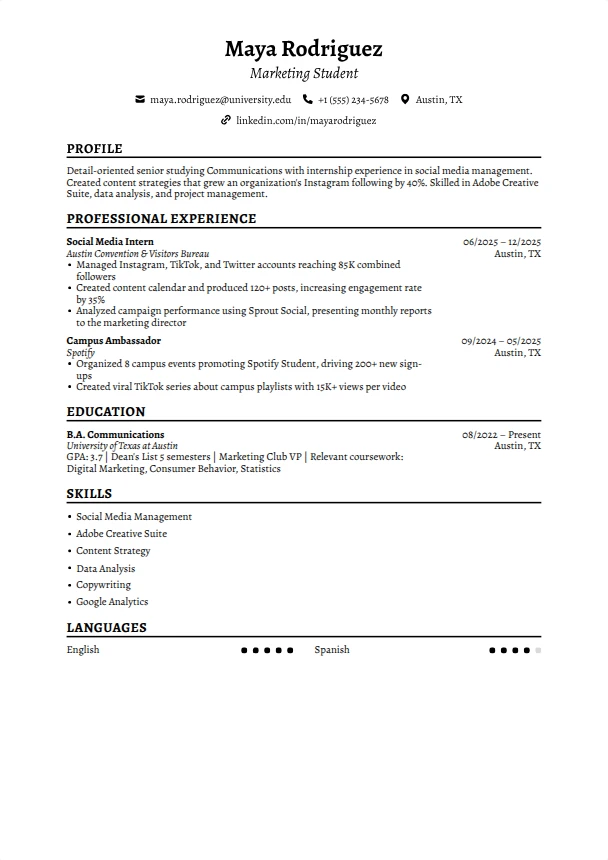
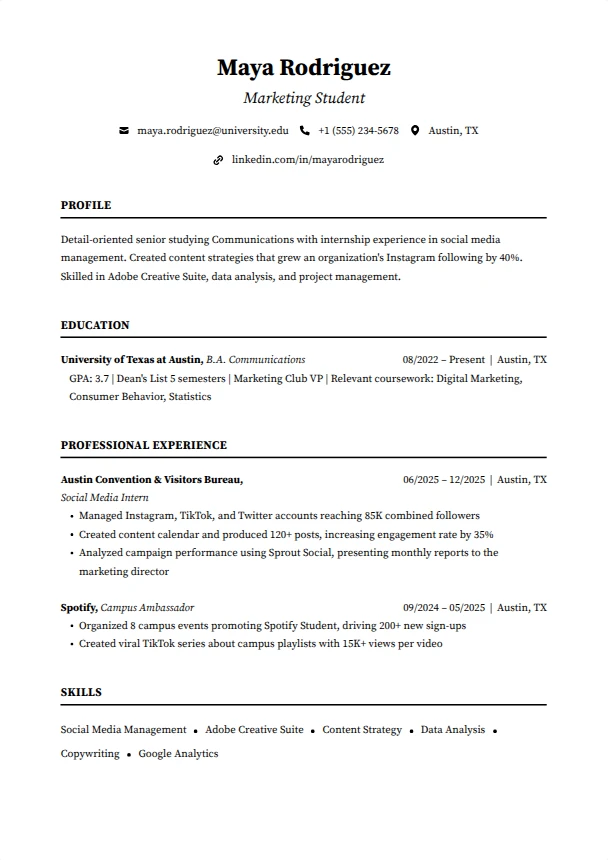
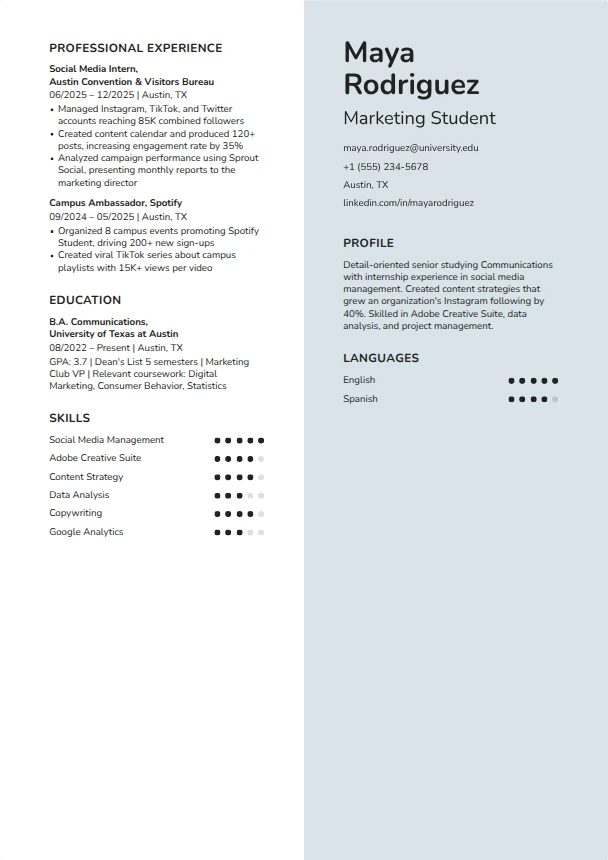
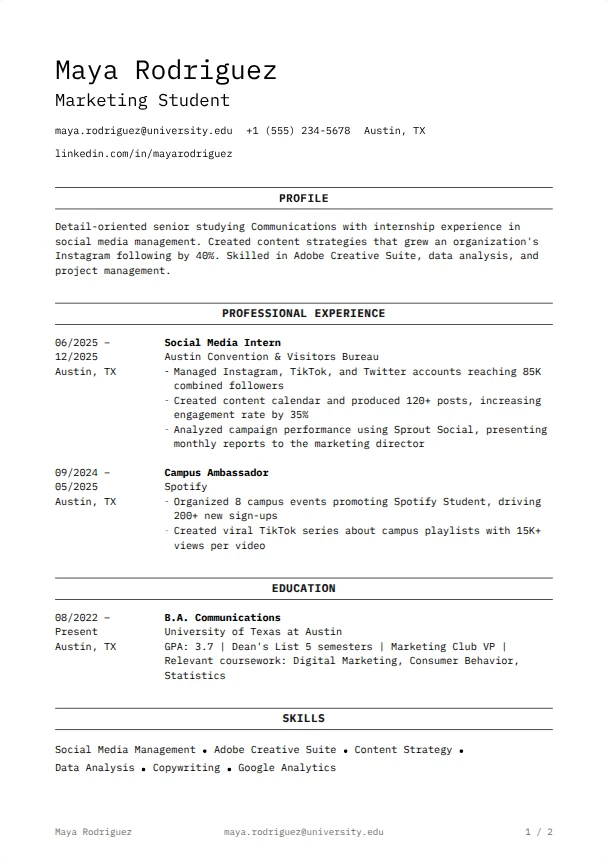
The order matters. Here's what a strong college resume with no experience looks like from top to bottom:
1. Contact header
Name, professional email, phone number, city, and LinkedIn URL. Add a portfolio link or GitHub profile if relevant to your field.
2. Resume objective (2-3 sentences)
Without experience, your objective must work harder to prove your value. Lead with your academic strengths, name a specific project or skill, and clearly state the type of role you want.
Strong: "Sophomore data science major at UT Austin seeking a summer analytics internship. Built a sentiment analysis tool in Python that processed 5,000 tweets for a social media research project, achieving 87% classification accuracy."
3. Education
This is your strongest section. Include your university, degree and major, expected graduation, GPA, relevant coursework (4 to 6 classes), honors, and dean's list semesters. If you did study abroad, include the institution and any relevant coursework taken there.
4. Skills
Be specific about tools and platforms rather than generic soft skills. Group them by category and only include skills you can demonstrate with a project, coursework, or certification.
Programming: Python (pandas, scikit-learn), SQL, R
Analytics: Tableau, Google Analytics, Excel (pivot tables, macros)
Collaboration: Slack, Notion, Asana, Git/GitHub
5. Projects and campus involvement
This section replaces traditional work experience. List class projects, personal projects, hackathon entries, and campus organization roles. Treat each one like a job with a title, date range, and 2 to 3 achievement bullets.
Strong: "Marketing Strategy Project (Spring 2026): Led a 4-person team in developing a go-to-market plan for a local startup, including customer segmentation analysis of 1,200 survey responses and a $15,000 projected ad budget allocation."
6. Certifications, awards, and additional sections
Online certifications (Google, AWS, HubSpot, Coursera), scholarships, hackathon awards, and language skills add credibility. Even completing a MOOC on a relevant topic shows initiative that sets you apart.
Key skills to include
When you lack work experience, your skills section carries extra weight. These are the most in-demand skills across entry-level college job postings.
Tip: For every skill you list, prepare a 30-second story about how you used it. 'I used Tableau in my econometrics class to visualize income inequality trends across 50 states' is much more convincing in an interview than 'I know Tableau.'
Resume summary examples you can steal
Use one as a starting point, then swap in your own technologies, numbers, and achievements.
"Statistics major at the University of Michigan with a 3.5 GPA and proficiency in Python, SQL, and Tableau. Built a predictive model for student retention as a class project that was adopted by the admissions office for further development. Seeking a summer data analytics internship."
Why it works: The project was adopted by a real department, which elevates it from a class assignment to a genuine professional deliverable.
"Communications sophomore at USC with experience managing social media accounts for two campus organizations, reaching a combined audience of 3,500 followers. Created a content strategy that increased engagement by 45% in one semester. Targeting a marketing internship at a tech company."
Why it works: Managing real social media accounts with real metrics is marketing work, even if it is unpaid. The engagement increase proves strategic thinking.
"Political science junior at Howard University with a concentration in public policy. Authored a 30-page policy brief on affordable housing that was submitted to the DC City Council through a faculty-led research group. Seeking a policy research internship."
Why it works: A policy brief submitted to a real government body transforms academic work into applied experience, which is exactly what policy employers want to see.
"Business administration freshman at Florida State University with a Google Project Management Professional Certificate. Coordinated logistics for a 200-person campus charity gala, managing vendor contracts, a $3,000 budget, and a team of 12 volunteers."
Why it works: The professional certificate combined with a real event management example makes a freshman competitive despite having zero traditional work history.
Writing strong experience bullets
Every bullet point should answer: "What did you do, and why did it matter?" Use this formula:
Before and after examples:
Participated in a case competition.
Placed 2nd out of 24 teams in the Southeast Regional Case Competition, presenting a cost-reduction strategy projected to save a healthcare client $340,000 annually.
Was the social media person for my fraternity.
Managed Instagram and Twitter accounts for a 90-member fraternity, growing follower count from 400 to 1,100 and increasing event attendance by 25% through targeted story campaigns.
Helped with a research project in my professor's lab.
Collected and cleaned datasets totaling 8,000 records for a consumer behavior study, using R to identify 3 statistically significant purchasing patterns published in the project's final report.
Strong action verbs for college resume with no experience resumes:
Built · Analyzed · Developed · Presented · Managed · Authored · Designed · Coordinated · Researched · Implemented · Launched · Optimized · Led · Secured · Created · Facilitated · Streamlined
7 mistakes that get college resume with no experience resumes rejected
Writing 'No relevant experience' on your resume
Never highlight what you lack. Replace the experience section with 'Projects,' 'Campus Involvement,' or 'Relevant Experience' and fill it with your strongest non-work accomplishments.
Padding with generic soft skills
'Team player, strong communicator, detail-oriented' without evidence is meaningless. Either demonstrate these skills through your bullets or leave them off. Actions prove traits better than labels.
Using your high school achievements as a college student
Once you complete your first year of college, your high school section should disappear. Holding onto it signals that you have not accomplished anything in college yet.
Listing coursework without context
'Intro to Statistics' means nothing by itself. 'Statistics (built regression models predicting housing prices using 10 variables)' gives the recruiter something concrete to evaluate.
Ignoring campus career center resources
Most university career centers offer free resume reviews, mock interviews, and connections to alumni. Students who use these services are significantly more likely to land interviews than those who do not.
Applying only to large companies
Fortune 500 internships are extremely competitive. Startups, nonprofits, and local businesses are more likely to take a chance on a student with no formal experience, and the learning opportunities are often richer.
Waiting until junior year to build your resume
Start building your resume in your first semester. Even a freshman can list coursework, a club role, and a personal project. Early resume building creates urgency to accumulate experiences.
What to do if you have no professional experience
Here are four concrete steps you can take this month to go from a blank resume to a full one:
Complete a professional certification
Google, HubSpot, and Salesforce all offer free certifications that take 20 to 40 hours. A Google Data Analytics Certificate or HubSpot Inbound Marketing Certification adds immediate credibility and shows you invest in your own development.
Build a project from a class assignment
Take your best class project and extend it beyond what was required. Add features, analyze more data, or present it at a campus event. The upgraded version becomes a portfolio piece you can link from your resume.
Apply for a micro-internship
Platforms like Parker Dewey connect students with short-term (5 to 40 hour) professional projects from real companies. You get paid, gain a resume line, and often receive a referral for future roles.
Volunteer for a role with measurable impact
Offer to manage social media for a campus org, coordinate a fundraiser, or tutor at a community center. Choose roles where you can track numbers: followers gained, dollars raised, students tutored. Numbers make your resume concrete.
Frequently asked questions
Can I get an internship with no prior work experience?
Yes. Many internship programs are designed specifically for students with no prior experience. Freshmen and sophomore internships, university partnerships, and diversity programs often prioritize potential over experience.
How do I fill a full page without work experience?
Expand your education section with relevant coursework and honors. Add a projects section with 2 to 3 entries. Include campus involvement and leadership. List certifications and technical skills. Most students can fill a page with these sections alone.
Should I include freelance or gig work on my college resume?
Absolutely. Freelance graphic design, tutoring, Etsy shops, and social media management are all real work experience. List them with dates, responsibilities, and measurable outcomes just like formal employment.
Is it better to have a resume objective or summary as a college student?
Use an objective if you are a freshman or sophomore (focus on what you want to learn and contribute). Use a summary once you are a junior or senior with substantial projects and involvement to highlight.
How do I address the lack of experience in a cover letter?
Do not apologize for it. Instead, focus your cover letter on one specific project or achievement that demonstrates the skills the job requires. Show the employer what you can do rather than explaining what you have not done yet.
Build your college resume now
Pick a template, add your details, and download a polished PDF in minutes. Free, no account required.
Start Building, It's FreeRelated resume guides
The complete guide to writing a college resume, covering all experience levels.
Broader strategies for anyone building a resume without traditional work history.
Advice for master's and PhD students entering the job market.
General tips for positioning yourself at the start of your career.
More resume examples: