What hiring managers actually look for
Before you model your resume after these examples, understand what makes certain graduate resumes succeed over others:
-
1
Specificity wins over breadth. A resume that deeply aligns with one role will outperform a generic resume sent to 20 different jobs. The examples below are tailored to specific industries because that is how successful graduate resumes actually work.
-
2
Numbers make claims believable. Any graduate can write 'strong analytical skills.' The ones who get interviews write 'Analyzed 10,000 rows of survey data using Python pandas to identify purchasing trends.' Notice how every strong example below includes a measurable detail.
-
3
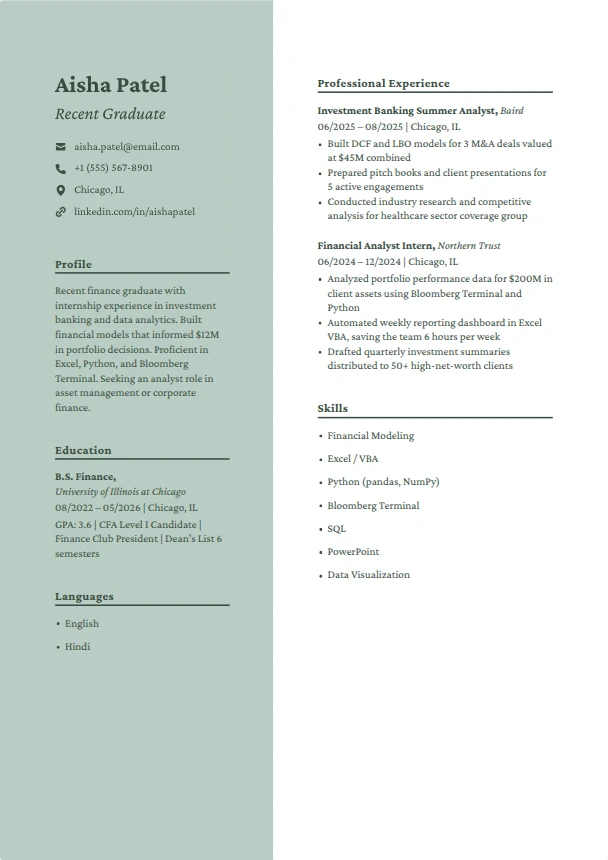
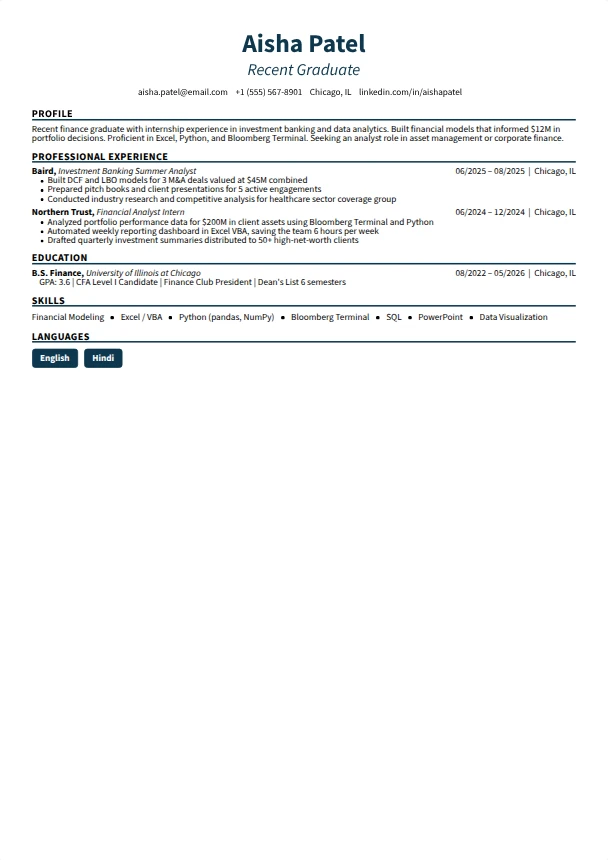
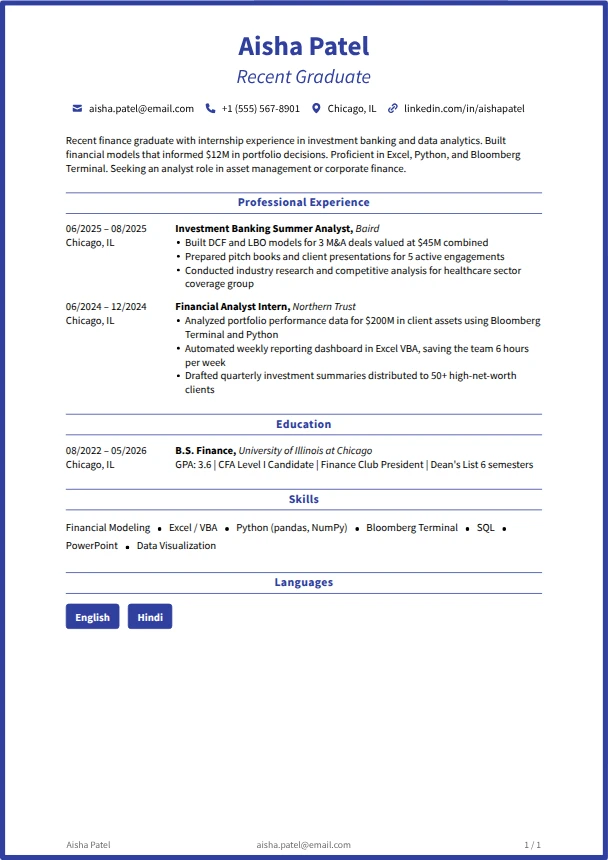
Format consistency signals professionalism. Inconsistent fonts, uneven spacing, and mismatched bullet styles make your resume look careless. The examples below follow a consistent structure throughout, which is exactly what recruiters expect from a polished candidate.
If your resume communicates these things in the first 7-second scan, you'll make it to the detailed read. Everything below is about making that happen.
How to structure your resume, section by section
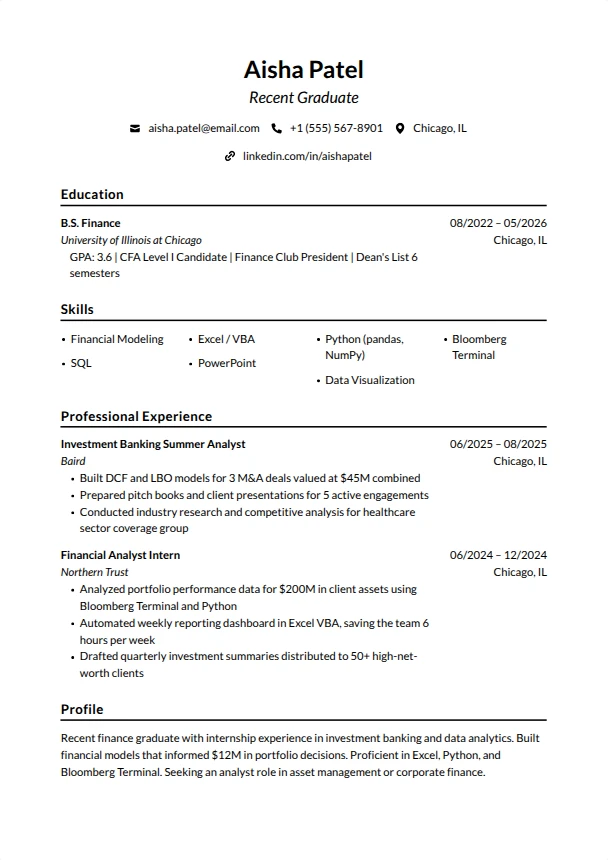
The order matters. Here's what a strong graduate resume examples looks like from top to bottom:
1. Contact header
Every example below starts with a clean header. Use the same format: name on top, then a single line with email, phone, location, and one professional link.
2. Professional summary (2-3 sentences)
The summary sets the tone. In these examples, notice how each summary names a degree, a specialization, and a measurable achievement within the first two sentences. Follow this pattern with your own credentials.
Strong: "Supply chain management graduate from Penn State with a Six Sigma Yellow Belt certification and a capstone project that reduced simulated warehouse processing time by 22%. Proficient in SAP ERP, demand forecasting, and inventory optimization. Seeking an operations analyst role in manufacturing or logistics."
3. Education
In graduate resume examples, education always appears near the top. Include your degree name, institution, graduation year, GPA if noteworthy, and two to three lines of relevant detail such as honors, thesis, or key coursework.
4. Skills
The example resumes below group skills into clear categories. This format is easier to scan than a comma-separated list and helps ATS systems parse your qualifications accurately.
Analytics: SQL, Python, R, Tableau, Power BI
Operations: SAP ERP, demand forecasting, lean methodology
Certifications: Six Sigma Yellow Belt, Google Data Analytics Certificate
5. Experience and projects
Each example uses the same bullet structure: action verb, specific task, and measurable result. Copy this pattern even if your experience comes from class projects or volunteer work.
Strong: "Redesigned the inventory tracking spreadsheet for a campus bookstore, reducing stock discrepancies by 35% and saving an estimated $2,400 per semester in lost inventory."
6. Additional sections
The strongest examples include one or two extra sections such as certifications, languages, publications, or leadership roles. These sections differentiate you from other graduates with similar degrees.
Key skills to include
These skills appear consistently in job postings targeting recent graduates. Match them against your own experience and include every one you can honestly claim:
Tip: When copying these examples, replace the skills with ones from your actual job posting. The structure and format should match, but the specific skills must be tailored to each application.
Resume summary examples you can steal
Use one as a starting point, then swap in your own technologies, numbers, and achievements.
"Accounting graduate from Indiana University with a 3.7 GPA and 150 credit hours completed toward CPA eligibility. Completed a tax preparation practicum where I prepared 25 individual and small-business returns using Intuit ProConnect. Seeking a staff auditor position at a public accounting firm."
Why it works: Mentions CPA eligibility (a major differentiator), quantifies the practicum with a specific number of returns, and names the exact software used.
"Mechanical engineering graduate from Purdue University with SolidWorks CSWA certification and 400 hours of machine shop experience. Designed a robotic arm prototype for senior capstone that achieved 0.5mm positioning accuracy in testing. Seeking a design engineer role in manufacturing."
Why it works: The certification, shop hours, and prototype precision measurement all provide concrete proof of engineering competence.
"Master of Public Health graduate from Emory University with a concentration in epidemiology and a practicum at the CDC analyzing COVID-19 surveillance data for three counties. Proficient in SAS, REDCap, and ArcGIS. Seeking an epidemiologist or program analyst position at a public health organization."
Why it works: A CDC practicum is immediately credible. The specific tools and focus area make this candidate easy to match with relevant openings.
"Data science graduate from UC Berkeley with a portfolio of six machine learning projects deployed on GitHub, including a sentiment analysis model trained on 500,000 product reviews with 89% accuracy. Experienced with Python, TensorFlow, and AWS SageMaker. Seeking a data scientist or ML engineer role."
Why it works: The portfolio is quantified (six projects), the standout project includes model accuracy, and cloud deployment experience (SageMaker) signals production readiness.
Writing strong experience bullets
Every bullet point should answer: "What did you do, and why did it matter?" Use this formula:
Before and after examples:
Helped the finance department with various reports.
Built 12 automated financial reports in Excel using VLOOKUP and pivot tables, reducing the finance team's monthly reporting time from 8 hours to 3 hours during a summer internship.
Made a website for a class project.
Designed and deployed a responsive e-commerce website using React and Stripe API for a senior capstone project, processing 45 test transactions with zero errors during the grading demo.
Wrote research papers for my graduate program.
Authored a 40-page thesis analyzing renewable energy adoption rates across 15 European countries, using regression analysis in R to identify three key policy predictors of solar panel installation growth.
Strong action verbs for graduate resume examples resumes:
Automated · Built · Designed · Deployed · Authored · Analyzed · Optimized · Reduced · Streamlined · Developed · Implemented · Created · Modeled · Forecasted · Validated · Integrated · Presented
7 mistakes that get graduate resume examples resumes rejected
Copying examples without customizing them.
These examples are starting points. If you submit a resume with obviously templated language, recruiters will notice. Replace every detail with your own specific experience and numbers.
Using the same summary for every application.
Your summary should change for each job. An operations analyst summary should not go on a marketing coordinator application. Adjust the focus to match the role.
Overloading the skills section with everything you know.
Listing 30 skills dilutes the impact. Keep it to 12 to 15 of your strongest, most relevant skills. Quality and relevance beat quantity.
Forgetting to proofread after customizing.
When you swap in your own details, typos and formatting inconsistencies creep in. Read your final version out loud before submitting.
Using passive language in bullet points.
Replace 'Was responsible for managing' with 'Managed.' Start every bullet with a strong action verb. The examples above all follow this pattern.
Including an outdated email address.
If your email is [email protected], create a professional one. [email protected] takes two minutes to set up and immediately improves your first impression.
Neglecting to match the job title in your summary.
If the posting says 'Junior Financial Analyst,' your summary should include those words. ATS systems and recruiters both scan for title alignment.
What to do if you have no professional experience
If the examples above have more experience than you do, here is how to adapt them:
Replace the experience section with a projects section.
Look at the project-focused examples above. You can fill an entire resume with three to four well-described projects from coursework, hackathons, or personal work.
Expand your education section.
Add relevant coursework, honors, dean's list semesters, and your thesis or capstone title. This section can take up a quarter of your resume when you are light on experience.
Add a certifications section.
Even one or two industry certifications show that you are actively building skills outside the classroom. List the certification name, issuing organization, and date earned.
Use volunteer work as experience.
Format volunteer roles exactly like paid positions. Include the organization name, your role, dates, and accomplishment-driven bullet points.
Frequently asked questions
Can I use these examples word for word?
Use them as structural templates, but replace all details with your own. Submitting someone else's wording risks sounding generic, and recruiters may recognize templated language. The value is in the format and approach, not the specific words.
Which example should I use if my major is not listed?
Pick the one closest to your field. A chemistry graduate can adapt the engineering example. A sociology graduate can follow the public health template. The structure transfers across disciplines.
How do I handle a low GPA in these formats?
Simply omit it. None of these formats require a GPA. If your major GPA is significantly higher than your cumulative, you can list the major GPA instead. Otherwise, leave it off and let your projects and skills carry the resume.
Should I include references on my resume?
No. References belong on a separate document that you provide when asked. Including 'References available upon request' wastes space and is assumed by default.
How often should I update my resume examples?
Update your master resume every time you complete a new project, earn a certification, or finish a volunteer commitment. When you apply for a job, pull from this master document and tailor a version specifically for that posting.
Skip the blank page
Open a complete, filled-in entry-level resume in our free builder. Swap in your own details, keep the wording that fits, and download as PDF, free.
Build your graduate resume now
Pick a template, add your details, and download a polished PDF in minutes. Free, no account required.
Start Building, It's FreeRelated resume guides
Full writing guide for turning your degree into a job-winning resume.
Focused advice for the transition from student to professional.
Tips for current college students building their first professional resume.
Strategies for anyone starting out with limited professional history.
More resume examples: