What hiring managers actually look for
Hiring managers reviewing new grad resumes evaluate candidates on these factors:
-
1
They want to see professional maturity in your presentation. Your resume should no longer read like a student document. Managers expect clean formatting, concise language, and a professional tone. The shift from student to professional starts with how you present yourself on paper.
-
2
They look for evidence that you can solve real problems. Capstone projects, senior theses, case competitions, and internships all demonstrate applied problem solving. Managers want to know that you can take ambiguous challenges and produce results, not just pass exams.
-
3
They assess culture fit and communication skills. A well written resume with thoughtful descriptions, consistent formatting, and zero errors signals that you will communicate professionally in emails, reports, and presentations. First impressions happen on paper before they happen in person.
If your resume communicates these things in the first 7-second scan, you'll make it to the detailed read. Everything below is about making that happen.
How to structure your resume, section by section
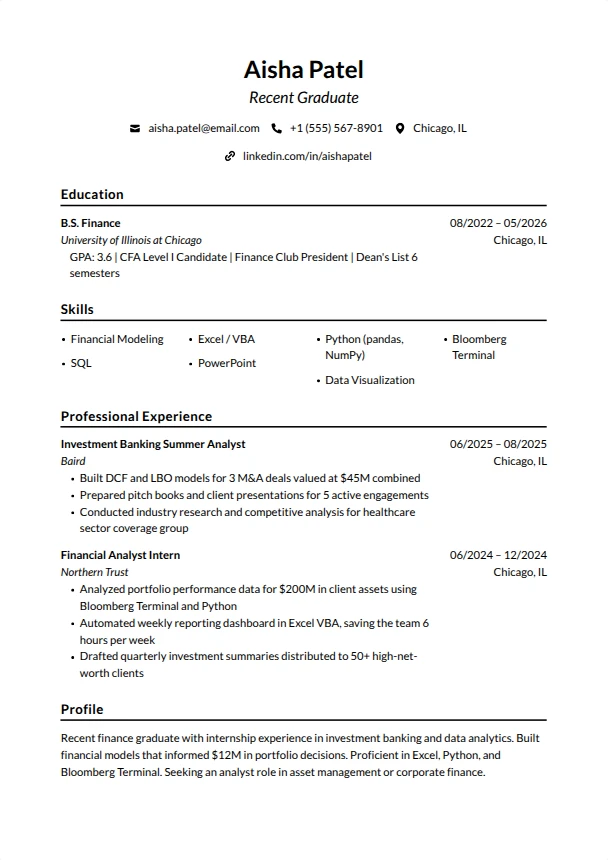
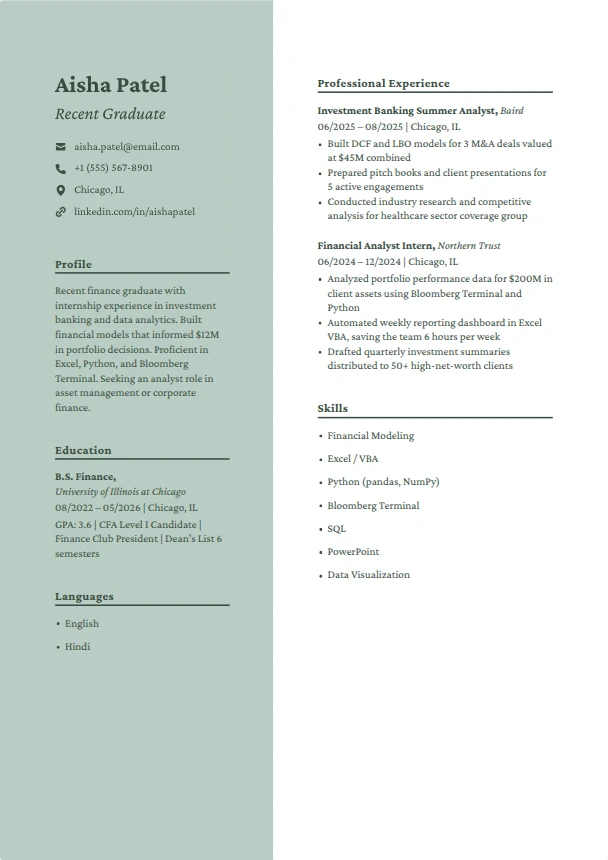
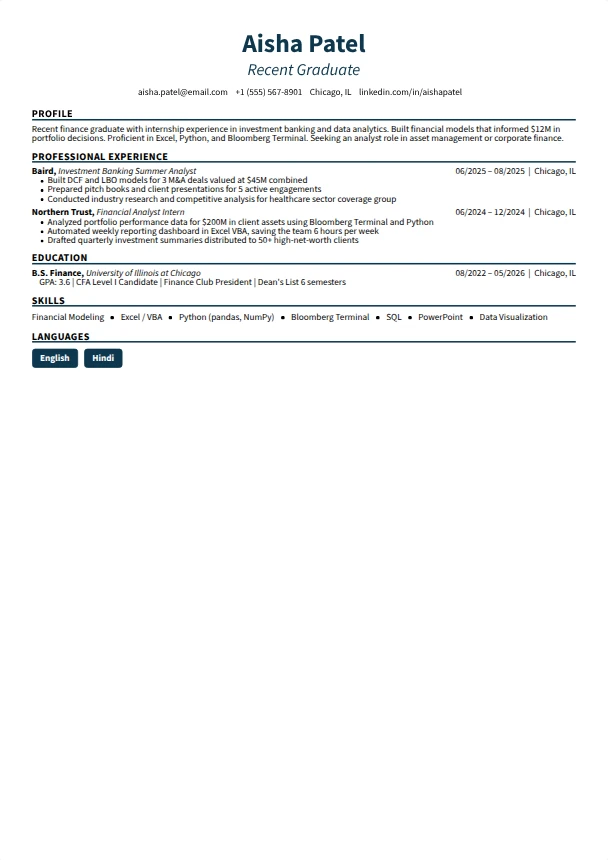
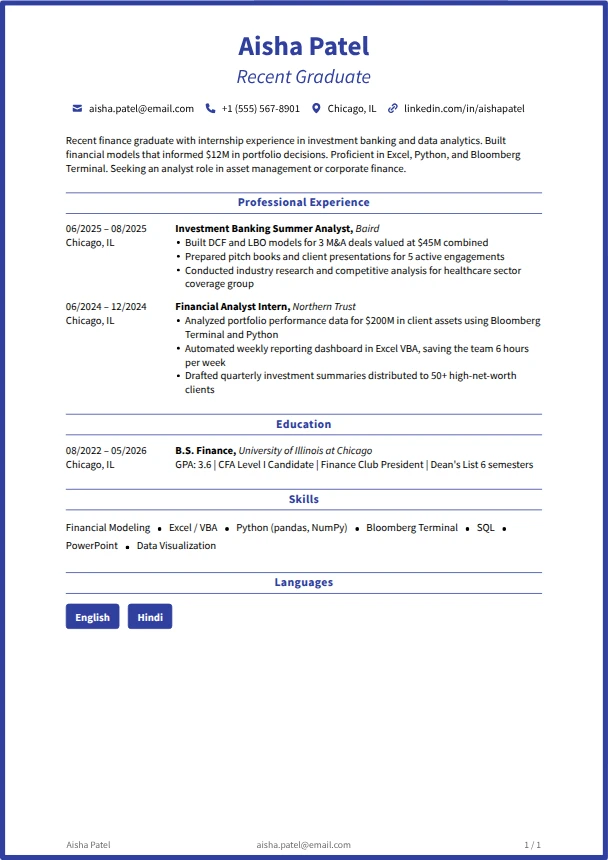
The order matters. Here's what a strong new grad resume looks like from top to bottom:
1. Contact header
Use a professional email (transition away from your .edu if it will expire). Include phone, city, LinkedIn, and portfolio or GitHub if relevant to your field.
Alexis Rivera · (555) 238-9014 · [email protected] · Denver, CO · linkedin.com/in/alexisrivera
2. Summary or objective
A summary works better than an objective for new grads because it positions you as someone with qualifications, not just ambitions. Lead with your degree, highlight your strongest achievement, and state your career direction.
Strong: "Recent B.S. in Computer Science graduate from Georgia Tech with a 3.6 GPA, specializing in machine learning and data engineering. Built an automated content recommendation system as a capstone project that processed 100,000 user interactions. Seeking a data engineer role where I can apply my skills in Python, SQL, and cloud infrastructure."
3. Education
Keep education prominent but start transitioning it downward if you have internship experience. Include your degree, university, graduation date, GPA, honors (cum laude, Phi Beta Kappa), and capstone or thesis title.
4. Skills
Be specific and industry relevant. Group skills logically and include both technical tools and professional competencies that employers in your field require.
Languages: Python · Java · SQL | Frameworks: React · Django · TensorFlow | Tools: AWS · Docker · Git | Methods: Agile · Test Driven Development · CI/CD
5. Experience / Activities / Projects
Lead with internships if you have them, followed by your capstone or thesis, then other relevant projects and campus leadership. Each entry should demonstrate professional caliber work with measurable outcomes.
Strong: "Software Engineering Intern, Acme Technologies (May to Aug 2025). Developed three RESTful API endpoints for the customer portal using Python and Flask, reducing page load time by 40%. Collaborated with a cross functional team of designers and product managers using Agile sprints. Wrote 85 unit tests achieving 92% code coverage for the authentication module."
6. Additional sections
Certifications carry significant weight for new grads. Include AWS, Google, Salesforce, or industry specific credentials. Also add publications, conference presentations, language fluencies, and any professional association memberships.
Key skills to include
As a new grad, your skills section bridges classroom knowledge and workplace readiness. Focus on tools and methodologies used in your target industry.
Tip: Prioritize skills that appear in multiple job postings for your target role. If 8 out of 10 data analyst postings mention SQL and Tableau, those skills should appear near the top of your list.
Resume summary examples you can steal
Use one as a starting point, then swap in your own technologies, numbers, and achievements.
"B.S. in Electrical Engineering from Purdue University, graduated cum laude with a 3.7 GPA. Completed a summer internship at Siemens designing circuit board layouts for industrial automation controllers. Proficient in AutoCAD, MATLAB, and PCB design. Seeking a full time hardware engineering role in manufacturing or energy."
Why it works: The internship with a recognized company, the cum laude distinction, and specific technical tools create a strong professional profile.
"Recent B.B.A. in Management from the University of Virginia with concentrations in strategy and analytics. Won second place in the Deloitte National Case Competition, analyzing a Fortune 500 supply chain challenge. Skilled in Excel modeling, data storytelling with Tableau, and client facing presentations. Pursuing an analyst role in management consulting."
Why it works: The case competition result with a named firm (Deloitte) and Fortune 500 context immediately communicates consulting readiness.
"B.S. in Chemistry from UC Davis with a 3.5 GPA and two semesters of undergraduate research in organic synthesis. Co-authored a paper submitted to the Journal of Organic Chemistry on novel catalytic methods. Experienced with NMR spectroscopy, HPLC, and wet lab techniques. Looking for a research scientist position in pharmaceuticals or materials science."
Why it works: A co-authored journal submission is a significant achievement for a new grad and demonstrates real research capability.
"B.A. in Political Science from NYU, Dean's List for six semesters. Interned at a policy research institute where I authored two published policy briefs on housing affordability. Strong writer and analytical thinker with experience in qualitative research methods, stakeholder interviews, and report development. Seeking a corporate affairs or government relations analyst role."
Why it works: Published policy briefs prove writing ability, and the specific research methods show analytical rigor that transfers to corporate roles.
Writing strong experience bullets
Every bullet point should answer: "What did you do, and why did it matter?" Use this formula:
Before and after examples:
Helped with the capstone project for my major.
Led the development of a capstone project building a mobile inventory management app, coordinating a four person team across 14 weekly sprints and delivering a fully functional prototype that the client department adopted for pilot testing.
Did marketing stuff during my internship.
Planned and executed a six week social media campaign during a marketing internship at BrightPath Inc., producing 24 content pieces across Instagram and LinkedIn that generated 15,000 impressions and a 4.2% engagement rate, exceeding the team target by 35%.
Wrote my thesis about something in economics.
Authored a 60 page senior thesis analyzing the economic impact of remote work adoption on suburban housing markets, using regression analysis on five years of Census Bureau data and presenting findings to a faculty committee of four professors.
Strong action verbs for new grad resumes:
Authored · Engineered · Implemented · Analyzed · Designed · Developed · Presented · Optimized · Researched · Deployed · Collaborated · Streamlined · Evaluated · Launched · Documented · Tested · Coordinated
7 mistakes that get new grad resumes rejected
Still writing like a student
Replace phrases like 'I learned about' or 'I was taught' with action oriented language. You did not just learn SQL in class. You built queries, analyzed datasets, and generated reports. Frame everything as accomplishment, not coursework.
Including irrelevant part time jobs with too much detail
Your barista job during sophomore year does not need four bullet points. Include it briefly to show work ethic, but dedicate most of your resume space to experiences relevant to your target career.
Using a student email that will expire
Many university email accounts deactivate after graduation. Switch to a permanent professional email before you start applying. Losing access to your contact email during a job search is a preventable disaster.
Neglecting to update your LinkedIn
Recruiters will check your LinkedIn profile after reading your resume. If your profile still says 'student' or lacks the experiences on your resume, it creates doubt. Keep both documents consistent and current.
Applying with a generic resume everywhere
New grads often send the same resume to 100 companies and wonder why they hear nothing back. Tailoring your summary, skills, and project emphasis to each specific role dramatically increases your response rate.
Listing graduation date in the future when you have already graduated
If you graduated in December 2025, your resume in 2026 should say 'December 2025,' not 'Expected December 2025.' Small inaccuracies raise questions about attention to detail.
Overloading the resume with soft skills
Phrases like 'team player' and 'strong communicator' without supporting evidence are filler. Either demonstrate these qualities through your experience bullets or replace them with specific, verifiable skills.
What to do if you have no professional experience
Graduating without internship experience puts you behind, but it does not disqualify you. Here is how to close the gap and build a competitive new grad resume:
Make your capstone or thesis the centerpiece
A well executed capstone project is your strongest substitute for internship experience. Describe the problem, your approach, the tools you used, and the results you achieved. If your project had a real client or partner organization, emphasize that connection. Treat it with the same seriousness you would give a job entry.
Pursue post graduation certifications immediately
While job searching, earn one or two industry certifications relevant to your target role. AWS Cloud Practitioner, Google Data Analytics, Salesforce Administrator, or PMP foundations courses all take 4 to 8 weeks and signal to employers that you are actively developing professional skills.
Freelance or volunteer in your field
Offer your skills to a local nonprofit, small business, or startup. Build a website, manage social media, analyze their data, or write content for them. Even a short engagement of two to four weeks gives you a professional experience entry with a real organization's name attached.
Reframe campus leadership as professional experience
If you were president of a student organization, managed a budget, organized events, led teams, or ran campaigns, describe those experiences using professional language. Replace 'club president' with 'Executive Director' or 'Organization Lead' and write bullet points that mirror job descriptions in your field.
Frequently asked questions
How soon after graduation should I start applying?
Start applying before you graduate if possible. Many employers recruit 3 to 6 months before start dates. If you have already graduated, begin immediately. The longer you wait, the harder it becomes to explain the gap. Job searching is a full time effort, so treat it like one.
Should I keep education at the top of my resume as a new grad?
If your education is your strongest section (high GPA, relevant thesis, honors), keep it near the top. If you have a solid internship or significant project experience, you can move education below your experience section. The strongest content should always be positioned first.
Is it worth applying for jobs that ask for 1 to 2 years of experience?
Yes. Many employers list 1 to 2 years as a preference, not a hard requirement. If you meet most of the other qualifications and can demonstrate relevant skills through projects or coursework, apply. The worst outcome is a no, which costs you nothing.
How do I explain my lack of internships in interviews?
Be honest and forward looking. You might have focused on academics, dealt with financial constraints, or simply not discovered your career direction until later. What matters is showing what you did instead, such as projects, coursework, campus leadership, or volunteer work, and demonstrating your readiness to contribute now.
Should I include my GPA six months after graduation?
If it is 3.0 or above, keep it on your resume for the first one to two years after graduation. After that, your work experience will carry more weight. If your GPA is below 3.0, leave it off and let your projects, skills, and experiences speak for themselves.
Skip the blank page
Open a complete, filled-in entry-level resume in our free builder. Swap in your own details, keep the wording that fits, and download as PDF, free.
Build your new grad resume now
Pick a professional template, position your degree and capstone project front and center, and create a resume that shows employers you are ready to contribute from day one.
Start Building, It's FreeRelated resume guides
Comprehensive resume guide for all recent graduates entering the workforce.
Resume advice for current college students pursuing internships and campus jobs.
General strategies for building a resume for your first professional role.
Specialized guidance for research positions and graduate school applications.
More resume examples: