What hiring managers actually look for
Recruiters reviewing college student resumes prioritize these qualities:
-
1
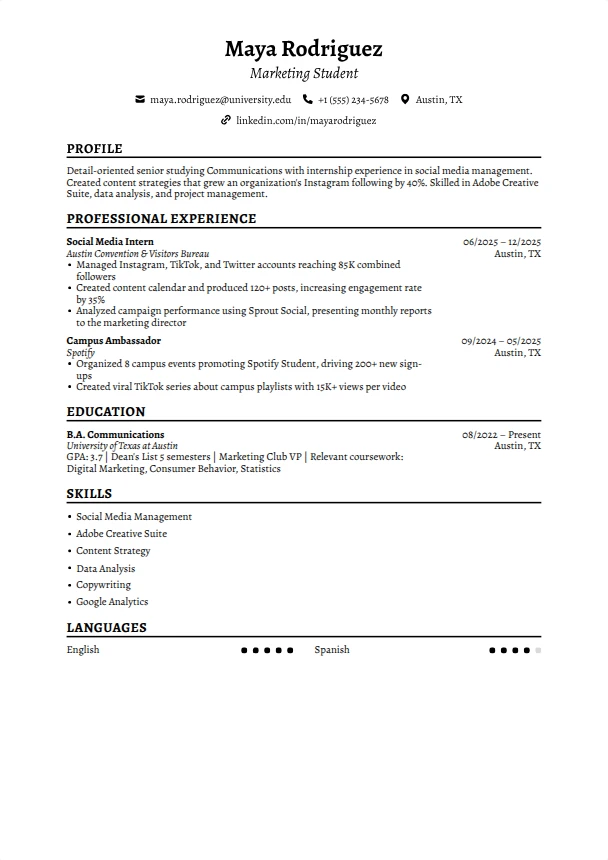
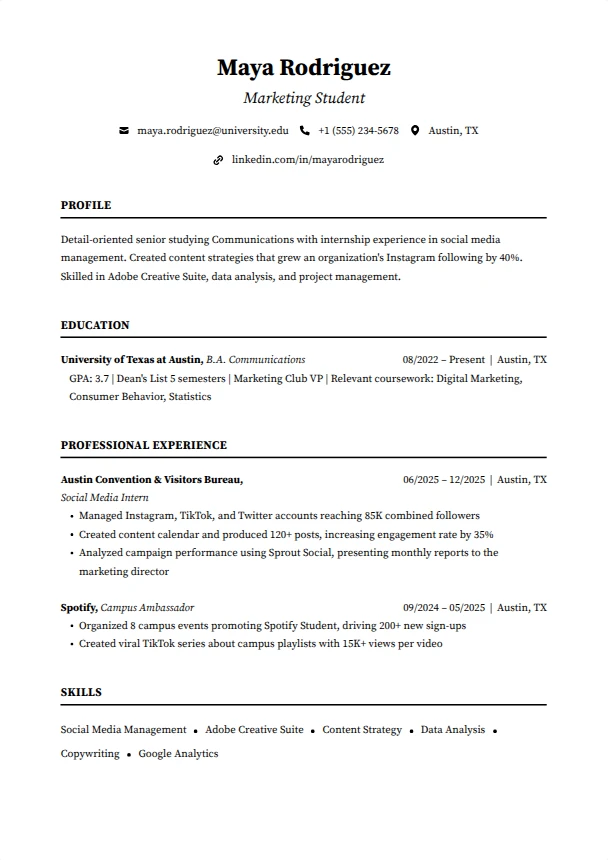
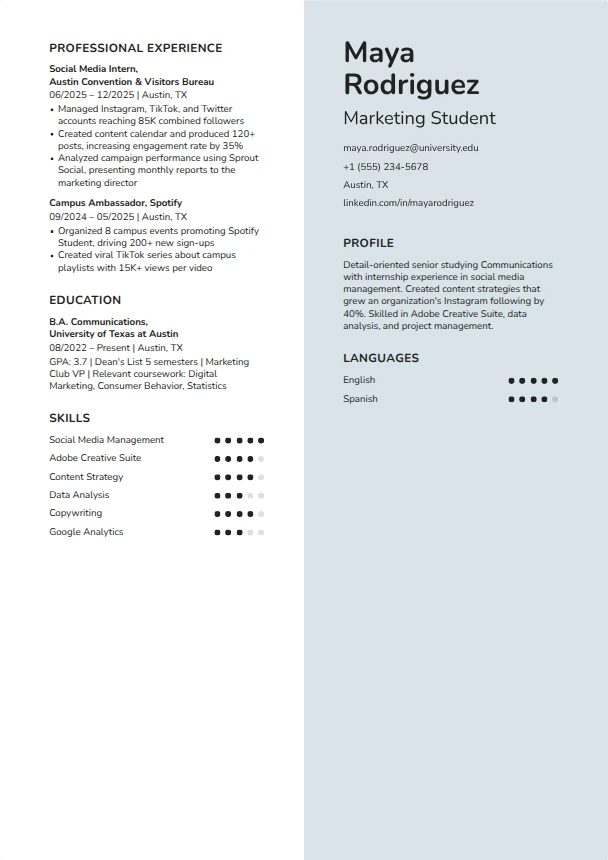
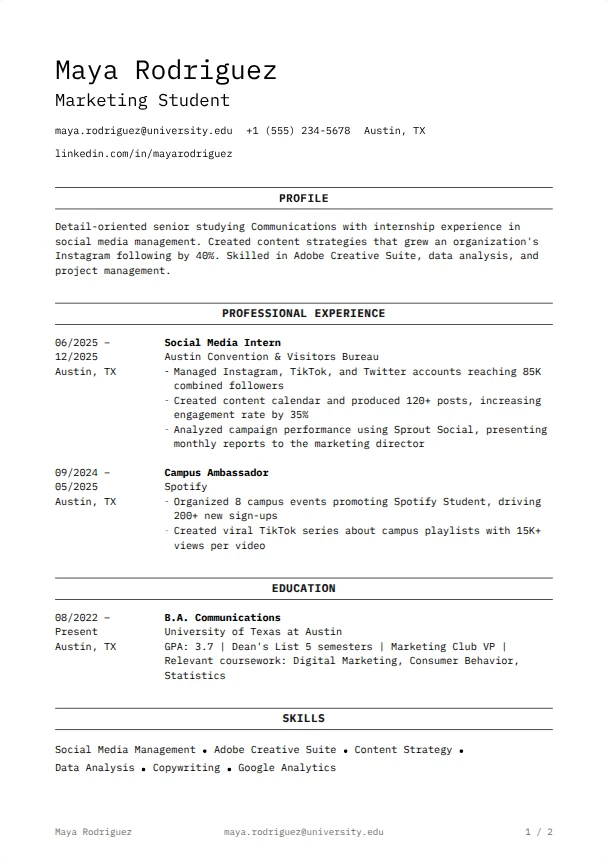
Relevant coursework signals preparedness. Listing courses that directly relate to the internship or job tells recruiters you already have foundational knowledge. A finance internship applicant who lists Financial Accounting, Statistics, and Corporate Finance immediately looks more prepared than one who lists only their major.
-
2
Campus leadership shows initiative beyond academics. Holding officer positions in student organizations, leading project teams, or organizing campus events demonstrates that you actively seek responsibility. Recruiters know that students who lead on campus tend to lead in the workplace.
-
3
Technical and software skills accelerate onboarding. Proficiency in industry tools like Excel, Python, Tableau, Adobe Creative Suite, or specialized platforms reduces the ramp up time for interns and part time hires. Recruiters favor candidates who can contribute quickly.
If your resume communicates these things in the first 7-second scan, you'll make it to the detailed read. Everything below is about making that happen.
How to structure your resume, section by section
The order matters. Here's what a strong college student resume looks like from top to bottom:
1. Contact header
Include your name, phone, professional email (your .edu email works well), city, and optionally a LinkedIn URL or portfolio link. If you are willing to relocate for an internship, mention that.
Priya Sharma · (555) 672-8901 · [email protected] · Chicago, IL · linkedin.com/in/priyasharma
2. Summary or objective
Tailor this to each application. Mention your major, year, one or two standout achievements, and what you are seeking. Keep it under three sentences.
Strong: "Junior marketing major at the University of Michigan with a 3.6 GPA, experienced in social media analytics and campaign strategy through managing a student organization's digital presence that grew followers by 45%. Seeking a summer marketing internship to apply data driven content skills."
3. Education
Place education near the top. Include your university, degree, expected graduation date, GPA (if 3.0+), Dean's List semesters, relevant coursework (4 to 6 courses), and any academic honors or scholarships.
4. Skills
Organize skills into categories if you have enough. Separate technical skills from soft skills or languages. Prioritize skills mentioned in the job description.
Technical: Python · SQL · Tableau · Excel (VLOOKUP, Pivot Tables) | Soft Skills: Public Speaking · Team Leadership · Project Management
5. Experience / Activities / Projects
List internships first if you have any, then campus jobs, then leadership roles in organizations, then significant class projects. Use bullet points with measurable results for each entry.
Strong: "Vice President of Marketing, University Marketing Association (Aug 2025 to Present). Planned and executed three professional development workshops with guest speakers from Nike, HubSpot, and a local agency, averaging 65 student attendees per event. Managed a committee of six students to coordinate logistics, promotion, and speaker outreach."
6. Additional sections
Consider adding a Projects section for significant coursework or personal projects, a Certifications section for Google Analytics, HubSpot, or AWS credentials, and a Volunteer section for community involvement. These add depth beyond the classroom.
Key skills to include
The right skills depend on your field, but these are commonly valued across internship and campus job postings in 2026.
Tip: Pair every technical skill with a context where you used it. 'Python' is good, but 'Python (built a web scraper for a data science course project)' is much more compelling to a recruiter.
Resume summary examples you can steal
Use one as a starting point, then swap in your own technologies, numbers, and achievements.
"Sophomore finance major at Boston University with a 3.5 GPA and Dean's List recognition for three consecutive semesters. Built financial models for two case competition entries and serve as treasurer for the Investment Club, managing a $3,000 operating budget. Seeking a summer analyst internship in corporate finance."
Why it works: It combines strong academics with practical application (case competitions, budget management) and states the exact role being targeted.
"Junior biology major with hands on laboratory experience in microbiology and organic chemistry. Completed an independent research project on antibiotic resistance patterns, presenting findings at the university's undergraduate research symposium. Looking for a research assistant position to deepen skills in experimental design and data analysis."
Why it works: Mentioning the symposium presentation proves the student went beyond coursework requirements, and the specific research topic adds credibility.
"Junior English major and experienced peer tutor at the university writing center, providing feedback on over 120 student papers across disciplines. Strong communicator with the ability to explain complex concepts clearly. Seeking a campus administrative role that values writing, organization, and attention to detail."
Why it works: The 120 papers figure quantifies tutoring experience, and the connection between writing skills and administrative work is clear.
"Mechanical engineering junior with SolidWorks and MATLAB proficiency, developed through coursework and a semester long capstone project designing a low cost prosthetic hand prototype. Team lead for a five person project group that presented to a panel of industry engineers. Seeking a co-op position in product development or manufacturing."
Why it works: The capstone project provides concrete technical experience, and the leadership role and industry presentation add professional exposure.
Writing strong experience bullets
Every bullet point should answer: "What did you do, and why did it matter?" Use this formula:
Before and after examples:
Was on the event planning committee for the business fraternity.
Chaired the event planning committee for Alpha Kappa Psi, organizing a professional networking night with 12 company representatives and 85 student attendees that generated 30 follow up informational interviews.
Did a group project in my data science class.
Developed a predictive analytics model in Python using a 50,000 row sales dataset for a data science course project, achieving 89% accuracy in quarterly revenue forecasting.
Worked at the campus recreation center.
Supervised facility operations at the campus recreation center during peak evening hours, managing equipment checkout for 60 daily users and resolving scheduling conflicts for court and field reservations.
Strong action verbs for college student resumes:
Developed · Analyzed · Coordinated · Presented · Managed · Designed · Implemented · Researched · Organized · Facilitated · Led · Authored · Evaluated · Streamlined · Trained · Collaborated · Built
7 mistakes that get college student resumes rejected
Burying your education at the bottom
As a current student, your education is your primary qualification. Place it near the top of your resume, right after your summary. Save the bottom placement for after you have several years of professional experience.
Listing club memberships without context
Writing 'Member, Psychology Club' tells a recruiter nothing. Describe what you did in the organization. Did you plan events, lead discussions, manage a budget, recruit members? Specifics make the difference.
Using your high school information
Once you are in college, remove high school details unless an achievement is truly exceptional (like a national award). College coursework and activities carry more weight for internship applications.
Ignoring keywords from the job posting
Many companies use applicant tracking systems to filter resumes. If the posting mentions 'data visualization' and you list 'making charts,' your resume might not pass the initial screen. Use the exact terminology from the posting.
Skipping the relevant coursework section
Recruiters cannot guess what you have studied. Listing 4 to 6 courses relevant to the position fills knowledge gaps and signals that you are academically prepared for the role.
Having an inconsistent format
Mixing date formats, alternating between bold and italic headers, and using different bullet styles make your resume look careless. Pick one format and apply it consistently throughout.
Not tailoring for each application
A marketing internship resume should look different from a campus library job resume. Adjust your summary, skills, and highlighted experiences to match each specific opportunity.
What to do if you have no professional experience
Many college students apply for their first internship without any prior work experience. Here is how to make your resume competitive:
Feature class projects prominently
A well executed group project with deliverables, data, and results functions like a mini work experience. Describe the project scope, your specific contribution, tools used, and the outcome. Treat it with the same detail you would give a job.
Leverage campus organizations for leadership experience
Join a club and volunteer for a committee or officer role. Even serving as social media coordinator for a small club gives you content creation, audience analytics, and scheduling experience that translates directly to professional roles.
Start a personal project in your field
Build a portfolio website, conduct an independent data analysis, write a blog about industry trends, or contribute to an open source project. Self initiated work demonstrates passion and capability beyond what a transcript can show.
Use campus career resources aggressively
Visit your career center for resume reviews, attend employer info sessions, and participate in career fairs. Many campuses also offer micro internships and job shadowing programs that take just a few hours and add real content to your resume.
Frequently asked questions
Should I use my university email or personal email on my resume?
Your .edu email is a solid choice because it immediately confirms your student status. However, make sure you check it regularly. If you prefer using a personal email, ensure it is a simple, professional format like [email protected].
How should I list a current degree that I have not finished yet?
Write your degree as 'Bachelor of Science in Computer Science, Expected May 2027' with your university name. Include your current GPA, completed relevant coursework, and any academic honors received so far.
Is it better to list relevant coursework or skills?
Include both. Relevant coursework shows academic preparation, while skills demonstrate practical capabilities. They serve different purposes and together give the recruiter a fuller picture of your qualifications.
Should I include part time jobs unrelated to my major?
Yes, if you can highlight transferable skills. A server position demonstrates customer service, multitasking, and working under pressure. A campus mail room job shows reliability and attention to detail. Frame any job through the lens of what it taught you.
How do I handle gaps between semesters on my resume?
Summer and winter breaks are expected in a college student's timeline, so they are not truly gaps. If you did something productive during a break (volunteered, took online courses, traveled for study abroad), include it. If not, do not worry. Recruiters understand academic calendars.
Skip the blank page
Open a complete, filled-in entry-level resume in our free builder. Swap in your own details, keep the wording that fits, and download as PDF, free.
Build your college student resume now
Pick a template designed for students, add your coursework and campus experiences, and download a polished resume ready for internship applications.
Start Building, It's FreeRelated resume guides
Broader guide covering resume writing for all college students and recent graduates.
Resume advice for recent graduates transitioning from campus to the professional workforce.
Specialized guidance for research focused and graduate school applications.
General strategies for landing your first professional role across any industry.
More resume examples: