What hiring managers actually look for
Civilian hiring managers reviewing military resumes without civilian experience are looking for three things, and they need to find them without a military glossary:
-
1
Translated job titles and responsibilities. A civilian recruiter does not know what an E-6 or a 25B does. Your resume needs to translate every title into a civilian equivalent. '25B Information Technology Specialist, U.S. Army' becomes 'IT Systems Administrator.' 'E-6 Staff Sergeant' becomes 'Team Lead supervising 12 personnel.' Do the translation for them.
-
2
Quantified leadership and operational scope. Military experience often involves managing more people, more equipment, and higher-stakes operations than comparable civilian roles. This is your advantage, but only if you quantify it. Include team sizes, equipment values, budget responsibilities, and operational outcomes with specific numbers.
-
3
Relevant certifications and clearance status. Security clearances, military certifications, and specialized training are extremely valuable in both federal and private sector roles. An active Secret or Top Secret clearance can be worth $10K-$20K in additional salary. Always include your clearance level, investigation date, and any industry-recognized certifications earned during service.
If your resume communicates these things in the first 7-second scan, you'll make it to the detailed read. Everything below is about making that happen.
How to structure your resume, section by section
The order matters. Here's what a strong military-to-civilian resume (no experience) looks like from top to bottom:
1. Contact information
Full name, city and state (or full address for federal applications), phone, email, LinkedIn. Include your clearance status and veterans' preference eligibility prominently. If you are still on active duty, include your expected separation date.
Anthony Rivera
4210 Veterans Blvd, San Antonio, TX 78229
(555) 703-8456 · [email protected] · linkedin.com/in/arivera-vet
U.S. Citizen · Veterans' Preference: 5-Point · Secret Clearance (active, 2022)
Separation Date: May 2026 (available for employment June 2026)
2. Professional summary (3-4 sentences)
Lead with your total years of military service, translated job title, and your strongest quantified achievement. Name the civilian role you are targeting. Do not use military acronyms, rank abbreviations, or jargon without translation.
Strong: "Logistics and supply chain manager with 6 years of U.S. Army experience overseeing inventory, distribution, and transportation operations for units of 200-500 personnel. Managed $15M in equipment inventory with 99.5% accountability across 3 deployment cycles. OSHA 30 certified with an active Secret clearance. Seeking a Logistics Coordinator or Supply Chain Analyst position in the defense contracting or federal civilian sector."
3. Military experience (translated format)
List your military service in reverse chronological order. For each entry, provide your civilian-equivalent title first, followed by your military title in parentheses. Include your unit, duty station, dates, and 4-6 translated accomplishment bullets. Avoid acronyms entirely or define them on first use.
Strong: "Logistics Manager (92A Automated Logistical Specialist)<br>U.S. Army, 3rd Infantry Division, Fort Stewart, GA<br>August 2020 to Present · 50+ hours/week<br><br>• Managed inventory tracking and distribution for $15M in organizational equipment across a 500-person infantry battalion, maintaining 99.5% accountability during 2 overseas deployments.<br>• Supervised 8 supply clerks and warehouse personnel, conducting weekly training on inventory management systems (GCSS-Army) and physical inventory procedures.<br>• Processed 300+ supply requests per month, coordinating with 5 supporting units to fulfill equipment and consumable needs within 72-hour delivery windows."
4. Certifications, training, and clearance
Military service generates certifications and training that civilian employers value. List security clearances first (with investigation date), then industry-recognized certifications, then relevant military training translated into civilian terms.
Security Clearance: Secret (active, investigated 2022)
Certifications: OSHA 30-Hour General Industry (2024) · Hazmat Shipping & Handling (2023) · Forklift Operator (2021)
Military Training: Advanced Leaders Course (equivalent to mid-level management training) · Combat Lifesaver (equivalent to EMT-Basic first aid)
5. Education
List any degree, military education converted to college credits through the American Council on Education (ACE), and any in-progress education. Include your Joint Services Transcript credit total if you have not yet completed a degree.
Associate of Applied Science, Logistics Management
Central Texas College (online), Killeen, TX · Expected December 2026
42 credits completed, including 18 ACE-recommended military training credits
Additional: 68 ACE-recommended credits from Army training (Joint Services Transcript)
Key skills to include
These are the most in-demand civilian skills that translate directly from military experience. List only the ones relevant to your target role and use civilian terminology throughout.
Tip: Use the Military-to-Civilian Occupation Translator on O*NET or the Department of Labor's My Next Move for Veterans tool to find the exact civilian job titles and skill keywords that match your MOS. Then use those exact words on your resume.
Resume summary examples you can steal
Use one as a starting point, then swap in your own technologies, numbers, and achievements.
"Logistics and supply chain professional with 6 years of U.S. Army experience managing inventory, distribution, and transportation for units of 200-500 personnel across 3 deployment locations. Maintained 99.5% accountability for $15M in equipment. Supervised 8 warehouse and supply personnel, trained 25+ soldiers on inventory management systems. OSHA 30 certified, active Secret clearance. Targeting Supply Chain Analyst and Logistics Coordinator positions."
Why it works: Translates MOS into civilian role title, quantifies scope and accountability, includes clearance and civilian certifications.
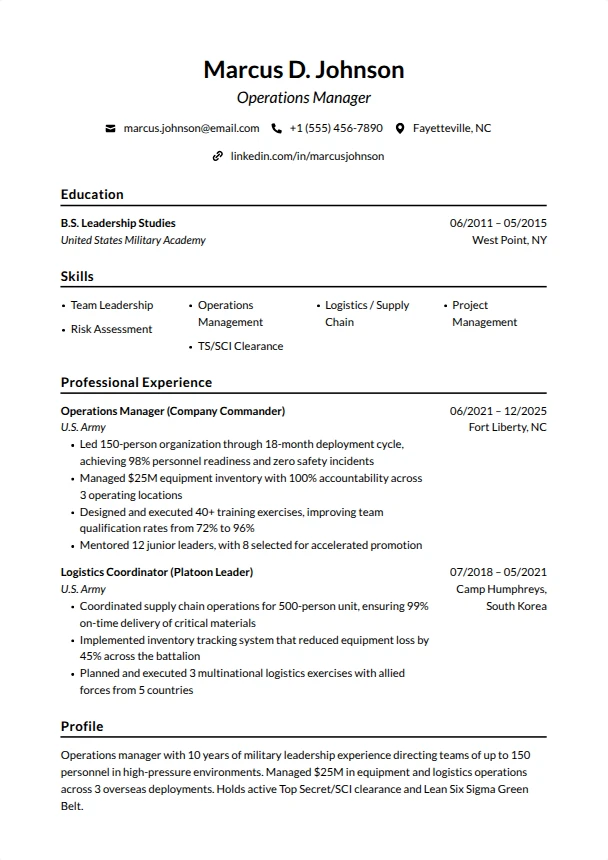
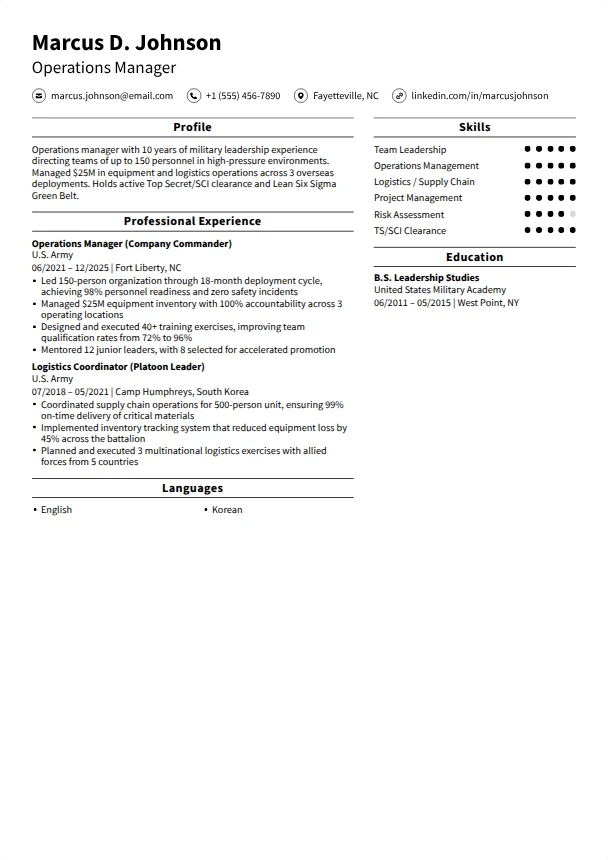
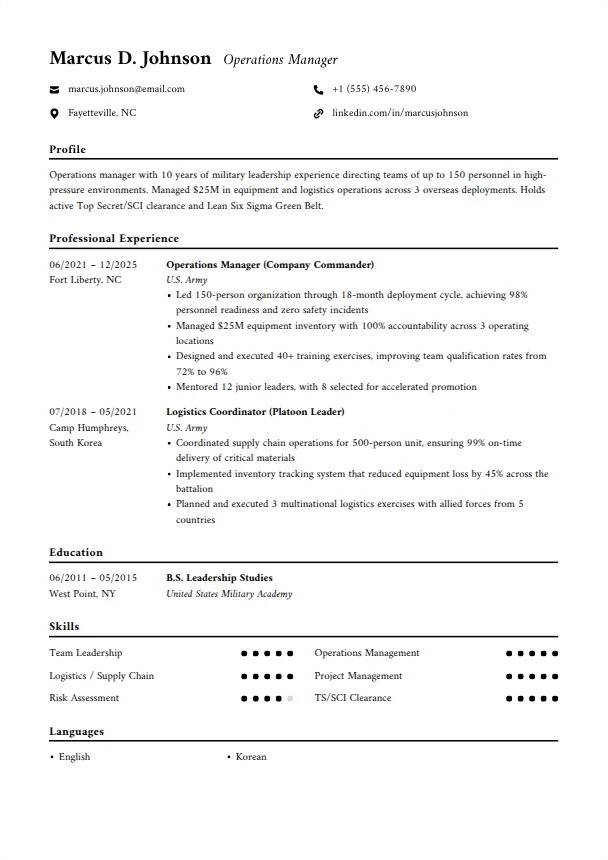
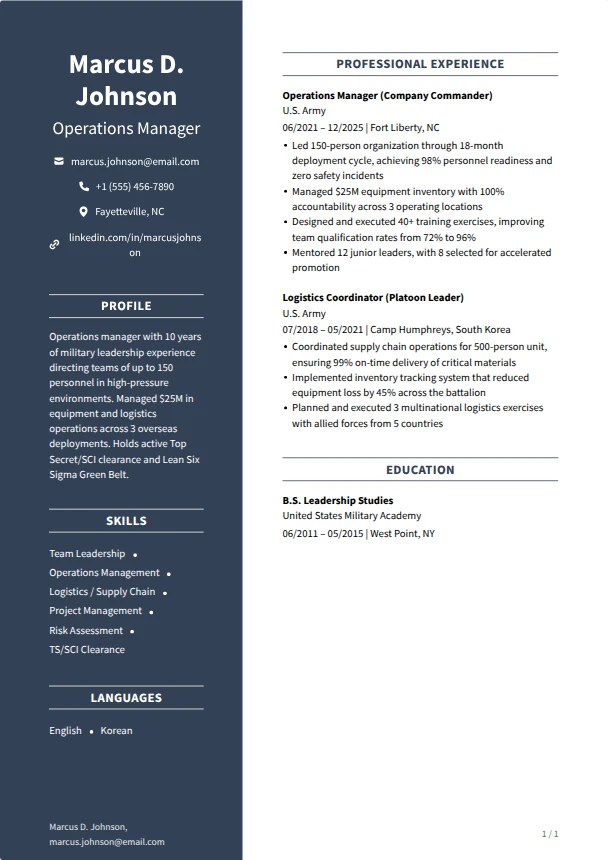
"Operations manager with 5 years of U.S. Marine Corps leadership experience directing teams of 13-40 personnel in high-pressure environments. Planned and executed 50+ training exercises and 2 overseas deployments, coordinating logistics, scheduling, and resource allocation for 200+ personnel. Achieved the highest readiness rating in the battalion for 3 consecutive evaluation cycles. Seeking Operations Manager or Program Coordinator roles in the private sector."
Why it works: Avoids all military jargon, translates infantry leadership into operations management language, quantifies team and operational scale.
"Cybersecurity and IT systems specialist with 4 years of U.S. Air Force experience managing network security for classified and unclassified environments supporting 800+ users. Monitored network traffic, investigated 150+ security incidents, and implemented access controls across 3 installations. CompTIA Security+ and CySA+ certified with an active Top Secret/SCI clearance. Targeting GS-9 Information Security Specialist (2210 series) positions."
Why it works: Leads with civilian-equivalent title, includes clearance level valued in federal IT, targets specific GS grade and series.
"Administrative and personnel management professional with 6 years of U.S. Navy experience managing records, pay, and benefits processing for a 180-sailor division. Processed 500+ personnel actions per year including transfers, promotions, and separations with 99% accuracy. Trained 4 junior administrators on Navy personnel systems. Honorable Discharge, eligible for veterans' preference. Targeting Administrative Analyst positions with the state Department of Veterans Affairs."
Why it works: Translates Navy yeoman experience into administrative analyst language, quantifies personnel action volume, targets a veteran-friendly agency.
Writing strong experience bullets
Every bullet point should answer: "What did you do, and why did it matter?" Use this formula:
Before and after examples:
Responsible for property book accountability for BN-level equipment as 92A.
Managed inventory tracking and accountability for $15M in organizational equipment across a 500-person infantry battalion, conducting monthly inventories and achieving 99.5% accountability during 2 overseas deployment cycles.
Led a squad of 13 Marines during training and deployments.
Supervised a 13-person team during 50+ training exercises and 2 overseas deployments, coordinating daily schedules, performance evaluations, and resource allocation. Achieved the highest readiness rating in the battalion for 3 consecutive evaluation periods.
Monitored network security for the base and responded to incidents.
Monitored network security for classified and unclassified environments supporting 800+ users across 3 Air Force installations, investigating 150+ security incidents annually and implementing access control changes that reduced unauthorized access attempts by 40%.
Strong action verbs for military-to-civilian resume (no experience) resumes:
Administered · Coordinated · Directed · Executed · Implemented · Led · Maintained · Managed · Monitored · Operated · Organized · Planned · Processed · Supervised · Trained · Tracked · Verified · Assessed
5 mistakes that get military-to-civilian resume (no experience) resumes rejected
Using military acronyms and jargon without translation
MOS, TIS, PCS, BN, HHC, GCSS-Army, NCOER, DD-214. None of these mean anything to a civilian recruiter. Translate every term. If you must reference a military-specific system, explain it: 'GCSS-Army (enterprise logistics management system equivalent to SAP).'
Leading with your rank instead of your role
Civilian hiring managers do not understand E-5, O-3, or SSgt. Lead with your civilian-equivalent job title: 'Logistics Manager,' 'IT Systems Administrator,' 'Operations Supervisor.' You can include your rank in parentheses for context, but the civilian title must come first.
Describing duties instead of accomplishments
Military evaluations are written in a duties-first format, but civilian resumes need accomplishments. Instead of 'Responsible for supply operations for BN,' write 'Managed $15M equipment inventory for a 500-person battalion, achieving 99.5% accountability.' Every bullet needs a number and an outcome.
Omitting your security clearance and certifications
An active security clearance is one of the most valuable assets you carry out of the military. Top Secret/SCI clearances take 6-12 months and thousands of dollars for an employer to sponsor. Include your clearance level, investigation date, and status prominently near the top of your resume.
Not using veteran-specific hiring resources
USAJOBS has a veterans' preference filter. Many state governments offer veterans' hiring points on civil service exams. Large private sector employers have veteran hiring programs. If you are not using veterans' preference, Hiring Our Heroes, and the VOW Act provisions in your job search, you are leaving advantages on the table.
What to do if you have no professional experience
Having no civilian experience does not mean starting from zero. Military service provides more transferable experience than most civilian jobs. Here is how to leverage it:
Use the DOL Military-to-Civilian translator to find your target roles
The Department of Labor's My Next Move for Veterans tool (mynextmove.org/vets) converts your military occupation code into matching civilian job titles with salary data and growth projections. Start here to identify which civilian roles your experience qualifies you for, then use those exact job titles in your resume summary.
Apply for federal positions using veterans' preference
Veterans with an honorable discharge receive 5-point preference on federal applications. Disabled veterans receive 10-point preference. Some positions are filled exclusively through veterans' hiring authorities (VRA, VEOA). Apply through USAJOBS with the veterans' filter enabled to find positions where your preference gives you a significant competitive advantage.
Leverage your SkillBridge or transition assistance program
DOD SkillBridge allows active-duty service members in their last 180 days to participate in civilian internships with approved employers. If you are still serving, apply for a SkillBridge fellowship in your target industry. This gives you civilian work experience on your resume before you even separate. Check the SkillBridge database for participating companies.
Convert military training to civilian certifications
Many military training courses have civilian equivalents. Army logistics training maps to APICS CSCP. Military IT certifications (CompTIA Security+ required for DoD 8570) are directly recognized in the civilian market. Request your Joint Services Transcript to see your ACE-recommended college credits, and check whether your training qualifies you for civilian certifications through reciprocity.
Frequently asked questions
How do I translate my MOS or military job code to a civilian resume?
Use the Department of Labor's My Next Move for Veterans tool (mynextmove.org/vets) or O*NET's Military Crosswalk. Enter your military occupation code and the tool will show matching civilian job titles, required skills, and salary ranges. Use those civilian job titles and skill keywords directly on your resume.
Should I include my DD-214 information on my resume?
Include your branch, years of service, discharge type (Honorable Discharge), and veterans' preference eligibility on your resume. Do not attach your actual DD-214 unless specifically requested. For federal applications, you will upload your DD-214 separately through the USAJOBS application portal.
How do I list my security clearance on a civilian resume?
Place it prominently in your header or near the top of your resume. Include the clearance level (Secret, Top Secret, Top Secret/SCI), the investigation date, and the status (active or inactive). If your clearance is still active, this is a major competitive advantage, so do not bury it at the bottom of the page.
Is a one-page resume enough for military-to-civilian transition?
For private sector applications, aim for 1-2 pages. Four years of military service can typically fit on one well-formatted page. For federal applications through USAJOBS, 3-5 pages is standard because of the additional detail requirements (hours per week, supervisor contacts, full addresses). Match the format to the application type.
What are the best industries for transitioning military members?
Defense contracting, federal government, logistics and supply chain, information technology, project management, and law enforcement consistently hire the most transitioning veterans. Your specific MOS determines which industries value your experience most. Use the DOL translator tool to find the closest matches, then target companies with established veteran hiring programs.
Skip the blank page
Open a complete, filled-in veteran-to-civilian resume in our free builder. Swap in your own details, keep the wording that fits, and download as PDF, free.
Build your military-to-civilian resume (no experience) in minutes
Pick a template, fill in your details, and download a polished military-to-civilian resume (no experience) ready to submit.
Start Building, It's FreeRelated resume guides
Complete guide to translating military experience for civilian resumes, including MOS conversion and clearance formatting.
USAJOBS guide for first-time federal applicants, covering Pathways, GS qualification, and veterans' preference.
Broader guide covering federal, state, and local government entry points for candidates with no public sector history.
More resume examples: