What hiring managers actually look for
Hospital recruiters reviewing no-experience applicants look for three things:
-
1
BLS/CPR and HIPAA certifications. These are baseline requirements for nearly every hospital role. Having them before you apply shows initiative and removes the most common disqualification. They cost less than $100 combined and take one to two days.
-
2
Customer service and data accuracy skills. Most entry-level hospital jobs involve patient interaction and computer systems. If you have retail, call center, or office experience, you already have transferable skills. Frame them using healthcare language.
-
3
Schedule flexibility and reliability. Hospitals run 24/7. Applicants who can work evenings, weekends, and holidays have a significant advantage. If you are flexible on scheduling, say so in your summary or cover letter.
If your resume communicates these things in the first 7-second scan, you'll make it to the detailed read. Everything below is about making that happen.
How to structure your resume, section by section
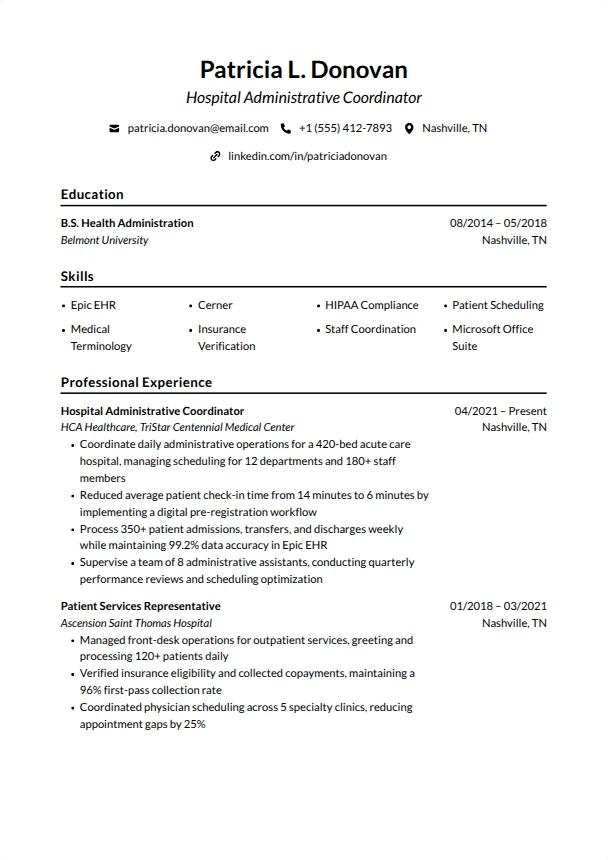
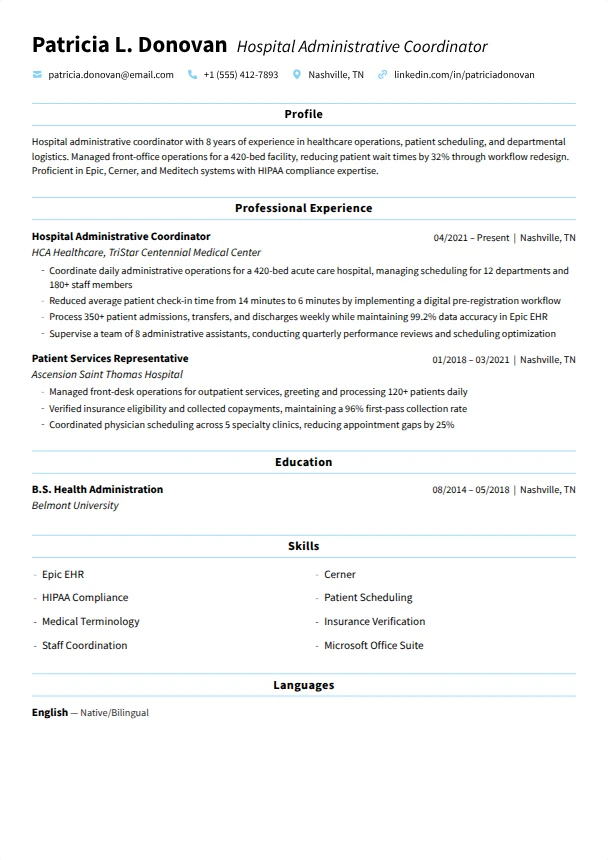
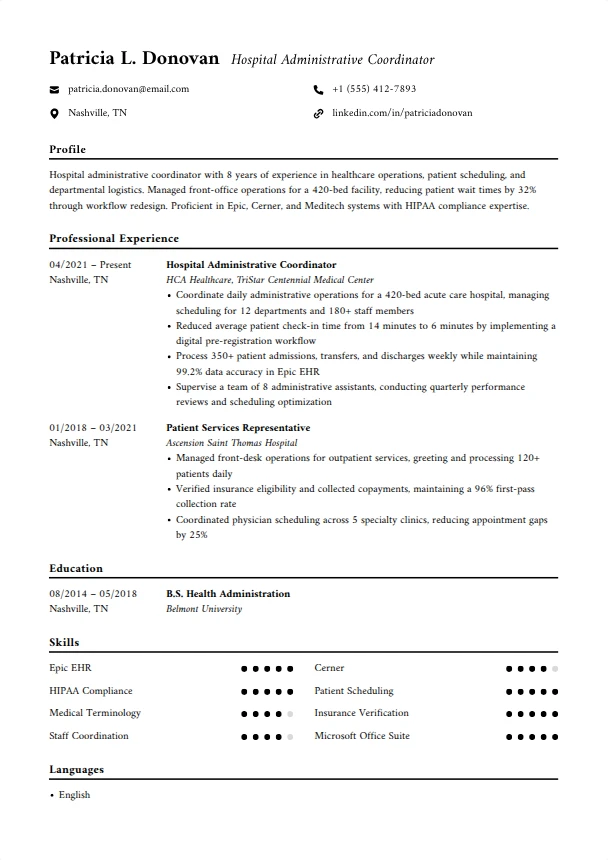
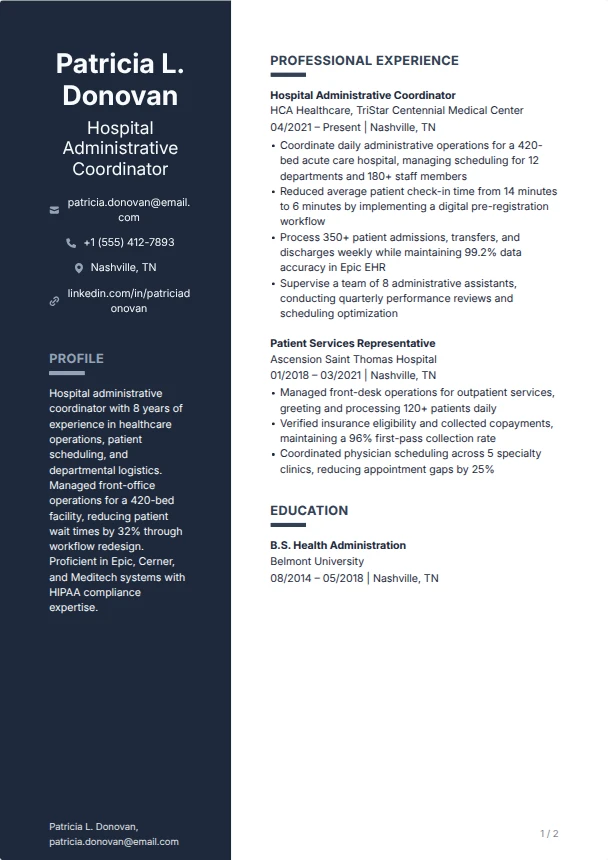
The order matters. Here's what a strong hospital resume (no experience) looks like from top to bottom:
1. Contact header
Name, email, phone, location (city + state). Keep it simple and professional.
2. Professional summary (2-3 sentences)
Lead with your strongest transferable skills and any healthcare certifications you have earned. Show that you understand the hospital environment.
Strong: "BLS-certified professional with 3 years of customer service experience in high-volume retail. Process 200+ transactions daily with 99% accuracy. Completed HIPAA compliance training and medical terminology coursework. Available for all shifts including evenings and weekends."
3. Certifications and training
Even without healthcare experience, you can list BLS/CPR, HIPAA training, medical terminology courses, and any First Aid credentials.
BLS/CPR (AHA, 2026) · HIPAA Compliance (online, 2026) · Medical Terminology (community college, 2025)
4. Skills
Focus on transferable skills that hospitals value: data entry accuracy, customer interaction, scheduling, Microsoft Office, phone systems, and multi-tasking under pressure.
Technical: Microsoft Office, data entry (60+ WPM), multi-line phone systems
Customer-Facing: Patient greeting, conflict resolution, queue management
Compliance: HIPAA, BLS/CPR, confidential records handling
5. Work experience
List your non-healthcare experience but reframe it using healthcare-adjacent language. Focus on volume metrics, accuracy rates, and customer interaction skills.
Strong: "Processed 200+ customer transactions daily with 99.2% accuracy in a high-volume retail environment. Resolved 15+ customer complaints per week while maintaining a 4.8/5.0 satisfaction rating."
Key skills to include
These transferable skills are valued across entry-level hospital roles. Include the ones you can demonstrate from prior work or training.
Tip: Read the job posting carefully and mirror their exact language for skills. If they say 'patient registration,' use that phrase instead of 'check-in' or 'intake.'
Resume summary examples you can steal
Use one as a starting point, then swap in your own technologies, numbers, and achievements.
"BLS-certified professional with 3 years of high-volume retail experience. Process 200+ transactions daily with 99% accuracy using POS and inventory systems. Completed HIPAA and medical terminology training. Seeking a patient access representative role where customer service skills translate directly to patient interaction."
Why it works: Quantifies retail pace, shows healthcare preparation through certifications, and names the target role.
"Customer service representative with 2 years of experience handling 80+ inbound calls daily in a fast-paced call center. Maintained 95% quality assurance scores and resolved escalated complaints within one business day. BLS certified with HIPAA training. Available for all shifts."
Why it works: Call volume and quality scores transfer directly to hospital phone-based roles.
"Health administration graduate with BLS certification and 120 hours of hospital volunteer experience in patient transport and information services. Proficient in Microsoft Office, medical terminology, and HIPAA compliance. Dean's list for 4 consecutive semesters."
Why it works: Degree relevance, volunteer hours in a hospital, and academic achievement.
"Former office manager transitioning to hospital administration with newly completed BLS and HIPAA certifications. Managed scheduling for 25 employees, processed 500+ daily transactions, and maintained confidential personnel records for 5 years. Strong proficiency in Excel, databases, and multi-line phone systems."
Why it works: Office management skills are directly transferable to hospital admin, with new healthcare credentials.
Writing strong experience bullets
Every bullet point should answer: "What did you do, and why did it matter?" Use this formula:
Before and after examples:
Helped customers at the register.
Processed 200+ customer transactions daily with 99.2% accuracy, handling cash, credit, and insurance-adjacent payment methods in a high-volume retail pharmacy.
Answered phones and took messages.
Managed 80+ inbound calls daily on a multi-line phone system, triaging inquiries, scheduling appointments, and escalating urgent requests within established response time targets.
Filed paperwork and did data entry.
Maintained confidential records for 500+ clients in a database system, entering data at 65+ WPM with 99% accuracy and ensuring compliance with privacy regulations.
Strong action verbs for hospital resume (no experience) resumes:
Processed · Managed · Scheduled · Verified · Maintained · Greeted · Resolved · Triaged · Documented · Coordinated · Filed · Handled · Organized · Entered · Communicated
5 mistakes that get hospital resume (no experience) resumes rejected
Not getting BLS/CPR before applying
It costs $60 and takes one day. Applying to hospital jobs without BLS is like applying to a driving job without a license. Get it first.
Using non-healthcare language for transferable skills
Replace 'customer' with 'patient,' 'checkout' with 'registration,' and 'complaint resolution' with 'patient concern resolution.' The skills are the same, but the language matters for ATS matching.
Leaving the summary generic
Do not write 'hard worker seeking hospital job.' Write a specific summary that names your certifications, quantifies your prior work pace, and states your schedule availability.
Not mentioning schedule flexibility
Hospitals need staff around the clock. If you can work nights, weekends, or holidays, say so explicitly. It is a real competitive advantage for entry-level applicants.
Applying to clinical roles without clinical credentials
Patient access, unit secretary, and medical records roles are realistic entry points. CNA, MA, and nursing roles require specific certifications. Target the right roles for your current qualifications.
What to do if you have no professional experience
You do not need healthcare experience to start working in a hospital. Here is how to prepare:
Get BLS certified and complete HIPAA training
BLS from the American Heart Association ($60, one day) and free online HIPAA courses are the two fastest ways to make your resume hospital-ready.
Take a medical terminology course
Community colleges and online platforms offer medical terminology courses for $50 to $200. This knowledge helps you understand hospital communication and is a resume differentiator.
Volunteer at a hospital
Most hospitals have volunteer programs. Even 2 to 3 months of volunteering gives you hospital environment exposure and a real entry on your resume.
Target patient access and unit secretary roles
These positions are the most common entry points into hospitals for people without healthcare backgrounds. They value customer service skills, data accuracy, and reliability over clinical knowledge.
Frequently asked questions
Can I get a hospital job with no healthcare experience?
Yes. Hospitals employ thousands of non-clinical workers in patient access, health information management, environmental services, food services, and administration. These roles require customer service skills and computer proficiency, not clinical training.
What certifications should I get before applying?
BLS/CPR from the American Heart Association and HIPAA compliance training are the two most important. Medical terminology coursework is a bonus. All three combined cost under $200 and take less than a week.
How do I explain no healthcare experience in an interview?
Focus on transferable skills: customer interaction, data accuracy, handling confidential information, working under pressure, and schedule flexibility. Mention any healthcare certifications you have earned to show commitment.
What is the easiest hospital job to get?
Patient access representative, unit secretary, environmental services, and food services are typically the most accessible. These roles have the lowest barrier to entry and offer internal transfer opportunities once you are in the system.
Do hospitals promote from within?
Many hospitals prefer internal candidates for higher-level roles. Starting in an entry-level position gives you access to tuition reimbursement, internal job postings, and networking with hiring managers across departments.
Skip the blank page
Open a complete, filled-in CNA resume in our free builder. Swap in your own details, keep the wording that fits, and download as PDF, free.
Build your hospital resume now
Pick a clean template, add your BLS certification and transferable skills, and download a polished PDF in minutes. Free, no account required.
Start Building, It's FreeRelated resume guides
Complete guide for all hospital roles with full section-by-section breakdown.
Broader guide for breaking into any healthcare role without prior industry experience.
General guide for writing a resume when you have no professional experience in any field.
More resume examples: