What hiring managers actually look for
Hospital hiring managers and healthcare recruiters scan resumes for three things before they read a single bullet point:
-
1
Compliance credentials and clearances. Do you have BLS/CPR certification? Have you passed a background check and drug screening? Are you HIPAA trained? Hospitals are heavily regulated, and missing credentials mean automatic disqualification regardless of experience.
-
2
EHR system proficiency. Epic, Cerner, Meditech, and Athenahealth run modern hospitals. If you have used any of these systems, list them by name. Recruiters filter on these keywords before a human ever reviews your application.
-
3
Volume and pace indicators. Hospitals operate 24/7 with high patient volumes. Managers want to see that you have worked in fast-paced environments. Include patient counts, admission volumes, or transaction numbers that demonstrate your capacity.
If your resume communicates these things in the first 7-second scan, you'll make it to the detailed read. Everything below is about making that happen.
How to structure your resume, section by section
The order matters. Here's what a strong hospital resume looks like from top to bottom:
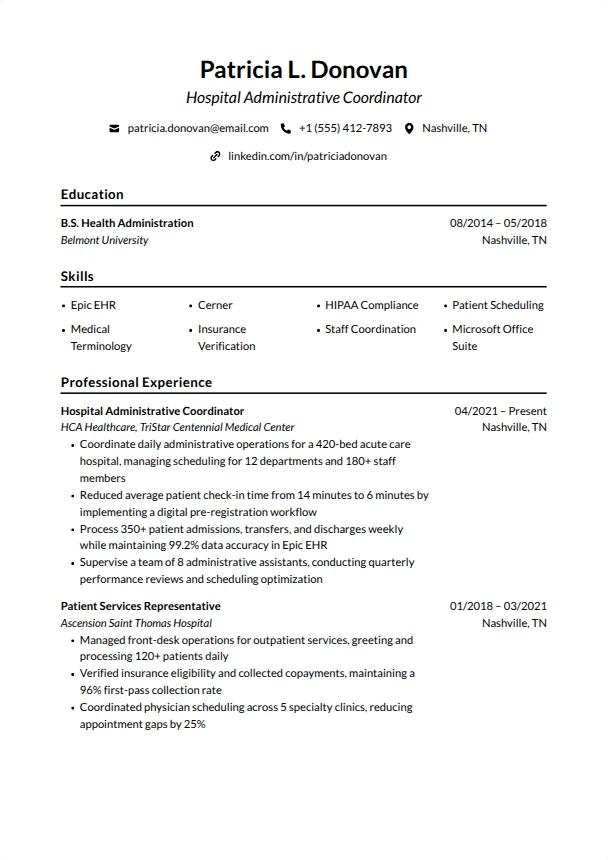
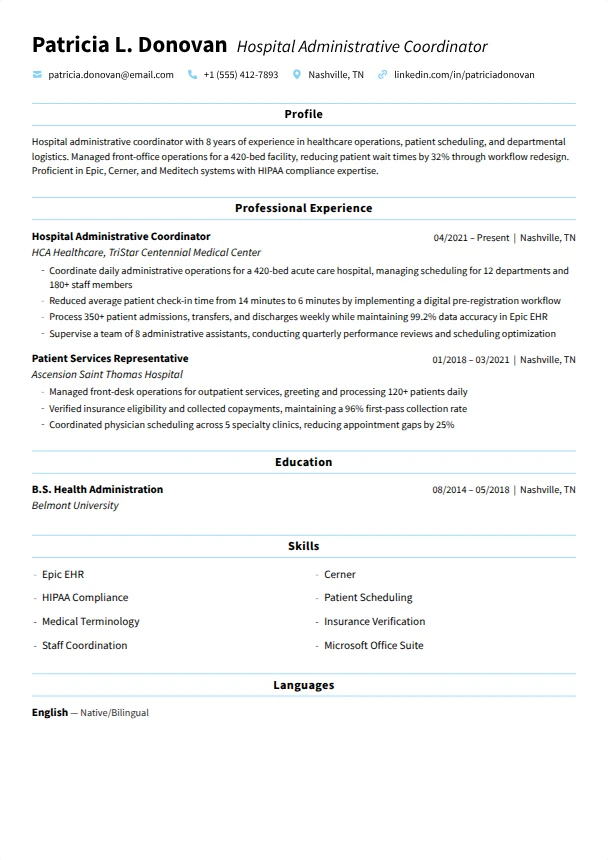
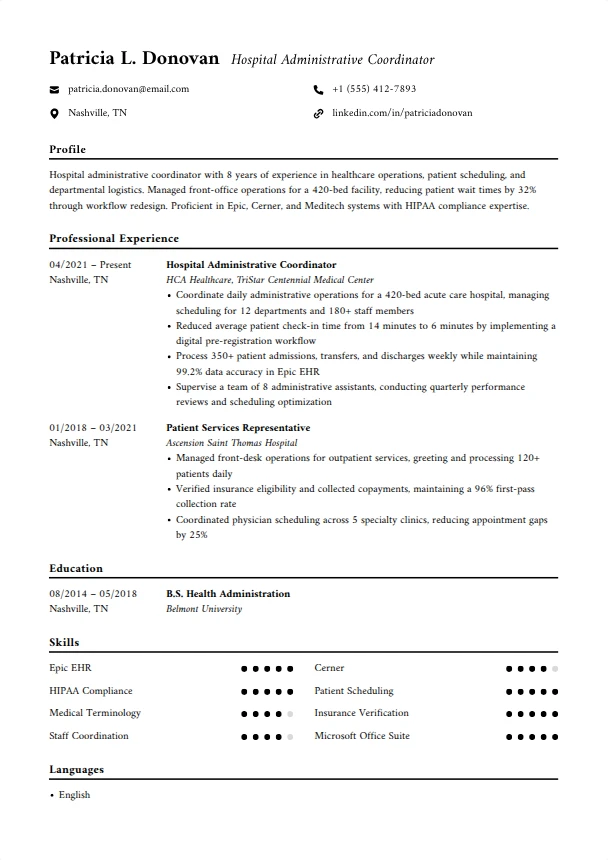
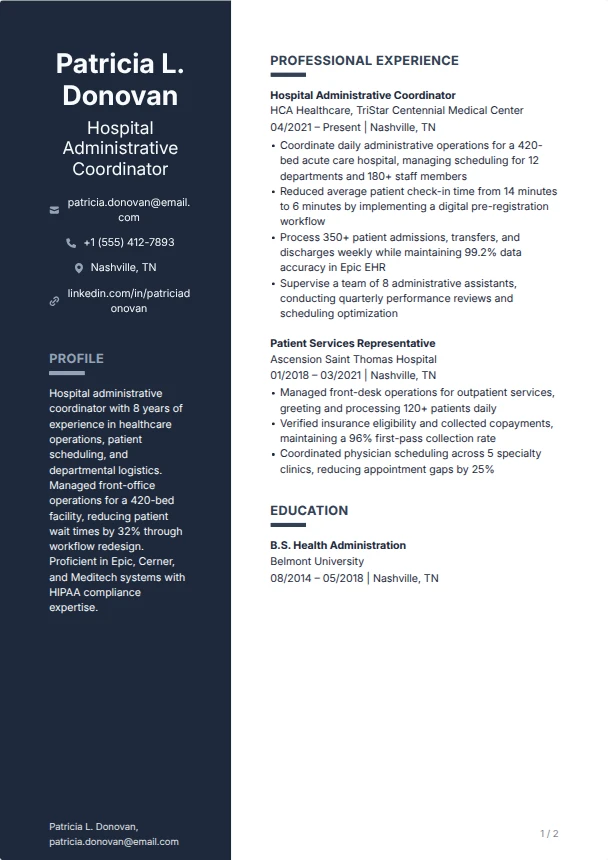
1. Contact header
Name, email, phone, location (city + state), and LinkedIn. If you hold any active licenses, you can note them next to your name. No photo, no full address.
Patricia Donovan · [email protected] · (555) 412-7893 · Nashville, TN
linkedin.com/in/patriciadonovan
2. Professional summary (2-3 sentences)
Communicate your role type, years of experience, the size of hospital you have worked in, and your strongest achievement. Tailor this for every application.
Strong: "Hospital administrative coordinator with 8 years of experience managing front-office operations for a 420-bed acute care facility. Reduced patient check-in time by 53% through digital pre-registration and workflow redesign. Proficient in Epic, Cerner, and HIPAA compliance protocols."
3. Certifications and credentials
List BLS/CPR, any clinical certifications, HIPAA training, and relevant licenses. Place this section right after your summary so recruiters see it immediately.
BLS/CPR (American Heart Association, 2025) · HIPAA Compliance (2025) · Epic Certified (2024)
4. Technical skills
Group by category: EHR Systems, Administrative, Clinical Support, Compliance. Match the job posting closely and use their exact terminology.
EHR: Epic, Cerner, Meditech
Administrative: Patient scheduling, insurance verification, medical coding (ICD-10)
Compliance: HIPAA, Joint Commission standards, infection control protocols
5. Work experience
Reverse chronological. For each role: hospital name, title, dates, and 3-5 bullet points. Include the bed count or patient volume to give context. Every bullet should follow the formula: Action verb + what you did + measurable result.
Strong: "Processed 350+ patient admissions, transfers, and discharges weekly across a 420-bed facility while maintaining 99.2% data accuracy in Epic EHR. Supervised a team of 8 administrative assistants."
6. Education
Degree, school, graduation year. Include relevant coursework only if you graduated within the last 2 years. For hospital roles, certifications often carry more weight than the degree itself.
Key skills to include
These are the most in-demand skills across hospital job postings in 2026. Pick the ones that match your experience and the specific role you are targeting.
Tip: If the job posting mentions a specific EHR system or credentialing requirement, add it to your skills section using their exact wording. ATS systems match keywords literally.
Resume summary examples you can steal
Use one as a starting point, then swap in your own technologies, numbers, and achievements.
"BLS-certified hospital support professional with 1 year of experience assisting nursing staff on a 32-bed medical-surgical unit. Completed patient intake for 40+ admissions per week while maintaining accurate records in Epic. Recognized for perfect attendance and selected for cross-training in the emergency department."
Why it works: Quantifies patient volume, names the EHR system, and shows growth potential through cross-training.
"Hospital administrative coordinator with 5 years of experience managing scheduling and patient flow for a 300-bed community hospital. Reduced average wait time by 28% by redesigning the triage intake process. Proficient in Epic, insurance verification, and Joint Commission compliance documentation."
Why it works: Bed count for scale, specific improvement metric, and compliance expertise.
"Healthcare operations manager with 10 years of experience overseeing non-clinical departments across a 600-bed Level I trauma center. Manage a $4.2M annual budget and 45 staff members across patient access, health information management, and environmental services. Led EMR migration from Cerner to Epic for 2,000+ users."
Why it works: Budget size, staff count, facility scale, and a major systems migration project.
"Former retail operations manager transitioning to hospital administration with newly completed HIPAA and medical terminology certifications. Brings 6 years of experience managing high-volume customer-facing operations, including scheduling 30+ employees and processing 500+ daily transactions in a fast-paced environment."
Why it works: Frames retail experience as transferable, highlights new healthcare credentials, and quantifies pace.
Writing strong experience bullets
Every bullet point should answer: "What did you do, and why did it matter?" Use this formula:
Before and after examples:
Checked in patients and entered their information into the computer.
Processed 350+ patient admissions, transfers, and discharges weekly in Epic EHR, maintaining 99.2% data accuracy across a 420-bed acute care facility.
Helped with scheduling and answered phones.
Coordinated physician scheduling across 5 specialty clinics and managed 200+ daily inbound calls, reducing appointment gaps by 25% through proactive overbooking analysis.
Worked at the front desk and verified insurance.
Verified insurance eligibility for 80+ patients daily using Availity and Epic, achieving a 96% first-pass collection rate and reducing claim denials by 18%.
Strong action verbs for hospital resumes:
Processed · Coordinated · Verified · Scheduled · Registered · Triaged · Documented · Managed · Reduced · Streamlined · Trained · Supervised · Audited · Implemented · Maintained · Reported
5 mistakes that get hospital resumes rejected
Not listing your EHR system experience
Epic alone is used by over 250 million patients in the U.S. If you have used Epic, Cerner, Meditech, or any other EHR, list it by name. Recruiters filter on these keywords and you will be invisible without them.
Writing generic bullets without patient volume
Every hospital hiring manager wants to know your capacity. How many patients per day? How many beds on your unit? How many admissions per week? Without numbers, they cannot gauge whether you can handle their environment.
Forgetting compliance certifications
BLS, HIPAA, and infection control training are baseline requirements at most hospitals. If you have them but do not list them, the ATS may filter you out before a human reviews your resume.
Using one resume for every hospital role
A patient access representative resume and a medical records clerk resume require different emphasis. Read the job description, identify their top requirements, and tailor your summary and skills for each application.
Listing duties instead of achievements
Do not write what you were responsible for. Write what you accomplished. 'Responsible for patient check-in' says nothing. 'Reduced average check-in time from 14 minutes to 6 minutes' tells a story.
What to do if you have no professional experience
Hospitals hire for dozens of non-clinical roles that do not require prior healthcare experience. Here is how to build a strong resume from scratch:
Get BLS/CPR certified immediately
A BLS certification from the American Heart Association costs about $60 and takes one day. It is required or preferred for nearly every hospital role, including non-clinical ones. Having it on your resume removes a common disqualification.
Complete a free HIPAA training course
HIPAA compliance is mandatory in every hospital. Free online courses are available through HHS.gov and several healthcare training providers. Listing HIPAA certification shows you understand the regulatory environment.
Highlight transferable customer service skills
Patient access, registration, and front-desk roles are fundamentally customer service positions in a healthcare setting. Frame your retail, hospitality, or call center experience using healthcare language: 'patient interaction' instead of 'customer service,' 'intake processing' instead of 'data entry.'
Apply for hospital volunteer or per diem positions
Many hospitals have volunteer programs that give you direct exposure to hospital operations. Even 3 months of volunteer experience in a hospital setting demonstrates your comfort with the environment and gives you real content for your resume.
Frequently asked questions
Do I need clinical experience to work in a hospital?
No. Hospitals employ thousands of non-clinical workers in patient access, health information management, billing, environmental services, food services, and administration. These roles require customer service skills and attention to detail, not clinical training.
How long should a hospital resume be?
One page for under 8 years of experience. Two pages maximum for department managers or senior administrators. Hospital recruiters review hundreds of applications per opening, so every line needs to earn its space.
Should I list my BLS certification even for non-clinical roles?
Yes. Many hospitals require or prefer BLS for all employees, including administrative staff. It shows preparedness and is often an ATS filter keyword.
What EHR systems should I learn?
Epic dominates the U.S. hospital market with over 38% market share. Cerner (now Oracle Health) is second. If you want to maximize your employability, take Epic or Cerner training courses. Some community colleges offer EHR certification programs.
How do I describe hospital experience if I worked through a staffing agency?
List the hospital as your workplace and note the staffing agency in parentheses. For example: 'Patient Access Representative, Memorial Hospital (via Maxim Healthcare Staffing).' This gives recruiters the context they need while being transparent about the employment arrangement.
Skip the blank page
Open a complete, filled-in CNA resume in our free builder. Swap in your own details, keep the wording that fits, and download as PDF, free.
Build your hospital resume now
Pick a clean, ATS-friendly template, add your hospital experience and certifications, and download a polished PDF in minutes. Free, no account required.
Start Building, It's FreeRelated resume guides
Broader guide for all healthcare roles including clinical coordinators and patient care technicians.
Specialized guide for RNs, LPNs, and nurse practitioners with clinical metrics and certifications.
Guide for CMAs covering phlebotomy, EKGs, and outpatient clinic experience.
More resume examples: