What hiring managers actually look for
Clinic managers and physician practice administrators scan medical assistant resumes for three things:
-
1
CMA, RMA, or CCMA certification. Certified Medical Assistant (AAMA), Registered Medical Assistant (AMT), or Certified Clinical Medical Assistant (NHA) credentials are strongly preferred or required at most clinics. If you have one, list it prominently with the exact issuing body. If you are studying for one, note it as in progress.
-
2
Clinical and administrative dual capability. MAs who can both room patients and handle prior authorizations are worth more than those who only do one. Show that you can move between patient intake and rooming, phlebotomy, and appointment scheduling without missing a beat.
-
3
Patient volume and clinic pace. How many patients do you room per day? How many injections or blood draws per week? Clinic managers need to know you can keep up with their volume. Include these numbers in your bullets.
If your resume communicates these things in the first 7-second scan, you'll make it to the detailed read. Everything below is about making that happen.
What medical assistants earn
According to the U.S. Bureau of Labor Statistics, Occupational Outlook Handbook, the median annual wage for medical assistants is $44,200 per year. The lowest paid 10 percent earn less than $35,020 and the highest paid 10 percent earn more than $57,830. Quantifying your patient volume, procedure counts, and EHR proficiency on your resume is the clearest way to position yourself toward the upper end of that band.
How to structure your resume, section by section
The order matters. Here's what a strong medical assistant resume looks like from top to bottom:
1. Contact header
Name, CMA/RMA credential, email, phone, location (city + state), and LinkedIn.
2. Professional summary (2-3 sentences)
State your certification, years of experience, patient volume, and top skills. Include the EHR or EMR systems you use.
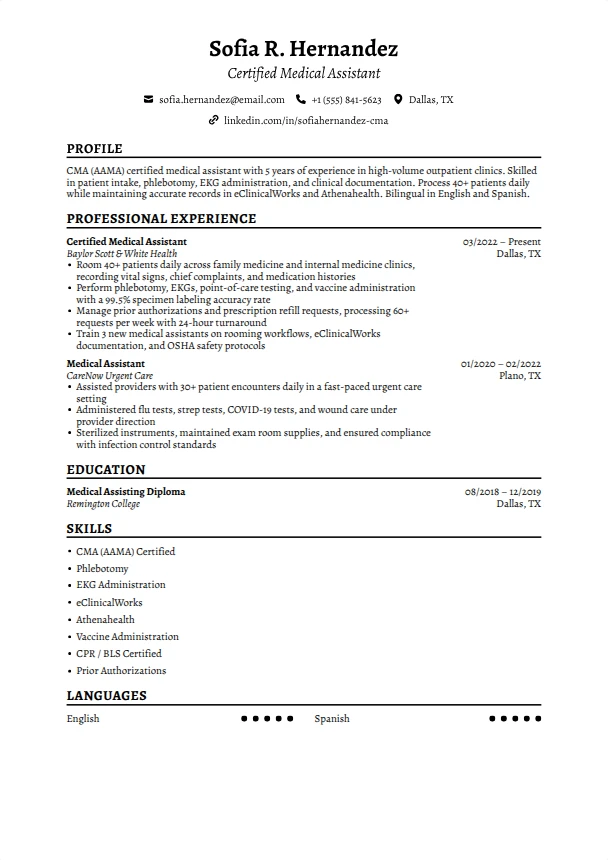
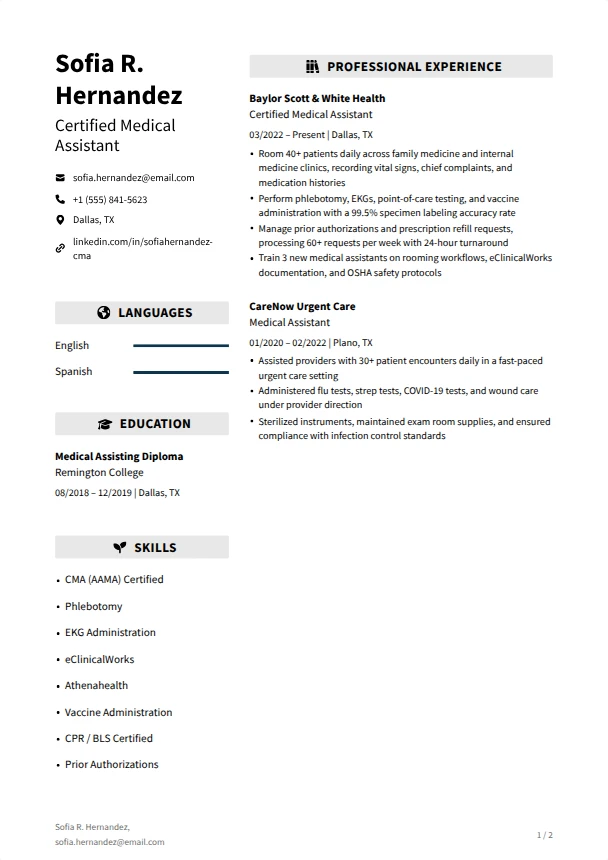
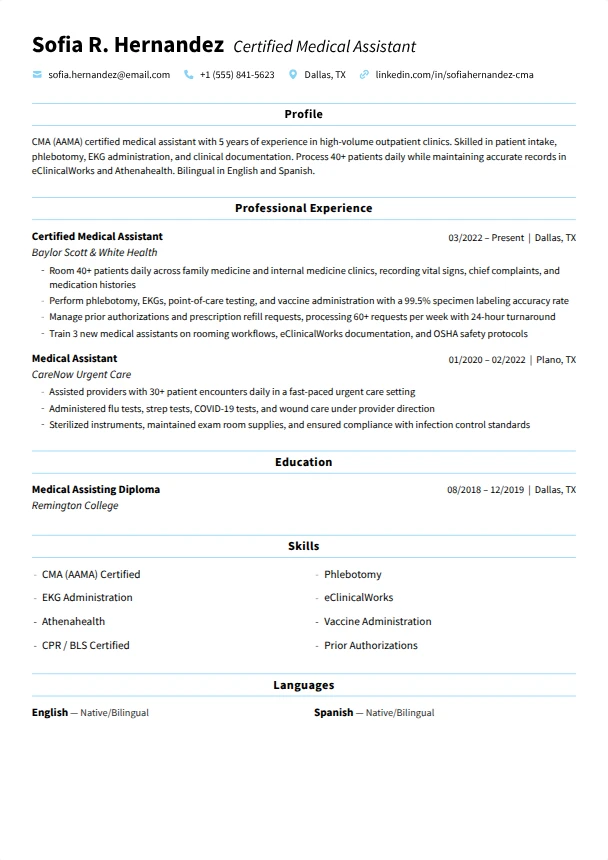
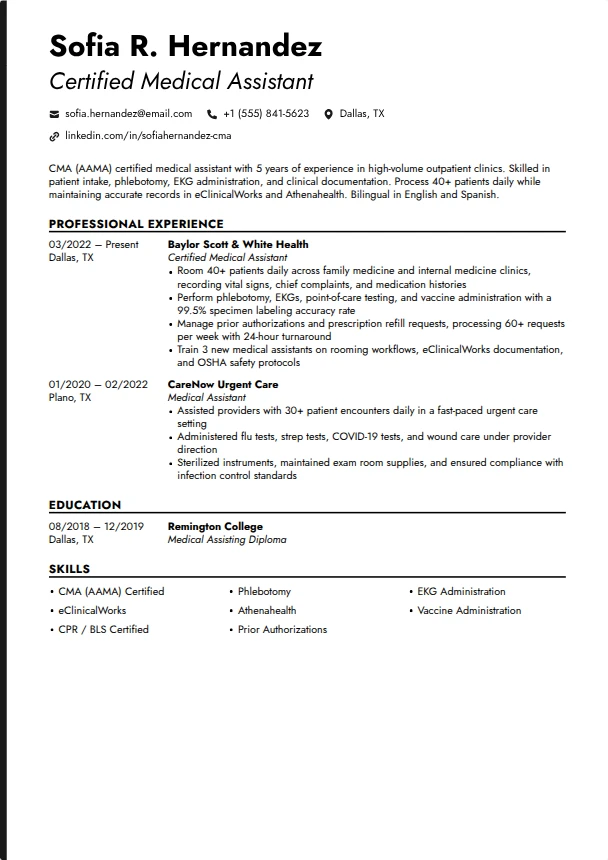
Strong: "CMA (AAMA) certified medical assistant with 5 years of experience in high-volume outpatient clinics. Room 40+ patients daily, perform phlebotomy and EKG administration, and manage prior authorizations in eClinicalWorks. Bilingual in English and Spanish."
3. Certifications
Your MA credential, BLS/CPR, phlebotomy certification, and any specialty training. List the issuing body and year.
CMA (AAMA) (2020) · BLS/CPR (AHA, exp. 2027) · Phlebotomy Technician (NHA, 2019) · HIPAA Compliance (2025)
4. Skills
Split into clinical skills and administrative skills. This is what makes MAs unique: they bridge both worlds.
Clinical: Phlebotomy and venipuncture, EKG administration, injection and vaccine administration, vital signs, specimen collection, point-of-care testing
Administrative: Prior authorizations, appointment scheduling, insurance verification, medical coding (ICD-10, CPT)
EHR/EMR: eClinicalWorks, Epic
5. Work experience
Reverse chronological. Include clinic name, specialty, and your daily patient volume. Show both clinical and administrative contributions.
Strong: "Roomed 40+ patients daily across family medicine and internal medicine clinics. Performed phlebotomy, EKG administration, and vaccine administration with a 99.5% specimen labeling accuracy rate. Processed 60+ prior authorizations per week in Epic."
Certifications and licenses worth listing
Most clinics prefer or require a nationally recognized medical assistant credential. Name the exact certification and the body that issued it, since recruiters and ATS filters look for the specific acronym. The three most widely accepted are:
- CMA (AAMA), Certified Medical Assistant. Issued by the Certifying Board of the American Association of Medical Assistants. AAMA certification details.
- RMA (AMT), Registered Medical Assistant. Issued by American Medical Technologists. AMT medical assistant page.
- CCMA (NHA), Certified Clinical Medical Assistant. Issued by the National Healthcareer Association. NHA CCMA details.
Tip: Add a BLS/CPR card and any phlebotomy certification underneath your primary credential. They reinforce that you can perform venipuncture and respond in an emergency from day one.
Key skills to include
These are the ATS keywords recruiters and screening software match against for medical assistant roles. Pick the ones that reflect your real experience and mirror the wording in the specific clinic's job posting.
Tip: If the job posting names a specific EHR/EMR system or clinical procedure, add it using their exact wording. ATS systems match keywords literally.
Example Medical assistant resume
Here is a short, illustrative example that pulls the pieces together. The name and clinic are fictional, so swap in your own credential, employers, and numbers.
Maria Delgado, CMA (AAMA)
Phoenix, AZ · [email protected] · (555) 207-4419 · Bilingual English/Spanish
Professional summary
CMA (AAMA) certified medical assistant with 4 years of experience in high-volume family medicine. Room 38+ patients daily, perform phlebotomy and EKG administration, and manage prior authorizations and appointment scheduling in eClinicalWorks and Epic. HIPAA compliant with a 99.5% specimen labeling accuracy rate.
Skills
Clinical: Phlebotomy and venipuncture, vital signs, EKG administration, injection and vaccine administration, specimen collection, point-of-care testing, patient intake and rooming
Administrative: Prior authorizations, appointment scheduling, medical coding (ICD-10, CPT), insurance verification
Systems: Electronic Health Records (EHR/EMR), eClinicalWorks, Epic
Experience
Medical Assistant, Sunrise Family Medicine · 2022 to present
- Roomed 38+ patients daily, recording vital signs, chief complaints, and medication histories in eClinicalWorks.
- Performed 25+ phlebotomy draws and 15+ vaccine administrations per week with a 99.5% specimen labeling accuracy rate.
- Processed 55+ prior authorizations per week and handled appointment scheduling for a 4-provider panel.
Certifications
CMA (AAMA), 2021 · BLS/CPR (AHA), current · HIPAA compliance, 2024
Resume summary examples you can steal
Use one as a starting point, then swap in your own systems, numbers, and achievements.
"CMA (AAMA) certified medical assistant with 160 hours of clinical externship experience at a multi-physician family practice. Handled patient intake and rooming, recorded vital signs, performed phlebotomy and venipuncture, and assisted with point-of-care testing during externship. BLS certified and proficient in eClinicalWorks."
Why it works: Lists the credential and issuing body, quantifies externship hours, names the EHR, and specifies clinical tasks performed.
"Certified medical assistant with 5 years of experience in high-volume outpatient clinics. Room 40+ patients daily, perform phlebotomy and EKG administration, and manage 60+ prior authorizations per week in Epic. Bilingual in English and Spanish with a 99.5% specimen labeling accuracy rate."
Why it works: Patient volume, weekly authorization count, named EHR, accuracy metric, and bilingual advantage.
"Medical assistant with 4 years of experience in dermatology and plastic surgery clinics. Assist with 20+ procedures per week including biopsies and excisions, handle specimen collection and point-of-care testing, and manage medical coding (ICD-10, CPT) for 100+ patients monthly in eClinicalWorks."
Why it works: Specialty focus, procedure count, coding ownership, and responsibilities that differentiate from primary care MAs.
"CMA with 6 years of clinical experience currently enrolled in a BSN program (expected graduation May 2027). Perform phlebotomy, EKG administration, injection and vaccine administration, and patient intake and rooming for a 5-provider urgent care clinic seeing 120+ patients daily. Selected to train all new MA hires on clinical workflows and HIPAA compliance."
Why it works: Shows career progression, a leadership role in training, and high-volume urgent care experience.
Writing strong experience bullets
Every bullet point should answer: "What did you do, and why did it matter?" Use this formula:
Before and after examples:
Took vital signs and prepared patients for the doctor.
Handled patient intake and rooming for 40+ patients daily across family medicine and internal medicine clinics, recording vital signs, chief complaints, medication histories, and allergy updates in eClinicalWorks.
Did blood draws and gave injections.
Performed 25+ phlebotomy and venipuncture draws plus 15+ injection and vaccine administrations per week with a 99.5% specimen labeling accuracy rate and zero adverse events over 3 years.
Handled prior authorizations and scheduling.
Processed 60+ prior authorization requests per week and owned appointment scheduling and medical coding (ICD-10, CPT) for a 4-provider panel, maintaining a 24-hour turnaround and reducing provider follow-up by 35%.
Strong action verbs for medical assistant resumes:
Roomed · Performed · Administered · Processed · Documented · Assisted · Triaged · Verified · Collected · Trained · Managed · Sterilized · Recorded · Prepared · Coordinated · Maintained
5 mistakes that get medical assistant resumes rejected
Not specifying your certification type
CMA (AAMA), RMA (AMT), and CCMA (NHA) are different credentials issued by different organizations. Be specific about which one you hold. Just writing 'certified medical assistant' without the issuing body is vague and can fail an ATS keyword match.
Listing tasks without patient volume
Every MA takes vital signs. What matters is how many patients you handle per day and at what pace. Include your daily patient intake count, weekly procedure volume, and any throughput metrics.
Omitting administrative skills
Many MAs focus only on clinical skills. But prior authorizations, appointment scheduling, insurance verification, and medical coding (ICD-10, CPT) are equally valuable. Show that you can handle both sides of the role.
Forgetting to list EHR/EMR systems
Electronic Health Records platforms such as eClinicalWorks and Epic are the systems MAs use daily. If you do not list the specific system by name, recruiters assume you do not have experience with it.
Using generic language for specialty experience
If you have worked in a specialty clinic (dermatology, cardiology, orthopedics, OB/GYN), name the specialty and the specific procedures you assisted with, from specimen collection to point-of-care testing. Specialty experience is highly valued.
What to do if you have no professional experience
Medical assisting is one of the most accessible healthcare careers. Here is how to build a strong resume as a new MA:
Lead with your clinical externship
Your MA program included a clinical externship (typically 160+ hours) at an actual clinic. Treat this as work experience. List the clinic name, specialty, patient intake volume, and every clinical and administrative task you performed, from vital signs to appointment scheduling.
Get certified before your first application
Take the CMA (AAMA) or CCMA (NHA) exam as soon as you are eligible. Both are nationally recognized credentials, and many clinics require certification for hiring. It is worth the investment.
Add phlebotomy to your skill set
If your MA program did not include phlebotomy training, take a separate phlebotomy course. Phlebotomy and venipuncture are among the most requested MA skills, and a phlebotomy certification makes you significantly more competitive.
Apply to urgent care and large clinic chains
Urgent care centers (CareNow, MedExpress, MinuteClinic) and large practice groups often hire new MAs and provide structured onboarding on systems like Epic. These employers value certification and eagerness over years of experience.
Frequently asked questions
Do I need certification to work as a medical assistant?
Legally, most states do not require certification. However, the vast majority of employers prefer or require CMA (AAMA), RMA (AMT), or CCMA (NHA) credentials. Certified MAs typically have stronger job prospects, and listing the exact credential and issuing body on your resume helps you clear ATS keyword filters.
How long should a medical assistant resume be?
One page. MA resumes should be concise and focused on certifications, clinical skills like phlebotomy and EKG administration, patient intake volume, and EHR or EMR proficiency. Hiring managers spend only seconds on an initial scan, so put your credential and patient volume near the top.
Should I list both clinical and administrative skills?
Yes. Medical assistants are unique because they bridge clinical work such as vital signs, specimen collection, and injection administration with administrative work such as appointment scheduling, prior authorizations, and medical coding. Listing both shows you can handle the full scope of the role, which is what most clinics want.
Which EHR systems should a medical assistant put on a resume?
List the Electronic Health Records (EHR/EMR) platforms you have actually used, naming them exactly as the job posting does. Epic and eClinicalWorks are among the most requested systems for medical assistants. If a posting names a specific platform, mirror that wording so the ATS registers the match.
What clinical skills matter most on a medical assistant resume?
Phlebotomy and venipuncture, vital signs, EKG administration, injection and vaccine administration, specimen collection, point-of-care testing, and patient intake and rooming are the clinical skills hiring managers scan for first. Pair them with HIPAA compliance to show you handle protected health information correctly.
How much do medical assistants earn?
According to the U.S. Bureau of Labor Statistics Occupational Outlook Handbook, the median annual wage for medical assistants was $44,200 per year. The lowest 10 percent earned less than $35,020 and the highest 10 percent earned more than $57,830. Pay tends to be higher in specialty clinics and in markets with strong demand.
Skip the blank page
Open a complete, filled-in medical assistant resume in our free builder. Swap in your own details, keep the wording that fits, and download as PDF, free.
Build your medical assistant resume now
Pick a clean template, add your CMA certification and clinical skills, and download a polished PDF in minutes. Free, no account required.
Start Building, It's FreeRelated resume guides
Guide for certified nursing assistants in hospitals and long-term care facilities.
Broader guide for all healthcare roles including clinical coordinators and patient care technicians.
Guide for RNs and LPNs, a common career path for experienced medical assistants.
More resume examples: