What hiring managers actually look for
Nursing directors and charge nurses scanning certified nursing assistant resumes look for three things right away:
-
1
Active state CNA certification and BLS. Your state CNA certification, Nurse Aide Registry listing, and current BLS/CPR card must be listed clearly. Without these, your resume is automatically rejected. Include your registry number and expiration date.
-
2
Patient-to-CNA ratio experience. Caring for 6 patients per shift is very different from caring for 15. Hiring managers need to know the volume you can handle. Include your typical patient assignment, unit type, and bed count.
-
3
Reliability and attendance record. CNA turnover is one of the biggest challenges in healthcare. Any evidence of attendance awards, tenure milestones, or rehire eligibility gives you an advantage over other candidates.
If your resume communicates these in the first 7-second scan, you'll make it to the detailed read. Everything below is about making that happen.
It also helps to know the market. Nursing assistants earned a median wage of about $39,530 per year as of May 2024, with the lowest 10 percent under roughly $31,390 and the highest 10 percent near $50,140, according to the U.S. Bureau of Labor Statistics Occupational Outlook Handbook (Nursing Assistants, 31-1131). Pay runs toward the top of that band in hospitals and specialty units, so the ratio, acuity, and EHR experience on your resume affect the offers you see.
How to structure your resume, section by section
The order matters. Here's what a strong CNA resume looks like, top to bottom:
1. Contact header
Name, CNA credential, email, phone, location (city + state), and LinkedIn if you have one. No photo, no full address.
2. Professional summary (2-3 sentences)
State your certification, years of experience, care setting, patient load, and one achievement. Keep it specific.
Strong: "Certified nursing assistant with 4 years of experience in long-term care and acute hospital settings. Provide ADL support and vital signs monitoring for 10 to 12 patients per shift on a 40-bed rehabilitation unit. BLS certified with PointClickCare and MEDITECH EHR charting expertise."
3. Certifications
State CNA certification, BLS/CPR, and any additional training (wound care, dementia care, phlebotomy). List your state, Nurse Aide Registry number, and expiration date.
State CNA (Arizona Nurse Aide Registry, #CNA-28451, exp. 2027) · BLS Provider (AHA eCard, exp. 2026) · Dementia Care Certificate (2024)
4. Skills
Focus on hands-on patient care skills, documentation systems, and safety protocols.
Documentation: PointClickCare, MEDITECH, Epic Systems, intake and output (I&O) documentation, EHR charting
Safety: Infection control, fall prevention, mechanical lift (Hoyer / sit-to-stand)
5. Work experience
Reverse chronological. Include facility name, unit type, bed count, and your typical patient assignment. Every bullet should show what you did and at what scale.
Strong: "Provided ADL support for 10 to 12 patients per shift on a 40-bed orthopedic rehabilitation unit, assisting with bathing, dressing, feeding, and patient transfers using a sit-to-stand mechanical lift, charting all care in PointClickCare."
Certifications and licenses to list
CNA roles are credential-gated. List these near the top where a recruiter and the ATS find them fast:
- State CNA certification (Nurse Aide Registry). Earned through a state-approved Nurse Aide Training and Competency Evaluation Program of at least 75 clock hours, including a minimum of 16 supervised practical hours, then listing on your state Nurse Aide Registry. The minimum is set by federal standard 42 CFR 483.152 (Centers for Medicare & Medicaid Services).
- Basic Life Support (BLS) Provider. The completion eCard from the American Heart Association is valid for two years. List the expiration date so employers can confirm it is current.
- Certified Patient Care Technician/Assistant (CPCT/A). An NCCA-accredited, 100-question exam from the National Healthcareer Association (NHA), useful if you are advancing into a PCT role.
Tip: Mirror the posting's phrase. "Nurse Aide Registry" and "state CNA license" filter for the same credential.
Key skills to include
These are the certified nursing assistant skills and keywords recruiters and ATS filters scan for most often. Pick the ones that match your experience and target facility.
Tip: If the posting names a specific EHR system or specialty skill, add it using their exact wording. ATS systems match keywords literally.
Resume summary examples you can steal
Use one as a starting point, then swap in your own systems and numbers.
"Newly certified nursing assistant who completed a 75-hour state Nurse Aide Training program with clinical rotations at a 90-bed skilled nursing facility. Assisted with ADLs, vital signs monitoring, and patient mobility and transfers for 8 to 10 residents per shift. BLS certified, trained in infection control and fall prevention."
Why it works: Program hours and patient load quantified despite no paid experience.
"Certified nursing assistant with 3 years of experience in a 120-bed skilled nursing and rehabilitation facility. Care for 12 to 15 residents per shift, handling ADL support, catheter care, and blood glucose monitoring. Maintained 98% on-time intake and output (I&O) documentation in PointClickCare."
Why it works: Facility size, high ratio, specialty skills, and a metric.
"Certified nursing assistant with 4 years of experience on a 40-bed orthopedic and rehabilitation unit at a Level II trauma center. Respond to call lights within an average of 2 minutes, chart vital signs in Epic Systems, and assist with patient transfers using Hoyer and sit-to-stand mechanical lifts."
Why it works: Response-time metric, named EHR, and specific transfer equipment.
"Certified nursing assistant with 5 years of bedside experience currently enrolled in an ADN nursing program (expected graduation December 2026). Care for 10+ patients per shift while mentoring newly hired CNAs on EHR charting and infection control. Selected for the unit fall prevention committee."
Why it works: Shows trajectory, leadership, and current nursing-school enrollment.
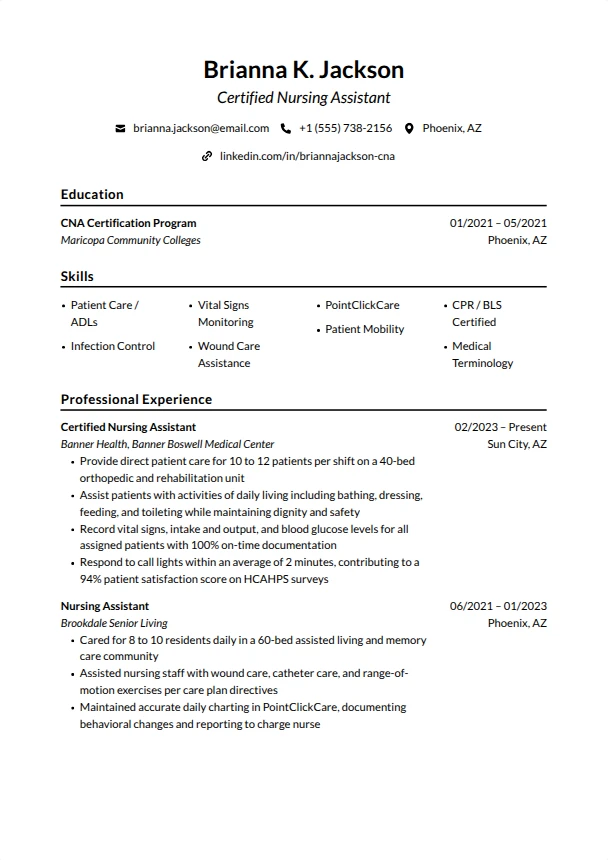
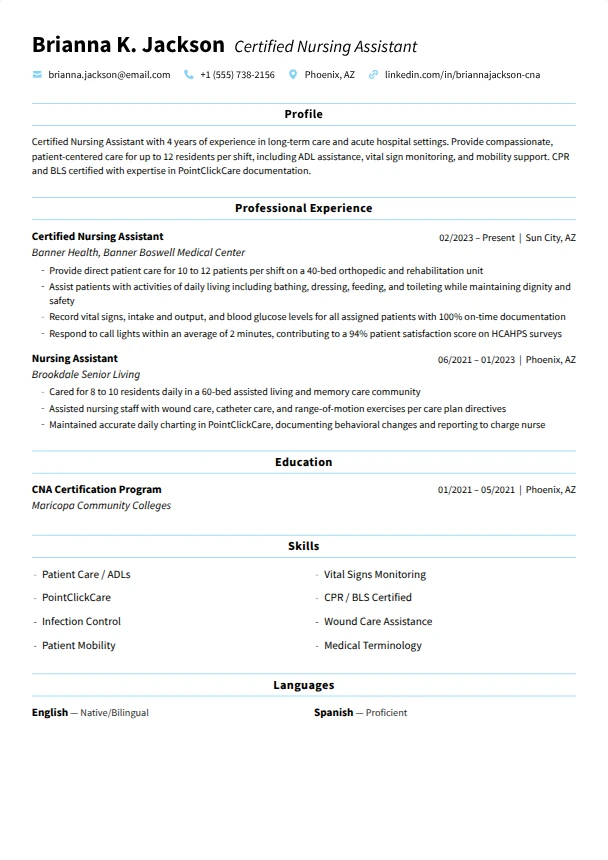
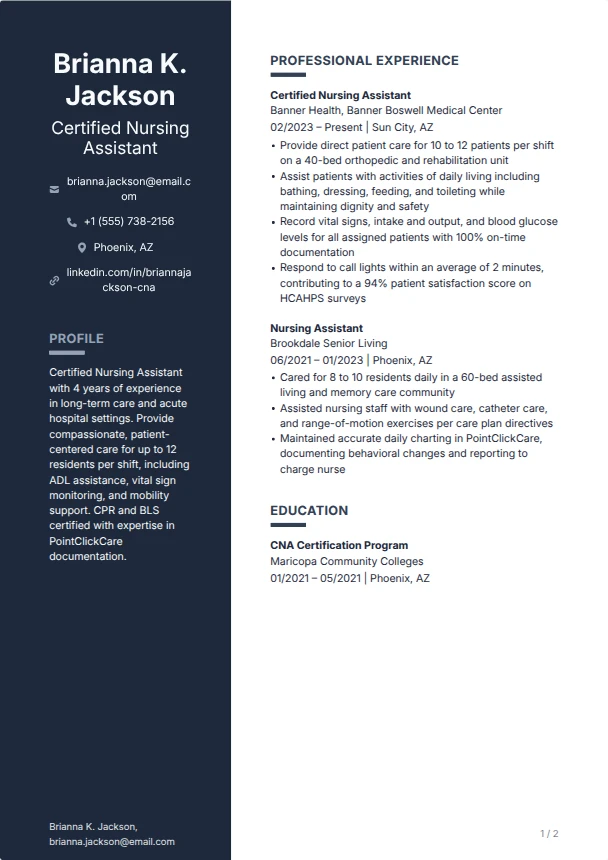
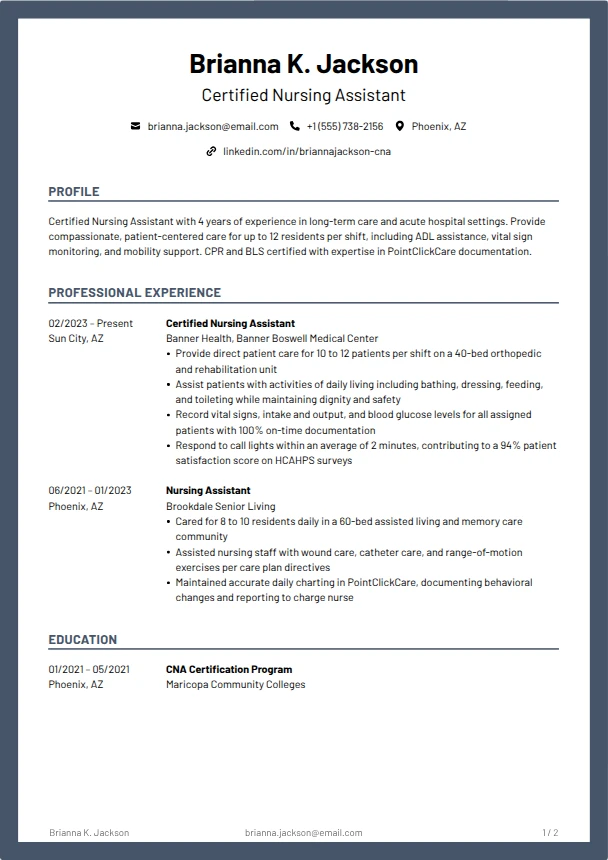
Example Certified nursing assistant (CNA) resume
A short example showing how the pieces fit together. The name and details are fictional. Use it as a model, then swap in your own facts.
Marisol Reyes, CNA
Tampa, FL · [email protected] · (555) 412-7780 · Florida Nurse Aide Registry #CNA-50912
Summary
Certified nursing assistant with 3 years across long-term care and acute rehabilitation. Provide ADL support and vital signs monitoring for 12 to 14 residents per shift, with on-time EHR charting in PointClickCare and MEDITECH.
Certifications
State CNA, Florida Nurse Aide Registry (exp. 2027) · BLS Provider, AHA eCard (exp. 2026) · CPCT/A, NHA (2025)
Skills
Activities of Daily Living (ADLs) · Vital signs monitoring · Blood glucose monitoring · Catheter care · Patient mobility and transfers · Mechanical lift (Hoyer / sit-to-stand) · Infection control · Fall prevention · PointClickCare / MEDITECH / Epic Systems
Experience
CNA, Bayshore Skilled Nursing & Rehabilitation, Tampa, FL (2023 to present)
- Provided ADL support for 12 to 14 residents per shift on a 60-bed long-term care unit, charting vital signs and intake and output (I&O) in PointClickCare.
- Completed patient mobility and transfers using Hoyer and sit-to-stand mechanical lifts under infection control and fall prevention protocols, with zero lift-related injuries.
Illustrative example only. Names, employers, and metrics are fictional.
Writing strong experience bullets
Every bullet should answer: "What did you do, and why did it matter?" Use this formula:
Before and after examples:
Took care of patients and helped them with daily tasks.
Provided Activities of Daily Living (ADLs) support for 10 to 12 patients per shift on a 40-bed rehabilitation unit, assisting with bathing, dressing, feeding, toileting, and patient transfers while maintaining patient dignity and safety.
Took vital signs and reported to nurses.
Recorded vital signs, blood glucose levels, and intake and output (I&O) measurements for all assigned patients every 4 hours, with on-time EHR charting in PointClickCare and escalation of critical values to the charge nurse.
Helped new employees learn the job.
Trained and mentored 6 newly hired CNAs on unit protocols, PointClickCare charting, infection control, and safe patient transfers over a 2-week orientation period.
Strong action verbs for CNA resumes:
Assisted · Monitored · Documented · Transferred · Bathed · Fed · Reported · Trained · Responded · Maintained · Provided · Recorded · Repositioned · Communicated · Supported
5 mistakes that get CNA resumes rejected
Not listing your CNA certification details
Your Nurse Aide Registry number, state, and expiration date should be clearly visible. Many facilities verify registry status before interviews, and ATS systems filter for "CNA" and "Nurse Aide" as keywords.
Writing 'helped patients' without specifics
Every CNA helps patients. What sets you apart is scale and context. How many patients per shift? What unit type? What was the acuity level? Include numbers in every bullet.
Omitting the facility type and bed count
A 30-bed assisted living facility and a 200-bed skilled nursing facility require different skill levels. Include the facility type, bed count, and unit specialty so hiring managers can assess your experience accurately.
Leaving out documentation systems
PointClickCare, MEDITECH, and Epic Systems are the EHR systems CNAs use daily for vital signs and intake and output (I&O) documentation. List by name any you have used. Facilities often filter applicants based on their current system.
Not mentioning attendance or reliability
CNA turnover is high at many facilities. If you have attendance awards, long tenure, or rehire eligibility, include it. It tells the hiring manager you will actually show up.
What to do if you have no professional experience
CNA is one of the fastest entry points into healthcare. Here is how to build a resume that gets you hired after certification:
Lead with your clinical rotation hours
Your Nurse Aide Training program included at least 16 supervised practical hours at a real care facility. This IS experience. List the facility name, unit type, patient count, and tasks such as vital signs monitoring and ADL support, and treat it like a work entry.
Get BLS certified before you apply
A Basic Life Support (BLS) Provider eCard from the American Heart Association is valid for two years and takes about a day to earn. Almost every CNA job requires it, so listing it before you apply removes a common barrier to hiring.
Highlight any caregiving background
Caring for a family member, babysitting, elder care, or volunteer work at a senior center all demonstrate caregiving aptitude. Frame these experiences using clinical language: 'assisted with mobility,' 'monitored dietary intake,' 'maintained safe environment.'
Apply to facilities with new-grad CNA programs
Large hospital systems and skilled nursing chains have structured orientation programs for new CNAs. These employers expect little to no experience and invest in training, making them an ideal first stop after certification.
Frequently asked questions
How long does it take to become a CNA?
Federal rules under 42 CFR 483.152 require a Nurse Aide Training and Competency Evaluation Program of at least 75 clock hours, including a minimum of 16 supervised practical (clinical) hours. Most programs run 4 to 12 weeks. After finishing, you must pass your state's written and skills competency exam and be listed on the state Nurse Aide Registry to work as a CNA.
How long should a CNA resume be?
One page. CNA roles do not require extensive documentation. Focus on your state certification and Nurse Aide Registry status, BLS card, patient care skills, EHR systems such as PointClickCare or MEDITECH, facility experience, and strongest metrics. Keep it clean and easy to scan in under 10 seconds.
Should I list my patient-to-CNA ratio?
Yes. This is one of the most important details a hiring manager looks for. It tells them whether you can handle their unit's workload. Include your typical assignment, such as 10 to 12 residents per shift, in your summary and in each job's bullet points alongside the unit type and bed count.
Can I work as a CNA while in nursing school?
Absolutely. Many nursing students work as CNAs to gain bedside experience and earn income. Mention your current enrollment in your summary and list your expected graduation date. Employers value CNAs who are advancing toward their RN and already know charting, ADL care, and infection control.
What is the difference between a CNA and a patient care technician?
The titles overlap, but the credential path differs. CNAs hold a state certification under the federal Nurse Aide standard and typically work in long-term care and hospitals doing ADL assistance, vital signs, and EHR charting. Patient care technicians often add skills such as phlebotomy, EKGs, and telemetry, and some hold the NHA Certified Patient Care Technician/Assistant (CPCT/A) credential. Many CNAs use the CPCT/A to advance into PCT roles.
Skip the blank page
Open a complete, filled-in CNA resume in our free builder. Swap in your own details, keep the wording that fits, and download as PDF, free.
Build your CNA resume now
Pick a clean template, add your certification and patient care experience, and download a polished PDF in minutes. Free, no account required.
Start Building, It's FreeRelated resume guides
Guide for RNs and LPNs, the next step up from CNA for those advancing their career.
Guide for home health aides and private caregivers working outside of facility settings.
Broader guide for all hospital roles including administrative and clinical support positions.
More resume examples: