What hiring managers actually look for
Home health agency coordinators and private families scanning caregiver resumes look for three things:
-
1
HHA certification and CPR/First Aid. A Home Health Aide certification and current CPR/First Aid credentials are the baseline. Most agencies require them before your first shift. If you are a CNA, that credential also qualifies you for home health work in most states.
-
2
Reliability indicators and client satisfaction. Caregiving has extremely high turnover. Any evidence of long-term client relationships, attendance awards, or positive references gives you a significant edge. Agencies track call-off rates closely.
-
3
Specialty care experience. Alzheimer and dementia care, diabetes management, wound care, and hospice support are specialized skills that command higher pay. If you have experience with these, highlight them prominently.
If your resume communicates these things in the first 7-second scan, you'll make it to the detailed read. Everything below is about making that happen.
How to structure your resume, section by section
The order matters. Here's what a strong caregiver resume looks like from top to bottom:
1. Contact header
Name, email, phone, location (city + state). Include your driver's license status if you provide transportation for clients.
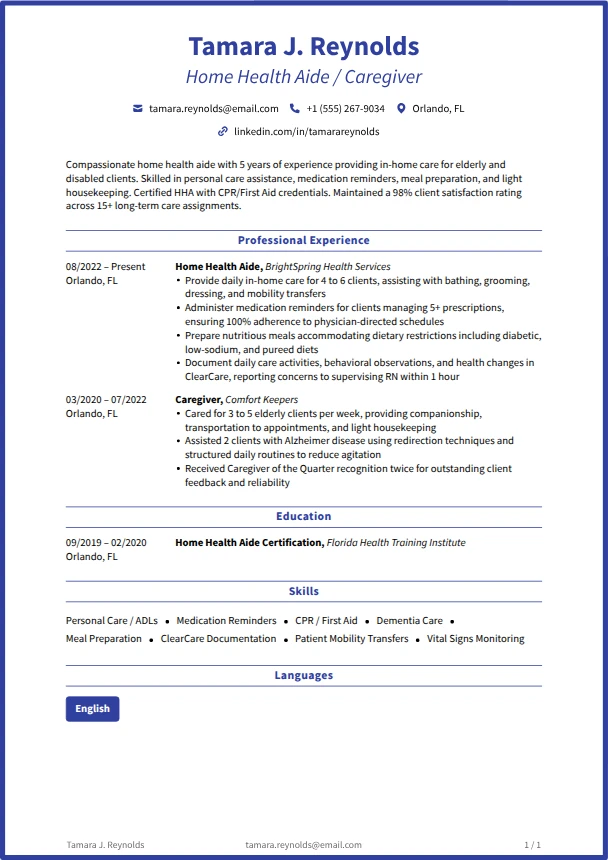
Tamara Reynolds, HHA · [email protected] · (555) 267-9034 · Orlando, FL
Valid FL driver's license · Reliable transportation
2. Professional summary (2-3 sentences)
State your certification, years of experience, number of clients managed, and specialty skills. Include your client satisfaction rating if you have one.
Strong: "Compassionate home health aide with 5 years of experience providing in-home care for elderly and disabled clients. Maintain a 98% client satisfaction rating across 15+ long-term assignments. Certified HHA with CPR/First Aid, specializing in Alzheimer care and diabetic meal preparation."
3. Certifications
HHA or CNA certification, CPR/First Aid, and any specialty training. Include driver's license if the role requires transportation.
HHA Certified (Florida, 2020) · CPR / First Aid (Red Cross, exp. 2027) · Alzheimer's Care Certificate (2023)
4. Skills
Focus on daily care tasks, specialty care, safety, and documentation.
Personal Care: Bathing, grooming, dressing, toileting, mobility transfers
Specialty: Dementia care, diabetic meal prep, wound care, hospice support
Documentation: ClearCare, HHAeXchange, daily activity logs
5. Work experience
List each agency or private client engagement. Include the number of clients, types of conditions, and your reliability metrics.
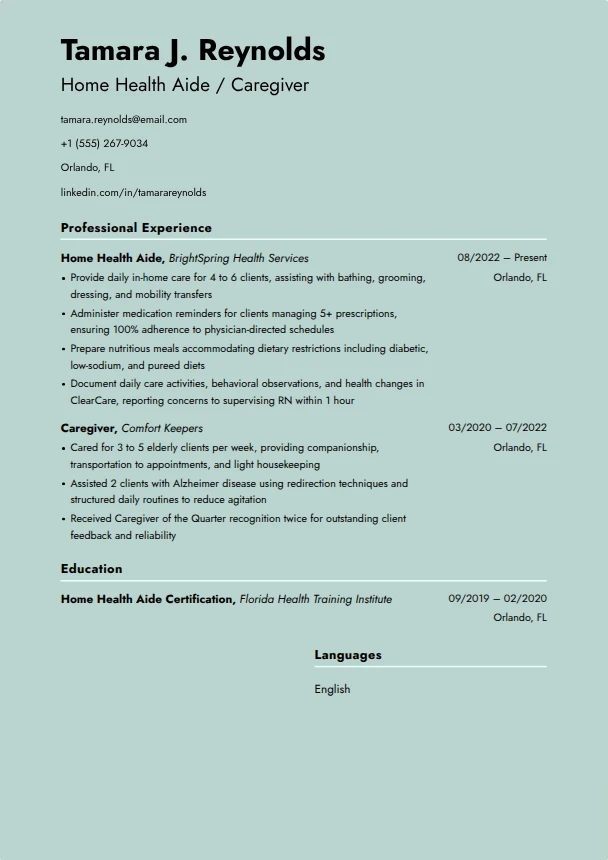
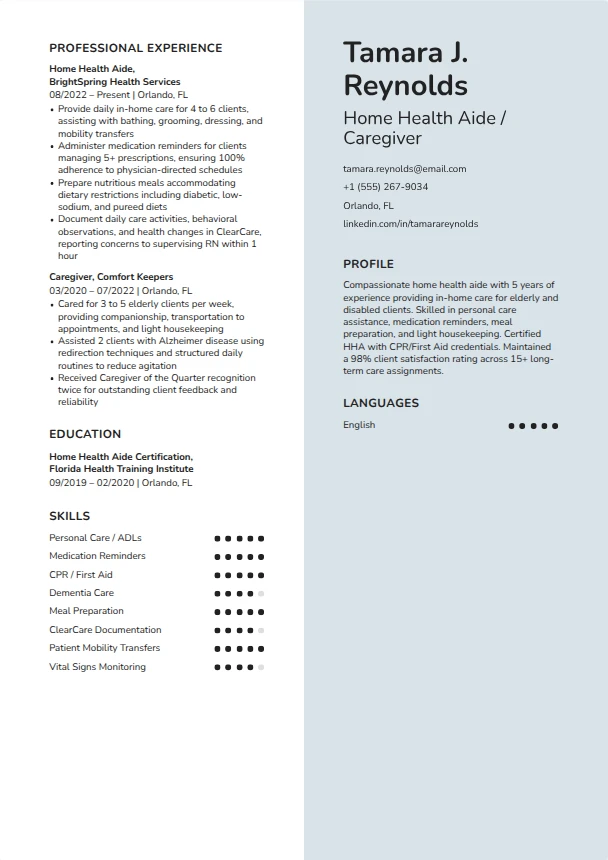
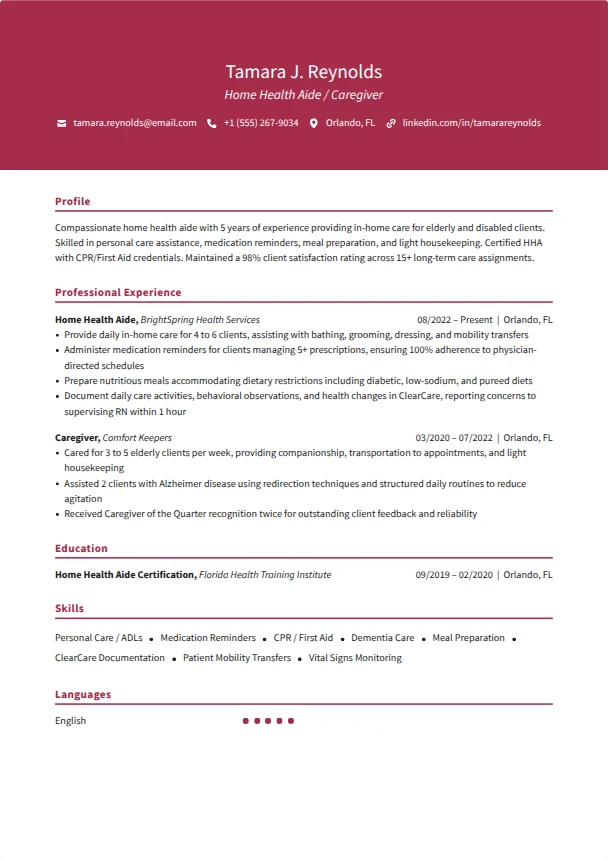
Strong: "Provided daily in-home care for 4 to 6 clients, assisting with bathing, grooming, dressing, and mobility transfers. Administered medication reminders for clients managing 5+ prescriptions with 100% adherence to physician-directed schedules."
Key skills to include
These are the most in-demand caregiver skills in 2026. Pick the ones that match your experience and the client population you are targeting.
Tip: If the job posting mentions a specific client condition or documentation system, add it using their exact wording. Agencies often filter applicants based on specialty experience.
Resume summary examples you can steal
Use one as a starting point, then swap in your own technologies, numbers, and achievements.
"HHA certified caregiver with 75 hours of supervised clinical training at a 60-bed assisted living facility. Assisted residents with ADLs, meal preparation, and recreational activities. CPR and First Aid certified with training in fall prevention and infection control."
Why it works: Quantifies training hours, names the facility type, and lists relevant certifications despite limited paid experience.
"Home health aide with 5 years of experience providing in-home care through a licensed agency. Care for 4 to 6 clients weekly, specializing in Alzheimer and dementia care, diabetic meal preparation, and mobility assistance. 98% client satisfaction rating with zero missed shifts in the past 2 years."
Why it works: Client count, specialty skills, satisfaction rating, and attendance record.
"Private caregiver with 7 years of experience providing 24/7 live-in care for elderly clients with complex medical needs. Managed medication schedules for 10+ prescriptions, coordinated with physicians and home health nurses, and maintained detailed daily care logs for family members."
Why it works: Live-in experience, medication complexity, multi-provider coordination, and family communication.
"Former childcare provider transitioning to home health care with newly earned HHA certification and CPR/First Aid credentials. Brings 5 years of experience managing daily care routines, meal preparation, and activity planning for groups of 8 to 12 children. Background check cleared, reliable transportation available."
Why it works: Transfers childcare skills to elder care, highlights new credentials, and addresses common screening requirements.
Writing strong experience bullets
Every bullet point should answer: "What did you do, and why did it matter?" Use this formula:
Before and after examples:
Helped elderly clients with their daily needs.
Provided daily in-home care for 4 to 6 elderly clients, assisting with bathing, grooming, dressing, toileting, and mobility transfers while maintaining patient dignity and documenting all activities in ClearCare.
Gave medication reminders and made meals.
Administered medication reminders for clients managing 5+ prescriptions each, ensuring 100% adherence to physician-directed schedules. Prepared 3 meals daily accommodating diabetic, low-sodium, and pureed diets.
Helped patients with Alzheimer's disease.
Provided specialized care for 2 clients with moderate-stage Alzheimer's, using redirection techniques, structured daily routines, and engagement activities to reduce agitation episodes by 40%.
Strong action verbs for caregiver resumes:
Assisted · Provided · Administered · Prepared · Documented · Transported · Monitored · Supported · Coordinated · Maintained · Communicated · Bathed · Groomed · Transferred · Engaged
5 mistakes that get caregiver resumes rejected
Not listing your HHA or CNA certification
Your certification is the first thing agencies verify. Include the state, certification type, and expiration date. Without it listed clearly, your resume may be filtered out before a human reviews it.
Writing vague descriptions without client counts
How many clients do you care for? How many hours per week? What conditions do they have? Include these details so agencies can match you to appropriate assignments.
Not mentioning your attendance and reliability
Caregiver no-shows are a serious safety concern. If you have a strong attendance record, long-term client relationships, or agency recognition for reliability, put it on your resume. It is one of the most valued traits.
Omitting specialty care skills
Dementia care, wound care, hospice support, and diabetic management are specialized skills that command higher pay rates. If you have this experience, highlight it prominently. Do not bury it in a generic bullet point.
Forgetting to mention transportation availability
Many caregiver roles require driving clients to appointments. If you have a valid driver's license and reliable transportation, state it clearly. Some agencies filter applicants on this requirement.
What to do if you have no professional experience
Caregiving is one of the most accessible entry points into healthcare, with many agencies willing to train. Here is how to get started:
Complete an HHA certification program
HHA programs typically take 75 to 120 hours and cost $500 to $1,000. Some agencies will sponsor your training in exchange for a work commitment. The certification opens doors to agency placements immediately.
Get CPR and First Aid certified
CPR/First Aid from the American Red Cross or American Heart Association costs about $60 to $80 and takes one day. It is required by virtually every home health agency.
Include any personal caregiving experience
Caring for a parent, grandparent, or family member with health needs is real caregiving experience. Frame it professionally: 'Provided daily care for elderly family member with mobility limitations, managing medication schedules and physician appointments for 2 years.'
Apply to agencies with training programs
Large home health agencies like BrightSpring, Amedisys, and Kindred at Home offer structured orientation for new caregivers. They expect minimal experience and invest in your development.
Frequently asked questions
Do I need certification to be a caregiver?
For agency work, most states require HHA certification or CNA credentials. Private caregiving for families may not require formal certification, but having one significantly improves your job prospects and pay rate.
How long should a caregiver resume be?
One page. Caregiver resumes should focus on certification, client care skills, reliability, and specialty experience. Keep it simple and easy to scan quickly.
Should I list private family clients on my resume?
Yes, but protect their privacy. List the engagement as 'Private Client' with the city, dates, and a description of care provided. Do not include the family's name unless they have given explicit permission.
How much do caregivers earn?
The median hourly wage for home health aides is $15 to $18 per hour in 2026, with wide variation by state and agency. Specialty skills like dementia care and live-in experience command $18 to $25+ per hour. Certification and experience are the biggest factors in pay.
Can I transition from caregiving to nursing?
Absolutely. Many caregivers use their experience as a stepping stone to CNA, LPN, or RN programs. Your hands-on patient care experience gives you a significant advantage in nursing school admissions and clinical rotations.
Skip the blank page
Open a complete, filled-in caregiver resume in our free builder. Swap in your own details, keep the wording that fits, and download as PDF, free.
Build your caregiver resume now
Pick a clean template, add your HHA certification and client care experience, and download a polished PDF in minutes. Free, no account required.
Start Building, It's FreeRelated resume guides
Guide for certified nursing assistants, a common next step for experienced caregivers.
Guide for RNs and LPNs for caregivers considering the nursing career path.
Broader guide covering all healthcare roles including clinical coordinators.
More resume examples: