What hiring managers actually look for
Nurse managers and healthcare recruiters scan registered nurse resumes for three things before reading any bullet points:
-
1
Active RN license and specialty certifications. Your state Registered Nurse (RN) license, proof you passed the NCLEX-RN, BLS, ACLS, PALS, and any specialty certifications (CCRN, CEN) must be listed clearly with expiration dates. ATS systems filter on these keywords, and many applications are rejected before a human sees them.
-
2
Clinical unit type and patient acuity. ICU experience is different from med-surg, which is different from outpatient. Managers need to know your unit type, bed count, nurse-to-patient ratio, and acuity level. A 5:1 ratio on a telemetry floor tells them exactly what you can handle.
-
3
Patient outcomes and quality metrics. HCAHPS scores, infection rates, fall prevention data, readmission reductions, and code response times are the metrics that set top nurses apart. If you have moved the needle on any quality measure, put it on your resume.
If your resume communicates these in the first 7-second scan, you'll make it to the detailed read.
On pay, registered nurses earned a median wage of about $93,600 per year, with the lowest tenth of RNs around $66,030 and the highest tenth above $135,320, according to the U.S. Bureau of Labor Statistics, Occupational Outlook Handbook (Registered Nurses, 29-1141). Specialty certification, high-acuity unit experience, and charge nurse responsibility push an offer toward the top of that band, so make them visible.
How to structure your resume, section by section
The order matters. Here's what a strong registered nurse resume looks like from top to bottom:
1. Contact header
Name with credentials (RN, BSN, CCRN), email, phone, location (city + state), and LinkedIn. Your credentials after your name are essential in nursing.
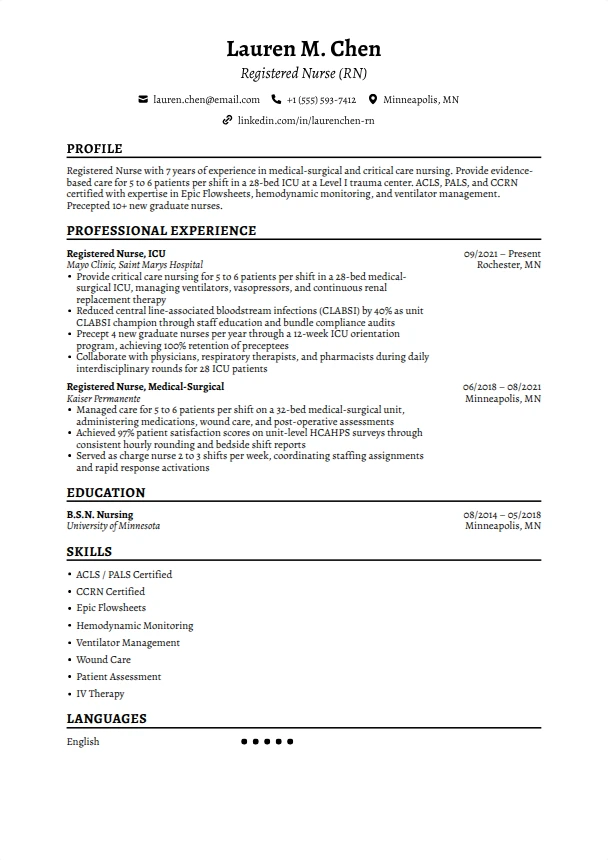
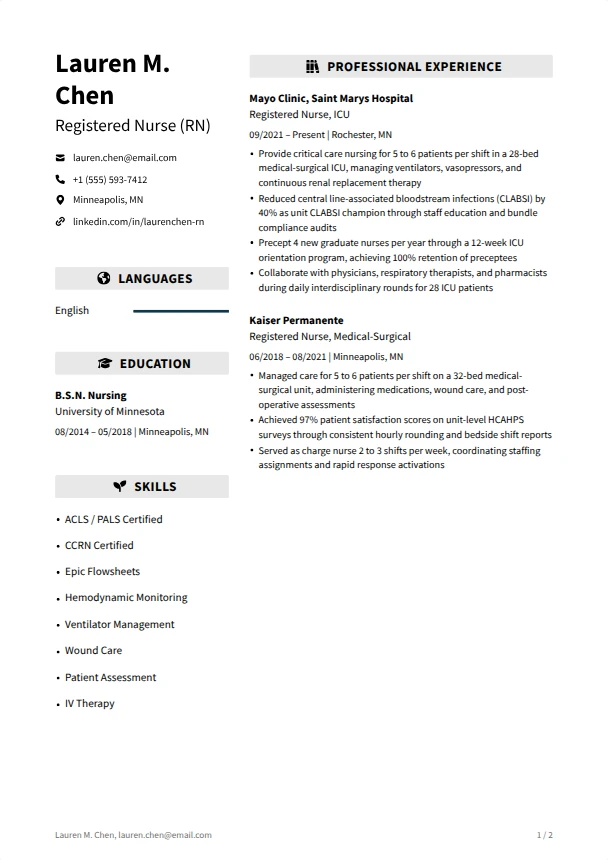
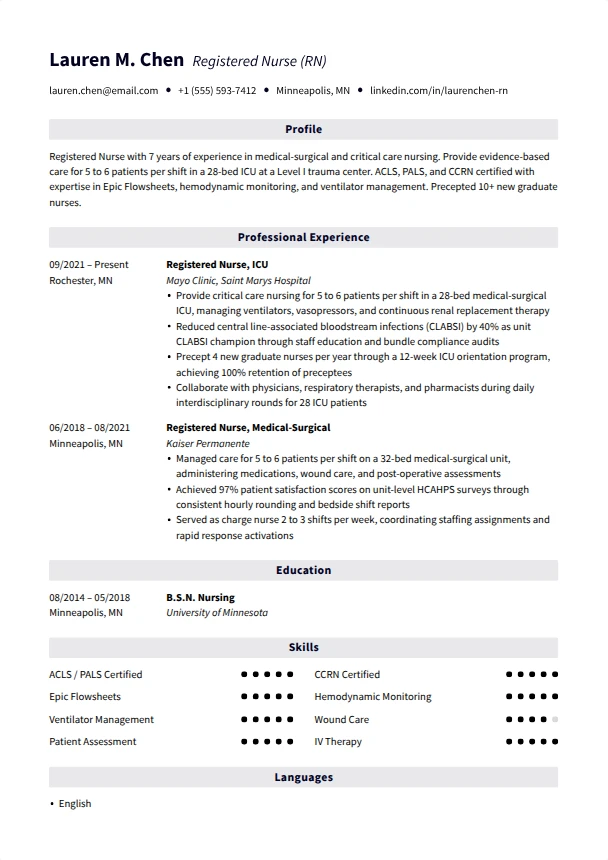
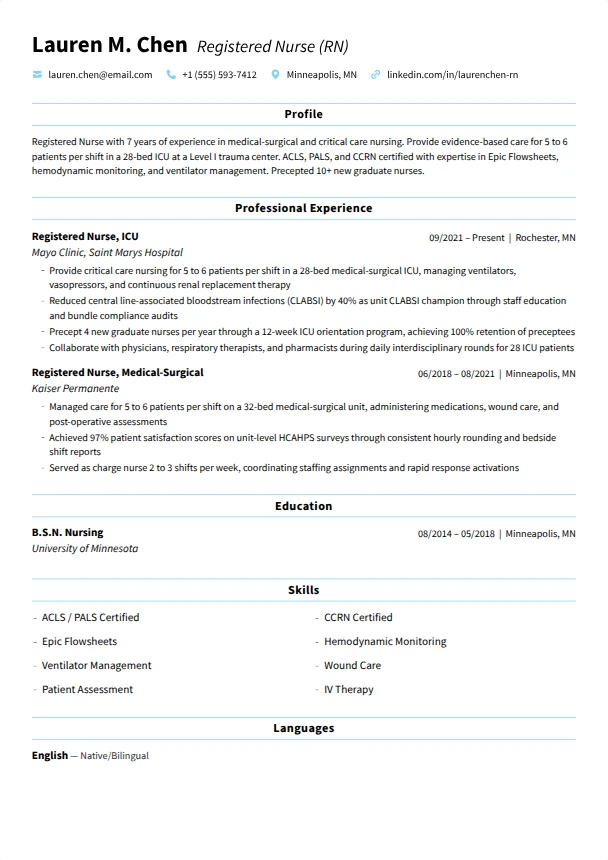
Lauren Chen, RN, BSN, CCRN · [email protected] · (555) 593-7412 · Minneapolis, MN
linkedin.com/in/laurenchen-rn
2. Professional summary (2-3 sentences)
State your RN license type, years of experience, unit specialty, patient ratio, and strongest clinical achievement.
Strong: "Registered Nurse with 7 years of medical-surgical and critical care experience and an active RN license. Provide evidence-based care, IV therapy, and telemetry monitoring for 5 to 6 patients per shift in a 28-bed ICU at a Level I trauma center. BLS, ACLS, and CCRN certified. Reduced CLABSI rates by 40% as unit infection prevention champion."
3. Licenses and certifications
RN license with state and expiration, BLS, ACLS, PALS, and specialty certifications. This section should be near the top of your resume.
RN License (Minnesota, #RN-384521, exp. 2027) · NCLEX-RN (passed 2018) · BLS (AHA, exp. 2027) · ACLS (AHA, exp. 2027) · PALS (AHA, exp. 2026) · CCRN (AACN, exp. 2028)
4. Clinical skills
Group by category: Clinical Procedures, Monitoring, Technology, and Specialties.
Procedures: IV therapy, medication administration, wound care, patient assessment and triage, Foley catheter
Monitoring: Telemetry and cardiac monitoring, hemodynamic monitoring, ventilator management, cardiac rhythm interpretation
Technology: Electronic Health Records (Epic, Cerner), Pyxis, IV pumps (Alaris, Baxter)
5. Work experience
Reverse chronological. Include hospital name, unit type, bed count, nurse-to-patient ratio, and 3-5 bullet points per role. Every bullet should include a clinical action and a measurable outcome.
Strong: "Provided critical care for 5 to 6 patients per shift in a 28-bed ICU, managing ventilators, vasopressor drips, IV therapy, and continuous renal replacement therapy. Reduced CLABSI rates by 40% through staff education and bundle compliance audits."
6. Education
BSN or ADN, school, graduation year. Include honors, clinical rotations, or capstone projects if you graduated within the last 3 years. If you are pursuing a higher degree (MSN, DNP), list it as in progress.
Key skills to include
These are the credential and clinical keywords registered nurse job postings and hospital ATS systems screen for in 2026. Pick the ones that match your unit and target role, using the exact wording from the posting.
Tip: If the job posting mentions a specific unit type, certification, or EHR system, add it using their exact wording. Registered nurse ATS systems filter aggressively on these keywords.
Resume summary examples you can steal
Use one as a starting point, then swap in your own technologies, numbers, and achievements.
"BSN-prepared registered nurse who passed the NCLEX-RN on the first attempt, with 720 clinical hours across medical-surgical, pediatric, and labor/delivery rotations. Performed patient assessment and triage, medication administration, and IV therapy for up to 4 patients per shift during senior practicum on a 36-bed telemetry unit. BLS and ACLS certified with proficiency in Epic."
Why it works: NCLEX-RN passage, clinical hours quantified, role-specific skills, patient ratio, and EHR proficiency.
"Registered Nurse with 4 years of experience and an active RN license on a 32-bed medical-surgical unit at a community hospital. Manage telemetry and cardiac monitoring, medication administration, and discharge planning for 5 to 6 patients per shift including post-operative, cardiac, and diabetic populations. Achieved 97% patient satisfaction on HCAHPS and serve as charge nurse 3 shifts per week."
Why it works: Active RN license, patient ratio, unit size, population types, satisfaction score, and leadership role.
"CCRN-certified ICU registered nurse with 7 years of critical care experience at a Level I trauma center. Manage ventilators, vasopressors, CRRT, IV therapy, and hemodynamic monitoring for 5 to 6 ICU patients per shift. Reduced CLABSI rates by 40% as unit infection prevention champion and precept 4 new graduate nurses annually."
Why it works: Specialty certification, high-acuity procedures, quality improvement metric, and precepting responsibilities.
"Travel RN with 5 years of experience across 8 hospital assignments in ICU, ER, and step-down units. Adapt to new Electronic Health Records (Epic, Cerner), unit protocols, and care teams within 1 to 2 shifts. BLS, ACLS, and PALS certified with a compact RN license covering 40 states."
Why it works: Multi-facility adaptability, compact license coverage, and breadth of unit experience.
Example Registered nurse resume
A short, illustrative registered nurse resume. The name and employers are fictional, so treat it as a model.
Maria Delgado, RN, BSN, CCRN
Phoenix, AZ · [email protected] · (555) 204-8810 · linkedin.com/in/mariadelgado-rn
Summary
Registered Nurse with 6 years of critical care experience and an active Arizona RN license. Provide IV therapy, telemetry and cardiac monitoring, and medication administration for 5 to 6 patients per shift in a 30-bed ICU. CCRN, BLS, and ACLS certified.
Licenses and Certifications
- Registered Nurse (RN) license, Arizona, exp. 2027; NCLEX-RN passed 2019
- BLS Provider and ACLS (American Heart Association)
- CCRN, Critical Care Registered Nurse, Adult (AACN Certification Corporation)
Experience
Staff Registered Nurse, ICU, Desert Vista Medical Center, Phoenix, AZ (2021 to present)
- Manage IV therapy, vasopressor titration, and telemetry and cardiac monitoring for 5 to 6 high-acuity patients per shift on a 30-bed ICU.
- Maintain care plan documentation in Epic, cutting charting errors flagged on audit by 30%.
- Led the unit central line bundle initiative, reducing CLABSI rates by 35% over 10 months.
- Deliver patient education and discharge planning that contributed to a 12% drop in 30-day readmissions.
Registered Nurse, Medical-Surgical, Saguaro Community Hospital, Mesa, AZ (2019 to 2021)
- Provided wound care and medication administration for 6 patients per shift, applying the five rights of medication administration on every pass.
- Served as charge nurse on weekend shifts for a 28-bed med-surg unit.
Education
Bachelor of Science in Nursing (BSN), Arizona State University, 2019
Writing strong experience bullets
Every bullet point should answer: "What did you do, and why did it matter?" Use this formula:
Before and after examples:
Provided patient care in the ICU.
Provided critical care nursing for 5 to 6 patients per shift in a 28-bed medical-surgical ICU, managing mechanical ventilation, vasopressor titration, IV therapy, and telemetry and cardiac monitoring.
Helped reduce infections on the unit.
Reduced central line-associated bloodstream infections (CLABSI) by 40% over 12 months as unit CLABSI champion through staff education sessions, daily bundle compliance audits, and standardized line insertion checklists.
Did medication administration and discharges.
Administered medications for 6 patients per shift using the five rights of medication administration, and delivered patient education and discharge planning that helped lower 30-day readmissions by 12%.
Strong action verbs for nursing resumes:
Assessed · Administered · Monitored · Titrated · Documented · Triaged · Precepted · Coordinated · Educated · Implemented · Reduced · Managed · Collaborated · Discharged · Responded · Led
Licenses and certifications worth listing
Credentials are the first thing a recruiter verifies. These come from the official issuing bodies, so list whichever you hold with the issuer and expiration date.
- NCLEX-RN (National Council Licensure Examination for Registered Nurses), National Council of State Boards of Nursing (NCSBN). Source
- Registered Nurse (RN) state license, State Board of Nursing (via NCSBN member boards). Source
- Basic Life Support (BLS) Provider, American Heart Association. Source
- Advanced Cardiovascular Life Support (ACLS), American Heart Association. Source
- CCRN (Critical Care Registered Nurse, Adult), AACN Certification Corporation. Source
- CEN (Certified Emergency Nurse), Board of Certification for Emergency Nursing (BCEN). Source
List only credentials you currently hold, and keep expiration dates accurate.
5 mistakes that get nursing resumes rejected
Not listing license and certification details
Your RN license state, number, and expiration date must be clearly visible, along with NCLEX-RN passage. Same for BLS, ACLS, PALS, and specialty certs. Many hospital ATS systems reject applications that are missing these keywords.
Writing 'provided patient care' without clinical specifics
Every nurse provides patient care. What matters is the unit type, acuity level, patient ratio, and specific interventions such as IV therapy, telemetry and cardiac monitoring, or medication administration. Managing 2 ICU patients on ventilators is very different from managing 6 med-surg patients.
Omitting quality metrics and outcomes
HCAHPS scores, infection rates, fall data, readmission metrics, and code response times are what separate a good nursing resume from a great one. If you contributed to any quality improvement, quantify the result.
Leaving out charge nurse and precepting experience
Leadership experience is critical for advancement. If you serve as charge nurse, precept new grads, or participate in unit committees, list it explicitly. These are often requirements for clinical ladder promotion.
Using a two-page resume with under 5 years of experience
Unless you have extensive certifications, publications, or committee involvement, keep your nursing resume to one page for your first 5 to 7 years. Nurse managers review hundreds of applications and appreciate conciseness.
What to do if you have no professional experience
New graduate registered nurses face a competitive job market, but hospitals have new-grad residency programs designed for you. Here is how to build a strong resume:
Lead with your clinical rotation hours and settings
Your BSN or ADN program included 600 to 1,000+ clinical hours across multiple settings. List each rotation: unit type, bed count, patient ratio, and skills practiced such as patient assessment and triage or medication administration.
Highlight your senior practicum in detail
Your final clinical practicum was essentially a job. Describe it like a work experience entry: facility name, unit type, preceptor relationship, patient load, and specific interventions you performed independently.
Pass NCLEX-RN and get BLS, ACLS, and PALS before you apply
Passing the NCLEX-RN and holding an active RN license are non-negotiable. Most new-grad programs also require BLS and ACLS, and PALS for pediatric and emergency roles. Having these before your first application puts you ahead of classmates who wait.
Apply to nurse residency programs
Major hospital systems (HCA, Ascension, Kaiser, Mayo Clinic, Cleveland Clinic) run structured nurse residency programs for new graduates. These programs expect zero experience beyond nursing school and provide 6 to 12 months of supported transition to practice.
Frequently asked questions
How long should a registered nurse resume be?
One page for new graduate registered nurses and RNs with under 7 years of experience. Two pages for experienced RNs with specialty certifications such as CCRN or CEN, committee involvement, publications, or charge nurse and management experience.
Should I put my RN license number on my resume?
Yes. Include your Registered Nurse (RN) license type, the state board that issued it, the license number, and the expiration date. Many recruiters verify the license against the state board before scheduling interviews, and having it readily available speeds up the process.
What is the most important section of a registered nurse resume?
Your licenses and certifications section. For registered nurses, the RN license and NCLEX-RN passage are the primary screening criteria. BLS, ACLS, PALS, and specialty certifications such as CCRN or CEN should appear near the top and be clearly formatted so ATS keyword filters can read them.
How do I handle gaps in my registered nurse career?
Be straightforward. If you took time off for family, education, or personal reasons, a brief note is fine. Focus on how you kept your RN license active and current: continuing education hours, BLS and ACLS renewals, refresher courses, or per diem work. Many hospitals offer return-to-practice programs for nurses re-entering the field.
What skills should a registered nurse put on a resume?
Lead with credential keywords and clinical skills that hospital ATS systems filter on: RN license, NCLEX-RN, BLS, ACLS, and PALS, plus patient assessment and triage, medication administration, IV therapy, telemetry and cardiac monitoring, wound care, and Electronic Health Records such as Epic and Cerner. Mirror the exact wording used in the job posting.
Skip the blank page
Open a complete, filled-in nursing resume in our free builder. Swap in your own details, keep the wording that fits, and download as PDF, free.
Build your nursing resume now
Pick a clean, ATS-friendly template, add your license and clinical experience, and download a polished PDF in minutes. Free, no account required.
Start Building, It's FreeRelated resume guides
Guide for certified nursing assistants, often the first step on the nursing career ladder.
Guide for all hospital roles including administrative and clinical support positions.
Broader guide covering clinical coordinators, patient care techs, and health services roles.
More resume examples: