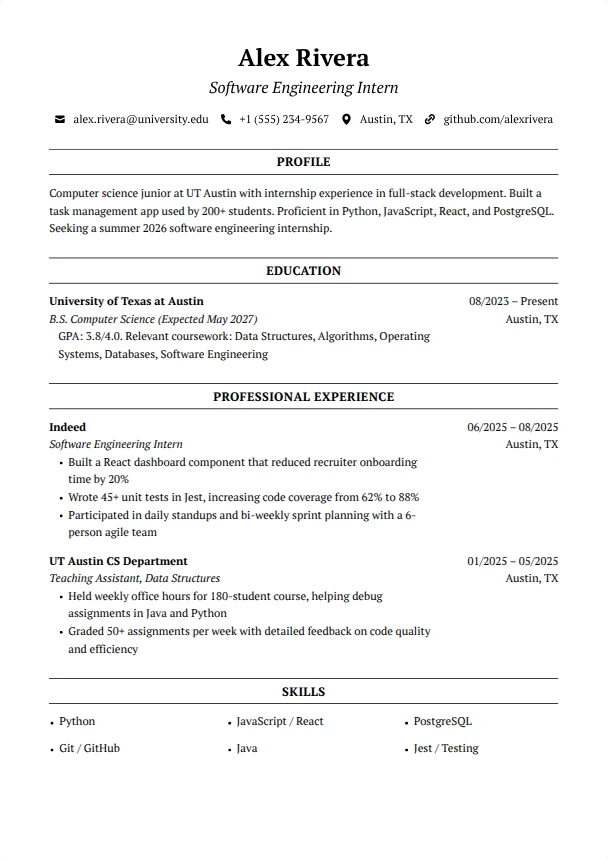
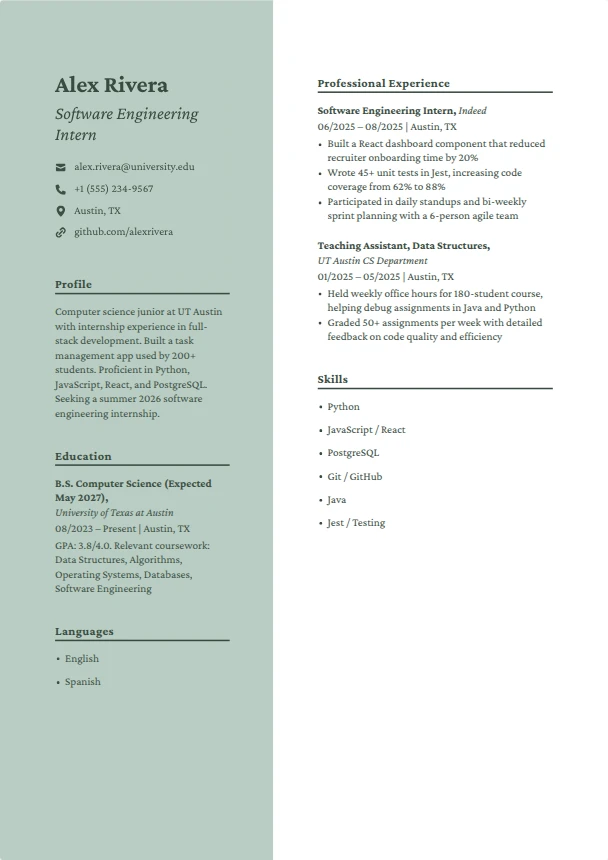
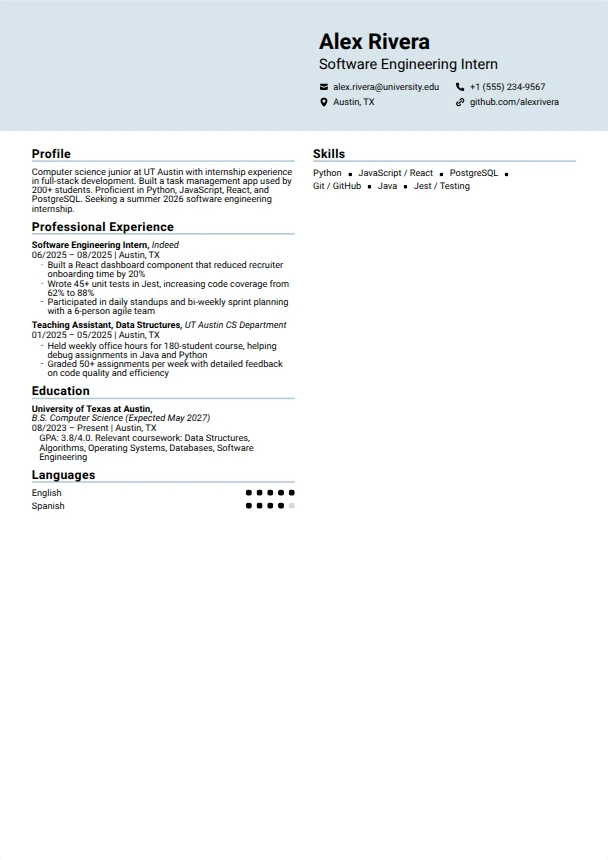
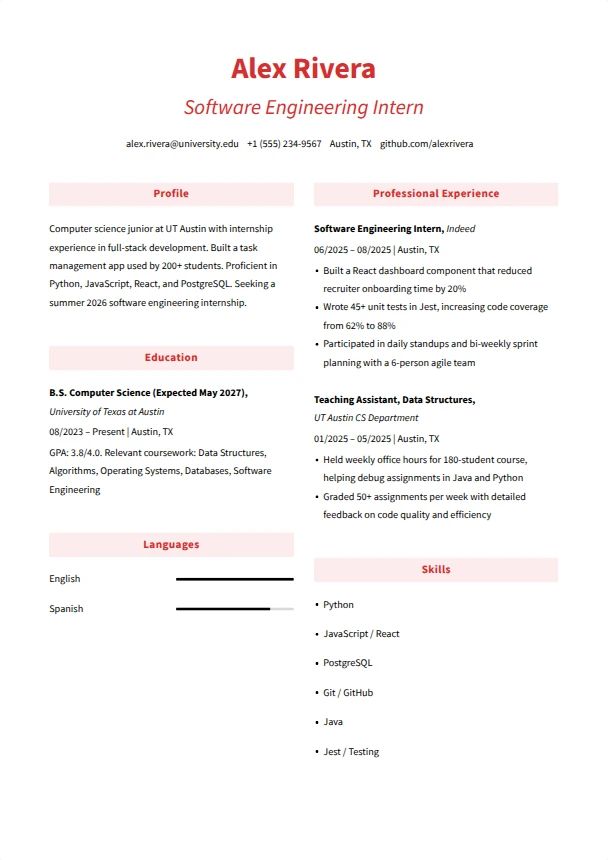
What hiring managers actually look for
Hiring managers evaluating intern candidates look for signals of growth potential and cultural fit. Your resume needs to demonstrate that you can learn quickly and contribute meaningfully.
-
1
Past internship performance is the strongest signal If you have completed an internship before, how you describe that experience is critical. Recruiters want to see specific contributions, not just a list of duties. Quantified results from a prior internship can carry more weight than a high GPA.
-
2
Transferable skills bridge experience gaps Retail, food service, tutoring, and campus jobs all build skills that translate to professional internships. Communication, time management, customer interaction, and problem-solving are valued across industries.
-
3
A tailored resume beats a perfect GPA Recruiters reviewing applications on Handshake and LinkedIn consistently report that candidates who customize their resume for each role advance further than those with stronger academics but generic applications.
If your resume communicates these things in the first 7-second scan, you'll make it to the detailed read. Everything below is about making that happen.
How to structure your resume, section by section
The order matters. Here's what a strong intern resume guide looks like from top to bottom:
Contact Information
List your name, email, phone, LinkedIn, and location. If you have a portfolio, personal website, or GitHub profile relevant to the role, include it. Use a professional email address tied to your university or a clean personal domain.
Marcus Rivera | [email protected] | (555) 789-0123 | linkedin.com/in/marcusrivera | Chicago, IL
Education
Place education near the top. Include your degree, major, university, expected graduation date, and GPA if it is 3.0 or above. Add relevant coursework, honors, or dean's list recognition. This section anchors your resume when professional experience is limited.
B.A. in Economics, State University, Expected December 2026 | GPA: 3.4 | Dean's List (3 semesters) | Relevant Coursework: Econometrics, Financial Accounting, Business Statistics
Professional Summary
Write a focused 2 to 3 sentence summary that positions you as an intern with specific skills and a clear goal. If you have prior internship experience, reference it briefly. If not, lead with your strongest academic or project credentials.
Strong: "Economics major with prior internship experience at a regional consulting firm, where I supported client research and built financial models in Excel. Seeking a summer 2026 analyst internship to apply quantitative skills and expand exposure to corporate strategy."
Internship and Work Experience
List your most relevant experience first, whether it is a previous internship, a part-time job, or a campus role. For each position, include the title, organization, dates, and 2 to 4 achievement-focused bullet points. Prioritize results over responsibilities.
Research Intern, Midwest Consulting Group (May 2025 to Aug 2025) | Conducted competitive analysis for 3 client engagements, contributing to $1.2M in retained contracts | Built an automated Excel dashboard that reduced weekly reporting time by 50%
Skills and Certifications
Group technical and soft skills into clear categories. Include tools, languages, and certifications relevant to your target role. If you have completed any online certifications or relevant training, list them here to show continued learning.
Technical: Excel (VLOOKUP, Pivot Tables), SQL, Tableau, Python | Certifications: Google Analytics Certificate | Soft Skills: Client communication, team collaboration, deadline management
Key skills to include
Your skills section should reflect both what you have learned in the classroom and what you have applied in projects or jobs. Match your listed skills to the internship description for the best results.
Tip: If the internship posting mentions a specific tool or platform, list it by name. Applicant tracking systems scan for exact keyword matches, so "Tableau" will score higher than "data visualization software."
Resume summary examples you can steal
Use one as a starting point, then swap in your own technologies, numbers, and achievements.
"Junior business administration student with internship experience at a Fortune 500 consumer goods company. Supported the product marketing team by coordinating campaign logistics and analyzing sales data, contributing to a 12% increase in Q3 promotional ROI. Seeking a second internship to deepen marketing analytics expertise."
Why it works: References a recognizable company context, includes a specific metric, and shows progression by seeking a second internship.
"Mechanical engineering sophomore with hands-on CAD experience from coursework and a university design competition. Modeled and 3D-printed a functional prosthetic hand prototype that placed second at the regional engineering showcase. Seeking a summer 2026 engineering internship to apply design and prototyping skills."
Why it works: Compensates for no prior internship by showcasing a tangible project with a competitive result, proving practical ability.
"Public policy major with volunteer coordination experience through a campus-affiliated nonprofit. Organized a fundraising event that raised $8,000 for local literacy programs and managed a team of 15 student volunteers. Looking to intern at a policy research organization during summer 2026."
Why it works: Shows leadership scale (15 volunteers), a clear financial result ($8,000 raised), and a focused career direction in policy.
"UX design student with a portfolio of 5 app redesign case studies and experience conducting usability testing for the university library website. Proficient in Figma, Adobe XD, and user research methodologies. Seeking a product design internship to contribute to user-centered design at scale."
Why it works: Highlights a portfolio, names specific tools, and grounds design skills in a real campus project rather than just coursework.
Writing strong experience bullets
Every bullet point should answer: "What did you do, and why did it matter?" Use this formula:
Before and after examples:
Assisted the marketing team with social media.
Created and scheduled 40+ social media posts across Instagram and LinkedIn during a 10-week internship, increasing follower engagement by 25%.
Worked on data analysis for a client project.
Analyzed 18 months of customer transaction data using SQL and Tableau, identifying a purchasing trend that informed a $200K reallocation of the client's ad budget.
Helped organize events for the student club.
Planned and executed 4 professional development workshops for a 120-member business fraternity, securing 3 industry speakers and achieving 90% attendee satisfaction ratings.
Strong action verbs for intern resume guide resumes:
Analyzed, Created, Coordinated, Built, Presented, Managed, Designed, Researched, Supported, Delivered, Organized, Automated, Streamlined, Launched, Evaluated
5 mistakes that get intern resume guide resumes rejected
Describing responsibilities instead of achievements
Saying you were "responsible for" a task does not show impact. Rewrite every bullet to start with an action verb and include a result. Hiring managers want to know what changed because of your work.
Burying your strongest experience
If your most impressive accomplishment is a project or campus role rather than a paid job, put it higher on the page. Recruiters scan from top to bottom, and your best material should appear in the top third of the resume.
Using an unprofessional email address
An email like [email protected] undermines an otherwise strong resume. Use your university email or create a clean personal email with your first and last name.
Including irrelevant personal information
Hobbies, age, marital status, and headshots are not standard on U.S. internship resumes. Save that space for another bullet point or skill that strengthens your candidacy.
Skipping proofreading
Typos and formatting inconsistencies suggest carelessness. Read your resume aloud, run spell check, and ask a friend or your university career center to review it before submitting.
What to do if you have no professional experience
Applying to internships without any prior experience is more common than you might think. Most employers hiring interns expect to train them, so your resume needs to prove you are capable of learning and contributing, not that you already know everything.
Feature class projects as portfolio pieces
Treat significant class projects like professional work. Describe the objective, your individual contribution, the tools you used, and the result. A well-documented project can be as convincing as an internship.
Include part-time and service jobs
Do not dismiss retail, restaurant, or campus employment. These roles develop communication, customer service, multitasking, and reliability. Frame each bullet around a transferable skill the internship requires.
Add certifications and online learning
Free and low-cost certifications from Google, Coursera, HubSpot, and others show initiative and fill skill gaps. A Google Analytics certificate or a Coursera Python specialization tells employers you invest in your own growth.
Network through campus resources
Visit your career center, attend career fairs, join professional student organizations, and build connections on LinkedIn and Handshake. Many internship offers come through networking rather than online applications alone.
Frequently asked questions
How do I list an internship on my resume?
Use the same format as any job: title, company name, location, dates, and 2 to 4 bullet points. Title it with your actual intern title (e.g., Marketing Intern) and focus bullets on what you accomplished, not just what you were assigned.
Should I include my internship if it was only a few weeks long?
Yes, as long as you can describe a meaningful contribution. Even a short internship shows that a company selected and trusted you. Focus on one or two strong bullet points rather than padding with generic tasks.
Is it okay to apply to multiple internships at the same company?
Check the company's policy first. Many large employers allow you to apply to two or three roles. Tailor your resume for each position and avoid submitting identical applications to different teams.
When should I start applying for summer internships?
For competitive programs at large companies, applications often open in August and close by November or December. Mid-size and smaller companies typically recruit from January through April. Start preparing your resume in the fall to have it ready for early deadlines.
Do I need a different resume for every internship application?
You do not need to rewrite from scratch, but you should adjust your summary, skills, and bullet point emphasis to match each posting. A few targeted changes can significantly improve your match rate with applicant tracking systems.
Skip the blank page
Open a complete, filled-in internship resume in our free builder. Swap in your own details, keep the wording that fits, and download as PDF, free.
Create Your Intern Resume Now
SmoothApply's resume builder helps you turn coursework, projects, and campus roles into a professional resume. Pick a template, fill in your details, and start applying to internships today.
Start Building, It's FreeRelated resume guides
A comprehensive guide to writing a resume for any internship application.
Targeted advice for summer internship applications, including seasonal timelines.
Transition from intern to full-time employee with a resume built for entry-level roles.
More resume examples: