What hiring managers actually look for
Summer internship programs are among the most competitive opportunities for college students. Understanding the recruiting timeline and what reviewers prioritize will help you submit a stronger application.
-
1
Spring applications face the highest volume Companies that recruit for summer internships between January and April receive the largest applicant pools of the year. Your resume needs to be scannable, keyword-optimized, and tailored to the specific role to survive both automated screening and a recruiter's quick review.
-
2
Availability dates matter more than you think Summer programs run on fixed schedules, often 10 to 12 weeks starting in late May or early June. Recruiters look for candidates whose availability matches the program dates. If your resume or application does not confirm your availability, it may be filtered out early.
-
3
Return offer potential shapes hiring decisions Many companies use summer internships as a pipeline for full-time hiring. Recruiters evaluate candidates not just on current skills but on long-term fit and growth potential. Showing enthusiasm for the company's mission and demonstrating a willingness to learn can set you apart.
If your resume communicates these things in the first 7-second scan, you'll make it to the detailed read. Everything below is about making that happen.
How to structure your resume, section by section
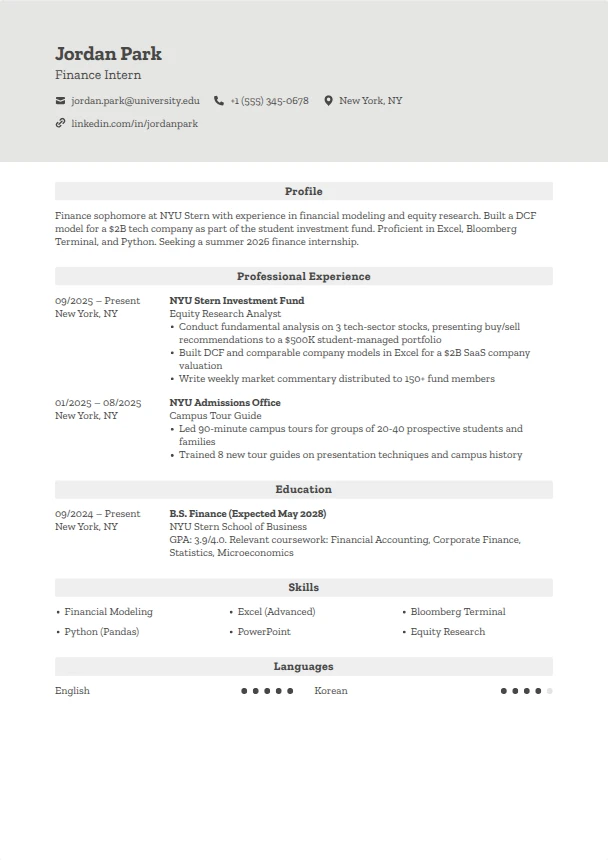
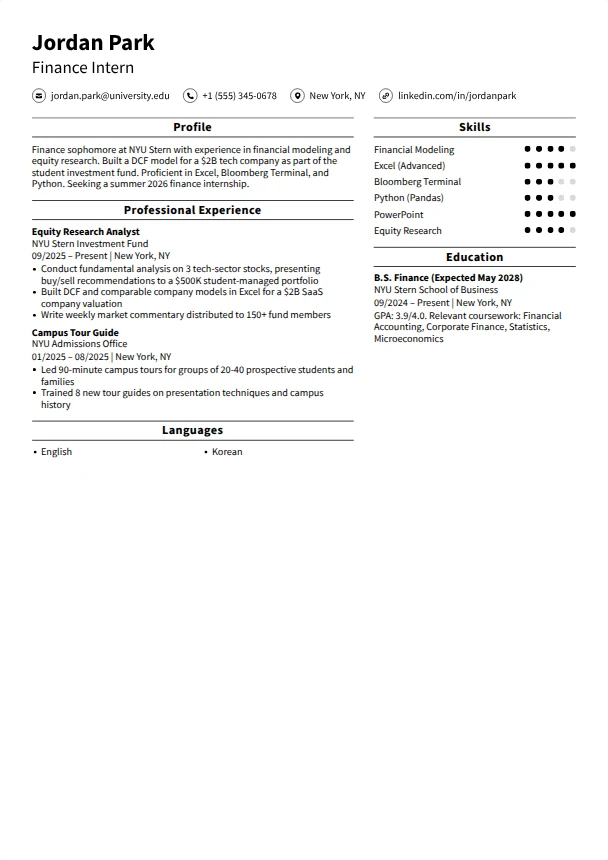
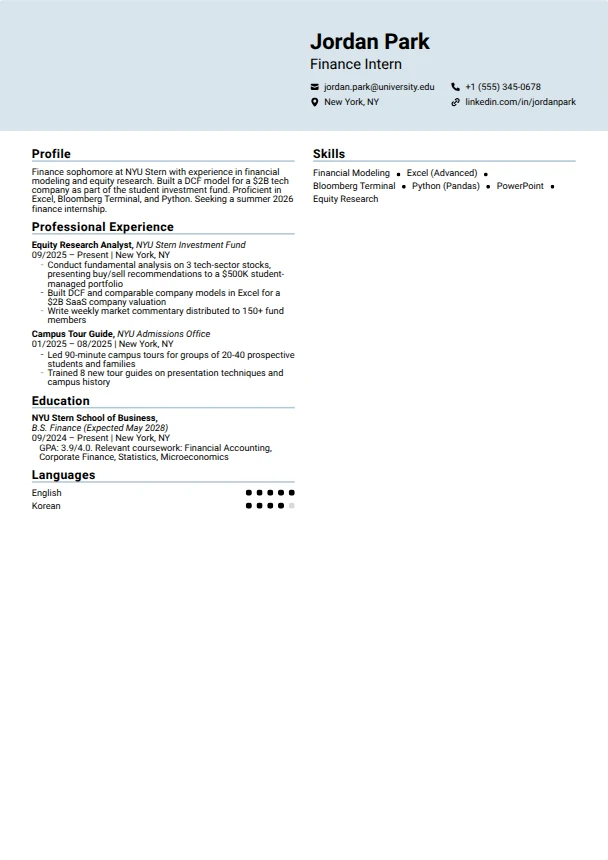
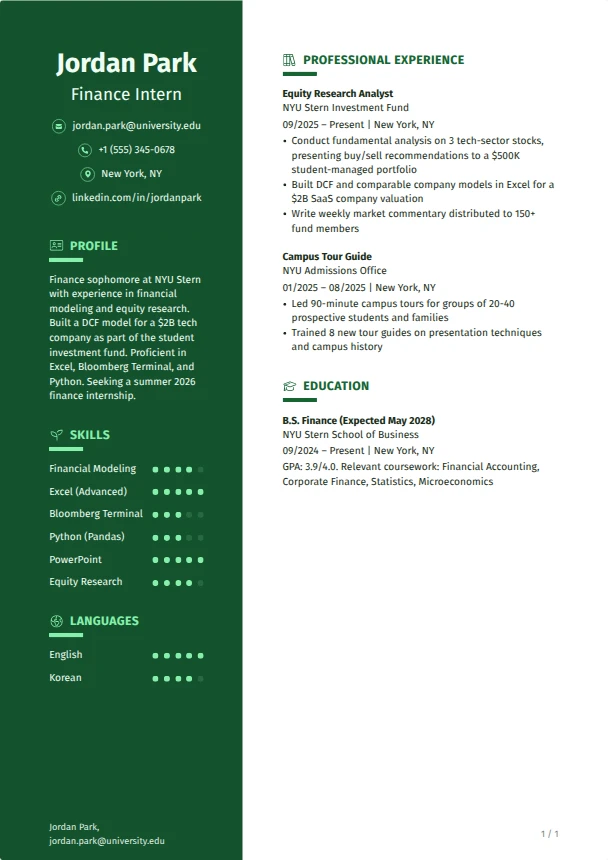
The order matters. Here's what a strong summer internship resume guide looks like from top to bottom:
Contact Information
Include your full name, university email or professional personal email, phone number, LinkedIn, and current city. If you will be relocating for the summer, you can mention your willingness to relocate in your summary or cover letter.
Priya Sharma | [email protected] | (555) 321-4567 | linkedin.com/in/priyasharma | San Jose, CA
Education
Lead with education. Include your school, degree, major, expected graduation date, GPA (3.0+), and relevant coursework. For summer internships, also mention any academic honors, scholarships, or dean's list recognition that signal strong performance.
B.S. in Information Systems, Santa Clara University, Expected May 2027 | GPA: 3.5 | Relevant Coursework: Database Management, Business Intelligence, Systems Analysis, IT Project Management
Summary Statement
Write a targeted 2 to 3 sentence summary that names the specific summer program or role type you are applying for. Mention your strongest qualifications and your availability for the summer term. This immediately tells the recruiter you are a serious, informed applicant.
Strong: "Information systems junior with project experience in SQL, Python, and Tableau. Led a 4-person team in building a business intelligence dashboard for a local nonprofit as part of a capstone course. Available full-time from May 26 through August 15, 2026 for a summer data analytics internship."
Projects and Experience
Combine internships, part-time jobs, academic projects, and campus roles into one or two sections. Order entries by relevance, not just chronology. For each entry, provide 2 to 4 bullet points that start with action verbs and include measurable outcomes whenever possible.
Business Intelligence Capstone Project (Jan 2026 to Apr 2026) | Designed a Tableau dashboard tracking donor engagement metrics for a local nonprofit, enabling the team to identify a 20% drop in recurring donations | Wrote SQL queries to clean and transform 3 years of donation data from a PostgreSQL database
Skills
List technical and professional skills in a compact format. Prioritize skills mentioned in the summer internship posting. Group them logically by category so the recruiter can quickly find what they need.
Technical: SQL, Python, Tableau, Excel (Pivot Tables, VLOOKUP) | Platforms: Salesforce, Google Analytics | Professional: Team leadership, stakeholder communication, deadline management
Key skills to include
Summer internship postings often list specific tools and competencies as requirements or preferences. Your skills section should mirror that language closely to pass automated screening and signal immediate readiness to contribute.
Tip: If you are still building a skill, list it only if you can discuss it confidently in an interview. Recruiters may test your proficiency during technical screens, especially for summer programs at larger companies.
Resume summary examples you can steal
Use one as a starting point, then swap in your own technologies, numbers, and achievements.
"Computer science sophomore with experience building web applications using React and Node.js. Completed a personal project, a budgeting app with 300 downloads on the App Store, and contributed to an open-source scheduling tool on GitHub. Available May through August 2026 for a summer software engineering internship."
Why it works: Names specific technologies, provides two concrete projects with a measurable result, and confirms summer availability upfront.
"Finance major with a 3.6 GPA and hands-on experience in equity valuation through the university investment club, where I managed a $50,000 simulated portfolio. Proficient in Excel financial modeling and Bloomberg Terminal. Seeking a summer 2026 investment banking or equity research internship."
Why it works: Combines academic credentials with a specific extracurricular accomplishment and names industry-standard tools that recruiters expect.
"Business strategy junior with case competition experience, placing in the top 5 at the regional DECA championship. Strong analytical and presentation skills developed through coursework in managerial economics and organizational behavior. Available for a 10-week summer consulting internship starting June 2026."
Why it works: Highlights a competitive achievement, names relevant coursework, and specifies the program length and start date to show awareness of consulting recruiting norms.
"Sociology major with 200+ hours of community service coordinating literacy programs for underserved youth. Experienced in grant writing, event logistics, and volunteer management. Looking for a summer 2026 program management internship at a mission-driven organization."
Why it works: Quantifies service hours, lists directly relevant operational skills, and uses language that aligns with nonprofit job postings.
Writing strong experience bullets
Every bullet point should answer: "What did you do, and why did it matter?" Use this formula:
Before and after examples:
Worked on a research project for my professor.
Collected and analyzed survey data from 500 respondents using SPSS for a faculty-led study on consumer behavior, contributing to a paper accepted at a regional economics conference.
Managed the social media accounts for my sorority.
Developed a content calendar and managed Instagram and TikTok accounts for a 150-member sorority chapter, growing combined following by 800 new followers over one semester.
Did some coding for a class project.
Built a Python web scraper that collected pricing data from 5 e-commerce sites, enabling a course team to complete a competitive analysis project two days ahead of the deadline.
Strong action verbs for summer internship resume guide resumes:
Built, Collected, Developed, Managed, Analyzed, Designed, Implemented, Coordinated, Presented, Automated, Researched, Organized, Delivered, Supported, Evaluated
5 mistakes that get summer internship resume guide resumes rejected
Missing the application deadline
Summer internship deadlines vary widely. Large companies often close applications by December or January, while smaller firms recruit through April. Research each company's timeline and set calendar reminders so your polished resume is ready well before the deadline.
Not mentioning availability dates
Summer programs have fixed start and end dates. If your resume or application does not confirm when you are available, recruiters may pass you over for a candidate who does. Include your availability in your summary or a note at the top of your resume.
Overloading the resume with filler content
A resume packed with vague phrases like "team player" or "strong work ethic" without supporting evidence wastes space. Replace every filler phrase with a specific example or metric that proves the claim.
Using the same resume for fall and spring applications
Your resume should evolve each semester as you complete new courses, projects, and activities. Update it before each application cycle to reflect your most current qualifications.
Neglecting to tailor for the specific program
Summer internship programs at different companies value different things. A startup may prioritize adaptability and side projects, while a large bank may weight GPA and technical certifications. Read the posting carefully and adjust your emphasis accordingly.
What to do if you have no professional experience
If this is your first time applying for a summer internship and you have no prior work or internship experience, do not worry. Thousands of students are in the same position. Focus on demonstrating curiosity, capability, and readiness to learn.
Build a project before application season
Start a personal or class project in the fall semester that you can feature on your spring applications. A completed project with a clear outcome gives you material for 2 to 3 strong bullet points and shows you take initiative outside the classroom.
Volunteer or take on a campus leadership role
Join a student organization and seek a leadership position, even a small one like committee chair or event coordinator. By the time spring recruiting begins, you will have tangible accomplishments to add to your resume.
Attend career fairs and info sessions early
Career fairs are not just for applying. They are for learning what companies look for and making a first impression. Attend in the fall to gather intelligence, then apply in the spring with a resume informed by those conversations.
Use your university career center
Most universities offer free resume reviews, mock interviews, and connections to alumni. Career counselors can help you identify transferable skills from everyday activities that you might overlook. They also have access to exclusive internship listings on Handshake and other platforms.
Frequently asked questions
When should I apply for summer 2026 internships?
For large companies in finance, consulting, and tech, many applications open in August 2025 and close by January 2026. Mid-size companies and startups typically recruit from January through April 2026. Start preparing your resume in the fall so you are ready for early deadlines.
Should I mention that I am available for the full summer?
Yes. Including your availability dates in your summary or a header note removes uncertainty for the recruiter. Something like "Available full-time, May 26 through August 15, 2026" is clear and helpful.
How do I handle a gap between spring semester and the internship start date?
If there is a short gap, it usually does not matter. If the gap is significant, consider using the time productively by completing an online certification, volunteering, or starting a personal project. You can mention these activities on your resume to show continuous growth.
Is it worth applying to summer internships if I am a freshman?
Absolutely. While some competitive programs target juniors, many companies have programs designed specifically for freshmen and sophomores. Look for "discovery" or "exploratory" internship programs at large firms, and also consider smaller companies that are open to all class years.
Can I list a summer internship I have not started yet on my resume?
No. Do not list a position you have not begun. However, once you have accepted an offer you can mention it in a cover letter or interview to show your trajectory. Only add it to your resume after you have started and can describe actual contributions.
Skip the blank page
Open a complete, filled-in internship resume in our free builder. Swap in your own details, keep the wording that fits, and download as PDF, free.
Start Your Summer Internship Resume
Spring deadlines are approaching. Use SmoothApply's resume builder to create a clean, professional resume that is ready for summer internship applications. Choose a template and get started in minutes.
Start Building, It's FreeRelated resume guides
General guide for writing an internship resume for any type of program or industry.
Advice for positioning yourself as a current or former intern on your resume.
Ready to move from internships to a full-time role? This guide covers the transition.
More resume examples: