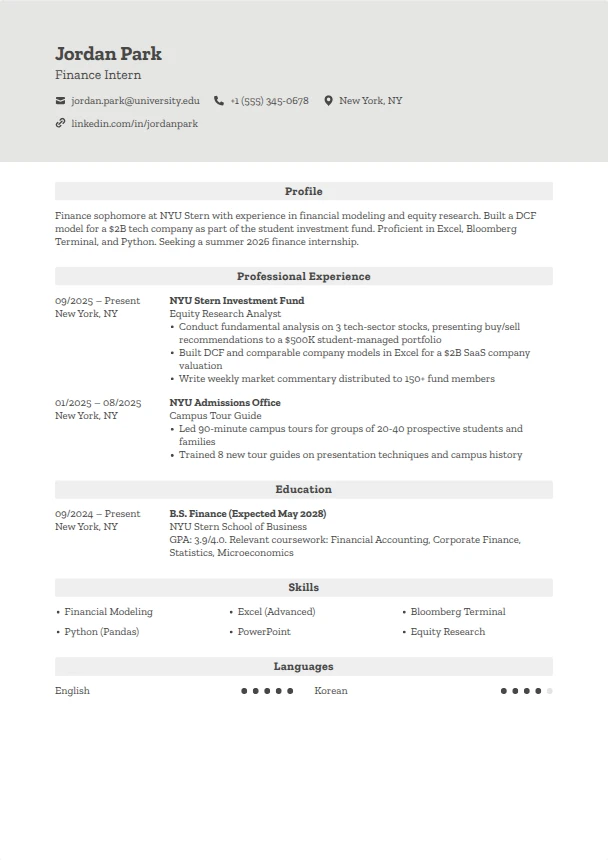
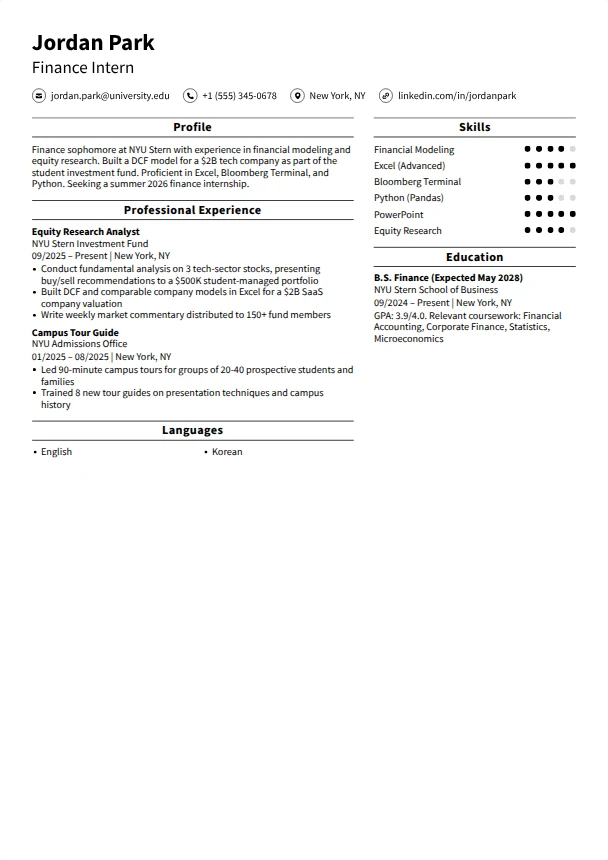
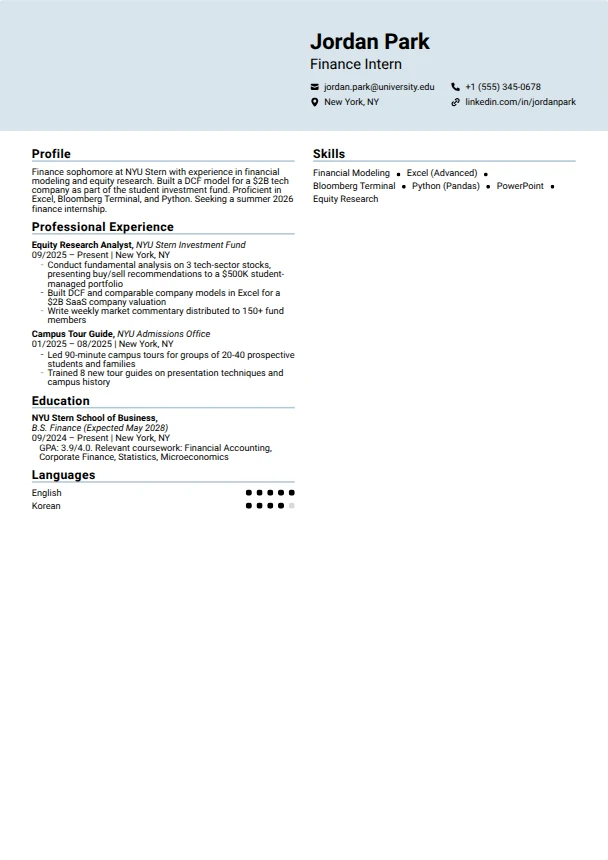
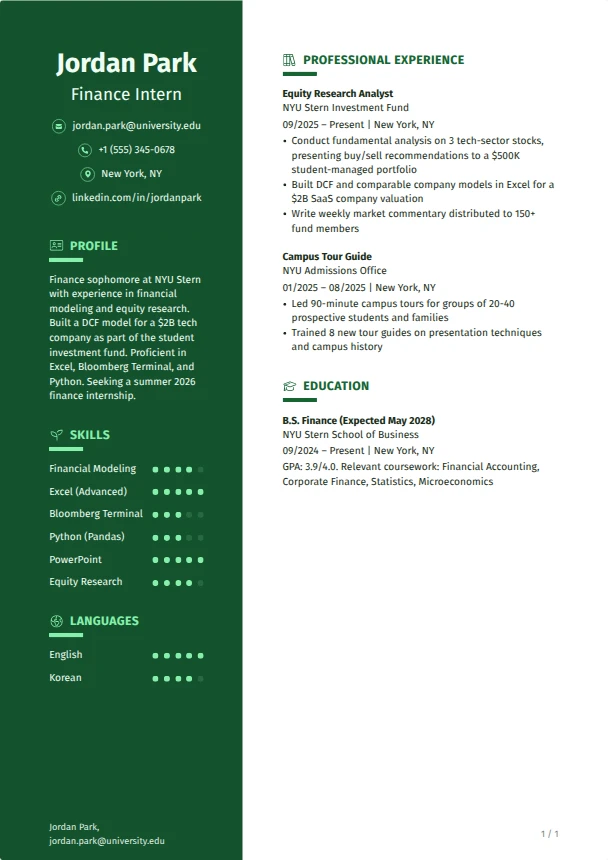
What hiring managers actually look for
Summer internship recruiters review hundreds of applications from students with similar backgrounds. The three things that make a no-experience candidate stand out are:
-
1
Timing and preparation that show genuine interest. Applying early with a tailored resume signals that you planned ahead. Many top summer programs fill months before the start date. A well-prepared application demonstrates the same organizational skills the company wants in an intern.
-
2
Projects and coursework relevant to the company's work. Recruiters want to see that your academic background maps to their industry. A finance internship application with coursework in valuation and a stock analysis project gets attention. Generic resumes do not.
-
3
Soft skills demonstrated through real examples. Claiming you are a team player is meaningless without proof. Leading a club, coordinating a campus event, or tutoring peers gives recruiters concrete evidence of collaboration, communication, and responsibility.
If your resume communicates these things in the first 7-second scan, you'll make it to the detailed read. Everything below is about making that happen.
How to structure your resume, section by section
The order matters. Here's what a strong summer internship resume (no experience) looks like from top to bottom:
1. Contact header
Keep it clean: full name, professional email, phone number, city and state, LinkedIn. Add a GitHub or portfolio URL if relevant to the role. Two lines maximum.
Sophia Martinez · [email protected] · (555) 567-8901 · Los Angeles, CA
linkedin.com/in/sophiamartinez · sophiamartinez.com
2. Professional summary
Write a two to three sentence summary that names your major, highlights your most relevant project or achievement, and states that you are targeting a summer internship specifically. Mentioning 'summer' signals availability and intent.
Strong: "Junior Marketing major at UCLA with coursework in digital strategy, consumer behavior, and analytics. Grew a campus food blog's Instagram from 200 to 3,500 followers in 4 months using data-driven content planning. Seeking a summer marketing internship to apply content strategy and social analytics skills at a consumer brand."
3. Education
Place education prominently since it is your strongest credential. Include degree, school, expected graduation, GPA (if 3.0+), relevant coursework, and any honors. For summer internships, mentioning your expected graduation year helps recruiters assess where you are in your academic journey.
B.A. Marketing, UCLA (Expected June 2027)
GPA: 3.4 · Dean's List (Fall 2025)
Relevant Coursework: Digital Marketing Strategy, Consumer Behavior, Marketing Analytics, Brand Management
4. Projects and campus involvement
This is where you demonstrate capability without formal employment. List 2 to 4 projects or campus roles, each formatted like a professional position with a title, timeframe, and achievement-oriented bullets.
Campus Food Blog | Creator and Content Strategist (Sep 2025 - Present)
• Grew Instagram following from 200 to 3,500 in 4 months using a data-driven posting schedule
• Analyzed weekly engagement metrics to optimize content type, posting times, and hashtag strategy
• Partnered with 8 local restaurants for sponsored posts, generating $600 in revenue
5. Skills
List 8 to 12 skills organized by category. Match them to the summer internship posting whenever possible. Only include skills you can discuss confidently in an interview.
Key skills to include
These skills appear frequently in summer internship postings. Focus on the ones that match both the role and your genuine abilities.
Tip: Summer internship postings often list 'preferred' and 'required' skills separately. Make sure every required skill appears on your resume if you have it. Preferred skills are a bonus, not a necessity.
Resume summary examples you can steal
Use one as a starting point, then swap in your own technologies, numbers, and achievements.
"Sophomore Chemical Engineering major at Purdue with a 3.6 GPA and coursework in organic chemistry, thermodynamics, and process control. Designed a water filtration prototype using activated carbon for a sustainability course, reducing simulated contaminant levels by 35%. Seeking a summer engineering internship to apply lab and analytical skills in an industrial setting."
Why it works: Ties coursework to a hands-on project with a quantified result, names the specific internship type and season.
"Junior Finance major at Indiana University with coursework in corporate finance, valuation, and Excel-based financial modeling. Completed a DCF valuation of a publicly traded company as a semester project, presenting findings to a panel of 3 finance professors. Looking for a summer finance internship to apply modeling and analytical skills at an investment firm."
Why it works: Describes a specific finance project with professional relevance, quantifies the audience, and targets a clear summer role.
"Sophomore Communications major with a minor in Film and a 3.5 GPA. Wrote, directed, and edited a 10-minute short film selected for the campus film festival, managing a 6-person production crew and a $500 budget. Seeking a summer internship in content production or media to grow storytelling and production skills."
Why it works: Quantifies creative work across multiple dimensions, shows leadership and budget management, and names a broad but relevant target.
"Computer Science sophomore at the University of Washington with coursework in data structures, algorithms, and systems programming. Built a task automation tool in Python that reduced manual file processing time by 70% for a student org. Eager to contribute coding and problem-solving skills during a summer software engineering internship."
Why it works: Highlights a real tool with measurable impact, connects coursework to practical application, and specifies the summer internship target.
Writing strong experience bullets
Every bullet point should answer: "What did you do, and why did it matter?" Use this formula:
Before and after examples:
Worked on a team project for my chemistry class.
Collaborated with 3 teammates to design a water filtration prototype using activated carbon, testing 5 filter configurations and achieving a 35% reduction in simulated contaminant levels.
Helped organize events for my fraternity.
Planned and executed 4 fundraising events for a 70-member fraternity chapter, raising $3,200 for local charities and increasing member participation by 40% compared to the previous year.
Did social media for a campus group.
Managed Instagram and TikTok accounts for a 300-member campus organization, creating 60+ posts over one semester and growing combined follower count from 500 to 2,100.
Strong action verbs for summer internship resume (no experience) resumes:
Analyzed · Built · Collaborated · Coordinated · Created · Designed · Developed · Directed · Drafted · Executed · Grew · Led · Managed · Organized · Planned · Produced · Published · Raised · Researched · Tested · Wrote
5 mistakes that get summer internship resume (no experience) resumes rejected
Applying too late with a generic resume
Many top summer internships have application deadlines months before summer starts. Companies like banks and tech firms recruit in fall for summer roles. Prepare your resume early and tailor it for each program.
Failing to mention summer availability
If the posting is specifically for a summer role, your summary should mention 'summer internship.' This confirms your availability and shows you read the posting carefully.
Listing responsibilities instead of achievements
Saying 'responsible for managing social media' tells the recruiter nothing about your impact. Say 'grew Instagram following by 200% in one semester through a data-driven content strategy' instead.
Using an unprofessional email address
An email like [email protected] undermines your credibility before the recruiter reads a single bullet point. Use a professional format like [email protected].
Submitting without proofreading
Typos and grammar errors are among the fastest ways to get eliminated from a summer internship pool. Read your resume aloud, use spell check, and have someone else review it before submitting.
What to do if you have no professional experience
Summer internship applications are built for students, and most students have limited or no work experience. Here is how to fill your resume with compelling content:
Start building your resume in the fall semester
Many summer internship deadlines land between September and January. Begin documenting your coursework, projects, and campus activities early so you are not scrambling at the last minute.
Use spring semester projects from the previous year
If you completed a strong class project, hackathon, or research assignment in the spring, it is still fresh and relevant for summer applications. Do not limit yourself to just the current semester.
Leverage winter break for quick wins
Complete an online certificate, build a small personal project, or volunteer during winter break. Even a two-week effort gives you new content to add to your resume before the spring application wave.
Apply broadly and tailor each resume
Do not put all your energy into one dream company. Apply to 10 to 15 summer programs, adjusting your summary and skills section for each one. Volume combined with quality gives you the best odds.
Frequently asked questions
When should I start applying for summer internships?
Start in September or October for the following summer. Large companies in finance, consulting, and tech often close applications by January. Smaller companies and startups may recruit later, but earlier is always better.
Can I get a summer internship as a freshman?
Yes. Many companies have programs specifically for first-year students. Focus your resume on coursework, personal projects, and high school achievements if you are early in your college career.
Should I mention that I have no prior internship experience?
Never. Focus on what you have done, not what you have not. Your coursework, projects, and campus involvement are your experience. Present them confidently and let the recruiter draw their own conclusions.
How many summer internships should I apply to?
Aim for 10 to 20 applications with tailored resumes. A higher volume increases your chances, but only if each application is customized to the specific role. Quality and quantity both matter.
Is a cover letter necessary for summer internship applications?
If the application includes a cover letter field, submit one. Keep it under one page, explain why you want to intern at that specific company, and connect your coursework or projects to the role. Even when optional, it can set you apart.
Skip the blank page
Open a complete, filled-in internship resume in our free builder. Swap in your own details, keep the wording that fits, and download as PDF, free.
Build your summer internship resume now
Pick a clean template, add your coursework and projects, and download a polished PDF in minutes. Free, no account required.
Start Building, It's FreeRelated resume guides
Complete guide to writing a resume for competitive summer internship programs.
Broader guide for writing any internship resume when you have no work history.
General guide for anyone entering the workforce with zero professional experience.
More resume examples: