What hiring managers actually look for
Security hiring managers evaluating candidates without professional experience focus on three specific signals:
-
1
Security-specific certifications as minimum proof. CompTIA Security+ is the baseline that tells a manager you understand security fundamentals. Without it, most entry-level security resumes don't survive initial screening especially for government-adjacent or defense roles where it's often a contractual requirement.
-
2
Hands-on security tool experience from labs or CTFs. Completing TryHackMe rooms, HackTheBox challenges, or building a home security lab with Splunk and Suricata demonstrates practical skill that certification alone doesn't prove. Managers want to see you've used the tools, not just studied them.
-
3
IT operational background as a foundation. Most security professionals started in help desk, sysadmin, or networking roles. If you have IT experience, frame it as security-adjacent: firewall rules you configured, access controls you managed, or incidents you escalated.
If your resume communicates these things in the first 7-second scan, you'll make it to the detailed read. Everything below is about making that happen.
How to structure your resume, section by section
The order matters. Here's what a strong cybersecurity resume (no experience) looks like from top to bottom:
1. Contact header
Name, email, phone, city/state, LinkedIn. Include your TryHackMe or HackTheBox profile, security blog, or GitHub with security scripts. These links differentiate you from other candidates without experience.
Sarah Mitchell · [email protected] · (555) 456-7890 · Raleigh, NC
linkedin.com/in/sarahmitchell-sec · tryhackme.com/p/smitchell
2. Professional summary (2-3 sentences)
Without security job titles, lead with your security certification, hands-on lab work, and any IT background. Be specific about what you've doneavoid vague statements about being ' passionate about security.'
Strong: "CompTIA Security+ certified professional with 200+ hours of hands-on security training through TryHackMe (top 5% globally) and a home security lab running Splunk, Suricata IDS, and Kali Linux. Former IT support specialist with 2 years of experience managing Active Directory, firewall rules, and access controls for 300 users."
3. Security certifications
Certifications are your primary credential when you lack experience. List Security+ first, then any vendor or platform certs. Include in-progress certs with dates Cy SA+ or OSCP in progress signals ambition.
CompTIA Security+ (2025) · CompTIA Cy SA+ (in progress, expected Sept 2026) · Splunk Core Certified User (2025) · TryHackMe Top 5% (2026)
4. Technical skills
Group by security domain: Monitoring & SIEM, Endpoint Security, Network Security, Scripting, Frameworks. Only include tools you've actually usedeven if only in a lab setting.
SIEM: Splunk (home lab), ELK Stack
Network: Wireshark, Nmap, Suricata IDS, pfSense
Endpoint: Windows Defender, Sysinternals, Autoruns
Offensive: Kali Linux, Burp Suite, Metasploit (lab)
Frameworks: NIST CSF, MITRE ATT&CK, CIS Controls
5. Security projects & labs
This section is critical for no-experience candidates. Describe your home lab, CTF achievements, and any security research. Treat each like a professional project with specific tools, scope, and outcomes.
Strong: "Built a home security lab with Splunk Enterprise (free license), Suricata IDS, and a Windows domain environment. Simulated 5 attack scenarios (brute force, phishing, lateral movement) and created detection rules that generated alerts with 90% accuracy. Documented all configurations and detection logic in a 25-page technical write-up."
6. IT experience & education
List any IT roles with security-relevant bullet points emphasized. For non-IT backgrounds, highlight any work involving compliance, risk assessment, investigations, or access management.
Key skills to include
For entry-level cybersecurity roles, focus on SOC analyst and security operations skills. These are the tools and concepts most frequently required in junior security job postings.
Tip: If your skills come from a lab environment, don't add '(lab only)' as a qualifier. The projects section establishes that context. In your skills section, ' Splunk'is ' Splunk'whether you learned it at a SOC or in your apartment.
Resume summary examples you can steal
Use one as a starting point, then swap in your own technologies, numbers, and achievements.
"IT support specialist transitioning to cybersecurity with CompTIA Security+ certification and 200+ hours of hands-on SIEM and detection training. Built a home security lab running Splunk, Suricata, and a Windows AD environment to simulate and detect common attack patterns. Brings 2 years of help desk experience managing access controls, firewall rules, and endpoint security for 300 users."
Why it works: Security cert + quantified lab hours + IT background framed as security-relevant = strong SOC analyst candidate.
"Cybersecurity major with CompTIA Security+ certification and hands-on experience from a university SOC internship monitoring network traffic for 5,000+ campus users. Completed 150+ TryHackMe challenges (top 5% rank) covering web exploitation, privilege escalation, and network forensics. President of university cybersecurity club, organizing 4 CTF competitions."
Why it works: Academic focus + certification + real SOC internship + CTF leadership demonstrates passion and preparation.
"Former financial analyst transitioning to cybersecurity with CompTIA Security+ and Splunk Core Certified User credentials. Built a security home lab to practice threat detection, log analysis, and incident response workflows. Completed TryHackMe SOC Level 1 learning path. Brings 4 years of experience in data analysis, compliance reporting, and risk assessment directly applicable to security operations."
Why it works: Finance background reframed as risk/compliance experience, multiple credentials, home lab, and structured learning path.
"U. S. Air Force cyber operations specialist transitioning to civilian cybersecurity with CompTIA Security+ and CEH certifications. Monitored classified network traffic and triaged security alerts for a 500-user installation. Holds active Secret clearance. Completed 100+ HackTheBox challenges and maintains a security research blog documenting vulnerability analyses."
Why it works: Military cyber experience, active clearance (huge differentiator), dual certifications, and continuous learning evidence.
Writing strong experience bullets
Every bullet point should answer: "What did you do, and why did it matter?" Use this formula:
Before and after examples:
Practiced using security tools in a home lab.
Built and maintained a security operations lab with Splunk Enterprise, Suricata IDS, and a 3-VM Windows domain. Created 12 custom detection rules for brute force, lateral movement, and privilege escalation attacks, achieving a 90% true-positive alert rate across simulated scenarios.
Managed user accounts and passwords at my IT job.
Administered Active Directory for 300 users, enforcing MFA, password policies, and conditional access rules. Investigated 5 account compromise incidents, identifying unauthorized access within 30 minutes and completing remediation within 2 hours.
Completed CTF challenges online.
Completed 200+ TryHackMe challenges across web exploitation, network forensics, and malware analysis paths, earning top 5% global ranking. Documented detailed write-ups for 30 challenges, publishing them on a personal security blog.
Strong action verbs for cybersecurity resume (no experience) resumes:
Monitored · Investigated · Detected · Triaged · Analyzed · Configured · Deployed · Built · Documented · Simulated · Remediated · Reported · Hardened · Scanned · Correlated · Scripted · Assessed · Escalated
6 mistakes that get cybersecurity resume (no experience) resumes rejected
Leading with ' passionate about cybersecurity'instead of credentials
Everyone applying to security roles claims passion. What separates you is evidence: certifications, lab hours, CTF rankings, and documented projects. Replace passion statements with proof statements.
Not documenting your security lab work
A lab you can't describe is a lab that doesn't exist on your resume. Write detailed bullet points for every lab project: what you deployed, what attacks you simulated, what you detected, and what you learned.
Applying to senior security roles without entry-level experience
Target SOC Analyst, Junior Security Analyst, or Security Operations Center Tier 1 roles. These positions are designed for people entering the field. Senior roles require 3-5+ years of professional security experience.
Ignoring your IT background on a security resume
If you've done help desk, sysadmin, or networking work, that experience is directly relevant to security. Firewall management, access controls, incident escalation, and endpoint configuration are all security-adjacent skills.
Listing offensive tools without defensive context
Listing Metasploit and Burp Suite without explaining how you used them defensively can raise flags. Frame offensive tool experience in a detection context: ' Used Metasploit to simulate attacks and developed Splunk detection rules for each technique.'
Skipping Security+ because you think you'll get OSCP first
Security+ is the industry's entry ticket especially for government and defense roles where it's required under Do D 8570. Get Security+ first, then work toward Cy SA+ or OSCP. Don't skip the baseline.
What to do if you have no professional experience
This entire guide is designed for your situation. Here are four concrete steps to build a security resume from zero:
Pass CompTIA Security+ in 8-10 weeks
Use Professor Messer (free) or Jason Dion's course (Udemy). Security+ validates your understanding of threats, vulnerabilities, and security operations. It's required for many government security roles and respected industry-wide.
Build a home security lab in one weekend
Install VirtualBox, spin up a Windows AD environment, add Splunk Free and Suricata IDS. Simulate attacks using Atomic Red Team or manual techniques. Create detection rules. Document everything with screenshots. Total cost: $0.
Complete TryHackMe SOC Level 1 path
This structured learning path covers log analysis, SIEM, network forensics, and incident responsethe exact skills SOC analysts use daily. It takes 40-60 hours and gives you a verifiable achievement to list on your resume.
Start a security blog or write-up portfolio
Document your CTF solutions, lab configurations, and vulnerability analyses. A blog with 10-15 technical write-ups proves analytical thinking and communication skillsboth critical for security roles where you'll need to write incident reports.
Frequently asked questions
Can I get a cybersecurity job with no IT experience at all?
It's harder but possible. Security+ certification, a documented home lab, 100+ TryHackMe challenges, and strong communication skills can land an entry-level SOC analyst role. However, 1-2 years of IT support experience first significantly improves your odds and starting salary.
Is Security+ enough to get hired?
For entry-level SOC analyst roles, Security+ plus hands-on lab evidence is often sufficient. For government and defense contractor roles, Security+ is literally required. Pair it with a home lab, CTF achievements, and any IT background to build the strongest possible application.
Should I mention CTF rankings on my resume?
Yes. TryHackMe rankings, HackTheBox achievements, and CTF competition placements are legitimate credentials in cybersecurity. They demonstrate hands-on skill that certifications alone don't prove. Include your ranking or percentile if it's competitive.
How do I transition from help desk to cybersecurity?
Get Security+ certified, build a home security lab, and reframe your help desk experience as security-relevant. Access control management, incident escalation, firewall rules, and endpoint security are all security skills you already have. Target SOC Analyst or Junior Security Analyst roles.
Do I need a degree in cybersecurity?
No. Most entry-level security job postings accept ' degree OR equivalent certification and experience.' Security+, Cy SA+, and hands-on lab work qualify. A cybersecurity degree helps but is not required certifications and demonstrable skills matter more at the entry level.
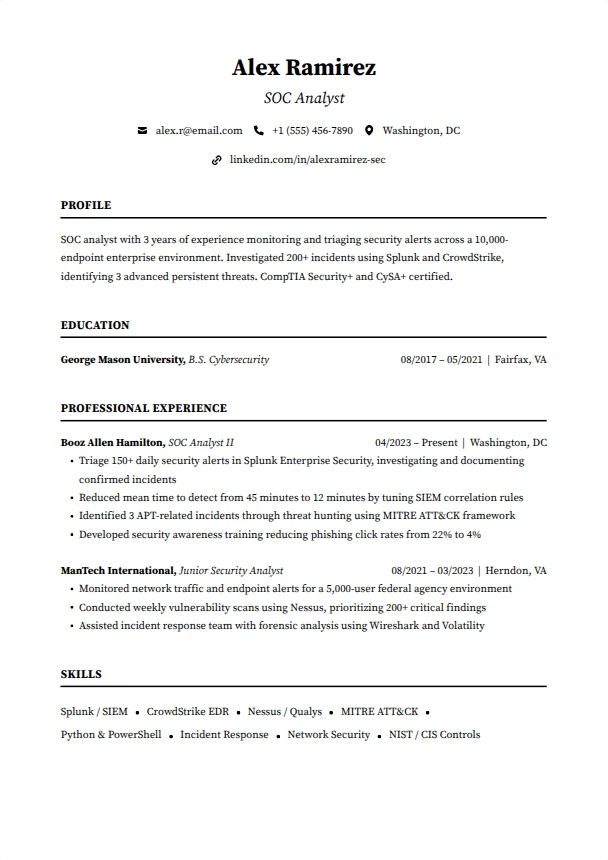
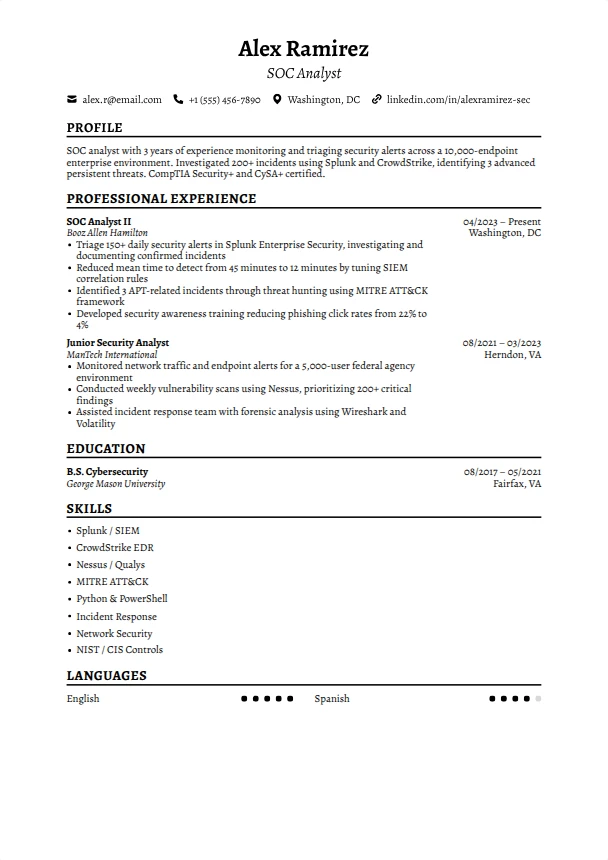
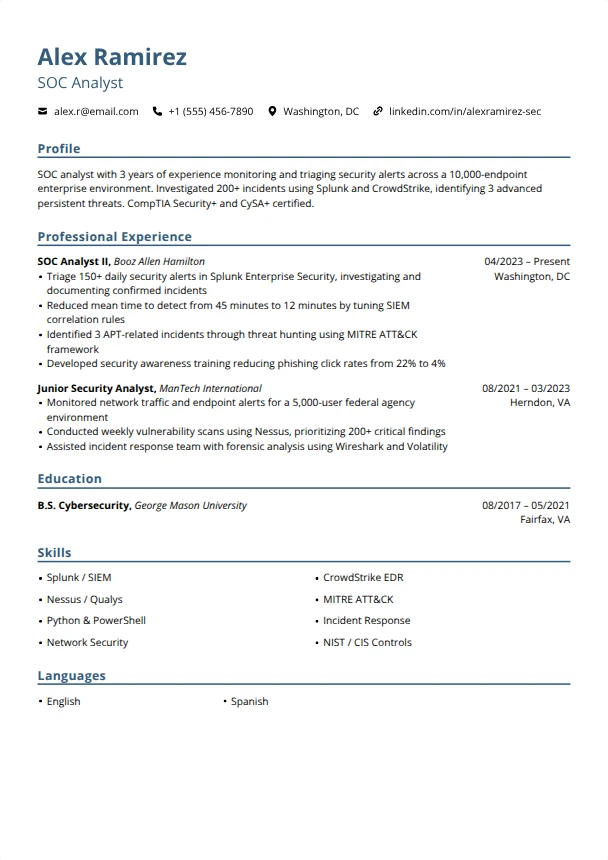
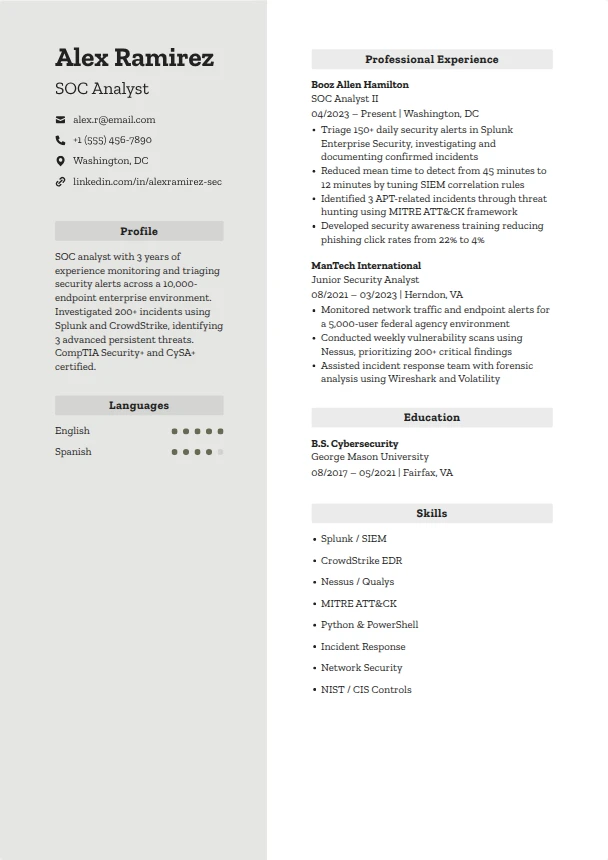
Skip the blank page
Open a complete, filled-in cybersecurity analyst resume in our free builder. Swap in your own details, keep the wording that fits, and download as PDF, free.
Build your cybersecurity resume now
Pick a template designed for security career entrants, add your certifications and lab projects, and download a polished PDF in minutes. Free, no account required.
Start Building, It's FreeRelated resume guides
Complete cybersecurity resume guide for all experience levels.
Start in help desk to build the IT foundation for a security career.
General IT resume guide for career changers without tech experience.
Cloud security is a growing specialization start here for cloud career paths.
More resume examples: