What hiring managers actually look for
Hiring managers filling IT management positions with first-time managers look for three specific signals that predict leadership success:
-
1
Informal leadership they can verify. Did you lead a project, mentor junior team members, or coordinate across departments? Managers don't need a ' Manager'title on your resumethey need evidence that people already follow your direction. Reference checks will confirm whether you led or just participated.
-
2
Technical credibility with strategic thinking. An IT manager who can't troubleshoot loses the team's respect. But one who only troubleshoots isn't managing. Managers want to see that you've made decisions about architecture, vendor selection, budget allocation, or process improvement not just executed tasks.
-
3
Ownership of outcomes, not just tasks. There's a clear difference between ' supported the server migration'and ' led the server migration for 3 offices, coordinating 5 engineers and delivering 2 weeks ahead of schedule.' The second one signals management readiness. Frame your experience around outcomes you owned.
If your resume communicates these things in the first 7-second scan, you'll make it to the detailed read. Everything below is about making that happen.
How to structure your resume, section by section
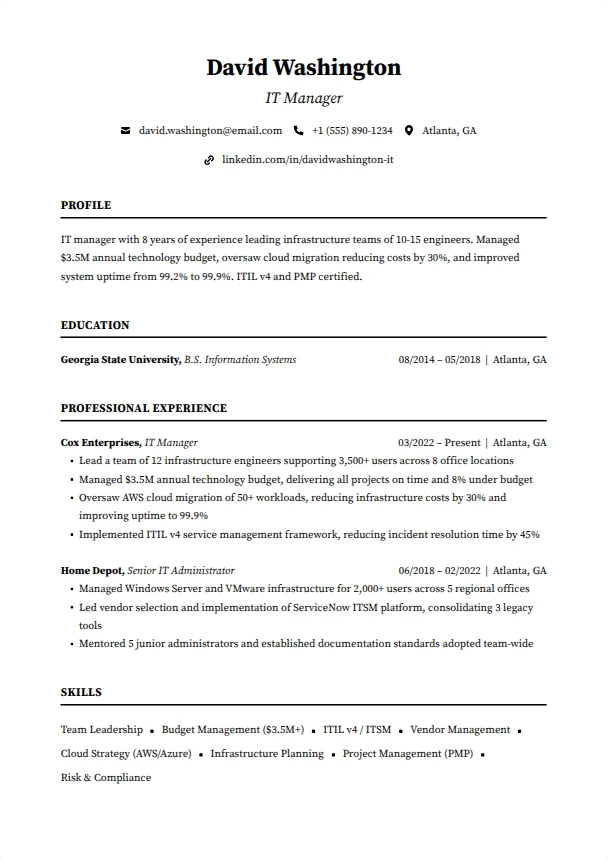
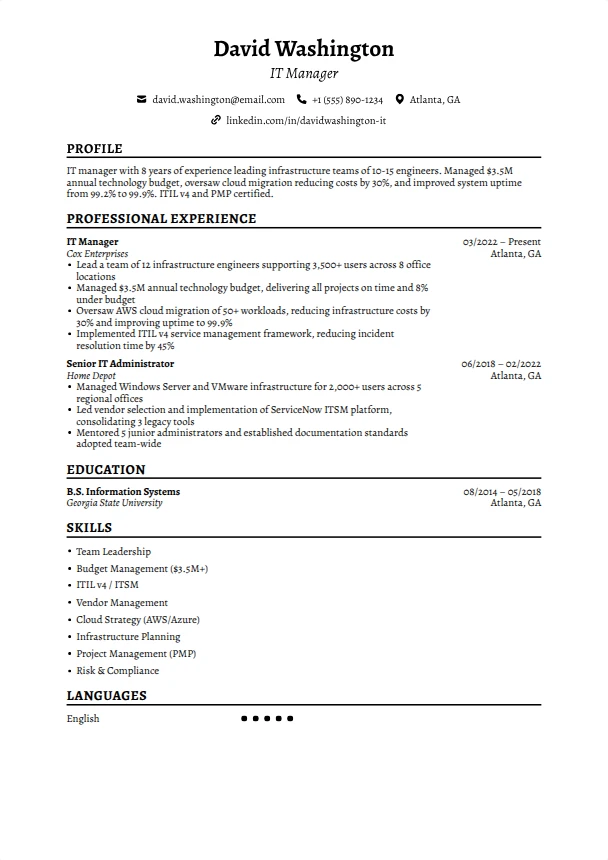
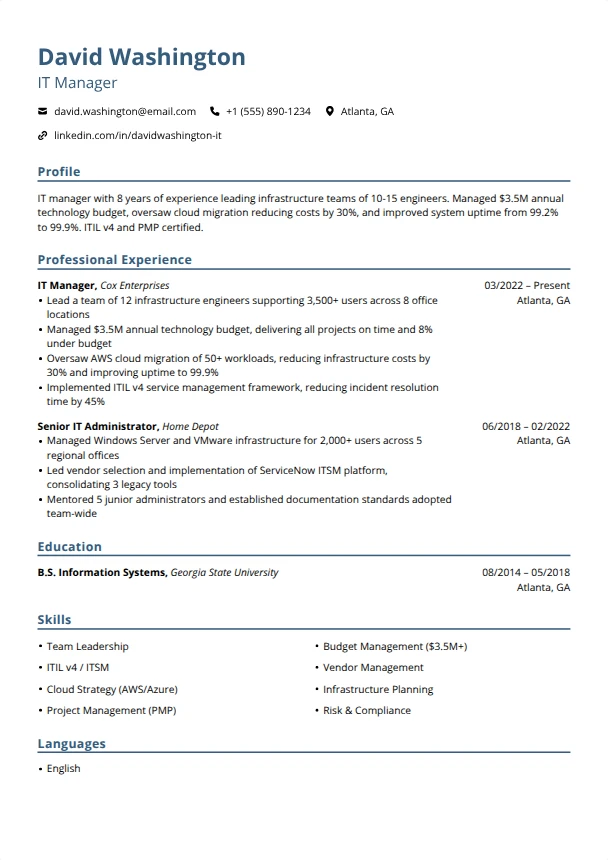
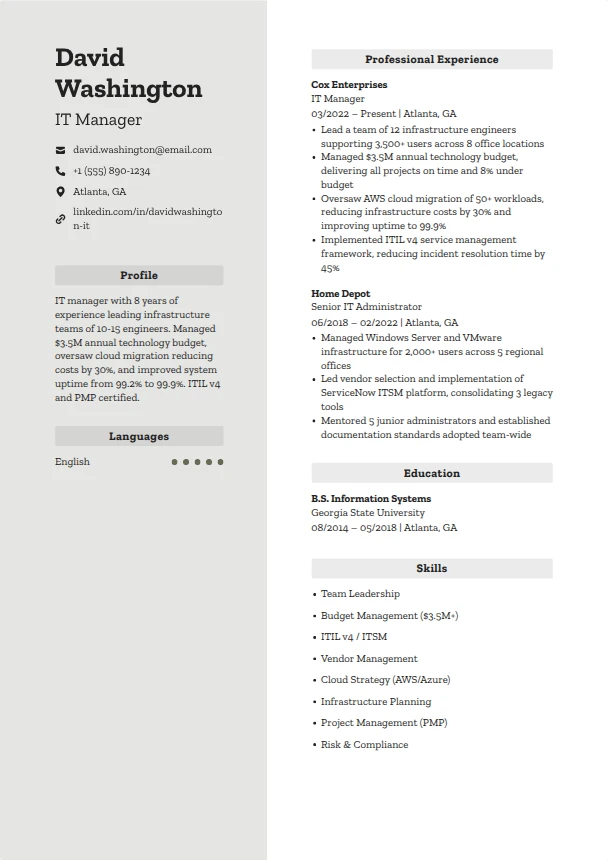
The order matters. Here's what a strong it manager resume (no management experience) looks like from top to bottom:
1. Contact header
Name, email, phone, city and state, LinkedIn. At the management level, LinkedIn is heavily used for reference checking and background verification. Ensure your profile matches your resume and includes recommendations from colleagues.
2. Professional summary (2-3 sentences)
Your summary needs to bridge the gap between your IC title and the management role you're targeting. Lead with years of IT experience, then highlight leadership activities: projects led, people mentored, processes improved. Name the management-level outcomes.
Strong: "Senior systems administrator with 7 years of IT infrastructure experience and a track record of informal leadership. Led a 5-person cross-functional team through a company-wide Office 365 migration (800+ users, 3 locations) delivered 2 weeks ahead of schedule. Mentored 3 junior engineers, 2 of whom were promoted within 18 months. ITIL v4 certified with PMP in progress."
3. Leadership & management skills
Create a dedicated section for management-relevant skills that sits alongside your technical skills. This signals to both ATS and human reviewers that you're positioning for management, not another IC role.
Leadership: Project management, team mentoring, cross-department coordination, vendor management
Process: ITIL v4, change management, incident escalation, capacity planning
Tools: Jira, Confluence, Microsoft Project, ServiceNow (admin)
4. Technical skills
Don't abandon your technical skillsthey're what give you credibility as a manager. But organize them to show breadth rather than depth. You're no longer the person configuring servers; you're the person deciding which servers to buy.
Infrastructure: Windows Server, Active Directory, VMware, Azure AD, AWS
Networking: Cisco, Meraki, VPN, firewall management
Security: Endpoint protection, vulnerability scanning, compliance frameworks
Scripting: PowerShell, Bash (automation focus)
5. Work experience (reframed for leadership)
This is where the transformation happens. Go through every role and identify bullets where you led, coordinated, mentored, planned, or made decisions. Rewrite those bullets with management language while keeping the technical credibility.
Strong: "Coordinated a 5-engineer team through a 3-month data center migration, managing task assignments, vendor timelines, and stakeholder communication. Completed the migration with zero unplanned downtime and $15K under budget."
6. Certifications & education
Management certifications (ITIL v4, PMP, or Certified Scrum Master) signal you're serious about the transition. List them alongside your technical certifications. If you have a relevant degree (IT management, business, MIS), make sure it's visible.
Key skills to include
IT management roles require a blend of technical knowledge and leadership capability. These are the most commonly requested skills in IT manager job postings.
Tip: IT manager postings vary widely. Some are heavily technical (managing a team of sysadmins), while others are strategic (IT director-lite). Read each posting carefully and adjust which skills you emphasizea ' people management'posting and a ' technical leadership'posting need different resumes.
Resume summary examples you can steal
Use one as a starting point, then swap in your own technologies, numbers, and achievements.
"Senior systems administrator with 7 years of experience managing enterprise Windows and Linux infrastructure for a 2,000-user organization. Informally led a 5-person team through a company-wide cloud migration, owning project timelines, vendor coordination, and executive reporting. Mentored 3 junior engineers and established a knowledge-sharing program that reduced onboarding time by 40%. ITIL v4 certified."
Why it works: Demonstrates leadership through action, quantifies mentoring impact, shows project ownership at management scale.
"IT team lead with 5 years of experience overseeing daily operations for a 6-person help desk team. Managed shift scheduling, ticket escalation workflows, and quality assurance reviews. Reduced average resolution time by 30% by redesigning the tiered support structure. Led quarterly business reviews with department heads, translating technical metrics into business outcomes."
Why it works: Already performing management functions, quantifies operational improvements, shows business communication skills.
"Network engineer with 6 years of experience and a track record of leading complex infrastructure projects. Managed the complete network refresh for a 4-building campus (200+ access points, 40 switches, 1,500 users), coordinating 3 vendors and 4 internal engineers over 6 months. Budget owner for $350K in network equipment. PMP certified with CCNP."
Why it works: Quantifies project scale and budget ownership, shows vendor and people coordination, combines technical and management certifications.
"IT specialist with 4 years of infrastructure experience and a growing portfolio of cross-functional leadership. Served as IT liaison for 3 major company initiatives: ERP implementation, office relocation, and compliance audit preparation. Coordinated between engineering, operations, and executive leadership. Recognized as ' go-to' IT contact by department heads across the organization."
Why it works: Shows influence beyond IT, demonstrates stakeholder management, positions cross-functional work as management preparation.
Writing strong experience bullets
Every bullet point should answer: "What did you do, and why did it matter?" Use this formula:
Before and after examples:
Worked on the Office 365 migration project and helped with the transition.
Led a 5-person cross-functional team through a company-wide Office 365 migration (800+ users, 3 locations), managing the project timeline, training schedule, and executive status reports. Delivered 2 weeks ahead of schedule with zero data loss.
Helped train new team members on our systems and processes.
Mentored 3 junior systems administrators through structured onboarding, including hands-on training on Active Directory, VMware, and incident response procedures. Two mentees were promoted to mid-level roles within 18 months.
Took care of vendor relationships and equipment purchases.
Managed vendor relationships with 4 IT suppliers, negotiating contract renewals that saved $45K annually. Owned the $200K annual hardware refresh budget, presenting quarterly spend reports to the CTO.
Strong action verbs for it manager resume (no management experience) resumes:
Championed · Coached · Coordinated · Delegated · Directed · Drove · Established · Facilitated · Guided · Led · Managed · Mentored · Negotiated · Oversaw · Planned · Presented · Prioritized · Streamlined
6 mistakes that get it manager resume (no management experience) resumes rejected
Writing your resume like a senior IC instead of an aspiring manager
If every bullet is about what you personally configured, deployed, or troubleshot, you're applying for the wrong role. Reframe: what did you lead, coordinate, plan, or improve at a team level? Managers manage outcomes through other people.
Not mentioning mentoring or training you've done
Every time you trained a new hire, guided a junior engineer through a complex problem, or created documentation for your team, you were performing a management function. These belong on your resume prominently they're the strongest evidence of leadership potential.
Ignoring management certifications
ITIL v4, PMP, or Certified Scrum Master tell a hiring manager you've invested in learning the management side of IT. If you don't have one yet, list one as ' in progress.' The investment signals intent and seriousness about the transition.
Leaving out budget and vendor experience
IT managers own budgets, negotiate contracts, and manage vendors. If you've ever been the point person for a vendor, handled an equipment purchase, or managed a project budget, include those details with dollar amounts. This is management work, even if your title didn't reflect it.
Underselling project leadership as ' participation'
There's a massive difference between ' participated in the data center migration'and ' led the data center migration, coordinating 5 engineers and 3 vendors.' If you owned the project, say so. Use ' led,' ' managed,' ' coordinated,' and ' owned'instead of ' helped,' ' assisted,' or ' participated.'
Applying only to ' IT Manager'titles
The same role is called IT Manager, IT Supervisor, Team Lead, Technical Lead, Infrastructure Manager, or Operations Manager depending on the company. Search broadly and read the actual responsibilities instead of fixating on the title.
What to do if you have no professional experience
You don't need a management title to prove you can manage. Here's how to build a management resume from your IC career:
Audit your career for informal leadership moments
Go through every role and ask: Did I ever lead a project? Train someone? Coordinate across teams? Make a decision that affected others? Present to leadership? Most senior ICs have done all of thesethey just didn't frame them as management experience. Every one of these becomes a bullet point on your management resume.
Volunteer to lead the next project at your current job
The fastest way to get management experience is to ask for it. Volunteer to lead the next migration, upgrade, or process improvement project. Take ownership of the timeline, coordinate the team, and present results to leadership. One well-led project gives you 3-5 management-caliber resume bullets.
Start mentoring junior team members formally
If your company has a mentorship program, join it. If not, create one informally: offer to onboard new hires, run knowledge-sharing sessions, or pair with junior engineers on complex tasks. Track who you mentored and their outcomes (promotions, skill growth, certifications earned). This is the most direct evidence of people management capability.
Get a management certification to complement your technical credentials
ITIL v4 Foundation is the most common and takes 2-4 weeks to prepare for. PMP is more intensive but carries significant weight for IT management roles. Even listing one as ' in progress'signals that you're investing in the transition and it gives you a framework to discuss management methodology in interviews.
Frequently asked questions
Can I become an IT manager without ever holding a management title?
Yesit's one of the most common career paths in IT. Most IT managers were promoted from senior IC roles (senior sysadmin, team lead, senior engineer). The key is demonstrating that you've already been performing management functions: leading projects, mentoring people, managing vendors, and communicating with stakeholders. Your resume needs to make this pattern visible.
What certifications help with the IC-to-manager transition?
ITIL v4 Foundation is the most common for IT service management roles. PMP (Project Management Professional) carries weight for roles with heavy project oversight. Certified Scrum Master is valuable if the organization uses Agile. Any of these paired with your technical certifications creates a compelling management-ready profile.
Should I keep technical skills on my IT manager resume?
Absolutely. Technical credibility is what earns your team's respect and helps you make informed decisions. But shift the framing: instead of listing every tool you can configure, show breadth across the technology stack you'd be managing. Your technical background is an advantage over candidates who are pure people managers.
How do I address the ' no management experience'gap in an interview?
Don't address it as a gapreframe it as a strength. ' I've been leading without the title for 3 years: managing projects, mentoring engineers, and coordinating across departments. What I'm looking for is the formal opportunity to do what I've already been doing informally.' Then back it up with specific examples from your resume.
Is it better to get promoted internally or apply externally for management roles?
Internal promotions are easier because your leadership is already visible. But if your company doesn't have openings or has a culture of promoting based on tenure rather than capability, external applications are the faster path. Many companies specifically hire first-time managers externally because they want fresh perspectives and energy.
Skip the blank page
Open a complete, filled-in IT manager resume in our free builder. Swap in your own details, keep the wording that fits, and download as PDF, free.
Build your IT manager resume now
Choose an ATS-friendly template, reframe your IC experience with management-focused language, and download a polished PDF in minutes. Free, no account required.
Start Building, It's FreeRelated resume guides
Full IT manager resume guide for experienced people managers.
General IT resume guide for candidates breaking into the field.
Comprehensive IT resume guide covering support, sysadmin, and infrastructure.
Full-stack, backend, and frontend engineering roles with code-focused bullets.
More resume examples: