What hiring managers actually look for
Hiring managers filling entry-level marketing roles are not expecting years of experience. Here is what they actually look for:
-
1
Evidence of curiosity and initiative. Did you start a blog, grow a personal social account, or run a small ad campaign on your own? Self-directed projects tell managers you are genuinely interested in marketing, not just applying to every open role.
-
2
Basic analytical ability. Marketing is increasingly data-driven. Showing that you understand Google Analytics, can interpret basic metrics, or have completed a data-related course signals that you can contribute from day one.
-
3
Clear, concise communication. Your resume is itself a marketing deliverable. Clean formatting, tight copy, and a logical structure demonstrate the exact skills you will use on the job.
If your resume communicates these things in the first 7-second scan, you'll make it to the detailed read. Everything below is about making that happen.
How to structure your resume, section by section
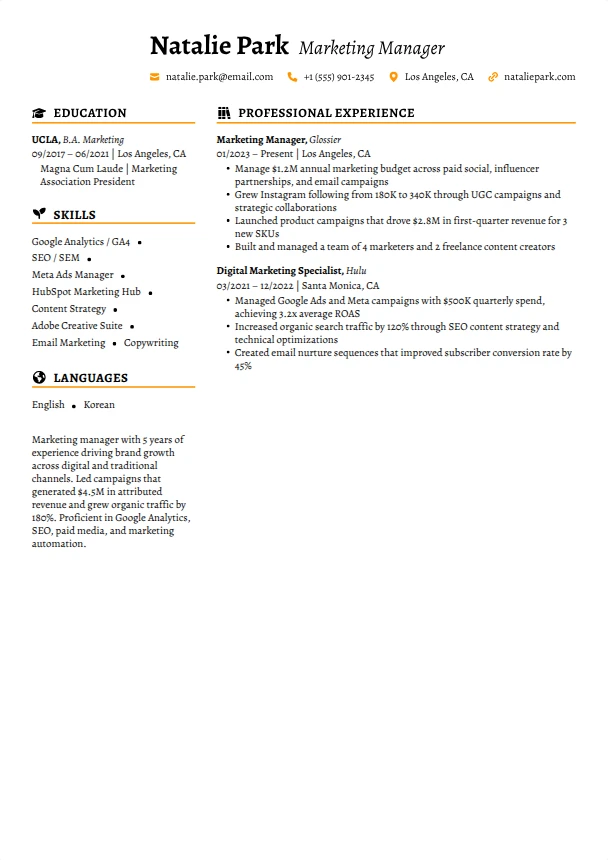
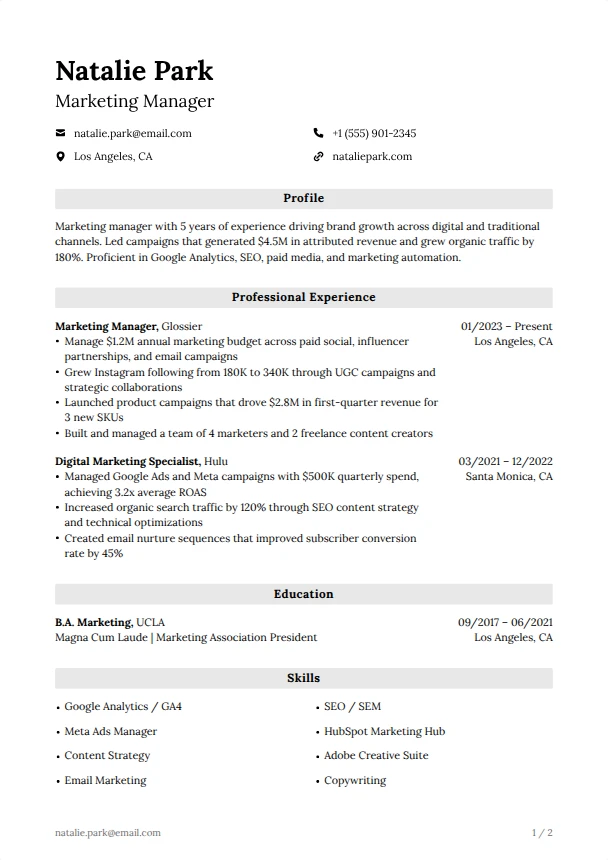
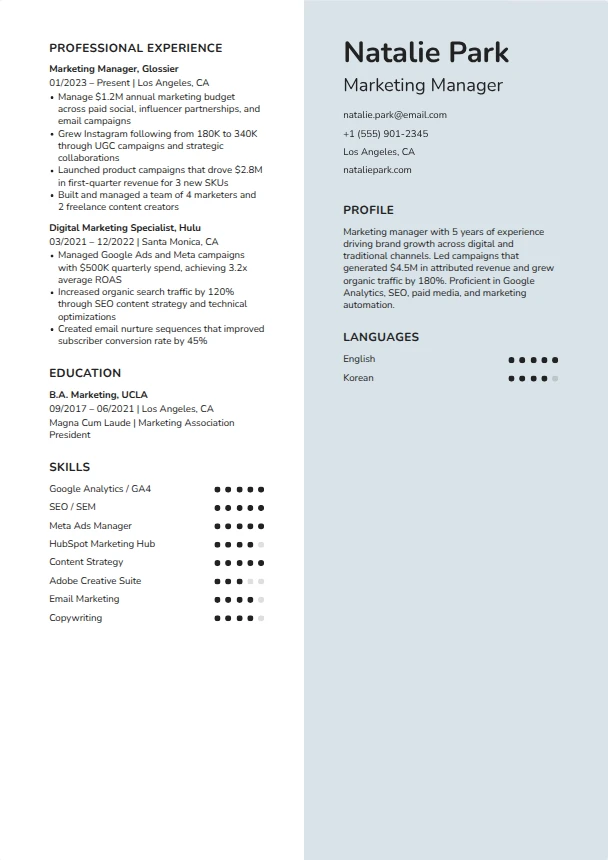
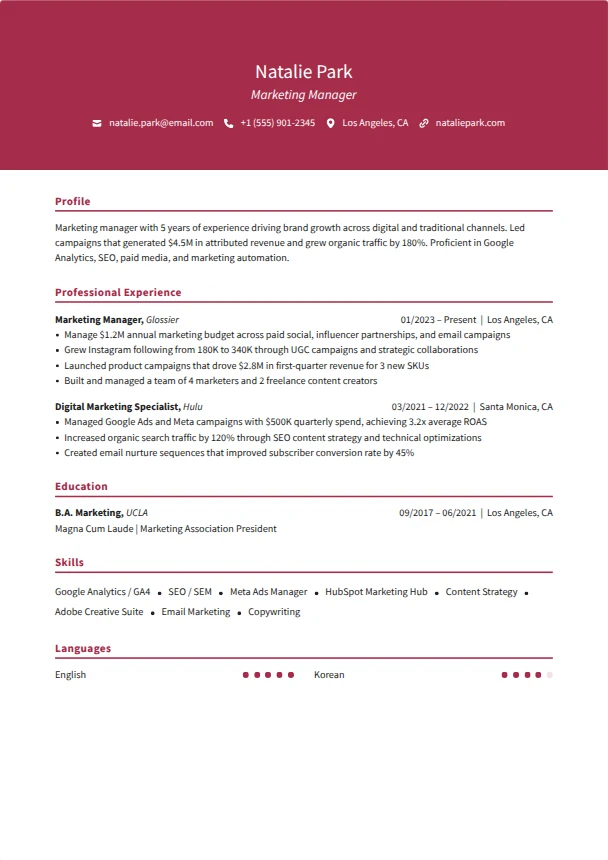
The order matters. Here's what a strong marketing resume (no experience) looks like from top to bottom:
1. Contact header
List your name, phone, email, city and state, and LinkedIn URL. If you have a portfolio or personal website, include it here.
Priya Sharma · (415) 555-0273 · [email protected] · San Francisco, CA · linkedin.com/in/priyasharma
2. Summary or objective
Use an objective statement rather than a summary when you have no professional experience. State the role you are targeting, the skills you bring, and what motivates you. Keep it to 2 sentences.
Strong: "Marketing graduate with hands-on experience managing social campaigns for two campus organizations and a Google Analytics certification. Seeking an entry-level marketing coordinator role where I can apply content creation and data analysis skills to drive engagement."
3. Projects and campaigns
Create a dedicated section for personal projects, class projects, or volunteer marketing work. Treat each one like a job: name the project, your role, and the outcome. This section replaces the traditional experience section for entry-level candidates.
4. Skills
Focus on tools and platforms you have actually used, even in a classroom or personal setting. Group them into categories like analytics, content, and social media.
Analytics: Google Analytics 4 · Google Search Console · Excel pivot tables
Content: Canva · WordPress · Copywriting · Email newsletters
Social: Instagram · TikTok · LinkedIn · Hootsuite
5. Experience
Include any work experience, even outside marketing. Focus on transferable skills like communication, customer interaction, problem solving, and teamwork. Reframe each bullet to highlight relevance to marketing.
Strong: "Served 200+ customers daily at a high-volume cafe, developing persuasive upselling techniques that increased average ticket size by 12% during promotional periods."
6. Education and certifications
Place education near the top of your resume since it is likely your strongest qualification. Include relevant coursework, academic projects, and certifications. Google Analytics, HubSpot, and Meta Blueprint certifications carry real weight with hiring managers.
Key skills to include
Even without job experience, you can build an impressive skills section by completing certifications and personal projects. Focus on these areas:
Tip: Only list skills you can demonstrate or discuss in an interview. Certifications are the fastest way to validate skills you have not used professionally.
Resume summary examples you can steal
Use one as a starting point, then swap in your own technologies, numbers, and achievements.
"Marketing graduate from Arizona State University with experience managing social media for three student organizations, growing combined audiences by 1,800 followers. Certified in Google Analytics and HubSpot Inbound Marketing."
Why it works: Names the school, quantifies campus work, and lists relevant certifications that validate skills.
"Customer-focused retail associate transitioning to marketing, bringing 3 years of experience understanding buyer behavior, driving promotional campaigns in-store, and analyzing sales data to optimize product placement."
Why it works: Reframes retail experience as directly relevant to marketing by emphasizing customer insight and data.
"Self-taught digital marketer who built a personal finance blog to 8,000 monthly readers through SEO and social content strategy. Completed Google Analytics, Meta Blueprint, and HubSpot certifications to formalize hands-on knowledge."
Why it works: Demonstrates results from self-directed work, which is the strongest signal for candidates without formal experience.
"Marketing intern with hands-on experience supporting email campaigns, writing blog content, and tracking campaign performance in Google Analytics. Contributed to a product launch email sequence that achieved a 34% open rate."
Why it works: Focuses on specific contributions during the internship rather than vague descriptions of intern duties.
Writing strong experience bullets
Every bullet point should answer: "What did you do, and why did it matter?" Use this formula:
Before and after examples:
Helped with social media for a student club.
Managed Instagram and TikTok accounts for the university marketing club, growing followers from 120 to 890 and increasing event attendance by 45%.
Did some email marketing for a class project.
Designed and executed a 5-email drip campaign for a class capstone project, achieving a 28% open rate and 12% click-through rate across 500 recipients.
Made graphics for social media posts.
Created 40+ branded social media graphics in Canva for a nonprofit client, maintaining visual consistency across Instagram, Facebook, and LinkedIn.
Strong action verbs for marketing resume (no experience) resumes:
Created · Managed · Designed · Analyzed · Launched · Coordinated · Wrote · Built · Researched · Tracked · Organized · Produced · Presented · Developed · Optimized · Grew
7 mistakes that get marketing resume (no experience) resumes rejected
Apologizing for lack of experience
Phrases like "although I have no experience" or "despite being new" weaken your resume immediately. Focus on what you have done, not what you have not.
Listing coursework without context
"Completed Marketing 301" means nothing to a hiring manager. Instead, describe what you built or analyzed in that course and what the result was.
Using a cluttered or overly creative format
Entry-level candidates sometimes overcompensate with flashy designs. Keep it clean. Your content and structure matter far more than colors and graphics.
Padding with irrelevant skills
Listing Microsoft Word and "strong communicator" wastes space. Focus on marketing-specific tools and capabilities that match the job posting.
Skipping certifications
Free certifications from Google, HubSpot, and Meta are one of the fastest ways to build credibility. Not having any signals a lack of initiative to most hiring managers.
Writing vague bullet points
"Assisted with marketing tasks" could mean anything. Be specific about what you did, which tools you used, and what happened as a result.
Not including personal projects
A blog you grew, a social account you managed, or a campaign you ran on your own budget counts as real experience. Leaving these off your resume is a significant missed opportunity.
What to do if you have no professional experience
Here are the most effective ways to build marketing credentials quickly:
Launch a personal project within a week
Start a niche blog, a themed Instagram account, or a small email newsletter. Document everything: your strategy, the tools you used, and the results after 30, 60, and 90 days.
Stack 2 to 3 certifications
Google Analytics, HubSpot Inbound Marketing, and Meta Blueprint can all be completed in a few weeks. These validate your knowledge and show employers you are serious about the field.
Offer free work strategically
Approach a local business or nonprofit and offer to manage one marketing channel for 2 to 3 months. Set clear goals, track results, and add the engagement to your resume as a client project.
Build a simple portfolio site
Use a free tool like WordPress, Carrd, or Notion to showcase your projects, writing samples, and campaign results. A portfolio link on your resume sets you apart from other entry-level candidates immediately.
Frequently asked questions
Can I get a marketing job with no experience?
Yes. Many entry-level marketing coordinator and marketing assistant roles are designed for candidates with foundational knowledge and enthusiasm rather than years of experience. Certifications, personal projects, and internships can all substitute for traditional work history.
What should I put on a marketing resume if I have never worked in marketing?
Focus on transferable skills from any work experience, personal marketing projects, relevant coursework, and certifications. A blog you grew, a social account you managed, or a class campaign you ran all count as legitimate experience.
Which certifications matter most for entry-level marketing?
Google Analytics 4, HubSpot Inbound Marketing, and Meta Blueprint are the most widely recognized. They are all free and can be completed in 1 to 3 weeks each.
Should I use an objective or summary with no experience?
Use an objective statement. It tells the hiring manager what role you are targeting and what skills you bring, which is more useful than a summary that has no professional achievements to reference.
How important is a portfolio for entry-level marketing roles?
Very important. Even a simple collection of 3 to 5 work samples (social posts, blog articles, email designs, campaign results) gives hiring managers something concrete to evaluate beyond your resume.
Skip the blank page
Open a complete, filled-in marketing resume in our free builder. Swap in your own details, keep the wording that fits, and download as PDF, free.
Build your marketing resume now
Pick a template, add your skills and projects, and create a professional marketing resume in minutes.
Start Building, It's FreeRelated resume guides
Comprehensive guide to writing a marketing resume at any experience level.
Break into social media marketing with personal projects and platform knowledge.
Land your first sales role by showcasing communication and persuasion skills.
Highlight PR, writing, and stakeholder management skills on your resume.
More resume examples: