What hiring managers actually look for
Graduate admissions committees and research supervisors evaluating early-career CVs look for these signals:
-
1
Research interest clarity matters more than publication count. At the early career stage, nobody expects a long publication list. What committees want to see is that you have a defined research interest, you understand the methods in your field, and you can articulate why your questions matter.
-
2
Intellectual curiosity shows through extracurricular academic activity. Attending departmental colloquia, joining an academic club, participating in reading groups, or completing independent study courses all demonstrate that your interest goes beyond earning a grade. These activities belong on your CV.
-
3
Strong faculty recommendations often start with CV content. When a professor writes your recommendation letter, they reference the experiences on your CV. A well-organized CV with specific details about your coursework and projects gives your recommenders better material to work with.
If your resume communicates these things in the first 7-second scan, you'll make it to the detailed read. Everything below is about making that happen.
How to structure your resume, section by section
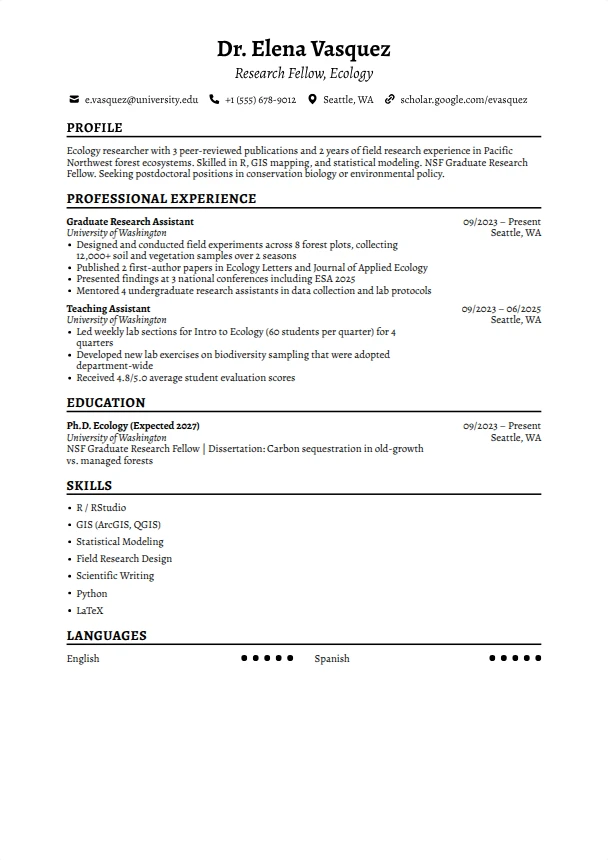
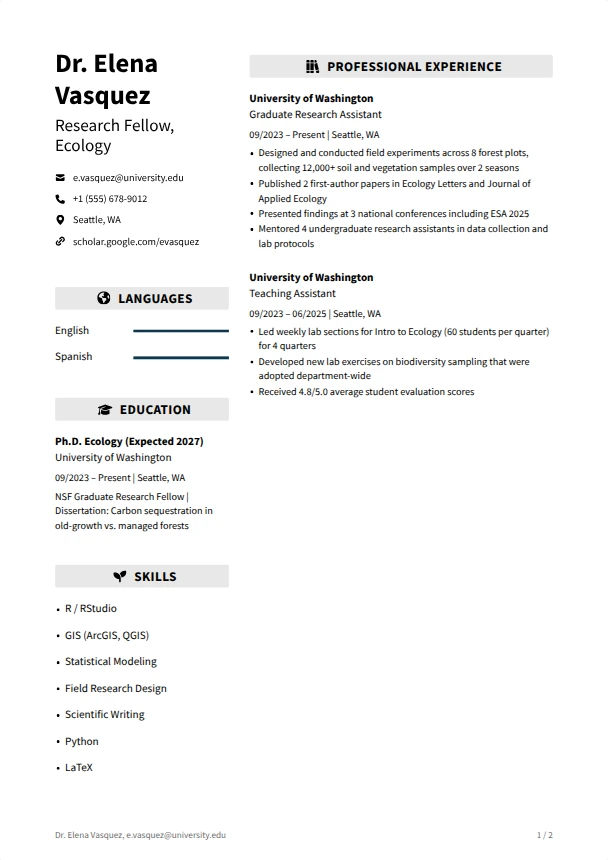
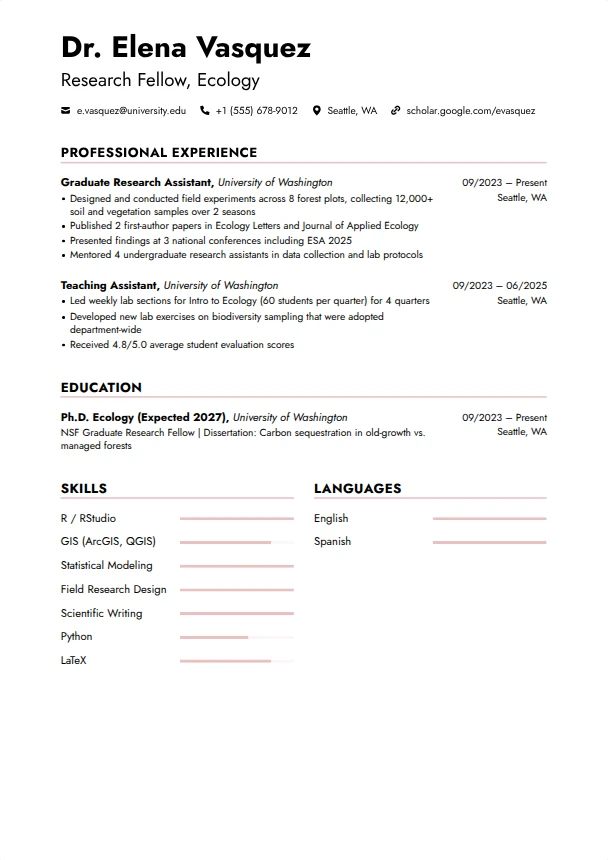
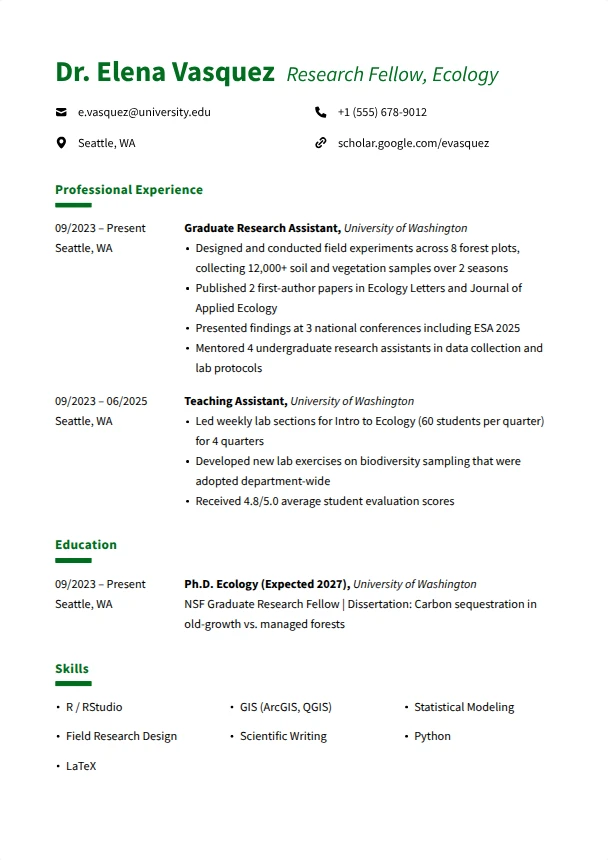
The order matters. Here's what a strong academic resume with no experience looks like from top to bottom:
1. Contact header
Include your name, university email, phone number, and academic website or LinkedIn if you have one. If you are applying to graduate school, include your current institution and expected graduation date.
Alex Nguyen · Department of History, UCLA · [email protected] · (555) 432-1098 · Expected B.A., June 2026
2. Research interests (2-3 sentences)
Replace the traditional summary with a concise statement of your research interests. Name the broad field, your specific focus area, and the types of questions you want to investigate.
Strong: "Undergraduate historian focusing on labor migration in the twentieth-century American Southwest. Interested in how agricultural policies shaped demographic patterns in border communities. Currently completing an honors thesis on Bracero Program documentation in Arizona county archives."
3. Education
List your current degree program, institution, expected graduation date, GPA (if 3.5 or above), honors status, and relevant coursework. Include your thesis or capstone title if applicable.
4. Research experience
Even informal research counts. Include independent studies, honors thesis work, research assistant roles, and any involvement in a faculty member's project. Name the supervisor, describe your specific contributions, and mention any methods or tools you used.
Research Assistant, Dr. Maria Gonzalez, UCLA Department of History (Jan 2025 - Present)
Transcribed and cataloged 150 Bracero Program-era documents from the Pima County Historical Society. Developed a metadata schema for a digital archive project.
5. Academic activities and skills
List conference attendance (even as an audience member at this stage), relevant workshops, academic society memberships, language proficiencies, and technical skills related to your field.
Strong: "Member, Phi Alpha Theta National History Honor Society (2025). Attended the Western History Association Annual Meeting, Denver, CO (October 2025). Completed Digital Humanities Workshop Series, UCLA Center for Digital Humanities (Spring 2025)."
6. Awards, leadership, and service
Dean's list, departmental awards, scholarship recipients, tutoring roles, and student organization leadership. Even small recognitions signal that faculty and administrators have noticed your work.
Key skills to include
Early-career academic CVs should highlight the methodological and technical skills that your target program or lab requires:
Tip: Tailor this section to your discipline. A biology lab application needs wet lab techniques. A sociology PhD application needs qualitative and quantitative methods. List only skills you have actually practiced, even if only in coursework.
Resume summary examples you can steal
Use one as a starting point, then swap in your own technologies, numbers, and achievements.
"Senior biology major at the University of Wisconsin-Madison with a 3.8 GPA and two semesters of research experience in the Chen Lab studying epigenetic regulation of gene expression in Arabidopsis thaliana. Proficient in PCR, gel electrophoresis, and R for statistical analysis. Applying to doctoral programs in molecular plant biology."
Why it works: Names the specific lab, organism, and techniques. The research topic is precisely defined, signaling that this student has genuine bench experience, not just classroom exposure.
"First-year M.A. student in English at Boston University with a focus on Victorian literature and digital humanities methods. Completed undergraduate honors thesis on serialization and readership in Dickens's periodicals. Experienced tutor with 80 hours of writing center appointments. Seeking a teaching assistantship in composition or survey literature."
Why it works: The thesis topic shows scholarly depth. The writing center hours provide concrete teaching experience with a specific number that committees can evaluate.
"Former high school math teacher with five years of classroom experience and a bachelor's degree in mathematics from Ohio State University. Independently completed three graduate-level statistics courses on Coursera. Applying to M.S. programs in applied statistics with the goal of transitioning to educational research."
Why it works: Reframes the teaching career as relevant to academic goals. The self-directed graduate coursework shows commitment and initiative beyond the career change declaration.
"Junior chemistry major at Howard University with a 3.6 GPA and a strong interest in materials science. Completed two semesters of advanced organic chemistry lab and an independent study synthesizing metal-organic frameworks under Dr. James Williams. Applying to the NSF REU program in sustainable materials at Georgia Tech."
Why it works: The independent study provides research credibility. Naming the specific research topic (metal-organic frameworks) and the target REU program shows that the student has done their homework about fit.
Writing strong experience bullets
Every bullet point should answer: "What did you do, and why did it matter?" Use this formula:
Before and after examples:
Helped a professor with their research project.
Transcribed and coded 45 oral history interviews for Dr. Rodriguez's migration studies project, developing a 12-category thematic coding scheme that was adopted for the full 200-interview dataset.
Worked in the writing center.
Tutored 15 undergraduate students per week in the university writing center for two semesters, specializing in thesis development and APA citation formatting for social science papers.
Took advanced classes in my major.
Completed a graduate-level seminar in computational linguistics as an undergraduate, producing a 25-page research paper analyzing sentiment patterns in 10,000 Twitter posts using Python's NLTK library.
Strong action verbs for academic resume with no experience resumes:
Transcribed · Coded · Analyzed · Tutored · Researched · Cataloged · Synthesized · Presented · Designed · Compiled · Reviewed · Drafted · Organized · Mentored · Collected · Digitized · Translated
7 mistakes that get academic resume with no experience resumes rejected
Trying to make your CV look longer than it should be.
Padding your CV with irrelevant content undermines your credibility. A focused two-page CV is far better than a four-page CV filled with unrelated summer jobs and high school awards.
Omitting your research interests statement.
For graduate school applications, this is one of the most important sections on your CV. Faculty want to know what you plan to study. A vague or missing research interest makes it impossible for them to evaluate fit.
Listing coursework without context.
A raw list of course names is not very useful. Instead, mention courses in the context of skills they taught you or projects they produced. 'Completed a 30-page archival research paper in HIST 450: Seminar in American Labor History' says more than just 'HIST 450.'
Using a corporate resume format for academic applications.
Academic CVs have a different structure than corporate resumes. Sections like Publications, Research Experience, and Teaching Experience are expected. A skills-based corporate layout will look out of place to an admissions committee.
Forgetting to name your faculty mentors.
In academia, your associations matter. If you worked with a professor on research, name them. Committee members may know your mentor personally, and that connection adds weight to your application.
Not including conferences you merely attended.
At the early career stage, conference attendance (even without presenting) shows engagement with your field. List the conference name, date, and location under a 'Professional Development' or 'Conferences Attended' section.
Leaving your CV static between applications.
Update your CV every time you complete a course, attend a talk, earn an award, or start a new research activity. Academic CVs are living documents that should always reflect your current record.
What to do if you have no professional experience
Building academic experience takes time, but you can start generating CV content right now:
Email three professors this week about research opportunities.
Faculty often need undergraduate assistants for data entry, literature reviews, or lab prep. Send a brief, specific email explaining your interest in their research and asking if they have openings. Persistence pays off.
Register for an independent study or honors thesis.
Independent study courses produce research experience, a faculty relationship, and a tangible deliverable (usually a paper or presentation). These are among the most efficient ways to build your CV while earning credit.
Submit a proposal to an undergraduate conference.
Turn a strong seminar paper into a conference presentation. Undergraduate conferences exist at most universities and in many disciplines nationally. Acceptance rates tend to be high, and you earn a presentation credit.
Join a departmental reading group or honors society.
These memberships show intellectual community engagement. They also connect you with faculty and graduate students who can point you toward research opportunities and write recommendations.
Frequently asked questions
Do I need an academic CV if I am just applying to graduate school?
Yes. Most graduate applications ask for a CV or resume. Use the academic CV format described in this guide. It shows the admissions committee that you understand academic conventions, which itself is a positive signal.
Is a one-page CV acceptable for an undergraduate?
Absolutely. Most undergraduates have one to two pages of content, and that is completely appropriate. Do not pad your CV to appear longer. Committees would rather see a focused one-page document than a padded three-page one.
Should I include non-academic jobs on an academic CV?
Only if they demonstrate relevant skills. A tutoring job is relevant. Working as a barista generally is not, unless you need to fill space and can frame the experience in terms of transferable skills like communication or time management.
How do I list research experience if I only observed and did not contribute data?
Be honest about your role. Writing 'Observed laboratory procedures and assisted with sample preparation in the Chen Lab' is perfectly valid. As you gain more responsibility, you can update the description to reflect your expanded contributions.
When should I start building my academic CV?
Start during your sophomore year if you are considering graduate school. The earlier you begin tracking your academic activities, the more complete your CV will be when application season arrives. Add entries in real time rather than trying to reconstruct them later.
Skip the blank page
Open a complete, filled-in entry-level resume in our free builder. Swap in your own details, keep the wording that fits, and download as PDF, free.
Build your academic resume now
Pick a template, add your details, and download a polished PDF in minutes. Free, no account required.
Start Building, It's FreeRelated resume guides
Comprehensive guide to writing academic CVs for research and teaching roles.
Resume tips for undergraduates seeking internships and first jobs.
How to write the very first resume of your career from scratch.
Resume writing guide for recent bachelor's and master's graduates entering the workforce.
More resume examples: