What hiring managers actually look for
Understanding what employers look for helps you make smarter decisions as you build your first resume:
-
1
Structure matters more than length. Recruiters prefer a well organized half-page over a cluttered full page. Clear section headers, consistent formatting, and logical flow show professionalism even when content is limited.
-
2
Relevance beats volume. Listing every activity, course, and hobby you have ever had weakens your resume. Select only the items that connect to the type of work you want and present them with purpose.
-
3
Effort is visible. A first-time resume that has been carefully proofread, thoughtfully formatted, and customized for the specific job tells employers you care about quality. That impression carries significant weight.
If your resume communicates these things in the first 7-second scan, you'll make it to the detailed read. Everything below is about making that happen.
How to structure your resume, section by section
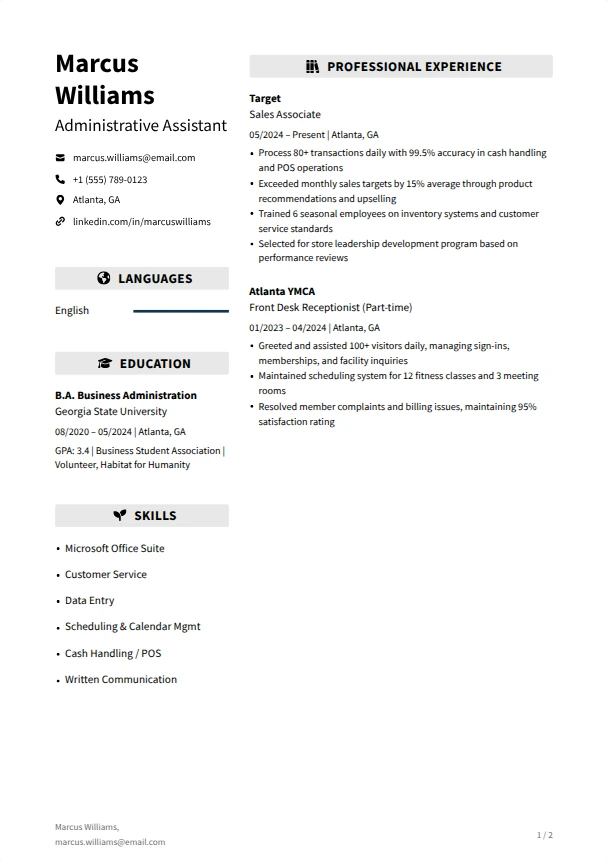
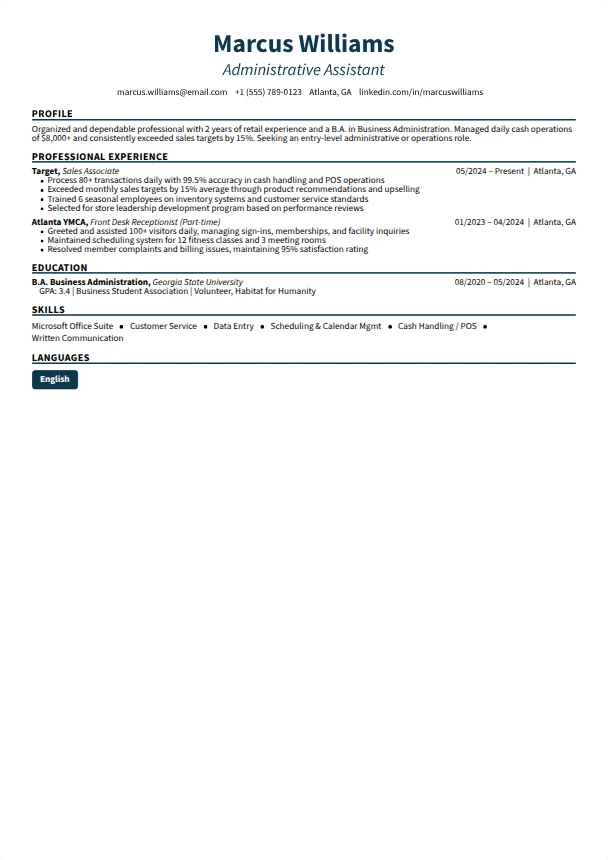
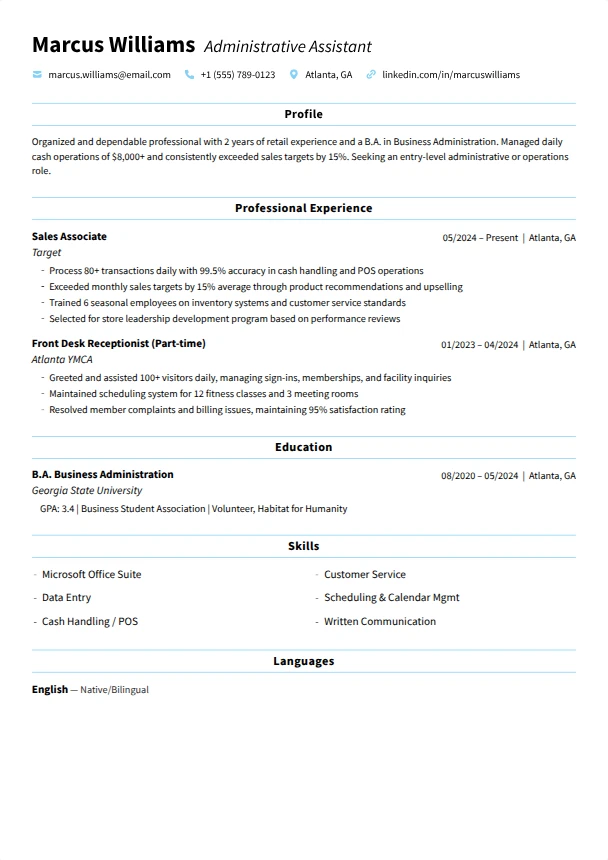
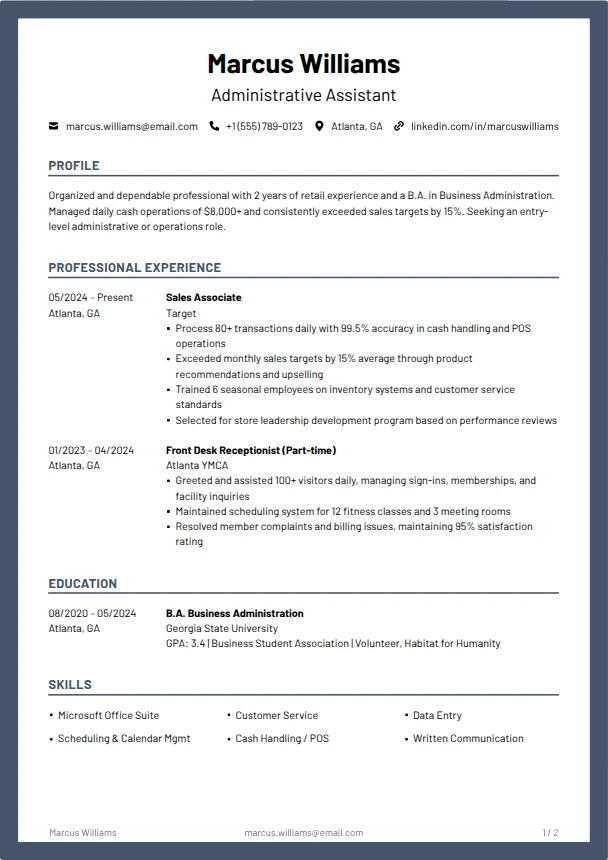
The order matters. Here's what a strong first resume looks like from top to bottom:
1. Contact header
Start with your full name in a slightly larger font, followed by your contact details on one line. Use a professional email address. Skip your full mailing address; city and state are sufficient.
2. Summary or objective
For your first resume, an objective statement works best. It tells the employer who you are, what you bring, and what position you are targeting. Keep it to two or three concise sentences.
Strong: "Detail oriented community college student studying business administration with strong organizational skills and experience coordinating campus events for 200+ attendees. Seeking a part-time administrative assistant position to apply scheduling and communication abilities."
3. Education
This is likely your strongest section. Include your school name, degree or program, expected graduation date, GPA if it is 3.0 or above, and two to three relevant courses. If you are still in high school, list your anticipated graduation date and any honors or AP courses.
4. Skills
List 8 to 12 skills relevant to the jobs you want. Think about both technical skills (software, tools, languages) and workplace skills (communication, organization, problem solving).
Microsoft Word · Google Docs · Email Communication · Scheduling · Filing and Organization · Basic Spreadsheets · Social Media · Customer Interaction
5. Experience / Activities / Projects
If you have any work experience, even babysitting, lawn care, or helping at a family business, list it here. If not, use this section for volunteer work, school clubs, or personal projects. The format is the same: title, organization, dates, and bullet points describing what you did.
Strong: "Staff Writer, Lincoln High School Gazette (Sep 2024 to Jun 2025). Researched and wrote 15 articles on campus events and student life, meeting weekly deadlines and collaborating with editors to improve clarity and accuracy."
6. Additional sections
Round out your resume with any of the following: certifications, languages you speak, awards and honors, or relevant hobbies. Only include items that add substance. Gaming or watching TV should not appear here.
Key skills to include
Your first resume should showcase skills that are broadly applicable across entry level and part-time positions. Here are strong options to start with.
Tip: Only list skills you can actually demonstrate. If an interviewer asks you to show your Excel skills, you need to be able to do more than open the program.
Resume summary examples you can steal
Use one as a starting point, then swap in your own technologies, numbers, and achievements.
"Responsible and punctual high school junior with a 3.6 GPA and experience organizing school fundraisers that raised over $2,000 for local charities. Seeking a part-time retail associate position to develop customer service and teamwork skills."
Why it works: It uses specific numbers, shows responsibility through school activities, and names the target role.
"Second year psychology student with strong research and writing skills developed through coursework and a departmental research assistantship. Applying for a student library assistant position to support academic services."
Why it works: It connects academic experience directly to the campus job requirements.
"Dedicated parent and community organizer with five years of experience managing household budgets, coordinating volunteer schedules for a 30 member PTA, and planning community events for 100+ attendees. Seeking an entry level office management role."
Why it works: It reframes unpaid organizational experience as legitimate management skills with real numbers.
"Licensed cosmetologist transitioning into pharmaceutical sales, bringing seven years of client relationship management, consultative selling, and product knowledge. Eager to apply interpersonal and sales skills in an entry level territory representative role."
Why it works: It draws clear parallels between the previous career and the new target, making the transition logical.
Writing strong experience bullets
Every bullet point should answer: "What did you do, and why did it matter?" Use this formula:
Before and after examples:
Was in charge of the bake sale.
Organized a school bake sale with 25 student volunteers, generating $1,400 in revenue for the senior class trip fund.
Babysat for neighbors on weekends.
Provided reliable childcare for three families on a weekly basis, managing schedules, meal preparation, and age-appropriate activities for children ages 3 to 10.
Helped my parents with their business.
Assisted with daily operations at a family-owned restaurant, including processing 80+ customer orders per shift, managing cash register reconciliation, and maintaining a clean service area.
Strong action verbs for first resumes:
Organized · Created · Managed · Assisted · Prepared · Coordinated · Delivered · Maintained · Processed · Researched · Wrote · Planned · Supported · Trained · Communicated · Built
7 mistakes that get first resumes rejected
Using a resume template with graphics and colors
Decorative templates with icons, progress bars, and multiple colors often break in applicant tracking systems. Stick with a clean, text-based layout that prioritizes readability.
Writing in paragraph form instead of bullet points
Long paragraphs are hard to scan. Use concise bullet points starting with action verbs so recruiters can quickly identify your qualifications.
Including references on the resume
The phrase 'References available upon request' wastes valuable space. Employers will ask for references separately when they need them.
Listing an unprofessional email address
Create a simple email using your name. Addresses with nicknames, birth years, or random numbers look careless.
Making the resume longer than one page
Your first resume should be one page. If you are struggling to fill it, add relevant coursework, skills, or a projects section instead of padding with filler content.
Using vague language
Words like 'various,' 'multiple,' and 'several' are meaningless without context. Replace them with specific numbers or descriptions.
Not saving the file as a PDF
Word documents can look different on different computers. Always save and submit your resume as a PDF to preserve formatting.
What to do if you have no professional experience
Writing your first resume with no experience is completely normal. Here is how to build one that still looks professional:
List school activities and clubs
Any organized activity where you had responsibilities counts. Student government, sports teams, debate club, and volunteer groups all give you material for bullet points.
Include informal work
Babysitting, tutoring, lawn care, pet sitting, and helping at a family business are all legitimate experience. Present them professionally with dates and accomplishments.
Describe class projects in detail
Group presentations, research papers, and lab experiments all demonstrate skills. Describe your role, the scope of the project, and the outcome.
Take on something new this week
Volunteer at a local organization, start a small project, or complete an online certification. Even a few days of activity gives you something concrete to write about.
Frequently asked questions
What is the best format for a first resume?
A reverse chronological format is the most widely accepted. Put your most recent education and experience at the top. If you have no work history, lead with education and skills instead.
How long does it take to write a first resume?
Plan for two to three hours for your first draft, plus additional time for revisions. Using a template and a guide like this one significantly speeds up the process.
Should I include my age or photo on my resume?
No. In the United States, including your age, date of birth, or photo is unnecessary and can introduce bias into the hiring process.
What file format should I use when submitting?
Save your resume as a PDF. This preserves your formatting across all devices and operating systems. Only use Word format if the employer specifically requests it.
Do I need different resumes for different jobs?
Yes. Adjust your summary, skills, and bullet points to match each job description. Keep a master version with all your details, then create tailored copies for each application.
Skip the blank page
Open a complete, filled-in entry-level resume in our free builder. Swap in your own details, keep the wording that fits, and download as PDF, free.
Build your first resume now
Pick a template, follow the structure in this guide, and create a polished resume in minutes. No experience or design skills required.
Start Building, It's FreeRelated resume guides
Targeted advice for landing professional entry level positions.
Resume tips specifically for high school students and recent graduates.
Focused strategies for building a resume when you have no work history at all.
Write a resume for internships, campus jobs, and your first post-college role.
More resume examples: