What hiring managers actually look for
Managers hiring for part-time and entry-level roles say the same things in surveys year after year:
-
1
Reliability matters more than experience. Retail and food service managers consistently rank dependability as their top trait. If your resume shows you stuck with a club, sport, or volunteer commitment for multiple semesters, that signals reliability more than any skill list.
-
2
Formatting signals effort. A clean, scannable layout tells a hiring manager you pay attention to details. When teens submit a wall of unformatted text, most managers stop reading within five seconds.
-
3
Specifics beat vague claims. Writing 'hardworking team player' tells a manager nothing. Writing 'organized a team of 8 volunteers and collected 200+ canned goods in one weekend' gives them a reason to call you.
If your resume communicates these things in the first 7-second scan, you'll make it to the detailed read. Everything below is about making that happen.
How to structure your resume, section by section
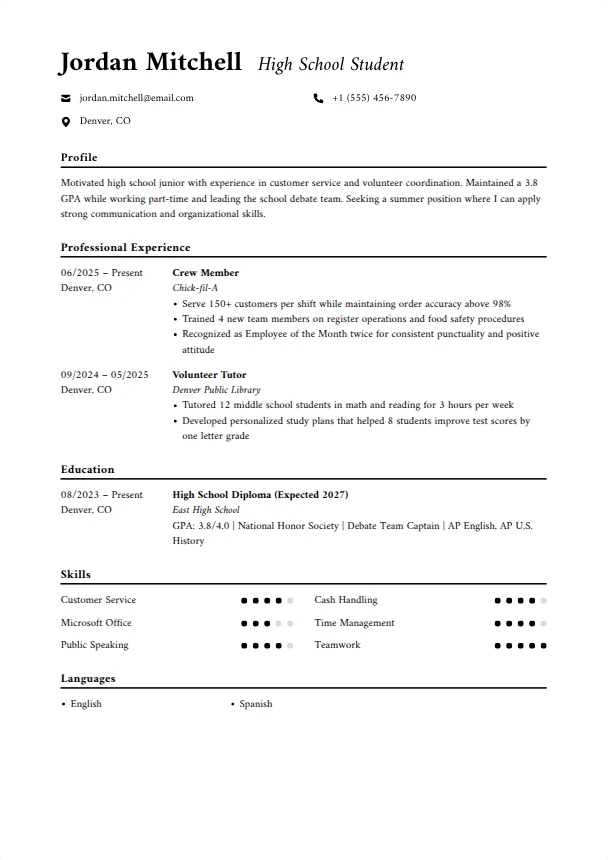
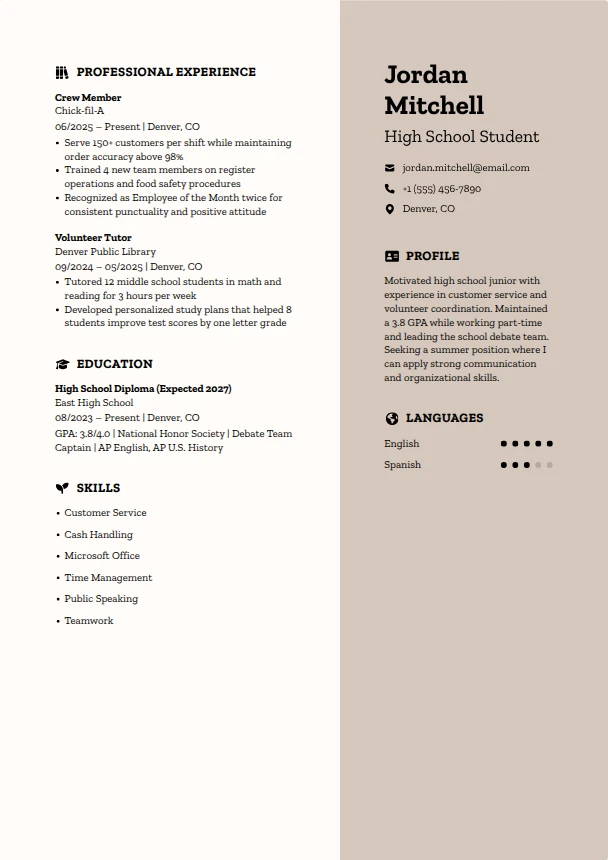
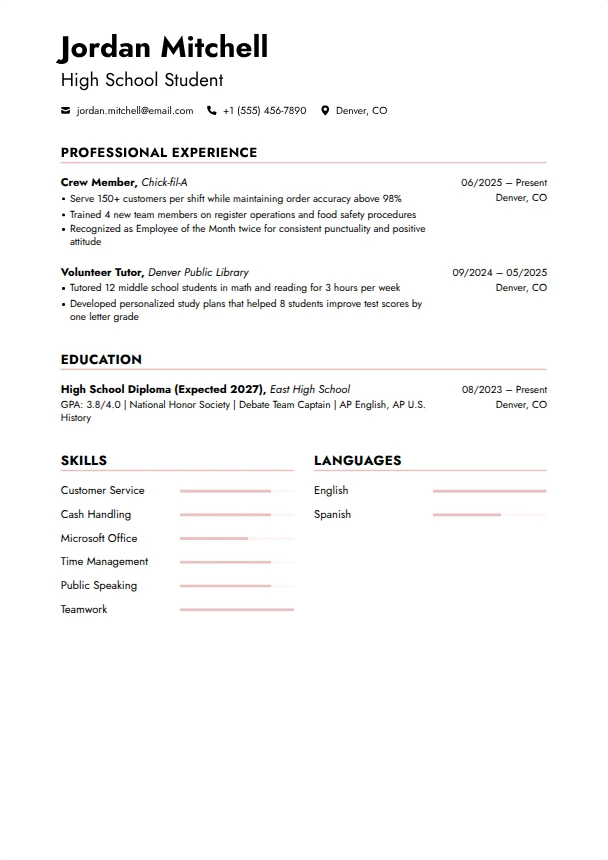
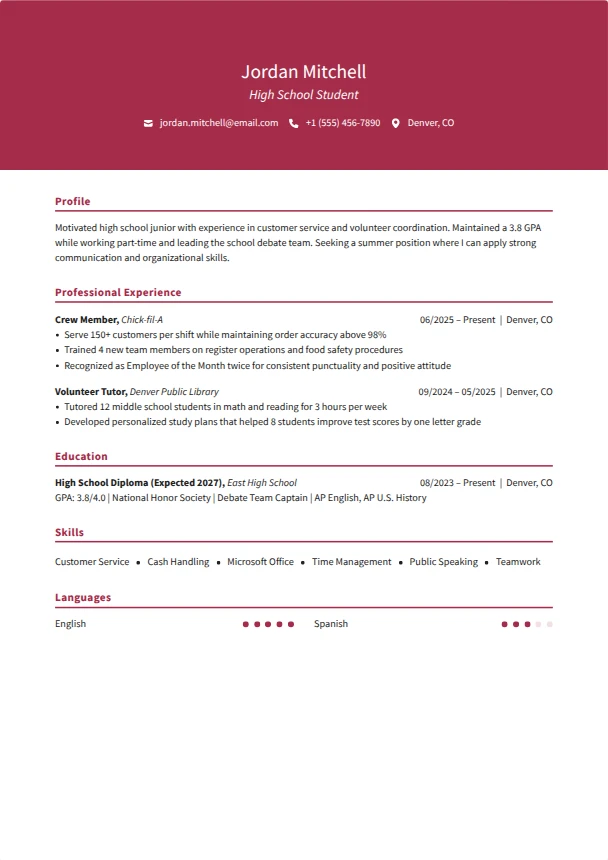
The order matters. Here's what a strong high school resume looks like from top to bottom:
1. Contact header
Keep it to one line. Include your full name, email, phone number, and city. Use a professional email address. If you only have a school email, create a free Gmail account with your real name.
2. Resume objective (2-3 sentences)
High school students benefit from an objective statement rather than a professional summary. State what role you want, what you bring, and one concrete detail that proves it.
Strong: "Junior at Westlake High School seeking a part-time retail position. Earned a 3.8 GPA while managing the school store, handling daily cash transactions of $150+ and restocking inventory weekly."
3. Education
List your school name, expected graduation date, and GPA if it is 3.0 or higher. Add relevant coursework, honors, or AP classes that connect to the job. For college applications, include your class rank if it is in the top 25%.
4. Skills
Mix practical skills with soft skills. Group them into two or three categories so the section is easy to scan. Always tailor this section to the job posting.
Customer Service: Cash handling, POS systems, conflict resolution
Technical: Google Workspace, Canva, basic HTML
Language: Fluent in English and Spanish
5. Experience, activities, and volunteering
Paid work goes first, but unpaid experience counts just as much at this stage. Babysitting, lawn care, tutoring, church volunteering, and club leadership are all valid. Use bullet points with action verbs and include numbers wherever possible.
Strong: "Coordinated a team of 6 student volunteers for the annual bake sale, raising $1,200 for the drama department, a 30% increase over the previous year."
6. Additional sections
Add certifications (CPR, food handler's permit, lifeguard), awards (honor roll, athletic letters, science fair placements), or extracurriculars that show leadership or commitment. Keep this section short and relevant.
Key skills to include
These are the skills employers and college admissions officers look for most often on high school resumes. Pick the ones you can back up with real examples.
Tip: Read the job posting carefully and mirror the exact skill phrases they use. If the listing says 'attention to detail,' use that phrase instead of a synonym like 'detail-oriented.' Many employers use keyword filters before a human ever sees your resume.
Resume summary examples you can steal
Use one as a starting point, then swap in your own technologies, numbers, and achievements.
"Reliable junior at Lincoln High School with a 3.6 GPA and two years of experience running the student store. Skilled in cash handling, inventory tracking, and customer service. Available 20+ hours per week including weekends."
Why it works: It leads with reliability, includes a measurable GPA, and addresses availability, which is the top concern for retail managers hiring students.
"Motivated sophomore with strong academic standing and a CPR certification, seeking a summer position at a local pool or recreation center. Led the swim team fundraiser that raised $800 in two weeks."
Why it works: It compensates for zero work experience by leading with a relevant certification and a concrete fundraising achievement.
"National Honor Society member and varsity debate captain with a 4.1 weighted GPA. Completed 6 AP courses and 120+ hours of community service tutoring elementary students in math."
Why it works: It stacks academic rigor with leadership and service, which are the three pillars college admissions officers evaluate.
"Tech-savvy high school senior proficient in Python and Google Sheets, seeking a summer internship in data entry or office support. Built a class scheduling tool used by 40 students."
Why it works: It names specific technical skills and proves them with a real project, making the student stand out from applicants who just list 'computer skills.'
Writing strong experience bullets
Every bullet point should answer: "What did you do, and why did it matter?" Use this formula:
Before and after examples:
Worked at the register at a grocery store.
Processed 80+ customer transactions per shift using POS software, maintaining a 99.5% accuracy rate over 6 months.
Helped with school newspaper.
Wrote and edited 15 articles for the school newspaper, increasing online readership by 25% after launching a social media promotion strategy.
Did babysitting for neighbors.
Provided after-school childcare for three families (ages 4 to 10), managing homework routines, meal preparation, and outdoor activities 12 hours per week.
Strong action verbs for high school resumes:
Organized · Led · Coordinated · Managed · Created · Trained · Processed · Collected · Designed · Tutored · Operated · Scheduled · Maintained · Launched · Resolved · Prepared
7 mistakes that get high school resumes rejected
Using an unprofessional email address
Addresses like [email protected] get your resume dismissed before anyone reads it. Create a simple email with your first and last name.
Including a photo
In the U.S., photos on resumes are not standard and can trigger unconscious bias. Leave it off unless the application specifically requests one.
Listing every class you have ever taken
Only include coursework that connects to the job or demonstrates academic strength. 'AP Chemistry' matters for a lab assistant role. 'PE' does not.
Writing in paragraph form instead of bullets
Hiring managers spend about 7 seconds on a first scan. Dense paragraphs make it impossible to pick out your key achievements quickly.
Stretching to two pages
High school students should keep their resume to one page. If you are padding to fill space, you are probably including irrelevant information that weakens your application.
Forgetting to proofread
One typo can cost you an interview, especially for roles that require attention to detail like cashiering or data entry. Read your resume out loud and ask a teacher or parent to review it.
Using the same resume for every application
A resume for a lifeguard position should emphasize different skills than one for a tutoring gig. Spend 10 minutes tailoring your skills and objective for each job.
What to do if you have no professional experience
No paid work history? That is completely normal in high school. Here is how to fill your resume with legitimate, impressive content:
Lead with school involvement
Clubs, sports teams, student government, and honor societies all count. Focus on leadership roles and time commitment. 'Varsity soccer, 3 seasons' shows dedication that employers value.
Quantify your volunteer work
If you volunteered at a food bank, say how many hours you logged and how many families you served. Numbers turn vague volunteering into concrete proof of your work ethic.
Include informal work
Babysitting, pet sitting, lawn mowing, tutoring classmates, and helping at a family business are all real experience. Treat them like jobs with titles, dates, and achievement bullets.
Highlight relevant coursework and projects
A marketing class where you built a social media campaign or a coding class where you developed an app gives employers a preview of what you can do on the job.
Frequently asked questions
Should a high school student have a resume?
Yes. Even if the application does not require one, submitting a resume shows initiative and professionalism. College applications, scholarships, and internships often request or strongly benefit from one.
How long should a high school resume be?
One page. You do not have enough professional experience to justify two pages, and hiring managers prefer a concise document they can scan in under 10 seconds.
Should I include my GPA on my resume?
Include it if it is 3.0 or above. If your unweighted GPA is lower but your weighted GPA is strong, use the weighted one. If neither is impressive, leave it off and focus on other strengths.
Can I list video gaming or social media as a skill?
Only if it is directly relevant. Managing a club Instagram account with 500 followers is a real marketing skill. Playing games casually is not. Frame hobbies in terms of transferable skills.
Do I need references on my resume?
No. Remove 'References available upon request' because it wastes space. Prepare a separate reference list with 2 to 3 contacts (teachers, coaches, volunteer supervisors) and bring it to interviews if asked.
Skip the blank page
Open a complete, filled-in entry-level resume in our free builder. Swap in your own details, keep the wording that fits, and download as PDF, free.
Build your high school resume now
Pick a template, add your details, and download a polished PDF in minutes. Free, no account required.
Start Building, It's FreeRelated resume guides
Ready for the next step? Build a resume tailored to internships and campus recruiting.
A complete walkthrough for anyone writing a resume for the very first time.
Proven strategies to create a compelling resume when your work history is blank.
Targeted advice for landing your first paid position with zero prior employment.
More resume examples: