What hiring managers actually look for
Civilian hiring managers have no framework for understanding Army resumes unless you build that bridge for them. Here are the three things they actually evaluate:
-
1
Can they understand what you did without Googling your MOS? If your resume says '11B Infantryman, conducted LSCO operations as part of 2BCT,' the recruiter will move on in 5 seconds. Rewrite it: 'Operations team leader who managed 12 personnel and $2.5M in equipment during high-pressure field operations.' Every line should be readable by someone who has never served.
-
2
Do your skills match the job posting's requirements? Army training covers leadership, logistics, communications, medical, and technical skills that civilian employers need. But you have to map those skills to the exact keywords in the job description. If they ask for 'project management,' do not write 'mission planning.' Translate first, then tailor.
-
3
Are there measurable results, not just duty descriptions? Your NCO evaluation reports are full of duty descriptions. Your resume needs accomplishments. How many people did you lead? What was the dollar value of equipment you managed? What efficiency improvements did you create? Numbers are the only language that works in both military and civilian worlds.
If your resume communicates these things in the first 7-second scan, you'll make it to the detailed read. Everything below is about making that happen.
How to structure your resume, section by section
The order matters. Here's what a strong army resume (no civilian experience) looks like from top to bottom:
1. Contact information
Full name, city and state (not your installation address), phone, email, and LinkedIn. If you have an active security clearance, include it here. Do not include your rank in the header.
Ryan Morales · [email protected] · (555) 482-6091 · Killeen, TX
linkedin.com/in/ryanmorales · Security Clearance: Secret (active, granted 2021)
2. Professional summary
Write 2-3 sentences that position you for the civilian role you want, not the Army role you had. Lead with years of relevant experience, team size, a key achievement, and the type of civilian role you are targeting. Drop all military jargon.
Strong: "Operations professional with 5 years of team leadership and logistics experience in the U.S. Army. Supervised a 12-person team responsible for $3.2M in equipment and supplies, achieving 99.5% inventory accuracy across quarterly audits. Earned the Army Achievement Medal for developing a training program that reduced onboarding time by 25%. Targeting operations coordinator and logistics analyst roles."
3. Military experience (translated)
List your Army service as work experience with a civilian-equivalent job title. Include your unit as the employer, your installation as the location, and write 4-6 accomplishment bullets. Every bullet needs a number.
Strong: "Operations Team Leader, U.S. Army (11B Infantry)<br>Fort Liberty, NC · March 2020 to February 2025<br><br>• Led a 12-person team through 4 training rotations and 1 overseas deployment, maintaining 100% personnel accountability and zero safety incidents across 14 months of continuous operations.<br>• Managed maintenance and accountability for $2.5M in vehicles, weapons systems, and communications equipment, passing all quarterly inspections with zero discrepancies.<br>• Designed and implemented a skills-tracking spreadsheet that identified qualification gaps across the platoon, increasing the team's overall certification rate from 82% to 97%."
4. Certifications and training
List civilian certifications you earned during service, military training with civilian equivalents, and any certifications in progress. Use the credentialing programs (Army CA, COOL) to convert Army training into recognized credentials before you separate.
Certifications: CompTIA Security+ (2024) · OSHA 30-Hour General Industry (2023) · PMP (in progress, expected July 2026)
Army Training: Basic Leader Course (equivalent to supervisory management training) · Combatives Level 2 (equivalent to defensive tactics/security training) · Combat Lifesaver (equivalent to EMT-Basic first response)
5. Skills section
Group skills by category using civilian terminology. Map every Army skill to its civilian equivalent. If the job posting uses specific terms, match them exactly.
Leadership: Team management (4-40 direct reports), performance evaluations, mentoring, conflict resolution
Operations: Logistics coordination, inventory management, risk assessment, training program development
Technical: Microsoft Office Suite, SharePoint, inventory tracking systems, radio communications
Clearance: Secret (active) · Languages: English (native), basic Korean
Key skills to include
These skills translate directly from common Army MOS backgrounds to civilian job postings. Choose the ones that match your service record and the position you are applying for.
Tip: Use the O*NET Military Crosswalk or Army COOL website to find the exact civilian job titles and skill names that match your MOS. Then mirror the job posting's language in your resume. If they say 'supply chain management,' do not write 'supply operations.'
Resume summary examples you can steal
Use one as a starting point, then swap in your own technologies, numbers, and achievements.
"Operations professional with 4 years of U.S. Army infantry experience leading teams of 12 personnel in high-pressure environments. Managed accountability for $2.5M in equipment, maintained zero safety incidents across 2 deployments, and developed a training tracker that improved team qualification rates by 15%. Completed Army SkillBridge program with a logistics company. Targeting operations coordinator and team lead roles."
Why it works: Translates infantry into operations language, quantifies team and equipment scope, mentions SkillBridge as a civilian experience bridge.
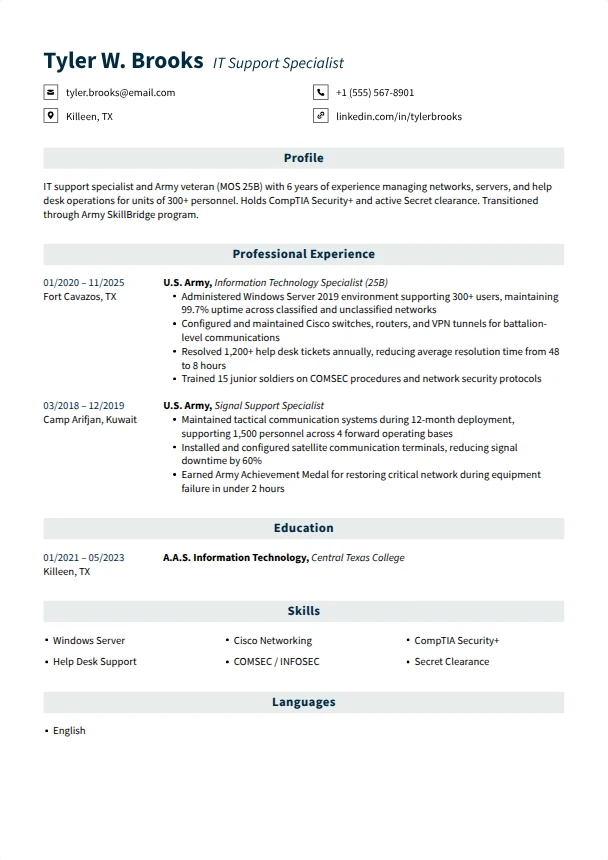
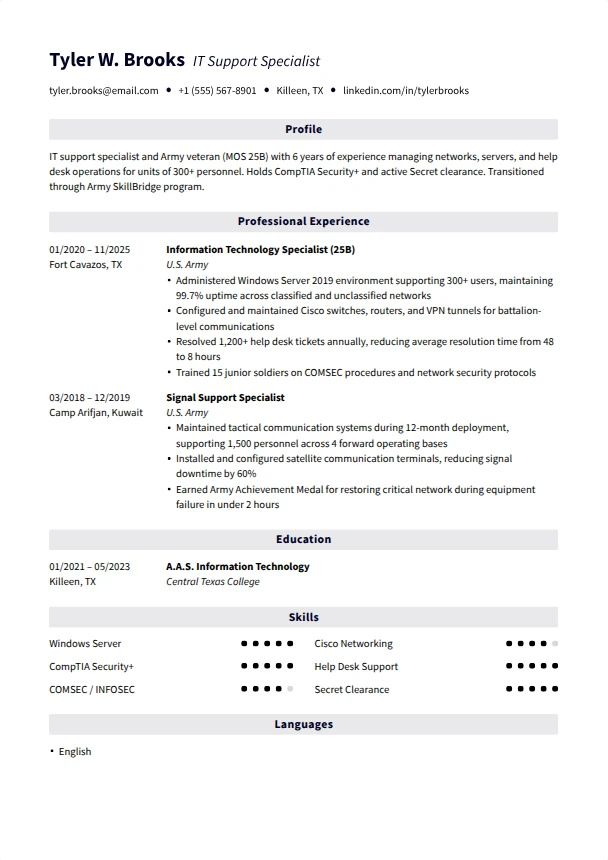
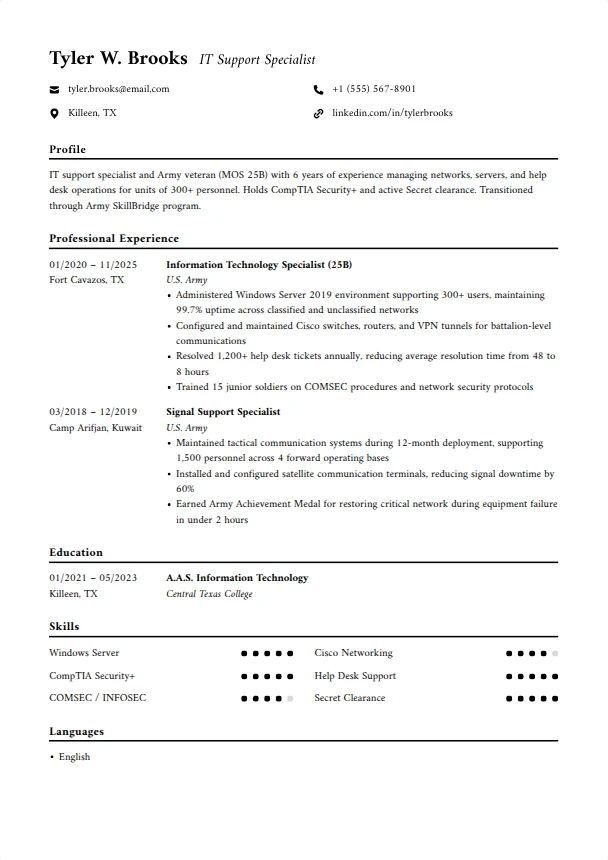
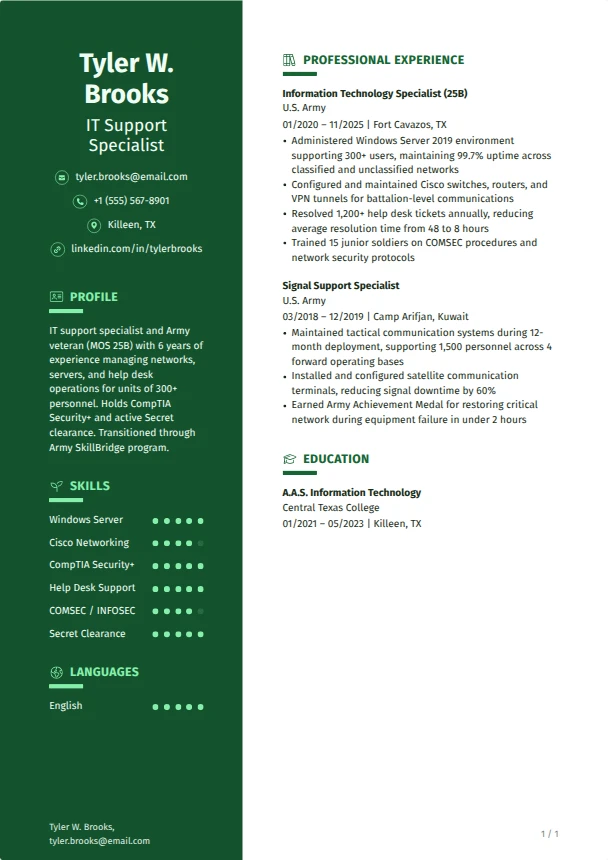
"IT professional with 5 years of U.S. Army experience administering networks for 300+ users across secure environments. Resolved 20+ support tickets daily, maintained 99.5% uptime across 100+ endpoints, and earned CompTIA Security+ and CCNA certifications during service. Active Secret clearance. Seeking help desk, network administration, or IT support roles."
Why it works: Maps Army IT work to civilian IT terminology, includes industry certifications earned during service, highlights clearance as an advantage.
"Healthcare professional with 4 years of U.S. Army combat medic experience providing emergency and primary care for a 150-person infantry company. Treated 500+ patients in garrison and field environments, maintained medical supply inventory valued at $120K, and trained 40 personnel in tactical combat casualty care. NREMT-B certified. Seeking EMT, medical assistant, or clinical support roles."
Why it works: Positions combat medic as healthcare experience, quantifies patient volume and training scope, names the civilian certification.
"Supply chain professional with 5 years of U.S. Army automated logistics experience managing $8M in equipment and supplies using GCSS-Army (SAP-based). Processed 150+ supply transactions weekly with 99.3% accuracy, coordinated distribution across 3 warehouse locations, and reduced quarterly audit preparation time by 60% through a barcode tracking process. APICS CSCP eligible. Targeting supply chain, procurement, and inventory analyst positions."
Why it works: Translates GCSS-Army into SAP language, quantifies accuracy and volume, includes a process improvement with measurable time savings.
Writing strong experience bullets
Every bullet point should answer: "What did you do, and why did it matter?" Use this formula:
Before and after examples:
Conducted PT and maintained physical readiness standards for the squad.
Designed and led daily fitness training programs for a 12-person team, achieving a 95% pass rate on quarterly physical assessments and reducing injury-related absences by 20% through structured warm-up protocols.
Performed PMCS on assigned vehicles and reported deficiencies.
Executed preventive maintenance inspections on a fleet of 8 tactical vehicles valued at $1.8M, identifying and resolving 30+ mechanical issues per quarter and maintaining a 96% operational readiness rate.
Supervised junior soldiers and ensured discipline and morale.
Mentored and supervised 12 team members, conducting weekly performance counseling sessions and creating individual development plans that resulted in 3 promotions and zero disciplinary actions over 18 months.
Strong action verbs for army resume (no civilian experience) resumes:
Administered · Briefed · Coordinated · Deployed · Developed · Directed · Evaluated · Executed · Implemented · Led · Maintained · Managed · Monitored · Planned · Supervised · Trained · Tracked · Streamlined
5 mistakes that get army resume (no civilian experience) resumes rejected
Submitting a resume full of Army acronyms
PMCS, LSCO, BCT, PLT, PSG, NCOER. None of these mean anything to a civilian recruiter. Every single acronym needs to be translated or removed. If you would not use the term with a friend who never served, do not put it on your resume.
Listing your MOS duties instead of accomplishments
Your MOS description is available on the Army website. Copying it adds zero value to your resume. Instead of 'performed duties as a 92A Automated Logistical Specialist,' write 'managed $8M inventory using SAP-based system with 99.3% accuracy across 3 distribution points.'
Waiting until after separation to start your resume
Start 12 months before your ETS date. Use that time to earn civilian certifications through Army Credentialing Assistance, apply for SkillBridge, and attend TAP workshops. Soldiers who start their resume early are 3 times more likely to have a job offer by separation date.
Putting your rank as your job title
A civilian recruiter scanning 200 resumes will skip past 'Sergeant, U.S. Army' because it tells them nothing about what you do. Use a translated job title: 'Operations Team Leader,' 'IT Support Specialist,' 'Logistics Coordinator.' Include your rank in parentheses if you want, but lead with the civilian title.
Not including your security clearance
An active Secret or Top Secret clearance can be worth $5K-$15K in additional salary and makes you eligible for thousands of defense contractor positions. List it prominently in your header or certifications section. If it expired within the last 2 years, note that it is within reinvestigation scope.
What to do if you have no professional experience
No civilian work experience does not mean an empty resume. Your Army service is real, valuable experience. Here is how to position it for the civilian job market:
Complete SkillBridge before your ETS date
The DoD SkillBridge program places you with a civilian employer for up to 180 days before separation, while you still receive military pay and benefits. This is the single most effective way to build civilian experience before you leave. Companies like Amazon, Microsoft, and Lockheed Martin all participate. Apply through your installation's TAP office at least 6 months before your ETS.
Earn civilian certifications through Army Credentialing Assistance
The Army CA program pays up to $4,000 per fiscal year for industry certifications. Use this while you are still serving to earn PMP, CompTIA, APICS, Six Sigma, CDL, or whatever credential maps to your target career field. A recognized certification on your resume bridges the gap between military training and civilian qualifications.
Rewrite every Army accomplishment in civilian language
Your NCOERs, awards citations, and evaluation reports are full of accomplishments that translate directly. 'Managed supply operations for a 200-person company' becomes 'coordinated logistics and inventory management for a 200-person organization, maintaining 99% accountability for $5M in assets.' Use the O*NET crosswalk to find the right civilian terms for your MOS.
Use Hire Heroes USA and American Corporate Partners for free support
Hire Heroes USA provides free resume reviews, career coaching, and job placement assistance specifically for transitioning service members. American Corporate Partners pairs you with a civilian mentor in your target industry for 12 months of coaching. Both programs have strong employer networks and can connect you directly to veteran-friendly hiring managers.
Frequently asked questions
Can I list my Army service as work experience on a civilian resume?
Yes, and you should. Your Army service is professional experience. List it in the work experience section with a translated job title, your unit as the employer, your duty station as the location, and 4-6 accomplishment bullets with numbers. The key is translation: use civilian language, not military jargon.
What is SkillBridge and how does it help my resume?
SkillBridge is a DoD program that allows service members to work with a civilian employer for up to 180 days before their separation date, while still receiving military pay and benefits. It gives you a legitimate civilian work experience entry on your resume. Companies like Amazon, Salesforce, and major defense contractors participate. Apply through your TAP office 6 months before your ETS.
How do I translate my Army MOS into civilian terms?
Use the O*NET Military Crosswalk (onetonline.org), Army COOL (cool.osd.mil), or the VA Military Skills Translator. Enter your MOS code and these tools will show you matching civilian job titles and required certifications. Then rewrite your resume using those civilian job titles and terminology instead of Army jargon.
Should I include my Army training on my resume?
Yes, but translate it. 'Basic Leader Course' becomes 'Supervisory Leadership Training (4 weeks).' 'Combat Lifesaver' becomes 'Emergency Medical Response (equivalent to EMT-Basic).' If the training has a civilian certification equivalent, note that. If it has no civilian relevance (e.g., weapons qualification), leave it off unless you are applying for security or law enforcement roles.
Do civilian employers care about Army awards?
Some awards translate well: Army Achievement Medal and Army Commendation Medal show performance above standard. Mention them briefly in the context of what you did to earn them, not as a separate awards list. For example, 'Earned the Army Achievement Medal for developing a training program that increased team certification rates by 15%.' Do not list every ribbon and badge.
Skip the blank page
Open a complete, filled-in veteran-to-civilian resume in our free builder. Swap in your own details, keep the wording that fits, and download as PDF, free.
Build your army resume (no civilian experience) in minutes
Pick a template, fill in your details, and download a polished army resume (no civilian experience) ready to submit.
Start Building, It's FreeRelated resume guides
Complete guide to writing a civilian resume from Army service, covering all MOS backgrounds and career fields.
Copy-paste Army resume examples across MOS codes including 11B Infantry, 25B IT, 68W Medic, and 92A Logistics.
Resume examples covering all branches with translated experience bullets and civilian summary statements.
More resume examples: