What hiring managers actually look for
Civilian hiring managers reviewing military resumes are not looking for rank or MOS codes. They scan for three things that translate into business value:
-
1
Leadership scope in civilian terms. A squad leader managing 12 personnel and $2M in equipment is a team lead with budget responsibility. Managers want to see how many people you supervised, what resources you controlled, and what outcomes you delivered. Translate rank into leadership language they recognize.
-
2
Technical skills mapped to industry tools. Military communications equipment, logistics software, and intelligence platforms have civilian equivalents. If you used GCSS-Army, that maps to SAP-based supply chain management. If you ran SIGINT operations, that maps to data analysis and threat intelligence. Draw the connection explicitly.
-
3
Measurable results, not duty descriptions. Your DD-214 and MOS description list duties. Your resume needs results. Instead of 'conducted vehicle maintenance,' write 'maintained a fleet of 28 tactical vehicles with 97% operational readiness rate, saving $180K in unscheduled repair costs.' Numbers are the universal language between military and civilian worlds.
If your resume communicates these things in the first 7-second scan, you'll make it to the detailed read. Everything below is about making that happen.
How to structure your resume, section by section
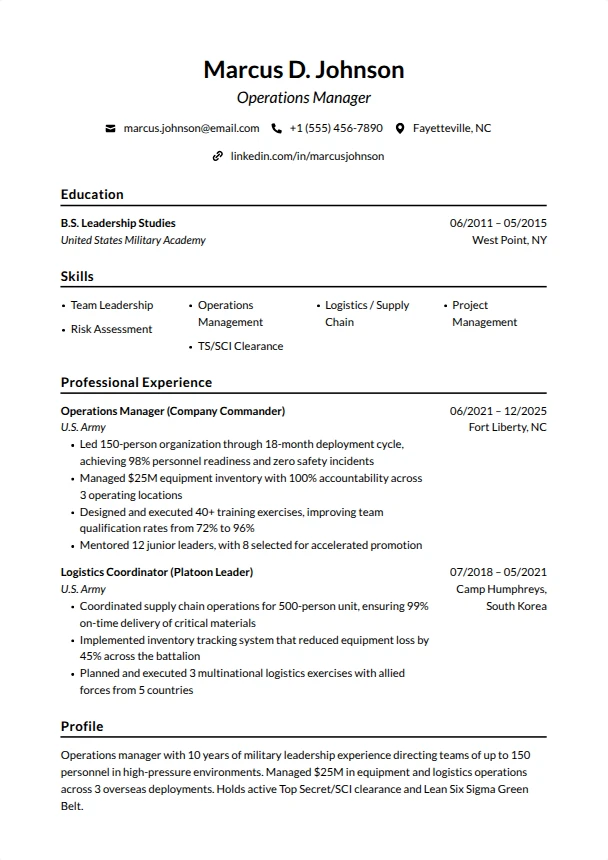
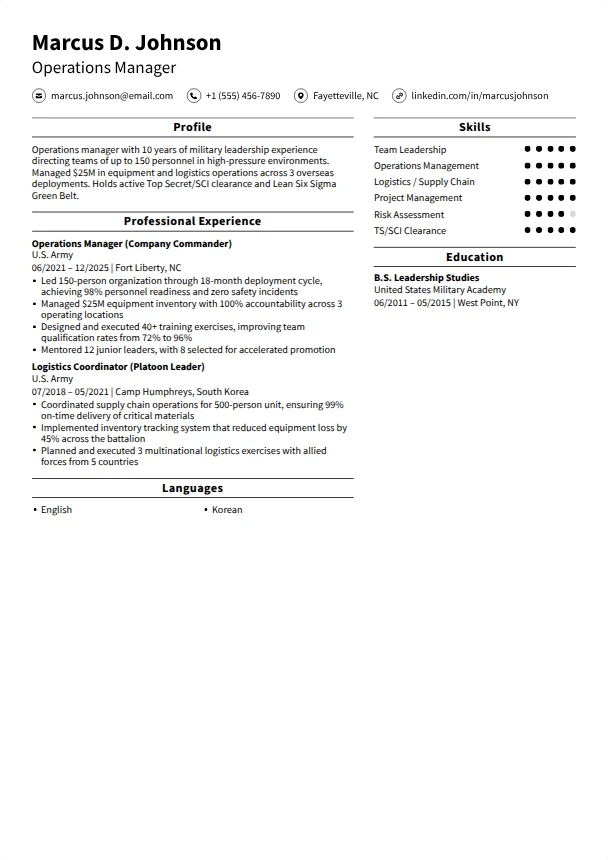
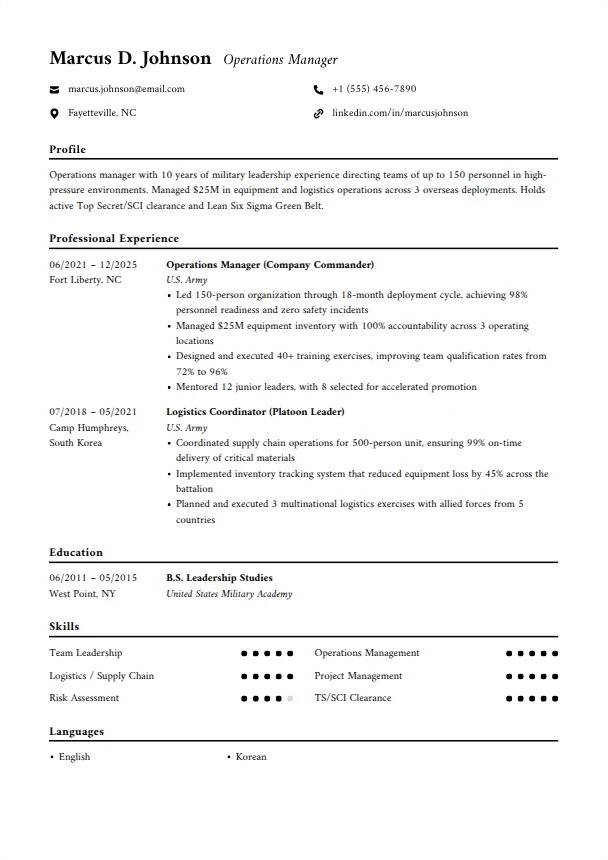
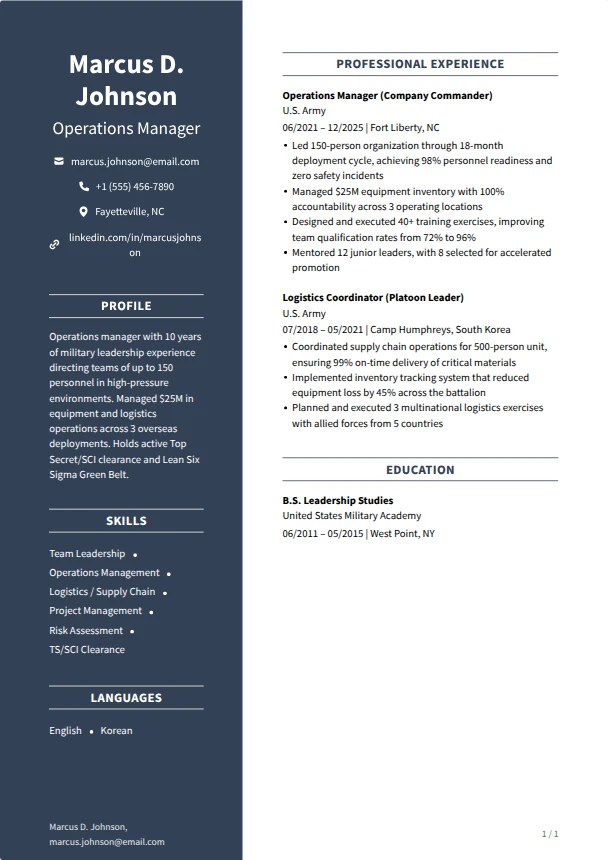
The order matters. Here's what a strong military resume examples looks like from top to bottom:
1. Contact information (civilian format)
Full name, city and state (no base address), phone, email, LinkedIn. Include your security clearance status if active or within scope. Do not list your rank in the header.
Marcus Williams · [email protected] · (555) 318-7742 · San Antonio, TX
linkedin.com/in/marcuswilliams · Security Clearance: Secret (active, granted 2022)
2. Professional summary example (infantry to operations)
Your summary should translate your military identity into a civilian job title and value proposition. Lead with years of experience, the civilian equivalent of your role, team size, and your strongest measurable achievement. Drop all military jargon.
Strong: "Operations leader with 6 years of experience managing teams of 12-40 personnel in high-pressure environments. Directed logistics, training, and personnel management for a 40-person platoon, maintaining 100% accountability for $4.5M in equipment across 3 overseas deployments. Reduced onboarding time for new team members by 30% through a standardized training program. Seeking operations management or project coordination roles."
3. Work experience example (logistics to supply chain)
Each military role should be rewritten as a civilian work entry. Use your branch and unit as the employer, your translated job title as the position, and write 4-6 bullets following the action-result format. Include the scope of the operation in civilian terms.
Supply Chain Manager (U.S. Army, 92A Logistics)
Fort Liberty, NC · March 2020 to February 2024
• Managed inventory and distribution for $8.5M in supplies and equipment across 3 warehouse locations, maintaining 99.4% accountability rate through weekly audits and cycle counts.
• Coordinated inbound and outbound shipments for a 500-person battalion, processing 200+ supply requests per month with an average fulfillment time of 48 hours.
• Trained and supervised 8 warehouse personnel on inventory management procedures, reducing data entry errors by 45% through standardized receiving protocols.
• Implemented a barcode tracking system that reduced manual inventory reconciliation time from 4 days to 6 hours per quarterly audit.
4. Work experience example (communications to IT)
Signal and communications roles translate directly to IT and network administration. Focus on the systems, the number of users supported, uptime metrics, and any certifications earned during service.
Network Administrator / IT Support Lead (U.S. Army, 25B IT Specialist)
Fort Cavazos, TX · June 2019 to May 2023
• Administered a secure communications network serving 350+ users across 4 locations, maintaining 99.7% uptime over 18 months.
• Installed, configured, and maintained 120+ workstations, 15 servers, and 30 network devices (switches, routers, firewalls) in a classified environment.
• Resolved 25+ support tickets daily for hardware, software, and network connectivity issues, achieving 92% first-contact resolution rate.
• Earned CompTIA Security+ and CCNA certifications during service, providing the unit's cybersecurity compliance training to 200+ personnel.
5. Skills section example
Group skills into civilian categories. Replace military acronyms with industry-standard terminology. If you hold certifications earned during service, list them prominently.
Leadership: Team management (12-40 direct reports), training program development, performance evaluation, conflict resolution
Operations: Logistics coordination, supply chain management, inventory control, fleet maintenance, risk assessment
Technical: Network administration, Windows Server, Cisco IOS, cybersecurity compliance, help desk support
Clearance: Secret (active, granted 2022) · Certifications: CompTIA Security+, CCNA, PMP (in progress)
Key skills to include
These skills translate across military branches and map directly to the most in-demand civilian job postings. Select the ones that match your MOS and the role you are targeting.
Tip: Never assume a civilian recruiter knows what your military acronym means. 'GCSS-Army' means nothing to them, but 'SAP-based enterprise supply chain system' does. Translate every military tool, system, and process into its civilian equivalent.
Resume summary examples you can steal
Use one as a starting point, then swap in your own technologies, numbers, and achievements.
"Operations leader with 8 years of U.S. Army experience managing teams of 12-40 personnel across 3 overseas deployments. Directed daily operations, logistics coordination, and personnel development for a 40-person platoon, maintaining 100% accountability for $4.5M in equipment. Developed a standardized onboarding program that reduced new-member integration time by 30%. Seeking operations management roles in logistics, manufacturing, or corporate operations."
Why it works: Translates infantry leadership into operations management language, quantifies team size, equipment value, and efficiency improvement.
"Supply chain professional with 5 years of U.S. Army logistics experience managing $12M in inventory across 3 distribution points. Processed 200+ supply requisitions monthly with a 99.4% accuracy rate and reduced quarterly audit time by 75% through barcode tracking implementation. APICS CSCP certified, proficient in SAP and advanced Excel. Targeting supply chain analyst and procurement coordinator positions."
Why it works: Maps military logistics directly to supply chain terminology, includes a process improvement with measurable savings, names industry certifications.
"Network engineer with 6 years of U.S. Army experience administering secure networks for 350+ users across classified and unclassified environments. Maintained 99.7% uptime across 15 servers and 120+ endpoints, resolved 25+ daily support tickets, and led cybersecurity compliance training for 200+ personnel. CompTIA Security+ and CCNA certified, active Secret clearance. Seeking network administration and IT infrastructure roles."
Why it works: Translates signal corps work into standard IT language, quantifies environment size and uptime, highlights clearance as a competitive advantage.
"Data analyst with 5 years of U.S. Army intelligence experience producing threat assessments and analytical reports for senior leadership. Analyzed multi-source data sets to generate 150+ intelligence products used by commanders across a 3-country area of operations. Proficient in data visualization (Tableau, Power BI), statistical analysis, and report writing. Active Top Secret/SCI clearance. Targeting business intelligence and data analytics roles in defense contracting or corporate strategy."
Why it works: Repositions intelligence analysis as data analytics, quantifies analytical output, emphasizes TS/SCI clearance for defense sector roles.
Writing strong experience bullets
Every bullet point should answer: "What did you do, and why did it matter?" Use this formula:
Before and after examples:
Conducted convoy operations and ensured force protection during movement.
Coordinated transportation logistics for 15-vehicle convoys carrying $3M in equipment across 200+ mile routes, completing 45 missions with zero loss incidents through pre-mission risk assessments and standardized safety protocols.
Maintained communications equipment and troubleshot technical issues.
Administered a secure communications network supporting 350+ users across 4 locations, diagnosing and resolving 25+ hardware and software issues daily while maintaining 99.7% network uptime over 18 consecutive months.
Supervised soldiers and conducted training exercises.
Led a 12-person team through 6 certification training cycles, developing a competency tracking system that identified skill gaps and increased the team's qualification rate from 78% to 96% within 4 months.
Strong action verbs for military resume examples resumes:
Administered · Briefed · Coordinated · Deployed · Directed · Evaluated · Implemented · Led · Maintained · Managed · Monitored · Operated · Planned · Supervised · Trained · Analyzed · Secured · Streamlined
5 mistakes that get military resume examples resumes rejected
Using military jargon and acronyms without translation
Writing 'served as PSG for a 40-PAX PLT in 2BCT' means nothing to a civilian recruiter. Translate everything: 'Served as senior operations supervisor for a 40-person team within a 4,000-person brigade.' If you cannot explain it to someone outside the military, rewrite it.
Listing duties instead of accomplishments
Your MOS description already exists online. Do not repeat it. Instead of 'responsible for vehicle maintenance,' write 'maintained a fleet of 28 vehicles with 97% operational readiness, reducing unscheduled downtime by 35% through a preventive maintenance tracking system.'
Leading with rank instead of skills
Civilian employers do not care whether you were an E-5 or E-7. They care what you managed, how many people reported to you, and what results you produced. Put your translated job title first (Operations Manager, not Staff Sergeant) and let the accomplishments speak for themselves.
Omitting your security clearance status
An active Secret or Top Secret clearance is a significant competitive advantage, especially for defense contracting and government positions. Always list your clearance level, status (active or expired), and the year it was granted. A clearance can be worth $10K-$15K in additional salary.
Ignoring civilian certifications that complement military training
Military training is valuable, but civilian employers often need to see recognized certifications. If your MOS maps to PMP, CompTIA Security+, APICS, or Six Sigma, earn the certification and list it. Many are available free or discounted through VA and DoD programs like Credentialing Assistance.
What to do if you have no professional experience
If your only professional experience is military and you have never held a civilian job, here is how to build a resume that works:
Use SkillBridge to build civilian experience before separation
The DoD SkillBridge program lets you work with a civilian employer for up to 180 days before your separation date while still receiving military pay and benefits. This gives you legitimate civilian work experience to put on your resume. Apply 6 months before your ETS date and choose a company in your target industry.
Translate your MOS into a civilian resume from day one
Do not wait until after separation to start rewriting your military experience. Use the O*NET Military Crosswalk tool to find the civilian job titles that match your MOS. Then rewrite every military accomplishment using civilian terminology, industry keywords, and measurable results.
Stack certifications through military credentialing programs
The Army Credentialing Assistance Program, Navy COOL, and Air Force COOL cover the cost of industry certifications while you are still serving. Earn PMP, CompTIA, APICS, or other certifications that validate your military skills in civilian terms. These go on your resume immediately and signal that you are serious about the transition.
Leverage veteran hiring programs and networks
Hire Heroes USA, American Corporate Partners, and the VA's Veteran Readiness and Employment program all provide resume writing help, interview coaching, and direct employer connections. Many Fortune 500 companies have dedicated veteran hiring programs. Use these resources before you start applying cold.
Frequently asked questions
Should I include my military rank on a civilian resume?
Include it in the work experience entry for context (e.g., 'Staff Sergeant / Operations Supervisor'), but do not lead with it. Civilian hiring managers care about what you managed, not your grade. Your translated job title should come first, with the rank in parentheses or as a secondary descriptor.
How do I translate my MOS into a civilian job title?
Use the O*NET Military Crosswalk tool (onetonline.org) or the VA's Military Skills Translator. Enter your MOS code and it will show you the closest civilian job titles. For example, Army 11B Infantry maps to Operations Manager, Security Supervisor, or Team Lead. Army 25B maps to Network Administrator or IT Support Specialist.
Do civilian employers value military experience?
Yes, but only if you translate it into language they understand. Leadership, logistics, operations, and technical skills are highly valued. The problem is when veterans submit resumes full of acronyms and duty descriptions that mean nothing outside the military. Translate your experience and you become a top candidate.
Should I list my security clearance on my resume?
Absolutely. An active clearance is a major competitive advantage, especially in defense contracting, government, cybersecurity, and intelligence roles. List the level (Secret, Top Secret, TS/SCI), status (active or within scope), and the year granted. Some employers specifically search for candidates with active clearances because sponsoring a new one takes 6-12 months.
How long should a military-to-civilian resume be?
One to two pages for most civilian positions. Two pages maximum unless you are applying for a federal government role, which requires 3-5 pages. If you served for 10+ years with multiple deployments and assignments, two pages is appropriate. For 4-6 years of service, aim for one strong page.
Skip the blank page
Open a complete, filled-in veteran-to-civilian resume in our free builder. Swap in your own details, keep the wording that fits, and download as PDF, free.
Build your military resume examples in minutes
Pick a template, fill in your details, and download a polished military resume examples ready to submit.
Start Building, It's FreeRelated resume guides
Complete guide to translating military service into civilian resume language, covering all branches and MOS types.
Army-specific resume examples across MOS codes including infantry, IT, medic, and logistics roles.
Guide for any veteran entering the civilian workforce, covering Veterans' Preference, VRA, and transition programs.
More resume examples: