What hiring managers actually look for
Civilian hiring managers evaluating veterans with no prior civilian experience focus on three factors that determine whether your resume moves forward:
-
1
Can they understand your experience without military context? Most civilian recruiters have never served. MOS codes, rate abbreviations, AFSC numbers, and military acronyms are a foreign language to them. If they cannot understand what you did within 10 seconds of scanning your resume, they move to the next candidate. Every line must be written in civilian terms with zero jargon.
-
2
Do your transferable skills match the job requirements? Military service develops leadership, operations management, logistics, IT, healthcare, security, and project management skills that civilian employers need. But you have to explicitly connect your military skills to the job posting's requirements using their exact keywords. Do not assume the recruiter will make the connection for you.
-
3
Have you taken steps to prepare for the civilian transition? Employers want to see that you have invested in your transition: civilian certifications, SkillBridge participation, education, or professional development. A veteran who separated and immediately started applying with an untranslated military resume signals a lack of preparation. One who earned industry certifications and completed SkillBridge signals commitment.
If your resume communicates these things in the first 7-second scan, you'll make it to the detailed read. Everything below is about making that happen.
How to structure your resume, section by section
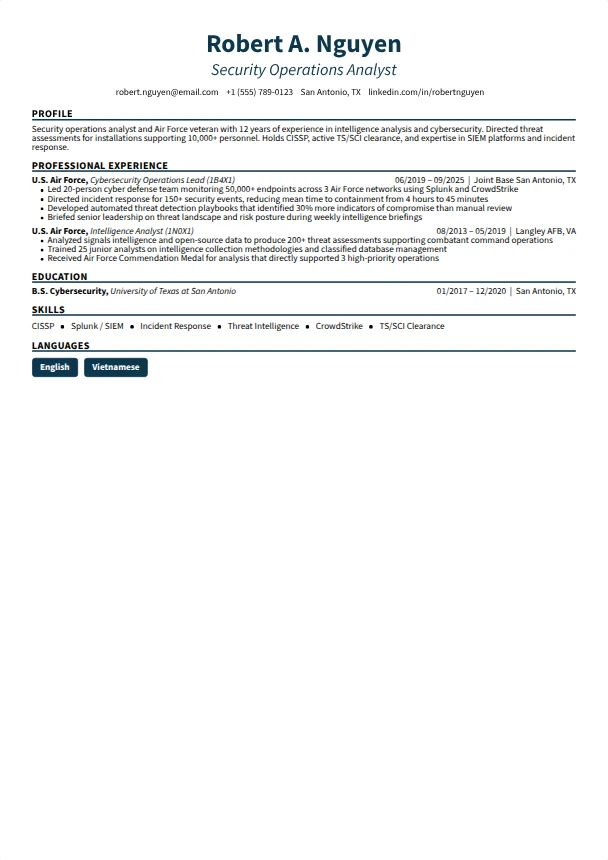
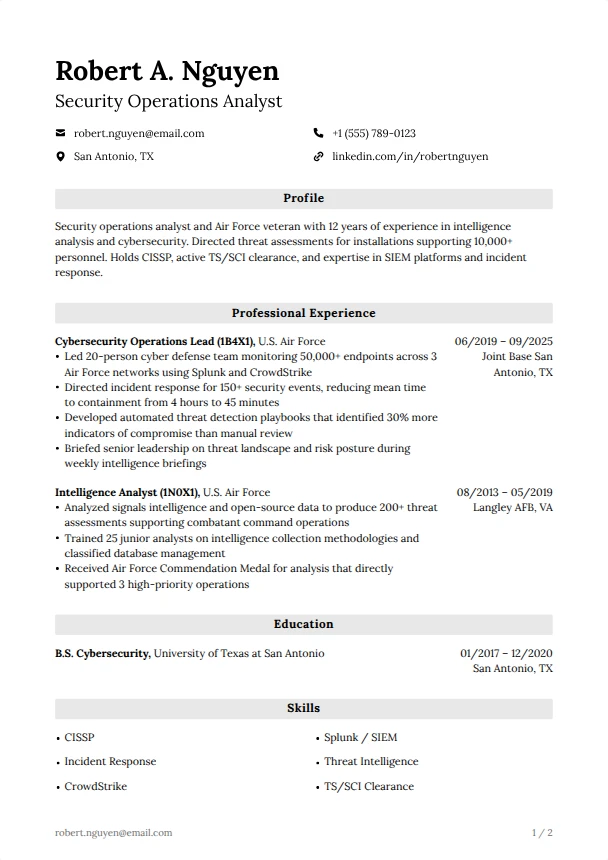
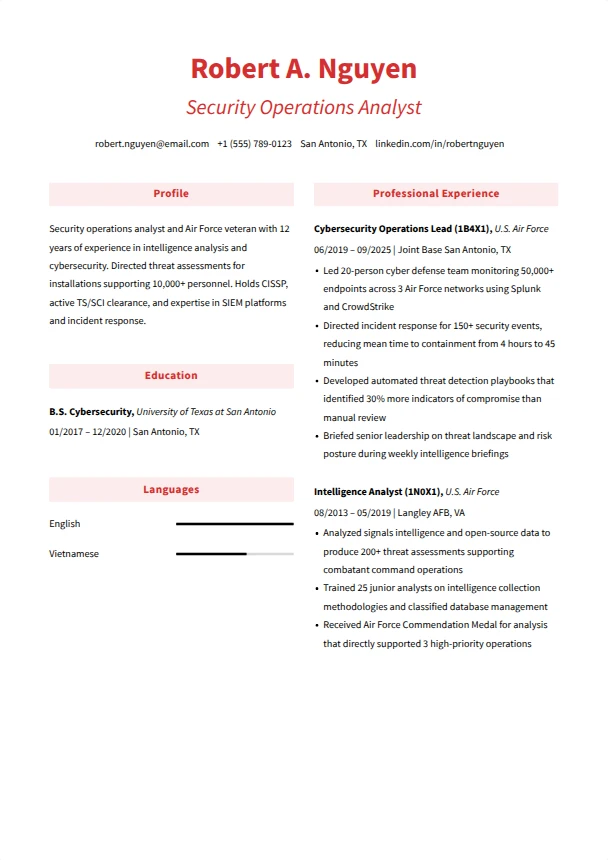
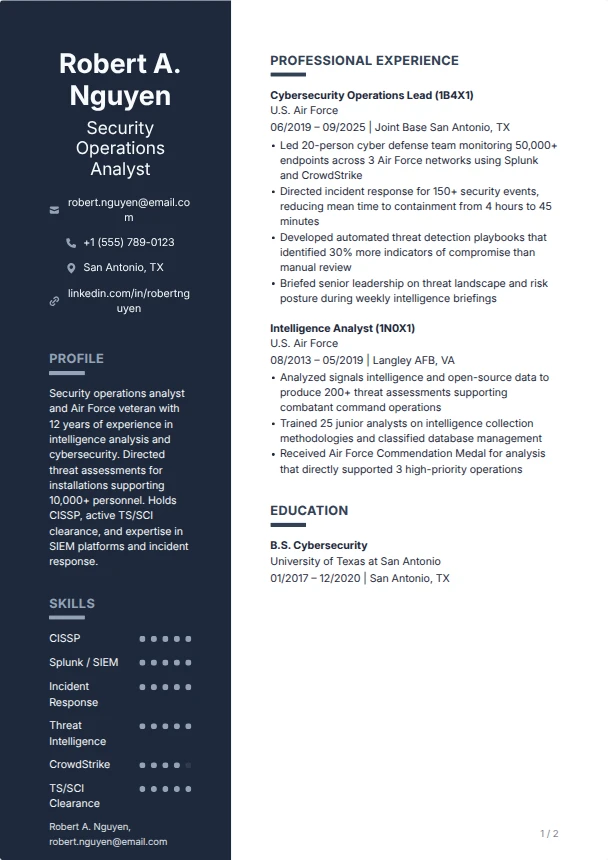
The order matters. Here's what a strong veteran resume (no civilian experience) looks like from top to bottom:
1. Contact information
Full name, city and state, phone, email, LinkedIn. Include your security clearance if active. If you are open to relocation, note that. Do not include your rank, branch logo, or military installation.
Taylor Simmons · [email protected] · (555) 894-3207 · San Diego, CA (open to relocation)
linkedin.com/in/taylorsimmons · Security Clearance: Top Secret (active, granted 2021)
2. Professional summary
Write 2-3 sentences in pure civilian language. Lead with years of experience, your translated role, team size, strongest achievement, and the type of civilian position you are targeting. Mention Veterans' Preference eligibility if applying for government roles.
Strong: "Operations and logistics professional with 6 years of U.S. military experience managing teams of 8-30 personnel and $5M+ in equipment across domestic and overseas assignments. Reduced supply delivery times by 35% through a demand forecasting process and maintained 99.6% inventory accuracy. CompTIA Security+ certified, active Top Secret clearance. Eligible for 5-point Veterans' Preference. Targeting operations management, logistics coordination, and supply chain analyst roles."
3. Military experience (translated)
List your service as work experience with a civilian job title. Use your branch and unit as the employer. Write 4-6 bullets with numbers in every line. Include team size, budget or equipment value, and measurable outcomes.
Strong: "Logistics Manager, U.S. Air Force (2T1X1 Vehicle Operations)<br>Joint Base Lewis-McChord, WA · April 2019 to March 2025<br><br>• Managed a motor pool of 45 vehicles valued at $8.2M, coordinating daily dispatch, maintenance scheduling, and operator training for 120+ authorized drivers across 3 squadrons.<br>• Reduced vehicle downtime by 28% through a predictive maintenance program that identified recurring failure patterns and pre-positioned replacement parts.<br>• Supervised 8 vehicle operators and 3 maintenance technicians, conducting monthly performance reviews and skills assessments that resulted in 4 promotions and zero safety violations over 2 years.<br>• Coordinated 500+ transportation missions annually supporting exercises, deployments, and base operations, achieving 100% on-time delivery rate for 18 consecutive months."
4. Certifications and transition preparation
List civilian certifications, SkillBridge completion, and relevant training. Group military training with civilian equivalents. This section demonstrates that you have invested in the transition, which matters to civilian employers.
Certifications: CompTIA Security+ (2024) · OSHA 30-Hour (2023) · CDL Class A (2024) · PMP (in progress, expected August 2026)
SkillBridge: Completed 120-day internship with XYZ Logistics, Tacoma, WA (October 2024 to January 2025)
Military Training: Vehicle Operations Technical School (equivalent to fleet management certification, 12 weeks) · NCO Academy (equivalent to supervisory leadership program, 6 weeks)
5. Skills
Group skills by category using civilian terminology. Include software, methodologies, and clearance status. Match the job posting's exact language for ATS compatibility.
Operations: Fleet management, logistics coordination, dispatch operations, route planning, supply chain management
Leadership: Team supervision (8-30 reports), performance management, training development, conflict resolution
Technical: Microsoft Office Suite, fleet management software, GPS tracking systems, inventory databases
Clearance: Top Secret (active, granted 2021) · License: CDL Class A
Key skills to include
These skills apply across all military branches and map to the most commonly sought civilian qualifications. Select the ones relevant to your service background and target role.
Tip: Use the O*NET Military Crosswalk tool or your branch's COOL website to find the exact civilian terms for your military skills. Then copy the job posting's language into your resume. If they say 'fleet management,' do not write 'motor pool operations.' The civilian term is what gets past ATS.
Resume summary examples you can steal
Use one as a starting point, then swap in your own technologies, numbers, and achievements.
"Operations professional with 5 years of U.S. Army experience managing teams of 12-40 personnel during domestic and overseas assignments. Directed logistics, training, and personnel development for a 40-person platoon, maintaining 100% accountability for $4.2M in equipment. Developed a skills-tracking system that improved team qualification rates by 18%. Completed Army SkillBridge with a manufacturing company. Targeting operations coordinator and project management roles."
Why it works: Translates Army experience into operations language, quantifies scope, and mentions SkillBridge as civilian experience proof.
"IT professional with 6 years of U.S. Navy experience administering networks for 220+ users aboard deployed warships. Maintained 99.5% uptime across classified and unclassified systems, resolved 20+ daily support tickets, and led cybersecurity compliance programs with zero findings. CompTIA Security+ and Network+ certified, active Secret clearance. Seeking network administration and cybersecurity roles."
Why it works: Uses standard IT metrics, names industry certifications, and translates shipboard IT into civilian network admin language.
"Fleet management professional with 6 years of U.S. Air Force experience coordinating vehicle operations for 120+ drivers and 45 vehicles valued at $8.2M. Reduced vehicle downtime by 28% through predictive maintenance, achieved 100% on-time delivery across 500+ annual transportation missions, and supervised 11 personnel. CDL Class A licensed, PMP in progress. Targeting fleet management, logistics, and transportation coordinator roles."
Why it works: Maps Air Force vehicle operations to civilian fleet management, quantifies fleet size and performance metrics, includes relevant licensing.
"Security and operations professional with 5 years of U.S. Marine Corps experience managing physical security, emergency response, and personnel accountability for installations supporting 2,000+ personnel. Conducted 200+ security assessments, trained 150 personnel in emergency procedures, and maintained zero security breaches across 3 years of oversight. Seeking corporate security, emergency management, and safety coordinator roles."
Why it works: Translates Marine Corps security into corporate security language, quantifies assessment volume and training scope, emphasizes zero-breach record.
Writing strong experience bullets
Every bullet point should answer: "What did you do, and why did it matter?" Use this formula:
Before and after examples:
Managed motor pool operations and ensured vehicle readiness for the squadron.
Managed a 45-vehicle fleet valued at $8.2M, coordinating daily dispatch, preventive maintenance, and operator certification for 120+ drivers and achieving a 28% reduction in vehicle downtime through predictive maintenance scheduling.
Supervised personnel and conducted training for the platoon.
Led a 12-person team through quarterly training cycles, developing competency assessments and individual development plans that resulted in 4 promotions and a 95% certification pass rate over 18 months.
Responsible for security operations and access control on base.
Directed physical security operations for an installation supporting 2,000+ personnel, conducting 200+ vulnerability assessments and implementing access control procedures that maintained zero security breaches across 3 consecutive years.
Strong action verbs for veteran resume (no civilian experience) resumes:
Administered · Briefed · Conducted · Coordinated · Delivered · Directed · Evaluated · Executed · Implemented · Led · Managed · Monitored · Operated · Planned · Secured · Supervised · Trained · Streamlined
5 mistakes that get veteran resume (no civilian experience) resumes rejected
Submitting an untranslated military resume
MOS codes, rate abbreviations, AFSC numbers, and military acronyms are meaningless to civilian recruiters. Every single line of your resume must be written in civilian language. If a non-veteran friend cannot understand your resume without asking questions, it is not ready to submit.
Relying on 'veteran friendly' employer labels instead of a strong resume
Many companies advertise veteran hiring programs, but your resume still goes through ATS screening and recruiter review before reaching the veteran hiring coordinator. A poorly translated resume will be filtered out regardless of the company's veteran commitment. Write a strong civilian resume first, then leverage veteran programs as an additional advantage.
Not leveraging Veterans' Preference for government applications
Veterans' Preference adds 5 points (non-disabled) or 10 points (disabled) to your federal application score. The Veterans Recruitment Appointment (VRA) allows agencies to hire eligible veterans non-competitively. If you are applying to federal jobs and not claiming these benefits, you are leaving your biggest advantage unused. Mark your preference status on every application.
Waiting to start the transition process until after separation
The veterans who transition most successfully start 12 months before their separation date. They use SkillBridge, earn certifications through their branch's COOL program, attend TAP workshops, and connect with Hire Heroes USA while still receiving military pay. Starting your resume after separation puts you months behind.
Including every assignment, deployment, and duty station
A civilian resume is not a service record. Focus on the 2-3 roles most relevant to your target position. If you had 4 duty stations with similar responsibilities, consolidate them into one entry and emphasize the best accomplishments. Save space for detailed bullets, certifications, and skills.
What to do if you have no professional experience
No civilian experience is the default for transitioning veterans. You are not behind. You just need to use the programs and strategies built specifically for your situation:
Complete SkillBridge before separation
SkillBridge is available to service members from all branches. It places you with a civilian employer for up to 180 days before your separation date while you continue to receive military pay and benefits. Amazon, Microsoft, Lockheed Martin, Deloitte, and hundreds of other companies participate. This is the single best way to get civilian experience on your resume before you leave. Apply through your career counselor 6-12 months before your separation.
Earn industry certifications through COOL and Credentialing Assistance
Every branch has a credentialing program: Army Credentialing Assistance, Navy COOL, Air Force COOL, Marine Corps COOL. These programs pay for industry certifications that validate your military training in civilian terms. CompTIA, PMP, APICS, CDL, NREMT, and hundreds of other certifications are covered. Use every dollar available before you separate. These credentials go directly on your resume.
Use Veterans' Preference and VRA for government positions
If you are targeting federal employment, Veterans' Preference adds 5 or 10 points to your application score. The Veterans Recruitment Appointment (VRA) lets agencies hire eligible veterans without going through competitive examination. Schedule A authority provides another non-competitive path for veterans with service-connected disabilities. Claim every eligibility you qualify for on your USAJOBS profile.
Connect with free veteran career services immediately
Hire Heroes USA offers free resume writing, career coaching, and job placement for all veterans. American Corporate Partners provides a free 12-month mentorship with a civilian executive in your target industry. The VA's Veteran Readiness and Employment (VR&E, Chapter 31) program offers career counseling, training, and job placement assistance. These are not generic career services. They specialize in military-to-civilian transitions and have direct relationships with veteran-friendly employers.
Frequently asked questions
What is Veterans' Preference and how do I use it?
Veterans' Preference is a federal hiring benefit that adds 5 points (for non-disabled veterans with qualifying service) or 10 points (for disabled veterans) to your application score for competitive federal positions. To claim it, mark your veteran status on your USAJOBS profile and include your DD-214 and VA disability letter (if applicable) with your application. It applies to most competitive service positions but not to Senior Executive Service or certain excepted service roles.
What is VRA and who is eligible?
The Veterans Recruitment Appointment (VRA) is a hiring authority that allows federal agencies to hire eligible veterans non-competitively for positions up to GS-11. You are eligible if you served during a qualifying campaign or received a campaign badge, were disabled, served on active duty for more than 180 days, or recently separated from active duty within 3 years. VRA does not require competing against non-veteran applicants.
Do I need to list my military experience on a civilian resume?
Yes. Your military service is professional work experience and should be listed in the work experience section with a translated civilian job title, your branch and unit as the employer, and 4-6 accomplishment bullets with measurable results. The key is writing everything in civilian language so a non-veteran recruiter understands it immediately.
How do I explain gaps between military service and civilian employment?
If you used SkillBridge, TAP, education, or certification programs during the transition period, list those activities with dates. 'Career Transition Period (March 2025 to present): Completed PMP certification, attended TAP career workshops, and completed Hire Heroes USA resume program.' This shows productive use of the transition time rather than an unexplained gap.
Which veteran career programs are actually worth using?
Three stand out: Hire Heroes USA (free resume reviews, career coaching, and job placement with a 90%+ satisfaction rate), American Corporate Partners (free 12-month mentorship with civilian executives), and your branch's SkillBridge program (civilian work experience before separation). TAP workshops are required and provide a solid foundation. VA VR&E (Chapter 31) is valuable if you have a service-connected disability rating. All of these are free.
Skip the blank page
Open a complete, filled-in veteran-to-civilian resume in our free builder. Swap in your own details, keep the wording that fits, and download as PDF, free.
Build your veteran resume (no civilian experience) in minutes
Pick a template, fill in your details, and download a polished veteran resume (no civilian experience) ready to submit.
Start Building, It's FreeRelated resume guides
Complete guide to writing a civilian resume for veterans of all branches, covering translation, certifications, and hiring programs.
Copy-paste resume examples covering all military branches with translated experience bullets and civilian summaries.
Guide to writing a federal resume for USAJOBS with no prior government experience, covering Pathways and Veterans' Preference.
More resume examples: